


Taking the first step by searching for "substance abuse help near me" is the most crucial part of the journey. In Massachusetts, a network of support is ready to help you or your loved one find the path to recovery. This guide will walk you through understanding local treatment options, navigating costs, and building a lasting support system right here in your community.
Key Takeaways
- Local Options Exist for Every Need: Massachusetts offers a full range of care, from medically supervised detox and inpatient residential programs to flexible outpatient services like PHP and IOP, ensuring treatment fits your life.
- Insurance and Costs Are Manageable: Most insurance plans cover addiction treatment. Reputable centers offer free, confidential benefits checks to clarify your coverage and minimize financial stress.
- The First Call is a Confidential Conversation: Reaching out is not an interrogation. It's a supportive, private discussion with a trained coordinator to understand your situation and find the best level of care.
- Long-Term Success Depends on Support: Lasting recovery is built on community. A strong aftercare plan, family involvement, and connection to peer support groups are essential for life after treatment.
Your First Steps for Finding Help in Massachusetts
Realizing you need help is a huge moment, and I want to be clear: you are not alone in this. This guide is your roadmap for navigating the next steps in Massachusetts. We'll cut through the noise and give you clear, practical advice.
It's completely normal to feel overwhelmed right now. The sheer number of people who need support shows just how common this struggle is. Back in 2021, a staggering 46.3 million people aged 12 or older met the criteria for a substance use disorder (SUD).
Despite those numbers, only a small fraction ever get specialized care. That gap is massive, but you're already taking action to cross it. You can see more of the national data over at drugabusestatistics.org.
Key Takeaway: The single most important part of this process is admitting you need help. Recovery isn’t a solo journey. Getting professional guidance makes sure you land in the right level of care for your specific situation.
Understanding Your Roadmap to Recovery
To keep things from feeling too heavy, let's break this down into four key areas. Think of these as the foundation for getting your recovery started on the right foot.
- 1. Identify Local Treatment Options: Massachusetts has a full spectrum of care available. This includes medically supervised detox to get through withdrawal safely, inpatient programs for 24/7 support, and more flexible outpatient services that let you keep up with work or family. We have a detailed guide on what to expect during the first steps of detox.
- 2. Navigate Insurance and Costs: Money should never be the reason you don't get help. We'll walk you through how to check your benefits, understand what terms like "deductible" actually mean, and find care that works for your budget. Most reputable centers have people on staff whose entire job is to make this part less stressful for you.
- 3. Prepare for Your First Call: Picking up the phone to ask for help can feel incredibly intimidating. We'll cover what questions they might ask and what info you should have handy to make it feel more empowering. This is a confidential, judgment-free call designed to see what you need.
- 4. Build a Lasting Support System: Recovery doesn't stop when your program ends. We'll touch on why it's so important to get your family involved (if it's a healthy option) and how to connect with aftercare programs and peer support groups right here in your community.
If you're ready to talk, our team is here 24/7. The conversation is always confidential. Call us at (888) 388-8660.
Understanding Your Local Treatment Options
The road to recovery isn't a one-size-fits-all map. It’s a personal journey, and what works for one person might not work for another. When you start searching for substance abuse help, especially here in Massachusetts, you'll find a whole spectrum of care designed to meet you right where you are.
Let's cut through the clinical jargon and talk about what these different levels of care actually look and feel like.
Medically Supervised Detoxification
Before you can really start the mental and emotional work of recovery, your body needs to be stable and safely clear of substances. This is where medically supervised detoxification, or detox, comes in. It's the critical first step for anyone who is physically dependent on a substance.
Trying to quit certain drugs—especially alcohol or benzodiazepines—cold turkey on your own can be incredibly dangerous, even life-threatening. A professional detox facility provides 24/7 medical monitoring to manage withdrawal symptoms safely. The goal is to make you as comfortable as possible while building a secure foundation for the next stage of treatment.
Inpatient and Residential Treatment Programs
For some, hitting the pause button on daily life is exactly what’s needed. Inpatient or residential treatment offers a structured, immersive environment away from the people, places, and stressors that trigger substance use. You live at the facility, which provides round-the-clock support and supervision.
Think of it as a protective bubble where your only job is to focus on getting well. Here in Massachusetts, these programs typically offer a blend of:
- One-on-one therapy
- Group counseling sessions
- Family involvement and therapy
- Workshops on addiction science and relapse prevention
This level of care is often the best fit for individuals with severe addiction, co-occurring mental health disorders, or a home environment that just isn't supportive of recovery.
Flexible Outpatient Treatment Options
Stepping away from life completely for 30, 60, or 90 days isn't realistic for everyone. Many people need to keep up with work, school, or family responsibilities. That’s why outpatient programs are so vital—they offer top-tier clinical care with the flexibility to live at home.
Take, for example, a professional living in Worcester who needs intensive support but can’t afford to leave their job. For them, a Partial Hospitalization Program (PHP) or an Intensive Outpatient Program (IOP) could be a perfect match.
- Partial Hospitalization Programs (PHP) are the most intensive outpatient option. You’ll typically attend treatment for several hours a day, five days a week, almost like a full-time job.
- Intensive Outpatient Programs (IOP) are a step down in time commitment, usually requiring fewer hours per week. This allows more time for work or family while still getting robust clinical support.
These programs deliver many of the same therapies found in residential care, just in a more flexible format. If you want to see the full range of options available, you can explore various drug rehab programs in Massachusetts.
Comparing Addiction Treatment Programs in Massachusetts
Figuring out the differences between programs can feel overwhelming. This table breaks down the key features of each level of care available in Massachusetts to help you see what might be the right starting point for you or your loved one.
| Level of Care | Typical Time Commitment | Living Situation | Best Suited For |
|---|---|---|---|
| Detox | 5-10 days | At the facility, 24/7 medical care | Individuals needing to safely manage withdrawal symptoms from physical dependence. |
| Inpatient/Residential | 30-90 days | At the facility, 24/7 supervision | Those with severe addiction, co-occurring disorders, or an unstable home environment. |
| PHP | 5-6 hours/day, 5 days/week | Live at home | Individuals needing intensive structure but have a supportive home life; a step-down from residential. |
| IOP | 3 hours/day, 3-5 days/week | Live at home | Those who need to balance treatment with work, school, or family and have a stable support system. |
Ultimately, a clinical assessment is the best way to determine the appropriate level of care. You don't have to make this decision alone.
Medication-Assisted Treatment (MAT)
For people fighting opioid or alcohol addiction, Medication-Assisted Treatment (MAT) can be an absolute game-changer. MAT is an evidence-based approach that combines FDA-approved medications with counseling and therapy. It’s about treating the whole person—not just the addiction.
The medications used in MAT work by curbing cravings, relieving withdrawal symptoms, and blocking the euphoric effects of opioids and alcohol. This stabilizes your brain chemistry, making it possible for you to fully engage in therapy and build the skills needed for long-term recovery. It’s not "trading one drug for another"; it’s a medical treatment proven to save lives.
This flowchart shows just how straightforward the path can be—from that first moment you acknowledge you need help to actually getting it.
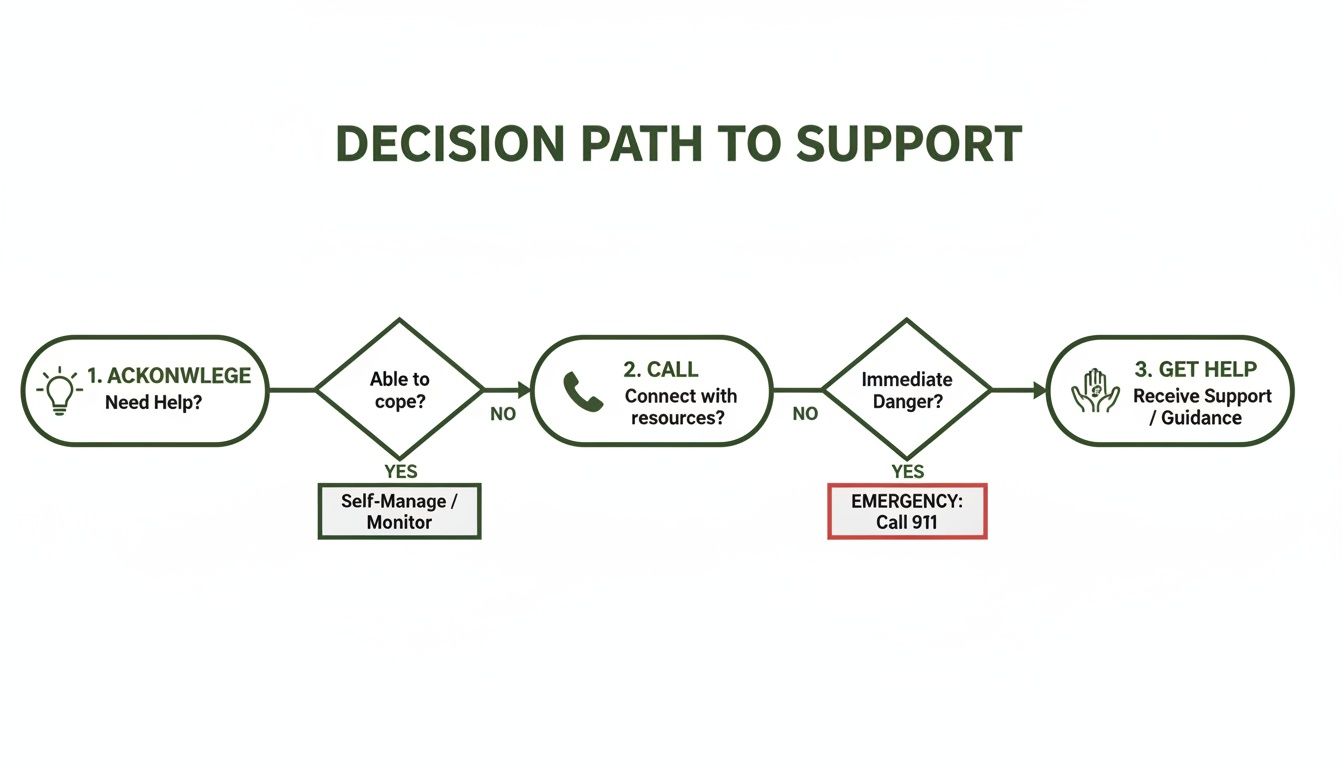
It all starts with a simple decision, followed by a single action: making the call. From there, support is waiting.
Navigating Insurance and Treatment Costs
Let's be honest: one of the biggest hurdles that stops people from getting help for substance abuse is the fear of the cost. The "what if I can't afford it?" question can be paralyzing. But it shouldn't be a roadblock to life-saving care. The good news is, you don't have to become an insurance expert overnight to make this happen.
The need for quality treatment is massive, and that's reflected in the numbers. The global substance abuse treatment market is expected to hit around USD 36.83 billion by 2034, and a huge part of that is driven by better insurance coverage. Laws have changed for the better, making behavioral healthcare an essential benefit.

What You Really Need to Know About Paying for Treatment
If you take away anything from this section, let it be these points:
- Don't DIY Your Insurance: You're dealing with enough already. Reputable treatment centers have teams that will verify your benefits for you, completely free. It's their job.
- Know What to Ask: A few key questions can save you a world of headaches and surprise bills down the road. I'll give you a simple script below.
- Coverage Is the Norm: Thanks to legislation like the Mental Health Parity and Addiction Equity Act, most insurance plans—including those here in Massachusetts—are required to cover addiction treatment.
- Keep Your Eye on the Prize: The financial piece is just logistics. Let the professionals handle the red tape so you can focus on getting well.
Your First Move: Verifying Your Insurance Coverage
The most direct way to get started is to simply call the member services number on the back of your insurance card. When you get a representative on the line, you'll want to have a few specific questions ready to go. This isn't the time for vague answers.
Here’s exactly what to ask to get the information you need:
- "What are my in-network benefits for behavioral health, specifically for substance use disorder treatment?" This confirms if a center you're looking at is in their network.
- "Which levels of care are covered? Do you cover detox, inpatient, PHP, and IOP?"
- "Can you walk me through my deductible, coinsurance, and out-of-pocket maximum for these services?"
- "Is pre-authorization required before I can be admitted?"
Understanding these terms is half the battle. Your deductible is the amount you pay out of pocket before your insurance starts kicking in. Coinsurance is the percentage of the cost you'll still pay after that, and the out-of-pocket maximum is the absolute most you'll have to pay in a given year.
Let Us Handle the Hard Part for You
Feeling your eyes glaze over reading about deductibles and coinsurance? That's completely normal. This is confusing stuff, but you absolutely do not have to figure it out alone. A good treatment center, like Paramount Recovery Centers, has admissions coordinators who do this all day, every day. Their entire role is to lift this weight off your shoulders.
Our admissions team can check your insurance benefits for you—quickly, confidentially, and at no cost. We'll tell you exactly what your plan covers, give you an honest estimate of any costs, and handle the entire pre-authorization mess so you don't have to.
This service is designed to let you focus on what really matters: your health. Not insurance paperwork.
For a free, no-obligation insurance check, give our team a call anytime at (888) 388-8660. We're here to make this part as painless as possible. If you want to dig deeper, you can also read our guide that explains how insurance can cover addiction treatment.
What to Expect From Your First Call and Assessment
Making that phone call is a huge step. For a lot of people, it's the hardest part of the entire process, but knowing what's on the other side of that call can make it a whole lot less intimidating. Let's be clear: when you call a treatment center, you shouldn't be met with a high-pressure sales pitch or judgment. You should connect with a real person who gets it, someone who is there simply to listen and help.
Think of this first conversation as a confidential, safe space to just talk about what's been going on. The only goal is to understand your situation so they can figure out the best way to help you. It's the first move toward getting the right kind of care you actually need to get better.
Key Takeaway: That first call isn't an interrogation; it's a conversation. It’s all about gathering the right information to build a treatment plan that fits you perfectly, ensuring you land in the right level of care from the start.
The Intake Conversation
When you dial that number, you'll likely speak with a trained intake coordinator. Their entire job is to make this process feel as smooth and stress-free as possible. They’ll gently guide you through a series of questions to get a clear picture of your story.
You can expect to talk about things like:
- Your Substance Use History: They’ll ask what you've been using, for about how long, and how often. This is crucial for figuring out the right level of care, especially if a medical detox is necessary for your safety.
- How You're Feeling Mentally: It's incredibly common to use substances to cope with things like anxiety or depression. Be as open as you can about any mental health struggles you're facing. This ensures they can find a program that addresses everything at once, not just part of the problem.
- Your Medical History: They'll need to know about any existing health conditions or medications you take. This is purely for your safety and well-being during treatment.
- What You Want to Get Out of This: They genuinely want to know what you're hoping for. What does a better life look like to you? This helps them tailor the whole approach to your personal goals.
Remember, everything you share is protected by strict privacy laws. This isn't just casual conversation; it's the information needed to build an effective and safe plan just for you.

The In-Person Assessment
After that initial phone screen, the next step is usually a more formal, in-person clinical assessment at the facility itself, often scheduled within a day or two. While the phone call provides a good overview, this assessment is a much deeper dive with a licensed clinician.
This is where the rubber really meets the road in designing your treatment plan. The clinician will expand on everything discussed over the phone, using standardized tools to formally assess the severity of the substance use and pinpoint any co-occurring mental health disorders. This step confirms the right level of care and truly sets the stage for your recovery.
Your Questions Matter, Too
This whole process is a two-way street. You aren't just there to be assessed; you're also there to see if the place is the right fit for you. Come prepared with your own list of questions.
You might want to ask things like:
- What does a typical day here actually look like?
- How do you involve family in the treatment process?
- Do you have specific therapies for issues I'm dealing with, like trauma or anxiety?
- What happens after I leave? What kind of aftercare planning or alumni support do you have?
Asking these questions gives you a sense of control and makes you an active partner in your own recovery right from day one.
Ready to take that first step? Our team is here 24/7 to listen without judgment and walk you through this process. Call us for a completely confidential chat at (888) 388-8660.
Building a Support System for Lasting Recovery
Finishing a treatment program is a huge accomplishment, but the real work of recovery starts the day you walk out the door. Let’s be honest: lasting sobriety isn’t built on willpower alone. It’s forged through connection, community, and having people in your corner who actually get what you're going through. This is where your support system becomes the single most important part of staying on track.

It’s about more than just avoiding temptation. It's about healing broken relationships and plugging into a network of people who genuinely want to see you thrive.
Building Your Support System: The Essentials
- Heal with Family: Addiction rocks the entire family. Family therapy is an incredible tool for rebuilding trust, learning to communicate again, and healing old wounds together.
- Find Your People: Connecting with others in recovery through alumni groups or local 12-Step meetings is vital. It gives you a sense of belonging with people who understand without you having to explain everything.
- Create Your Aftercare Blueprint: A solid aftercare plan isn't a suggestion; it's your roadmap for life after treatment. It needs to include therapy, meetings, and sober activities.
- Master Healthy Boundaries: Learning how to protect your sobriety by saying "no" and setting firm boundaries with people, places, and old routines is a non-negotiable skill for long-term success.
The Role of Family in Healing
There's a reason they call addiction a "family disease." Its effects ripple out, causing pain and chaos for spouses, parents, and children. Bringing your loved ones into the recovery process through structured family therapy can be a complete game-changer. It provides a safe space to finally talk through years of hurt, misunderstanding, and broken trust.
For families here in Massachusetts, that support doesn't end when treatment does. Groups like Al-Anon and Nar-Anon offer free, confidential meetings where relatives can get their own support. They learn crucial lessons: they didn't cause it, they can't control it, and they can't cure it—but they can learn to cope in healthier ways.
Creating Your Sober Network
One of the most powerful tools you have for staying sober long-term is connecting with other people who are also in recovery. This kind of peer support offers a level of understanding that even the most well-intentioned friends or family members just can't provide.
You can find this community in a few key places:
- Alumni Groups: Good treatment centers, like Paramount Recovery Centers, have active alumni programs. They're great for sober events and staying connected.
- 12-Step Fellowships: Groups like Alcoholics Anonymous (AA) and Narcotics Anonymous (NA) have meetings all over Massachusetts, every single day.
- Alternative Support Groups: If the 12-Step model isn't your thing, that's okay. Options like SMART Recovery or Refuge Recovery offer different approaches to the same goal.
The need for this kind of connection is staggering. In 2023, an estimated 316 million people used drugs across the globe. Yet, only about 1 in 12 people with a drug use disorder actually received any kind of treatment, highlighting a massive gap. You can discover more insights about these global statistics and the immense challenges in getting people the help they need.
Your Aftercare Plan: A Foundation for the Future
Think of your aftercare plan as the blueprint for your new life. It’s not just a piece of paper you get when you graduate; it's a concrete strategy you build with your therapist before you leave. A strong plan maps out those critical first few months post-treatment, which are often the most vulnerable.
A solid aftercare plan must include:
- Scheduled appointments with your individual therapist.
- A list of specific support group meetings you'll attend weekly.
- Contact info for your sponsor and key people in your sober network.
- A real plan for getting involved in healthy, sober hobbies.
This isn't busywork—it’s structure and accountability. It ensures you keep building on the incredible progress you made. If you’re ready to lay that foundation for yourself or your family, our team is here to help you figure out the right path. Call us for a confidential conversation at (888) 388-8660.
Frequently Asked Questions
How do I know I really need professional help?
If substance use is negatively impacting your health, relationships, career, or finances, it's a clear sign that professional support could be beneficial. You don't need to hit a dramatic "rock bottom" to deserve help. If it's a problem for you, it's a problem worth solving.
Is my call to a treatment center confidential?
Yes, 100%. All conversations with a treatment provider are protected by strict federal privacy laws like HIPAA. Your inquiry is completely private and secure, from the first call onward.
What is dual diagnosis treatment?
Dual diagnosis refers to treating a substance use disorder and a co-occurring mental health condition (like anxiety, depression, or PTSD) at the same time. This integrated approach is crucial because these conditions often fuel each other. Effective treatment must address both for a successful recovery.
What if my loved one refuses to get help?
This is a painful and common challenge. While you can't force an adult into treatment, you can change the dynamic. Setting firm, healthy boundaries and stopping any enabling behaviors can make recovery a more appealing option. Professional guidance from an interventionist or family therapist can be invaluable in these situations.
How long does addiction treatment take?
There is no one-size-fits-all timeline. The duration of treatment depends entirely on individual progress and clinical needs. Detox might last a week, while residential programs often range from 30 to 90 days. Outpatient programs can continue for several months, adjusting as you grow stronger in your recovery.
Your journey to a healthier life can start today. At Paramount Recovery Centers, our compassionate team is here 24/7 to answer your questions, verify your insurance, and help you find the right path forward. Call us now for a free, completely confidential conversation at (888) 388-8660.


