



When you or a loved one are facing addiction, the cost of treatment shouldn't be another barrier. The good news is that thanks to federal and state laws, most health insurance plans are legally required to cover addiction treatment. This guide will walk you through what your insurance covers, how to verify your benefits, and how to get the help you need right here in Massachusetts.
Key Takeaways
- Coverage is Legally Required: The Affordable Care Act (ACA) and the Mental Health Parity and Addiction Equity Act (MHPAEA) mandate that most insurance plans, including those in Massachusetts, cover addiction treatment as an essential health benefit, just like any other medical condition.
- A Full Range of Services is Covered: Your insurance benefits typically extend beyond just one type of care. Coverage often includes medically supervised detox, day treatment (PHP), intensive outpatient programs (IOP), and medication-assisted treatment (MAT).
- In-Network is Key to Affordability: Choosing a treatment center that is "in-network" with your insurance plan is the single most important step to minimize your out-of-pocket costs. This ensures you get the pre-negotiated, discounted rates your insurer has arranged.
- Verification is a Crucial First Step: Every plan has different deductibles, copays, and authorizations. The best way to understand your specific costs is to get a confidential benefits check. You can call your insurer or let an experienced treatment center like Paramount Recovery Centers do it for you for free.
Why Your Insurance Plan Covers Addiction Treatment
If you’re wondering why your insurance plan has to cover addiction treatment, you’re not alone. For a long time, getting help for substance use was treated as something separate from regular medical care, which left most people struggling to find affordable options. Thankfully, that reality has completely changed.
Two landmark federal laws fundamentally shifted the landscape. They now require insurance companies to treat addiction and mental health care just like any other chronic condition, such as diabetes or heart disease. Insurers can no longer place stricter limits on your addiction treatment than they do on surgical or primary care. Let's break down what this "parity" really means for you as a Massachusetts resident.
The Legal Foundation for Your Coverage
Having your addiction treatment covered by insurance isn’t a special perk or a loophole; it’s a right protected by federal law. Two key pieces of legislation work together to make this happen.
- The Mental Health Parity and Addiction Equity Act (MHPAEA): Passed back in 2008, this law is the bedrock of equal coverage. It says that large group health plans can't impose tighter restrictions on mental health or substance use disorder benefits than they do on medical and surgical benefits.
- The Affordable Care Act (ACA): Enacted in 2010, the ACA took MHPAEA's protections even further. It officially classified mental health and substance use disorder services as one of the ten essential health benefits. This means that almost all individual and small group plans sold on the marketplace are required to cover addiction treatment.
Think of it this way: if your insurance plan covers unlimited doctor visits for a heart condition, it can't turn around and cap your therapy sessions for addiction at just a handful of visits per year. The financial side—like copays and deductibles—and any limits on treatment must be comparable.
How the Affordable Care Act Expanded Access
The ACA did more than just tweak the rules; it threw open the doors to treatment for millions of people who were previously shut out. By mandating coverage and expanding Medicaid, its impact was immediate and massive.
Before the ACA expansion, for example, nearly 28% of low- and middle-income adults with substance use disorders were completely uninsured. By 2016, that number had plummeted to under 19%. Even more telling, Medicaid coverage for this same group more than doubled, jumping from 6.3% to 13.6%. This is a crystal-clear sign that the law successfully reached those who needed help the most. You can read the full research about these findings to see the data for yourself.
This seismic shift means that today, whether your plan is through an employer, the Massachusetts Health Connector, or MassHealth, you have a strong legal foundation for accessing care.
What This Means for Massachusetts Residents
Here in Massachusetts, these federal protections are firmly in place. Your insurance plan, whether it's from a big national carrier or a local provider, has to comply. This ensures a solid baseline of coverage no matter what kind of plan you have.
The core principle is simple but incredibly powerful: addiction is a treatable medical condition. The law demands that your insurance plan treats it that way, giving you a fair shot at recovery without facing discriminatory financial hurdles.
Understanding these rights is the first step toward getting the help you deserve. It changes the question from "Does my insurance even cover this?" to "How do I use my insurance to get the best treatment possible?" It gives you the confidence to ask the right questions and demand the coverage you are legally entitled to receive.
If you're not sure how these laws apply to your specific plan or just need help figuring it all out, our team is here to cut through the confusion. A quick, confidential call to (888) 388-8660 can help you understand your benefits and start your recovery journey today. We’ll handle the insurance details so you can focus on what really matters—healing.
What Levels of Addiction Care Your Insurance Will Cover
Knowing your insurance plan is legally required to cover addiction treatment is a huge relief. But the next logical question is, what exactly does that mean? It helps to see the road to recovery not as a single event, but as a journey with distinct, supportive stages—most of which your insurance will help you access.
In Massachusetts, your benefits are designed to align with this journey. Think of it like physical therapy after a major surgery. You’d probably start with intensive, daily sessions and then gradually taper down as you regain strength. Addiction treatment often follows a similar path, and your insurance is set up to cover these different levels of intensity based on what’s medically necessary for your situation.
The legal framework mandating this coverage is solid, thanks to laws like the ACA and MHPAEA that protect your right to treatment.
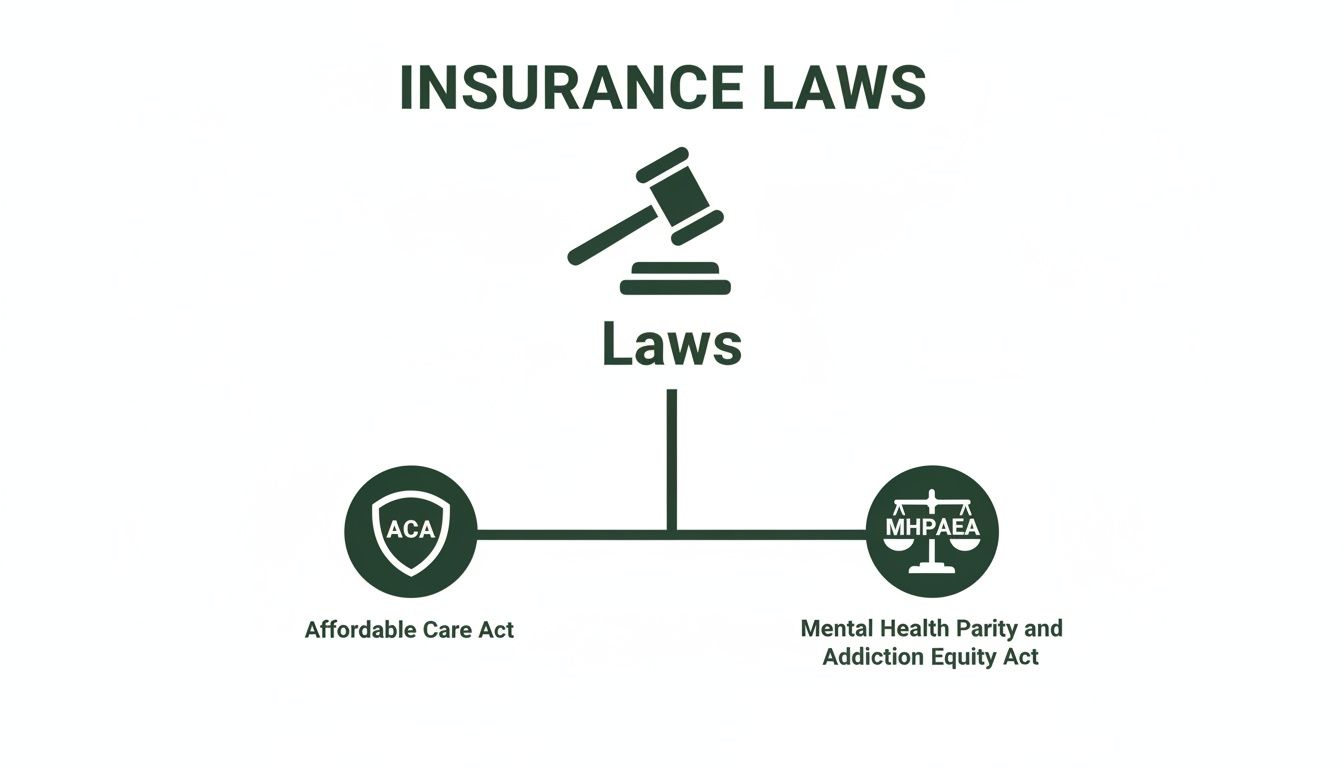
These federal laws form the foundation of your right to care, ensuring insurance plans treat substance use disorder with the same importance as any other medical condition.
To give you a clearer picture, this table breaks down the common levels of care and what you can generally expect from insurance coverage here in Massachusetts.
Typical Insurance Coverage for Addiction Treatment Services in Massachusetts
This table breaks down common levels of addiction care and the general likelihood of insurance coverage for each, helping you match your needs to potential benefits.
| Level of Care | Description | Commonly Covered by Insurance? | Notes for Massachusetts Patients |
|---|---|---|---|
| Medical Detox | Medically supervised management of withdrawal symptoms to ensure safety and stability. | Yes, almost always | Considered a critical first step. Coverage is typically approved when a doctor deems it medically necessary due to withdrawal risks. |
| Day Treatment (PHP) | Intensive, structured therapy for several hours a day, 5 days a week, while living at home. The highest level of outpatient care. | Yes, very commonly | A prior authorization from your insurer is usually required. This is a core service covered by most private plans and MassHealth. |
| Intensive Outpatient (IOP) | A step-down from PHP, offering structured group and individual therapy for a few hours a day, a few times per week. Balances treatment with work/school. | Yes, very commonly | Like PHP, this generally requires pre-authorization. It's a standard benefit for those needing robust support without residential care. |
| Medication-Assisted Treatment (MAT) | Combines FDA-approved medications (like buprenorphine or naltrexone) with counseling to treat opioid or alcohol use disorders. | Yes, widely covered | Both the medications and the required therapy sessions are considered essential benefits under federal parity laws. MassHealth has strong MAT coverage. |
| Dual Diagnosis Programs | Integrated treatment for co-occurring substance use and mental health disorders (e.g., addiction and anxiety). | Yes, required by law | Mental health parity laws mandate that if your plan covers medical care, it must cover mental health care equally. This is the standard of care. |
| Standard Outpatient & Aftercare | Weekly individual or group therapy sessions to maintain recovery progress. | Yes, commonly | These services are typically covered, but you may have copays or coinsurance. Insurers see this as a key part of preventing relapse. |
| Residential/Inpatient Rehab | 24/7 care in a live-in facility. This is the most intensive and immersive level of treatment. | Yes, but with strict criteria | Coverage depends heavily on medical necessity. Insurers require documentation showing that lower levels of care are insufficient for the patient's needs. |
Understanding these levels helps you see the different tools available for recovery. Let's dig a little deeper into what each one involves.
Medically Supervised Detox
For many, the first and most critical step is detox. This is the process of safely managing the acute physical symptoms of withdrawal under medical supervision. Because stopping certain substances can lead to severe and even life-threatening complications, detox is almost always covered by insurance when deemed medically necessary.
Your insurance provider sees this not just as a treatment step but as a crucial safety measure. They will typically authorize coverage for a detox program as long as a medical professional confirms it would be unsafe for you to stop using on your own.
Day Treatment And Intensive Outpatient Programs
Once you're medically stable, the real work of recovery begins. This is where programs like Day Treatment—also known as a Partial Hospitalization Program (PHP)—and Intensive Outpatient Programs (IOP) come in. These are structured, highly effective levels of care that most insurance plans in Massachusetts readily cover.
- Partial Hospitalization Program (PHP): This is the most intensive form of outpatient care. It often involves treatment for several hours a day, five days a week, giving you the structure of an inpatient program while letting you return home at night.
- Intensive Outpatient Program (IOP): As a step down from PHP, an IOP provides robust support with fewer hours. It’s perfect for people transitioning from a higher level of care or those who need significant support but have to maintain work or school commitments.
At Paramount Recovery Centers, we specialize in these effective outpatient models. We find they provide the perfect balance of structured support and real-world integration, and we work directly with insurance providers to secure coverage for our clients. For more on how these programs are structured, you can explore our guide explaining the differences between inpatient and outpatient rehab.
Choosing the right level of care is a clinical decision. A professional assessment will determine what is medically necessary, which is the key factor insurance companies use to approve coverage. Our team at (888) 388-8660 can help you start this process.
Medication-Assisted Treatment (MAT)
For anyone recovering from opioid or alcohol addiction, Medication-Assisted Treatment (MAT) can be a life-saving component of their recovery plan. MAT combines FDA-approved medications with counseling and behavioral therapies to treat substance use disorders.
Under the MHPAEA and ACA, MAT is considered an essential part of addiction treatment. Because of this, most insurance plans, including MassHealth, provide coverage for both the medications and the associated therapy sessions. This integrated approach is proven to reduce cravings, prevent relapse, and support long-term recovery.
Dual Diagnosis Programs
Addiction rarely exists in a vacuum. It often goes hand-in-hand with mental health conditions like depression, anxiety, or PTSD. Treating both at the same time is known as dual diagnosis care, and it’s the gold standard for effective, lasting recovery.
Thanks to mental health parity laws, your insurance plan can't offer less favorable coverage for mental health services than it does for physical health services. This means if your plan covers therapy for a medical condition like diabetes, it must also cover integrated therapy for a co-occurring disorder. This ensures you can get the complete, whole-person care you need without facing discriminatory coverage limits.
In-Network vs. Out-of-Network Rehab: What's the Difference?
Figuring out your insurance plan can sometimes feel like choosing between two paths to the same place. One is a smooth, paved highway with predictable costs. The other is a winding country road dotted with unexpected tolls. That’s the best way to think about the difference between in-network and out-of-network addiction treatment providers.
Getting this one distinction right is probably the most important step you can take to make rehab affordable.

An in-network provider is a treatment center that has a contract with your insurance company. Through this agreement, they’ve pre-negotiated lower rates for all their services. When you choose an in-network facility in Massachusetts, like Paramount Recovery Centers, you tap into these discounted rates, which means much lower copays, deductibles, and overall out-of-pocket costs for you.
On the other hand, an out-of-network provider is one that has no contract with your insurer. While your plan might still cover some of the costs for out-of-network care, it will be a far smaller percentage, leaving you to pay the difference. This is how people end up with the shock of huge, unexpected medical bills.
Why Choosing In-Network Is So Important
Opting for an in-network provider isn't just about saving money—it's about financial predictability when you need it most. When your focus should be on getting better, the last thing you need is to worry about surprise expenses. Because your insurance company has already vetted in-network facilities, it also makes things like billing and getting authorizations much simpler.
It’s hard to overstate how critical good insurance coverage is. Just think back to 2011, before the ACA really kicked in, when getting help was a massive financial gamble. A staggering 59.6% of adults aged 26 and older who went to a substance abuse treatment facility had no health insurance at all. That’s almost three out of five people walking into recovery with no financial safety net. Discover more insights about addiction treatment coverage to see just how far we've come.
Choosing an in-network provider is the single most effective way to maximize your insurance benefits and minimize your personal financial burden. It ensures you get the highest level of coverage your plan offers.
How to Find an In-Network Rehab in Massachusetts
Finding a rehab facility that works with your insurance is pretty straightforward once you know where to look. Here are the most effective ways to do it:
- Check Your Insurer’s Online Directory: The quickest way to start is by going to your insurance company's website. They all have a provider search tool where you can filter by specialty ("Substance Use Disorder Treatment" or "Behavioral Health") and location (e.g., "Southborough, MA"). This will give you a list of every contracted, in-network center in the area.
- Call Your Insurance Company: If you’d rather talk to a person, the member services number on the back of your insurance card is your best friend. A representative can look up and even email you a list of in-network addiction treatment centers near you.
- Contact the Treatment Center First: Honestly, this is often the easiest route. An experienced admissions team, like ours at Paramount Recovery Centers, can do the legwork for you. Just give them your insurance information, and they can run a quick benefits check to confirm they are in-network with your specific plan and explain your coverage in simple, easy-to-understand terms.
When you call a potential treatment center, have these questions ready:
- "Do you accept my insurance plan, [Your Plan Name]?"
- "Are you an in-network provider for that plan?"
- "Can you help me verify my benefits to see what my out-of-pocket costs might be?"
At Paramount Recovery Centers, we firmly believe that financial stress should never stand in the way of recovery. We are proud to work with most major insurance carriers as an in-network provider. Give us a call at (888) 388-8660 for a free, confidential insurance verification today.
A Step-by-Step Guide to Verifying Your Insurance Benefits
Knowing you have coverage is a great first step, but what comes next can feel like navigating a maze. How do you figure out what your specific plan will actually pay for? Taking on the task of verifying your insurance benefits can feel pretty daunting, but with the right approach, it’s a lot more manageable than you think.
This guide breaks it down into a clear, step-by-step checklist to give you the confidence to understand exactly what your coverage looks like. You can absolutely take these steps on your own, but remember, the easiest path is often letting an experienced treatment center handle it all for you.

Step 1: Gather Your Information
Before you even think about making a call, get all your essential details in one place. This simple bit of prep work makes the whole conversation smoother and helps you get accurate answers without a lot of back-and-forth.
You will need:
- Your Insurance Card: Have the physical card in front of you. You'll need the Member ID number, Group number, and the customer service phone number usually found on the back.
- Personal Information: Be ready with your full name, date of birth, and address so they can confirm it’s you.
- Provider Information (Optional): If you already have a treatment center in mind, like Paramount Recovery Centers in Southborough, Massachusetts, have their name and address handy.
Step 2: Know What to Ask Your Insurance Provider
When you call the number on your insurance card, you'll be speaking with a representative who can pull up your specific plan details. The key is to ask targeted questions that get you the clear answers you need. Don't be afraid to ask them to explain anything that sounds like confusing jargon.
Here are the essential questions to ask:
- "Can you confirm my plan covers behavioral health and substance use disorder treatment?"
- "What is my annual deductible for behavioral health services, and how much of it have I met so far this year?"
- "What are my copay and coinsurance amounts for outpatient addiction treatment?"
- "Is prior authorization required for services like a Partial Hospitalization Program (PHP) or an Intensive Outpatient Program (IOP)?"
- "What is my out-of-pocket maximum for the year?"
It's easy to get lost in the jargon. A term like "out-of-pocket maximum" simply means the absolute most you will have to pay for covered services in a plan year. Once you hit this amount, your insurance pays 100% of the costs for the rest of the year.
Step 3: Let the Treatment Center Do the Work for You
While you can definitely verify your benefits on your own, there's a much easier way. This is hands-down the best step for reducing stress and getting fast, accurate answers. Experienced addiction treatment centers do this every single day—they're experts at navigating the complexities of insurance.
At Paramount Recovery Centers, our admissions team will handle this entire verification process for you with a free, confidential benefits check. We know exactly what information your provider needs and, more importantly, how to interpret the fine print of your plan. This service is designed to take the burden completely off your shoulders so you can focus on what matters: getting help.
We make the calls, confirm your coverage for our Massachusetts programs, and explain your benefits in plain English. For a fast and simple verification, you can complete our confidential insurance verification form online right now: https://paramountrecoverycenters.com/verify-insurance/
Taking this step ensures you have a complete and accurate understanding of what your insurance will cover. It removes all the guesswork and prevents any financial surprises down the road. Our team is ready to help you navigate this process from start to finish. Just call (888) 388-8660 to get started.
What to Do If Your Insurance Claim Is Denied
An insurance denial can feel like a solid brick wall, a final "no" on the path to recovery. But in my experience, it's rarely the final word. A denial is often just the start of a conversation—a request for more information or a decision you have every right to challenge.
You are your own best advocate, and understanding the appeals process empowers you to fight for the care you need. It’s worth remembering that many initial denials are overturned, especially when you have the right support and documentation.
The Appeals Process Explained
When you get a denial letter, the first step is to stay calm and get organized. That letter is a crucial piece of the puzzle because it explains exactly why they denied the claim. Common reasons include the treatment being deemed "not medically necessary" or some issue with pre-authorization.
The appeals process generally unfolds in two main stages:
- Internal Appeal: This is where you formally ask your insurance company to take a second look at its decision. You’ll submit a written request, which should be backed up by a letter from your doctor or treatment provider explaining why the care is essential for your health.
- External Review: If the internal appeal doesn't work out, you can take your case to an independent third party. This unbiased reviewer, often overseen by a state regulatory body, will examine all the facts and make a final, legally binding decision.
Never assume a denial is the end of the story. You have a legal right to appeal the decision, and many patients win their appeals and get the coverage they need. Treatment centers like Paramount Recovery Centers can be your staunchest advocate in this process.
Alternative Financial Options
While the appeals process unfolds, or if coverage remains a hurdle, it's important to know that other financial pathways exist. The goal is to get you into treatment without delay, and there are several ways to manage the cost of care in Massachusetts. For a detailed breakdown, check out our guide on how people pay for alcohol rehab in Massachusetts.
Insurance coverage has certainly supercharged the addiction treatment industry, linking better reimbursement to wider access for many. The global addiction treatment market was valued at $9.44 billion in 2024 and is projected to hit $16.22 billion by 2034. Despite this growth, significant hurdles remain, including an estimated 37.6% of patients with drug disorders being unaware of their coverage options. You can discover more insights about health insurance coverage on SAMHSA.gov.
Don't Navigate This Alone
Facing an insurance denial while trying to manage a health crisis is incredibly stressful. You don't have to do it by yourself. The team at Paramount Recovery Centers is experienced in handling these exact situations, from initial verification to navigating complex appeals.
We can help you understand the denial letter, gather the necessary clinical documentation, and communicate effectively with your insurance provider. Our entire mission is to remove these barriers so you can focus completely on your recovery.
If you’ve received a denial or are just worried about your coverage, give us a call. Let our team advocate for you. Contact us today at (888) 388-8660 for a confidential consultation.
Frequently Asked Questions
How much will I have to pay out-of-pocket for addiction treatment?
Your out-of-pocket cost depends on your specific insurance plan's deductible, copay or coinsurance, and out-of-pocket maximum. Choosing an in-network provider in Massachusetts significantly reduces these costs. The fastest way to get a clear estimate is to call us at (888) 388-8660 for a free and confidential benefits verification.
Will my insurance cover treatment for a dual diagnosis?
Yes, absolutely. Federal parity laws require insurance companies to cover mental health conditions (like anxiety or depression) with the same level of benefits as they do for medical conditions. Integrated treatment for co-occurring addiction and mental health disorders is the standard of care and is a covered benefit.
If I use my company's insurance, will my employer find out?
No. Your privacy is protected by the Health Insurance Portability and Accountability Act (HIPAA). Your insurance company cannot legally share your personal health information, including details about addiction treatment, with your employer without your explicit written consent.
What are my options if I have MassHealth?
MassHealth provides excellent coverage for addiction treatment, often with little to no out-of-pocket cost for the member. The key is to find a quality provider that is in-network with MassHealth. At Paramount Recovery Centers, we have extensive experience working with MassHealth and can help you access the full range of benefits your plan provides.
At Paramount Recovery Centers, our entire goal is to remove barriers to care. Let our experienced team take the stress of insurance off your plate. We'll answer your questions, handle the verification, and find a clear path forward for you. Call us for a free, confidential benefits check at (888) 388-8660 or visit us online to get started today.


