


Navigating the path to recovery in Massachusetts can feel overwhelming, but finding the right help is the most important first step you can take. This guide is designed to provide clear, actionable information about the different types of drug rehab programs available in the state, helping you or your loved one make an informed decision with confidence.
Key Takeaways
- Understand Levels of Care: Massachusetts offers a full spectrum of treatment, from 24/7 inpatient care to flexible outpatient programs. A clinical assessment is the best way to determine the right starting point for your specific situation.
- Look for State Licensing: Always choose a program licensed by the Massachusetts Bureau of Substance Addiction Services (BSAS). This is your assurance of quality, safety, and adherence to state standards.
- Know Your Financial Options: Most private insurance plans are required to cover addiction treatment. State-funded programs and financing options are also available to ensure cost is not a barrier to getting help.
- Evidence-Based Therapy is Crucial: Effective treatment is built on scientifically proven therapies like Cognitive Behavioral Therapy (CBT) and specialized care like dual diagnosis, which addresses both addiction and co-occurring mental health conditions.
Understanding the Levels of Care in Massachusetts Rehabs
The path to recovery isn’t a single event—it’s a journey with different stages and needs along the way. That’s why drug rehab programs in Massachusetts are built on a “continuum of care,” a framework designed to provide the right amount of support at precisely the right time.
Think of it like a staircase. Each step represents a different intensity of treatment, allowing you to move up to more intensive care or step down to more flexible support as you progress in your recovery. This system ensures that whether you’re just starting to confront substance use or working to solidify long-term sobriety, there’s a program designed to meet you exactly where you are.
Medical Detoxification: The First Step
For most people, the first and most vital step is medical detoxification. This isn’t therapy; it’s a medically supervised process designed to safely manage the physical symptoms of withdrawal. Coming off substances like alcohol, opioids, or benzodiazepines can be intensely uncomfortable and, in some cases, dangerous.
A supervised medical detox is the safest way to clear your body of substances, manage withdrawal, and prepare for the psychological work of recovery. It creates a stable foundation for everything that comes next.
Inpatient Residential Treatment: A Structured Environment
Once you’re medically stable, the next step is often an inpatient or residential program. This level of care provides a 24/7 structured, supervised, and substance-free environment. By removing you from daily triggers and stressors, residential treatment allows for a singular focus on recovery.
A typical day is highly scheduled and packed with healing activities, including:
- Individual Therapy: One-on-one sessions with your dedicated counselor.
- Group Therapy: Professionally facilitated groups and discussions with peers who understand what you’re going through.
- Educational Workshops: Classes that teach you about the science of addiction, relapse prevention, and crucial life skills.
- Holistic Activities: Opportunities for mindfulness, yoga, art, or other wellness practices that heal the whole person.
This immersive approach is perfect for those with more severe substance use disorders or anyone who lacks a stable, supportive home life. It’s all about building a rock-solid foundation by establishing healthy new routines and coping mechanisms.
This infographic breaks down the essential components of choosing a rehab program, from understanding care levels to evaluating therapies and costs.
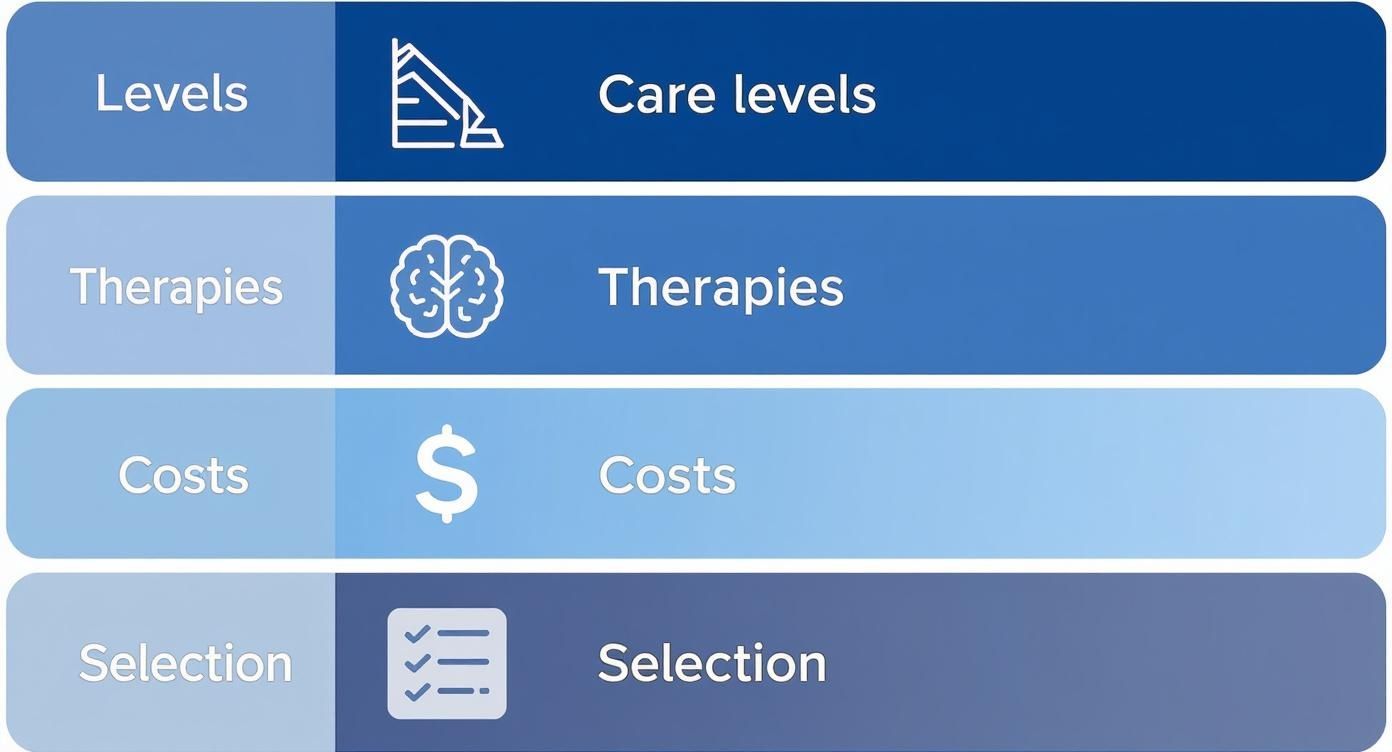
As the visual shows, recovery is a multi-faceted process. The level of care you choose is just the first of several critical decisions you’ll make on your journey.
To help you get a clearer picture of how these programs differ, we’ve put together a simple comparison.
Comparing Addiction Treatment Levels in Massachusetts
This table offers a side-by-side look at the primary levels of care, breaking down their intensity, setting, and duration to help you find the right starting point.
| Level of Care | Setting | Intensity and Time Commitment | Best Suited For |
|---|---|---|---|
| Medical Detox | Hospital or standalone detox facility | 24/7 medical supervision, typically lasting 3-10 days. Focus is on physical stabilization. | Individuals at risk of severe or dangerous withdrawal symptoms. |
| Inpatient/Residential | Residential treatment facility | 24/7 structured care, usually for 30, 60, or 90 days. Immersive therapeutic environment. | Those with severe SUD, co-occurring disorders, or an unstable home environment. |
| Partial Hospitalization (PHP) | Outpatient clinic/treatment center | 5-6 hours/day, 5 days/week. Intensive therapy while living at home or in sober living. | A “step-down” from residential care or for those needing intensive support without 24/7 supervision. |
| Intensive Outpatient (IOP) | Outpatient clinic/treatment center | 3 hours/day, 3-5 days/week. Balances structured treatment with work/school/family life. | Individuals transitioning back into daily life who still need significant support and accountability. |
| Standard Outpatient | Therapist’s office or clinic | 1-2 sessions per week. Ongoing support and relapse prevention. | People who have completed higher levels of care and are maintaining their long-term recovery. |
Understanding these distinctions is key to making an informed decision. Each level serves a crucial purpose in building a sustainable, sober life.
PHP and IOP: Flexible Yet Intensive Support
As you become more stable in recovery, you can “step down” to programs that offer serious clinical support with more personal freedom.
Partial Hospitalization Programs (PHP) are the most intensive type of outpatient care. You’ll typically attend treatment for five to six hours a day, five days a week, participating in the same kinds of therapies you’d find in a residential program. The key difference is that you return home or to a sober living environment each evening.
Intensive Outpatient Programs (IOP) provide even more flexibility, usually requiring about three hours of therapy, three to five days a week. This structure is perfect for people who are getting back to work, school, or family life but still need consistent support and accountability. Figuring out which is the better fit is a big step, and you can learn more about how to pick the right PHP or IOP in Massachusetts in our detailed guide.
Standard Outpatient: Ongoing Recovery Maintenance
The final step on the continuum is standard outpatient care. This usually means meeting with a therapist or attending a group once or twice a week. It acts as an ongoing maintenance plan, helping you navigate the challenges of daily life while reinforcing the skills you learned in more intensive programs.
Standard outpatient is vital for long-term recovery, giving you a consistent touchpoint for support and relapse prevention long after you’ve left the more structured levels of care.
Inside Effective Treatment: The Therapies That Heal
Beyond the daily schedules and different levels of care, the real engine of recovery is the therapy itself. The most effective drug rehab programs in Massachusetts are built on a solid foundation of evidence-based treatments. These are therapies that have been scientifically studied and proven to help people break free from substance use disorders.
These aren’t just casual talk sessions. They are structured, goal-oriented approaches designed to help you rewire your brain’s response to stress, triggers, and cravings.
Think of addiction like a well-worn path through a dense forest. When you feel distressed, it’s the easiest, most familiar route to take. Evidence-based therapies act as your guide, helping you clear new, healthier paths and build the strength to choose them, even when the old one seems tempting. This whole process is about learning practical skills to manage your thoughts, emotions, and behaviors in a completely new way.
Core Therapies in Massachusetts Rehabs
At the heart of any quality treatment program are several key therapeutic models. Each one comes at addiction from a different angle, giving you a well-rounded toolkit for recovery.
Cognitive Behavioral Therapy (CBT) is a true cornerstone of modern addiction treatment. It’s built on a simple but powerful idea: our thoughts, feelings, and behaviors are all connected. CBT helps you spot the negative thought patterns that drive substance use and swap them out for more constructive ones.
For instance, a thought like “I can’t handle this stress without a drink” gets challenged and reframed into something like, “I’m feeling stressed, so I’ll use the breathing techniques I learned and call my sponsor.” It’s all about building real-world coping skills to manage life’s curveballs.
Dialectical Behavior Therapy (DBT) is particularly powerful for people who struggle with intense emotions and self-destructive behaviors. While it was first developed for borderline personality disorder, its skills are now widely used in addiction recovery. DBT zeroes in on four key areas:
- Mindfulness: Learning to stay in the present moment without judging yourself.
- Distress Tolerance: Building skills to get through painful emotions without turning to substances.
- Emotion Regulation: Understanding and managing intense feelings in a healthier way.
- Interpersonal Effectiveness: Improving how you communicate and building stronger, more supportive relationships.
Mastering these skills gives you the ability to navigate emotional storms without getting swept away. Digging into the best forms of therapy for addiction recovery can offer a deeper look at how these methods work together to create lasting change.
The Role of Medication in Recovery
For many people, especially those recovering from opioid or alcohol addiction, therapy alone isn’t enough to overcome the intense physical grip of the substance. This is where Medication-Assisted Treatment (MAT) becomes an absolutely crucial part of care.
Medication-Assisted Treatment (MAT) combines FDA-approved medications with counseling and behavioral therapies. It’s a proven, whole-person approach that dials down cravings and withdrawal symptoms, giving you a stable foundation to fully dive into the therapeutic work.
It’s a common myth that MAT is just swapping one drug for another. The reality is that these medications work by normalizing brain chemistry and blocking the euphoric effects of alcohol and opioids. This effectively quiets the physical “noise” of addiction, allowing you to focus on the psychological healing that needs to happen.
Specialized Programs for Whole-Person Healing
Recovery isn’t a one-size-fits-all journey. The most effective drug rehab programs in Massachusetts get this, offering specialized tracks designed to meet unique individual needs.
One of the most critical of these is dual diagnosis treatment. Substance use and mental health conditions like anxiety, depression, or PTSD are often deeply tangled together. In fact, the National Institute on Drug Abuse estimates that about 40-60% of people with a substance use disorder also have a co-occurring mental health condition.
Trying to treat one without addressing the other is like trying to fix a leaky boat by only bailing out half of the water. An integrated dual diagnosis program tackles both conditions at the same time, with a team that understands how they fuel each other. This approach leads to a much more complete and sustainable recovery.
How to Navigate Costs and Insurance for MA Rehab
Money is often the first thing people worry about when they consider getting help. Let’s be honest—it can be a huge source of stress. But financial concerns should never be the reason you don’t get the care you deserve.
This section is a practical, no-nonsense guide to figuring out the costs of drug rehab programs in Massachusetts. We’ll break down what different levels of care might cost and, more importantly, how you can actually pay for it.
Understanding the Cost of Treatment in Massachusetts
The price tag for rehab isn’t one-size-fits-all. It can swing pretty widely depending on the level of care you need, the facility’s amenities, and how long you’ll be staying.
Massachusetts has high standards for care, and the investment reflects that. The average cost for a 30-day inpatient substance abuse program hovers around $56,725, which puts the state on the higher end nationally. Without insurance, inpatient treatment runs about $630 per day. But with 80% coverage, that number can drop all the way down to $126 per day.
Outpatient programs are a much more affordable route, averaging about $57 daily without insurance and as low as $11 per day with 80% coverage. You can dig deeper into Massachusetts rehab cost statistics to get a more complete view of the financial landscape.
Making Treatment Affordable With Insurance
Here’s the good news: most private insurance plans are legally required to cover treatment for substance use disorders. Thanks to federal laws like the Mental Health Parity and Addiction Equity Act (MHPAEA), insurance companies have to offer the same level of benefits for mental health and addiction treatment as they do for other medical care.
Put simply, your health plan can’t put up more roadblocks for addiction treatment than it does for, say, surgery or diabetes management.
Before you even start, our admissions team can handle a critical first step for you: verifying your insurance benefits. We’ll get on the phone with your provider to figure out the specifics of your policy, including:
- Deductibles: The amount you have to pay out-of-pocket before your insurance kicks in.
- Copayments/Coinsurance: Your share of the costs after you’ve met your deductible.
- Out-of-Pocket Maximum: The absolute most you’ll have to pay for covered services in a year.
Knowing exactly what your coverage looks like upfront eliminates a ton of uncertainty and helps you plan. Our team has years of experience working with insurers to maximize benefits and keep your personal expenses as low as possible.
Other Ways to Pay for Rehab
If you don’t have private insurance, don’t write off getting help. There are still plenty of other paths to make treatment affordable. Massachusetts is dedicated to ensuring its residents can access the care they need, no matter their financial situation. For a more detailed look, check out our guide on how much drug rehab costs in MA.
Here are a few other options that might be available:
- State-Funded Programs: Massachusetts offers public funding for addiction treatment to eligible residents through MassHealth and other state-level initiatives.
- Sliding Scale Fees: Many treatment centers, including ours, offer payment plans based on your income to make the cost more manageable.
- Financing and Loans: Medical or personal loans can cover the immediate costs of treatment, allowing you to pay the balance back over time.
Financial stress shouldn’t stop your recovery journey before it even begins. Call us at (888) 388-8660 for a completely confidential chat about your options. We’re here to help you navigate the costs and find a path forward.
The Massachusetts Approach to Addiction and Recovery
Every state has its own story when it comes to addiction and recovery, shaped by local history, politics, and community. Here in the Commonwealth, our approach has been forged in the fire of the opioid crisis, leading to years of proactive, state-level efforts to support residents on their path to healing.
When you look for help here, you’re tapping into a system with high standards for safety, quality, and accountability. This isn’t just about meeting a baseline; it’s about a deep commitment to patient well-being that you can feel in the quality of drug rehab programs in Massachusetts.
The Role of State Oversight and Licensing
A key piece of this puzzle is the Bureau of Substance Addiction Services (BSAS). Think of BSAS as the state’s quality control agency for all addiction treatment programs. They’re the ones who do the licensing, the monitoring, and set the high bar that every facility has to clear.
When you see that a program is BSAS-licensed, it’s not just a piece of paper. It’s a seal of approval. It tells you that the program meets strict requirements for everything from clinical care and staff qualifications to patient safety. It’s a huge confidence booster, knowing that a facility is part of a statewide network committed to ethical and effective care.
A Proactive Response to the Opioid Crisis
Massachusetts has been on the front lines of the nation’s opioid epidemic for a long time. It’s a tough reality that has profoundly shaped our public health strategies. For over two decades, the state has been grappling with this, and between 2005 and 2021, we saw a heartbreaking 450% increase in opioid-related deaths.
But Massachusetts didn’t just stand by. In response, the state rolled out some forward-thinking measures to save lives and make it easier for people to get help.
Initiatives like the Massachusetts Prescription Monitoring Program have made a real impact, helping to reduce opioid prescriptions by an incredible 48% between 2015 and 2022. On top of that, community campaigns like State Without StigMA and Making The Right Call are working hard to chip away at the shame that keeps too many people from reaching out. You can learn more about these Massachusetts-specific recovery statistics and initiatives to see the full picture of the state’s efforts.
The Commonwealth’s long and difficult experience has fostered a deep understanding that addiction is a public health issue, not a moral failing. This perspective is the driving force behind the compassionate, evidence-based treatment you’ll find all across the state.
This history has created a treatment landscape that is both resilient and deeply knowledgeable. Many programs here have developed specialized care for opioid use disorder, including advanced Medication-Assisted Treatment (MAT) protocols that are saving lives every day.
Community Support and Reducing Stigma
The state’s strategy doesn’t stop at the clinic door. There’s a powerful emphasis on building support at the community level and educating the public to reduce the stigma around addiction. This work creates a much more supportive environment where individuals and families feel they can ask for help without fear of judgment.
This focus on community means that recovery isn’t something that just happens inside a treatment center. It’s nurtured in our neighborhoods, workplaces, and families all across Massachusetts, building a stronger, more compassionate network for long-term success.
Choosing the Right Massachusetts Rehab: A Practical Checklist
You’ve done the research, and now it’s time to make a decision. This section is all about turning information into action. We’ll walk through a practical checklist to help you sort through the many drug rehab programs Massachusetts has to offer and find the right one.
Picking a facility is a deeply personal choice. The goal is to find a program where the philosophy, clinical approach, and environment truly connect with your specific needs. Asking the right questions upfront gives you the clarity and confidence to move forward.
Essential Questions for Admissions Staff
When you start calling potential treatment centers, don’t hold back. A quality provider will welcome your questions and answer them honestly. Think of it as an interview—you’re seeing if they’re the right fit for you.
Here are the key areas you’ll want to cover:
- Licensing and Accreditation: Start with the most important question: “Is your program licensed by the Massachusetts Bureau of Substance Addiction Services (BSAS)?” This is a non-negotiable that confirms the program meets state standards for safety and care.
- Clinical Team Credentials: Ask about who you’ll be working with. “What are the specific licenses and qualifications of your clinical staff?” You want to hear about licensed therapists (like LICSWs or LMHCs) and medical professionals who specialize in addiction medicine.
- Treatment Philosophy: Get a feel for their approach. “What is your core philosophy on treatment? Do you use evidence-based therapies like CBT or DBT?” Make sure their methods are grounded in science and resonate with you.
- Aftercare Planning: Recovery doesn’t end when you walk out the door. Ask, “What does your aftercare planning and alumni support involve?” A strong aftercare program is a clear sign that a facility is invested in your long-term success.
Making the right choice is about more than just logistics. It’s about finding a place where you feel safe, respected, and understood—a community that will support your healing from day one.
Aligning the Program with Your Needs
Beyond the basics, think about what you personally need to feel supported in a treatment setting. Do you need specialized services that could make all the difference in your recovery?
For instance, if you’re dealing with both substance use and anxiety, a program with a robust dual diagnosis track is essential. If you’ve found strength in fellowship, ask about their approach to 12-Step meetings or other mutual-help groups. The best drug rehab programs in Massachusetts will tailor the treatment plan to you, not the other way around.
When you’re ready to start this conversation, our experienced team is here to listen. We can answer these questions and more in a confidential, no-pressure call. Reach out anytime at (888) 388-8660.
Frequently Asked Questions About Drug Rehab in Massachusetts
Stepping into the world of recovery can feel overwhelming, and it’s natural to have a lot of questions. We’ve answered some of the most common questions we hear from individuals and families across the Commonwealth to help you feel more confident in your next steps.

How Long Does Rehab Typically Last in Massachusetts?
There is no one-size-fits-all timeline for recovery. Inpatient residential programs often have 30, 60, or 90-day options, but the final duration is based on clinical need. Outpatient programs like PHP and IOP are more flexible and can last for several months, providing a supportive transition back to daily life.
Can I Lose My Job for Going to Rehab in MA?
No, you are protected. Federal laws, including the Family and Medical Leave Act (FMLA) and the Americans with Disabilities Act (ADA), provide job protection for individuals seeking medical treatment for a substance use disorder. This means you cannot be legally fired for getting help.
What Is the Difference Between State-Funded and Private Rehab?
The primary difference is funding and immediate availability. State-funded rehabs in Massachusetts are covered by the government and are often low-cost or free, but may have waiting lists due to high demand. Private rehabs are funded by clients and insurance, and typically offer more amenities, specialized therapies, and immediate admission.
What Should I Pack for an Inpatient Rehab Stay?
Each facility provides a specific packing list. Generally, you should bring about a week’s worth of comfortable clothing, alcohol-free toiletries, and a list of important contacts. To help you focus entirely on your recovery, items like cell phones and laptops are usually restricted.
The journey to recovery starts with a single, confidential conversation. At Paramount Recovery Centers, our team is available 24/7 to answer your questions and help you find the right path forward. Call us today at (888) 388-8660 to explore your options.


