


Deciding on the right kind of drug rehabilitation is a critical first step toward recovery. The choice between inpatient and outpatient programs can feel overwhelming, but understanding the core differences in structure, support, and daily life will empower you to choose the path that best fits your needs. This guide breaks down what you need to know about rehab options in Massachusetts.
Key Takeaways: Inpatient vs. Outpatient Rehab
- Environment is the Key Difference: Inpatient rehab requires you to live at the facility for 24/7 immersive care, removing you from daily triggers. Outpatient rehab allows you to live at home, integrating treatment into your existing life and responsibilities.
- Best Fit Depends on Personal Needs: Inpatient care is ideal for those with severe addiction, co-occurring health issues, or an unstable home environment. Outpatient is a powerful option for individuals with mild-to-moderate addiction and a strong, supportive home life.
- Outpatient Care Offers Real-World Practice: A major advantage of outpatient programs is the ability to apply coping skills learned in therapy to real-life situations immediately, strengthening resilience and long-term sobriety.
- Cost and Insurance Vary Significantly: Inpatient care is more expensive due to 24/7 staffing and housing costs. Outpatient is more affordable and widely covered by insurance, making high-quality treatment accessible to more people in Massachusetts.
Choosing Your Path To Recovery In Massachusetts
Deciding between inpatient and outpatient drug rehab is one of the most important first steps you'll take on the road to recovery. This guide is designed to give you a clear, compassionate look at both options available right here in Massachusetts. To help frame your thinking, let's start with a breakdown of the essential differences in structure, time commitment, who it's best for, and how treatment fits into your daily life.
Think of this section as your foundation. It's here to give you the confidence to understand the more detailed comparisons that follow, so you can find the right level of care for your unique situation.
A Quick Comparison
Getting a handle on these distinctions will help you see which path aligns best with your personal needs. This isn't about which option is "better" in general, but which one is the right fit for you, right now.
| Decision Factor | Inpatient Rehab (Residential) | Outpatient Rehab (PHP/IOP) |
|---|---|---|
| Structure & Environment | Immersive & Controlled: You live at the facility, completely removed from daily triggers. This is ideal for building a new foundation from the ground up. | Flexible & Integrated: You live at home, learning to integrate recovery skills directly into your real life from day one. |
| Daily Commitment | Full-Time: Your entire day is structured around therapy, counseling, and recovery-focused activities. It's a total immersion. | Part-Time: You attend treatment for several hours a day, a few days a week, leaving time for work, school, or family obligations. |
| Ideal Candidate | Severe Addiction or Unstable Home: Best for those who need constant medical supervision or a safe, trigger-free environment to heal. | Mild to Moderate Addiction & Strong Support: Suited for motivated individuals who have a stable, supportive home life. |
| Real-World Application | Delayed Application: You learn crucial skills in a protected setting and then apply them to the real world after you've completed the program. | Immediate Application: You practice coping mechanisms in your actual environment every single day, which builds incredible resilience. |
The most successful recovery outcomes happen when the level of care matches the individual's clinical needs and life circumstances.
This table gives you a bird's-eye view, but there's a lot more nuance to consider. As we continue, we'll dive deeper into these differences to help you make a confident and informed choice for yourself or someone you care about.
For immediate, confidential guidance on what option is right for you in Massachusetts, call our team 24/7 at (888) 388-8660.
Comparing Treatment Environments And Daily Structure
When you’re weighing inpatient versus outpatient rehab, what you’re really deciding on is the daily environment and structure. One path immerses you in a recovery-focused setting, completely removed from your everyday triggers. The other teaches you to build recovery skills while still navigating your real life. Getting a feel for the day-to-day reality of each is the key to making a choice that will stick.
The biggest difference boils down to one simple thing: where you sleep at night. Inpatient rehab is a residential program where you live on-site, while outpatient lets you go home after your sessions. That single distinction creates two completely different rhythms for recovery.
A Typical Day Inpatient Rehab
Life at a residential facility is structured from sunup to sundown for one reason—to remove you from the chaos and temptations of the outside world. The sole focus is on your healing, without the constant pull of work deadlines, family drama, or social situations that may have fueled your substance use in the first place.
Your day starts early and follows a full schedule.
- Morning: Usually begins with a healthy breakfast, followed by group therapy. These sessions often dive into core topics like understanding the science of addiction or building relapse prevention skills.
- Afternoon: This time is often dedicated to individual counseling, specialized therapies (like trauma-focused care), and educational workshops. You might also have time for holistic practices like yoga, meditation, or art therapy.
- Evening: Evenings are typically for more group meetings, like 12-Step programs, and quiet time for journaling or personal reflection before a set bedtime.
This immersive environment, with 24/7 clinical supervision, creates a protective bubble. It gives you the space to build a rock-solid foundation for sobriety. For someone in Massachusetts dealing with a severe substance use disorder or living in an unstable home, this intensive approach can be a lifesaver.
The Outpatient Experience In Massachusetts
Outpatient programs, like Partial Hospitalization (PHP) or Intensive Outpatient (IOP), are built differently. They deliver high-quality clinical care but are designed to fit around your existing commitments to work, school, and family. The whole model is about applying what you learn in therapy immediately in your daily life.
Think about someone attending an IOP in Framingham, MA. They might work their job during the day, then head to therapy sessions for a few hours in the evening. Their schedule is demanding, but it’s integrated into their world.
The real power of outpatient care is that you get to practice recovery in real-time. You could talk about a tough situation with a coworker in group therapy one night and then use the exact coping strategy you just learned to handle it the very next morning.
This hands-on approach strengthens recovery by closing the gap between the therapy room and the real world. You can learn more about how these programs are set up by exploring the different levels of outpatient drug rehab.
Inpatient vs Outpatient Rehab At A Glance
To really get a handle on the inpatient vs. outpatient debate, it helps to see the core differences laid out side-by-side. The living situation, daily schedule, and level of support are worlds apart, and seeing them clearly can help you picture which one fits your life right now.
| Feature | Inpatient Rehab (Residential) | Outpatient Rehab (PHP/IOP) |
|---|---|---|
| Living Arrangements | You live onsite at the treatment facility for the entire program, usually 30, 60, or 90 days. | You live at home or in a sober living house and commute to the center for your scheduled sessions. |
| Daily Schedule | A highly structured, full-day schedule with 8+ hours of therapies, counseling, and recovery activities. | A flexible but structured schedule, with sessions lasting several hours a day, 3-5 days per week. |
| Clinical Supervision | 24/7 medical and clinical support is available right there with you. Staff is always present to handle any crisis. | Clinical support is available during program hours. After hours, you rely on your personal support network. |
| Peer Support | You're constantly surrounded by peers who are living the same experience, which builds an incredibly strong community. | You build strong bonds with peers during group therapy, but the interaction is limited to scheduled program times. |
| Independence Level | Very limited. The facility manages your daily routine to minimize outside stressors and protect your focus. | High. You are responsible for managing your own time, responsibilities, and sobriety outside of treatment. |
In the end, one isn’t better than the other—it's all about what's right for you. The best choice depends on your specific clinical needs, how stable your home life is, and whether you’re ready to manage your freedom while building new habits. For a personalized assessment, give our team a call at (888) 388-8660. We can help you figure out which structure makes the most sense for your situation.
Determining The Right Level Of Care For You
The best rehab program is the one that actually fits your life and your needs. Choosing between inpatient vs outpatient drug rehab isn’t about picking the “superior” option—it’s about finding the right one for your personal situation. To get this right, you have to take a hard, honest look at a few key things: the severity of your substance use, any co-occurring mental health needs, and what your home life is really like.
For instance, someone in Massachusetts with a long history of addiction and an unstable, chaotic home life will almost certainly need the 24/7 structure and support of inpatient care to get a solid footing. On the other hand, a professional with a solid family support system and a deep internal drive to get better might find lasting success in a flexible outpatient program that weaves recovery into their existing daily life.
Assessing Your Personal Needs
The first step is a frank assessment of where you are right now. No two people walk the same path to recovery, so the level of care has to match the level of need. Simple as that.
Ask yourself these key questions:
- How severe is the substance use? How long has this been going on? How much are you using, and how often? Are the withdrawal symptoms intense? A higher severity often means you need a medically supervised detox first, followed by inpatient care.
- Are there co-occurring disorders? Are you also struggling with depression, anxiety, PTSD, or another mental health condition? A dual diagnosis requires an integrated treatment plan, and the intensity of that plan often helps decide the best setting.
- What is your home environment like? Is your home a safe, stable, and trigger-free space? A supportive environment is a non-negotiable for success in outpatient treatment. If it's not, residential care offers a much-needed sanctuary.
- Have you tried treatment before? If you've been through rehab before, what was the experience? If you relapsed after finishing an outpatient program, a more immersive inpatient stay might be the logical next step.
This visual guide can help simplify the decision by boiling it down to two of the most critical factors: your home stability and your medical needs.
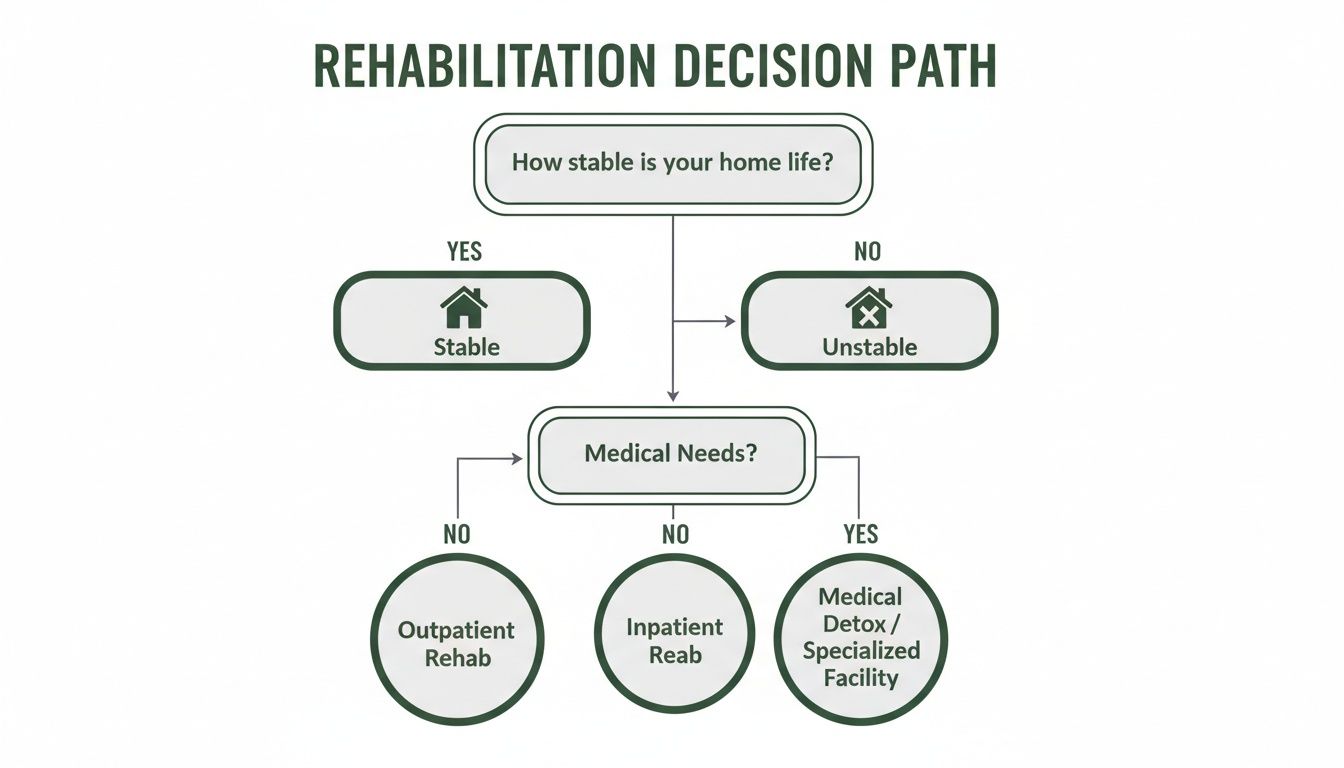
As the flowchart shows, an unstable environment almost always points toward inpatient care. But if your home life is solid, the door is wide open for powerful, effective outpatient options.
The Power Of Outpatient Programs
While inpatient rehab provides an indispensable service for those who truly need it, it's crucial to recognize that outpatient treatment is an incredibly powerful—and often preferred—path to recovery. The national data on this is clear and compelling.
Outpatient rehab is, by far, the most common form of addiction treatment in the United States. In fact, after being discharged from a hospital for substance use, 43% of patients chose outpatient services, while only 9% went to short-term residential care. This preference is also reflected in what's available; 82% of all treatment facilities offer some level of outpatient care, like a Partial Hospitalization Program (PHP) or an Intensive Outpatient Program (IOP).
This isn't just about accessibility. The results speak for themselves. Studies show that 85-95% of people who complete rehab are still drug-free nine months later, highlighting just how central outpatient care is to modern recovery.
The goal isn't just to get sober inside a facility; it's to stay sober in the real world. Outpatient care builds that bridge from day one.
Outpatient programs let you take the coping skills you learn in therapy and immediately put them to the test in real-world situations at work, at home, and in your community. This immediate application is what builds true resilience against triggers and helps you develop unshakable confidence in your sobriety. To get a better feel for how these programs offer both structure and flexibility, you can learn more about what a PHP rehab program entails.
Figuring out the right level of care can feel overwhelming, but you absolutely do not have to do it alone. A confidential call with a treatment professional can provide the clarity you're looking for. Call us at (888) 388-8660 for a free, no-obligation assessment to talk through your unique situation and find the best path forward for you here in Massachusetts.
Comparing Clinical Services And Therapeutic Methods
When you’re weighing inpatient vs. outpatient rehab, it’s easy to get caught up in the setting, but the real engine of recovery is the clinical care you receive. While both approaches often share the same evidence-based foundations, the way those therapies are delivered and applied can be night and day.
The core difference isn't just what's on the menu, but the intensity, the context, and how quickly you get to put new skills to the test in the real world.
Both inpatient and outpatient programs are built around proven, effective methods. These are the pillars of addiction treatment, whether you’re living at a facility or attending a local program in Massachusetts.
- Cognitive Behavioral Therapy (CBT): This is a cornerstone of treatment. It’s all about helping you identify and rewire the destructive thought patterns and behaviors that keep addiction going.
- Group Counseling: There's immense power in sharing your story with others who just get it. In a professionally led group, you build a community, break through isolation, and gain fresh perspectives on the challenges of recovery.
- Family Therapy: Addiction never happens in a vacuum; it pulls the whole family into its orbit. These sessions are designed to heal broken trust, improve communication, and help build a supportive home environment that can sustain long-term recovery.
But how these services fit into your life is where the paths diverge dramatically.
The Advantage of Real-World Application
The most powerful distinction for outpatient care is the immediate feedback loop between therapy and life. In an inpatient setting, you learn crucial coping skills inside a protected bubble. It’s effective, but the real test doesn’t begin until you walk out the door.
With an outpatient program, there’s no gap. You can talk about a trigger at work during your morning group session and then apply the exact relapse prevention strategy you just learned that very same afternoon. This daily practice of navigating real-world stressors with new tools builds an incredibly durable kind of recovery.
This isn't just theory—it's active, real-time recovery. Outpatient care uniquely transforms your daily environment into a training ground for sobriety, where every small victory reinforces your progress.
Specialized Services on a Flexible Schedule
Modern outpatient centers in Massachusetts have evolved far beyond simple weekly group meetings. They've become sophisticated clinical hubs, offering advanced treatments that were once almost exclusively found in residential facilities. This shift is making high-level care more accessible than ever.
Today's specialized outpatient centers are fully equipped to provide:
- Dual Diagnosis Psychiatry: For the many individuals whose substance use is tangled up with mental health conditions like anxiety, depression, or PTSD, this integrated care is a game-changer.
- Advanced Therapies: Modalities like Eye Movement Desensitization and Reprocessing (EMDR) for trauma are now available on a flexible schedule. This allows people to heal deep-seated issues without having to put their entire lives on hold.
- Medication-Assisted Treatment (MAT): Combining medications like buprenorphine or naltrexone with counseling is now a critical part of modern addiction care, and it’s seamlessly integrated into outpatient models.
The global addiction rehab market, projected to hit $20.93 billion by 2025, is surging because of this move toward more personalized, accessible care. Outpatient programs are leading the charge, with 76% of U.S. facilities offering standard outpatient services and 36% providing MAT. This growth is especially vital for the 3.8% of U.S. adults battling both addiction and a co-occurring mental illness, who can now get advanced therapies without a lengthy hospital stay. Paramount Recovery Centers embodies this model, offering gender-responsive programs licensed by BSAS to deliver this exact level of care. To learn more, you can read the full research about the addiction rehab market.
Integrating Medication-Assisted Treatment (MAT)
MAT is a powerful tool for treating opioid and alcohol use disorders, but it’s a marathon, not a sprint. This is where outpatient settings really excel. They are perfectly structured for the ongoing appointments, medication monitoring, and counseling that successful MAT requires.
Patients can see their providers, get their medication, and attend therapy without having to live at a facility for months. This sustained, integrated support makes MAT a practical and sustainable part of a long-term recovery plan—one that truly fits into a person's life.
For a confidential assessment of your clinical needs, call (888) 388-8660 to speak with our team. We can help you figure out if our specialized outpatient services in Massachusetts are the right fit for you.
Navigating Costs And Insurance In Massachusetts
Let's be honest: the financial side of treatment is a huge worry for most families in Massachusetts. Figuring out the costs of inpatient versus outpatient drug rehab is a critical step, but it doesn't have to be overwhelming. While there's a significant price difference between these two paths, it's directly tied to the level of care and services you receive.
Inpatient rehab is, without a doubt, the more expensive option, and for good reason. The price covers 24/7 medical supervision and clinical staffing, housing, meals, and a completely immersive therapeutic environment. This all-inclusive structure provides a necessary sanctuary for those who need intensive, round-the-clock support.
The Value Of Outpatient Care
Outpatient programs, like Partial Hospitalization (PHP) and Intensive Outpatient (IOP), offer a more affordable clinical solution. Because you live at home, you automatically eliminate the high costs of residential housing and constant staffing. This makes top-tier, evidence-based treatment accessible to far more people.
It’s a common myth that a lower price tag equals lower-quality care. The reality is that outpatient treatment is a powerful and often preferred path, delivering the same core therapies as inpatient programs but with the huge advantage of applying what you learn in the real world, in real time.
The most valuable investment is in the program that aligns with your specific clinical needs and life situation, ensuring the best chance for sustained recovery.
Verifying Your Insurance Benefits
Insurance can feel like a maze, but most major plans in Massachusetts cover substance use disorder treatment as an essential health benefit. The trick is to find out exactly what your specific policy covers for different levels of care.
To get the ball rolling, here’s what to do:
- Call Your Provider: Find the member services number on the back of your insurance card and give them a call.
- Ask Specific Questions: Don't be vague. Inquire about your coverage for "Partial Hospitalization Programs (PHP)" and "Intensive Outpatient Programs (IOP)."
- Confirm Details: Make sure to ask about your deductible, copay, and any out-of-pocket maximums so there are no surprises.
This whole process can be a headache, but you don't have to tackle it alone. The team at Paramount Recovery Centers is here to help. We accept most major insurance plans and are experts at verifying benefits and explaining your coverage in clear, simple terms. For a deeper dive into this, check out our guide that answers the question, does insurance cover drug rehab?
For immediate, confidential help with your insurance questions, just call our team at (888) 388-8660. We’ll work directly with your provider to maximize your benefits and minimize your out-of-pocket costs, making your path to recovery as smooth as possible.
Your Next Steps With Paramount Recovery Centers
Deciding to get help is the single most important step you can take. The next is finding the right people to walk alongside you on that journey. At Paramount Recovery Centers, our job is to provide a clear, supportive path forward, whether you’re just starting to explore recovery or need to transition from a higher level of care. We know the choice between inpatient and outpatient rehab can feel overwhelming, and we’re here to bring clarity and direction to that decision.
The best place to start is with a simple, completely confidential conversation. Our team is here to listen to your story, understand your specific challenges, and help you figure out which level of care makes the most sense for you. We believe in giving you all the information you need to make a confident choice for yourself or your family member.

Our Full Continuum Of Outpatient Care
Here in Massachusetts, Paramount Recovery Centers specializes in providing top-tier outpatient services. Our programs are built to deliver intensive clinical support while still allowing you to stay connected to your work, family, and community. We offer:
- Day Treatment (PHP): This program provides the structure of a full-day treatment schedule while you live at home, offering a very high level of support.
- Intensive Outpatient (IOP): Our IOP offers powerful group and individual therapy for several hours a day, a few days a week, often with flexible schedules that can work around your life.
If an initial assessment shows that you need medical detox or a 24/7 inpatient program first, we’ll handle it. We coordinate directly with our trusted partners to make sure your transition is seamless. Our number one goal is getting you to the right level of care, even if that means starting somewhere else.
Recovery is absolutely possible, and you don’t have to figure it all out on your own. Call our 24/7 helpline at (888) 388-8660 for a free, totally confidential assessment with our expert team. Let us help you take that next step toward a healthier, more fulfilling life.
Frequently Asked Questions
Sorting through the details of addiction treatment can feel overwhelming, and it's natural to have questions. Here in Massachusetts, we talk to people and their families every day who have practical concerns about how rehab will actually fit into their lives. Here are straightforward answers to the questions we hear most often.
Can I still work while in outpatient rehab?
Yes, absolutely. This is one of the main reasons people choose outpatient treatment. Programs like PHP and IOP are intentionally designed with morning or evening schedules so you can keep your job, go to school, and be there for your family while getting the clinical care you need. We'll work directly with you to build a schedule that supports both your recovery and your responsibilities.
Is inpatient rehab more effective than outpatient?
Effectiveness depends entirely on the individual's needs, not the program type. Inpatient rehab is critical for someone with a severe addiction, an unsafe home life, or who needs 24/7 medical supervision. However, studies show that outpatient rehab has excellent long-term success rates, largely because it allows you to practice recovery skills in your real-world environment from day one. The best program is the one that is correctly matched to the person's clinical needs.
Which is better for a dual diagnosis?
Both settings can effectively treat a dual diagnosis. The choice depends on the severity of the conditions. Inpatient facilities provide constant supervision, which is essential for acute psychiatric symptoms. However, specialized outpatient centers in Massachusetts are fully equipped to manage dual diagnosis with integrated psychiatry, medication management, and advanced therapies. A professional clinical assessment is the only way to determine the safest and most effective setting.
How do I find out if my insurance covers rehab in Massachusetts?
While most major insurance plans are required to cover substance use treatment, the specifics of what they cover for inpatient versus outpatient care can vary widely. The easiest way to get a clear answer is to call our admissions team for a free, confidential insurance verification. We'll contact your provider directly to clarify your benefits and help minimize your out-of-pocket costs. Call us at (888) 388-8660 to get started.


