



Navigating the complexities of insurance to pay for drug rehabilitation can be overwhelming, but it's often the most critical first step toward recovery. For residents of Massachusetts, understanding your rights and how your specific plan works is key to unlocking the life-saving treatment you or your loved one deserves. This guide breaks down exactly what you need to know about using your insurance to cover the cost of rehab.
Key Takeaways
- Coverage is Legally Required: Federal laws like the ACA and MHPAEA mandate that most health insurance plans, including those in Massachusetts, must cover addiction treatment as an essential health benefit. They cannot impose stricter limits on this care than they do for physical health conditions.
- Your Specific Plan Determines Costs: While coverage is required, your out-of-pocket expenses depend on your plan's details—your deductible, copayments, coinsurance, and whether you use an in-network or out-of-network provider. MassHealth, private insurance, and employer-sponsored plans all have different structures.
- Verification is Non-Negotiable: Before committing to a program, you must verify your benefits with your insurance provider. This step confirms which levels of care (like detox, inpatient, or outpatient) are covered and prevents unexpected, costly bills down the line.
- You Have the Right to Appeal a Denial: If your insurance company denies coverage, it is not the end of the road. You have the right to an internal appeal and an external review. A denial is often a procedural hurdle, not a final decision.
Your Guide to Insurance for Drug Rehab in Massachusetts
Trying to find the right addiction treatment is hard enough. Piling on the stress of deciphering insurance jargon can feel completely overwhelming. This guide is here to cut through the confusion, give clear answers to Massachusetts families, and show you that getting coverage isn't just a possibility—it's your right.
Understanding your benefits is a huge first step on the road to recovery. It’s empowering.

Navigating insurance is often the first major hurdle for families seeking help. Understanding that legal protections are in place can provide the confidence needed to advocate for comprehensive care and begin the path to lasting recovery.
While these laws have been game-changers, coverage gaps definitely still exist. Before these reforms, a huge number of adults who needed treatment simply didn't have insurance. Data shows the ACA's Medicaid expansion did a great job increasing insurance coverage for patients in SUD treatment, but just having a card in your wallet doesn't always mean you get immediate, hassle-free care.
Why Your Insurance Plan Is Required to Cover Rehab
Knowing your rights is a powerful first step. If you're wrestling with the question, "does insurance cover drug rehab?" the answer is, for the most part, yes. This isn't just a courtesy from insurance companies; it's a requirement baked into two landmark federal laws.
Think of it this way: your insurance has to treat addiction with the same level of importance as physical conditions like heart disease or diabetes. They can't just invent a separate, stricter set of rules or slap on higher costs because the illness is a substance use disorder. This legal backstop ensures you have a fair chance at getting the care you need.
These protections apply to the vast majority of plans out there, including private insurance policies, plans you get through your job, and vital Massachusetts programs like MassHealth. Realizing that coverage isn't just a possibility—it's your right—can give you the confidence to start the treatment process.
Your Rights Under Federal Law
Two major pieces of legislation are the bedrock of your right to treatment coverage:
- The Mental Health Parity and Addiction Equity Act (MHPAEA): This is the big one. It's the law that mandates equal coverage. It stops group health plans from putting up roadblocks for mental health or substance use disorder benefits that are tougher than the ones for medical or surgical benefits.
- The Affordable Care Act (ACA): The ACA took this a step further by officially classifying mental and substance use disorder services as one of the ten essential health benefits. This means pretty much any individual or small group plan sold on the marketplace has to cover addiction treatment.
Working together, these laws make sure that things like visit limits, deductibles, and prior authorization rules for rehab are on par with what you'd expect for any other kind of medical care.

The Reality of Getting Coverage
While having these laws on the books is incredibly important, getting an insurer to follow through isn't always a walk in the park. Companies might still throw up administrative hurdles or deny care based on their own narrow definition of what's "medically necessary." This is where you have to be ready to stand your ground.
Despite the legal mandate for parity, a gap often exists between the law and how insurance companies operate. For instance, a study showed that from 1986 to 2014, while insurance payments for general mental health care grew, payments for substance use disorder treatment stayed almost flat. This often translates to insurers pushing back on long-term care and creating delays—a critical problem when more than 103,000 overdose deaths happened in the U.S. in a single year. You can discover more about the disparities in insurance spending for addiction treatment and see just how vital it is to understand your rights.
The law is on your side, but you might need to become a strong advocate for yourself or your loved one. A denial isn't the final word; it's often just the start of a conversation that can lead to getting the necessary coverage approved.
Don't let the fear of an insurance battle stop you from seeking help. The protections are there, and so are people who can help you navigate the system. Call us at (888) 388-8660—our team can help you make sense of your rights and verify your benefits right away.
Navigating Rehab Coverage with Massachusetts Insurance Plans
Trying to figure out "does insurance cover drug rehab?" can feel like a maze, and the answer almost always comes down to your specific plan. Here in Massachusetts, the type of insurance you have—whether it's from your job, the state, or the federal government—really dictates the rules of the road. Each one has its own network of providers, costs, and hoops you might need to jump through.
The absolute key to getting the care you need is understanding your policy. Let's walk through the most common types of insurance in the Bay State so you have a much clearer picture of what to expect.

Private and Employer-Sponsored Insurance
A lot of people in Massachusetts get their health insurance either through their job or by purchasing a plan on the Health Connector marketplace. These private plans, from big names like Blue Cross Blue Shield of MA, Tufts Health Plan, or Harvard Pilgrim Health Care, usually offer solid coverage for addiction treatment.
These plans generally fall into two categories:
- HMO (Health Maintenance Organization): With an HMO, you have to stick with doctors and facilities inside their network. You'll also typically need a referral from your primary care physician (PCP) to see a specialist, and that includes addiction treatment centers.
- PPO (Preferred Provider Organization): PPOs give you a lot more freedom. You can see providers both in and out of the network without needing a referral. The catch? Your out-of-pocket costs will be much, much lower if you stay in-network.
Think of your deductible as the amount you have to pay yourself before your insurance company starts chipping in. If you have a $1,000 deductible, you're responsible for the first $1,000 of your medical bills. After you hit that, you'll usually just pay a copayment (a flat fee, like $40 for a therapy session) or coinsurance (a percentage of the total cost).
MassHealth and Medicare Coverage
For those who qualify, state and federal programs are an essential lifeline for covering drug and alcohol rehab.
MassHealth (Massachusetts Medicaid)
MassHealth is a critical resource for lower-income individuals and families across Massachusetts, offering comprehensive coverage for substance use disorder treatment. Thanks to federal parity laws, MassHealth is required to cover essential services, including:
- Medically monitored detox
- Inpatient and residential programs
- Outpatient care like PHP and IOP
- Medication-assisted treatment (MAT)
- Individual and group therapy
The whole point of MassHealth is to remove the financial roadblocks to getting necessary healthcare. When it comes to addiction treatment, this means providing access to the full spectrum of care so that cost never has to be the reason someone can't get help.
Medicare
Medicare is the federal health insurance program mainly for people 65 and older, as well as for some younger individuals with disabilities. Its coverage for rehab is broken down into a few parts:
- Medicare Part A (Hospital Insurance): This is what typically covers inpatient hospital stays, which would include medically necessary inpatient rehab or detox services.
- Medicare Part B (Medical Insurance): Part B handles your outpatient needs, like appointments with a therapist, outpatient rehab programs, and fees for doctors' services while you're in an inpatient facility.
Getting a handle on the financial side of treatment is a big piece of the puzzle, and it often goes beyond just your insurance card. For a deeper look into the different ways people cover the cost of care, check out our guide on how people pay for alcohol rehab in Massachusetts.
No matter what kind of plan you have, the single most important thing you can do is confirm your specific benefits. Insurance is confusing, but you don't have to sort through it all by yourself. Our admissions team deals with every type of Massachusetts insurance provider day in and day out.
We can verify your benefits for you, break down what’s covered in plain English, and walk you through any potential out-of-pocket costs. This is a completely free and confidential service that takes the guesswork out of the equation so you can focus on what really matters—getting help.
Ready for some clear answers? Give us a call at (888) 388-8660 today for a free insurance verification.
Decoding the Levels of Care Covered by Insurance
When you hear the word "rehab," what comes to mind? For many, it’s a single image of a residential facility. But addiction treatment isn't a one-size-fits-all solution; it's a whole spectrum of care with different levels of intensity.
Insurance companies look at it the same way. They categorize treatment to figure out what's "medically necessary" for someone's unique situation. Understanding these levels is the key to knowing what your plan will likely approve and pay for.
Think of it like treating any other illness. A small cut might just need a bandage at home, but a serious injury requires a full hospital stay. Addiction treatment is matched to the severity of your needs, offering different amounts of structure and medical oversight along the way. Let's break down what these levels actually look like in Massachusetts.
From Medical Detox to Residential Stays
For most people, the recovery journey starts by getting through the physical part of withdrawal. This is where the most intensive—and most structured—levels of care come into play.
- Medically Supervised Detox: This is the highest level of care, and it’s all about safely managing withdrawal symptoms in a secure, medically staffed facility. Because unmanaged withdrawal can be dangerous and even life-threatening, insurance companies almost always cover detox when a doctor or clinical professional says it's necessary.
- Inpatient or Residential Treatment: Once detox is complete, many people step into an inpatient program. This is what most people picture when they think of rehab—you live at the facility 24/7, following a highly structured schedule of therapy, counseling, and group activities. Insurers typically cover this when someone needs constant support to stay sober and prevent relapse.
Coverage for these high-intensity programs almost always requires prior authorization. This just means the treatment center has to get a green light from your insurance company before you're admitted. They'll need to show that a less intensive program wouldn't be safe or effective for you right now.
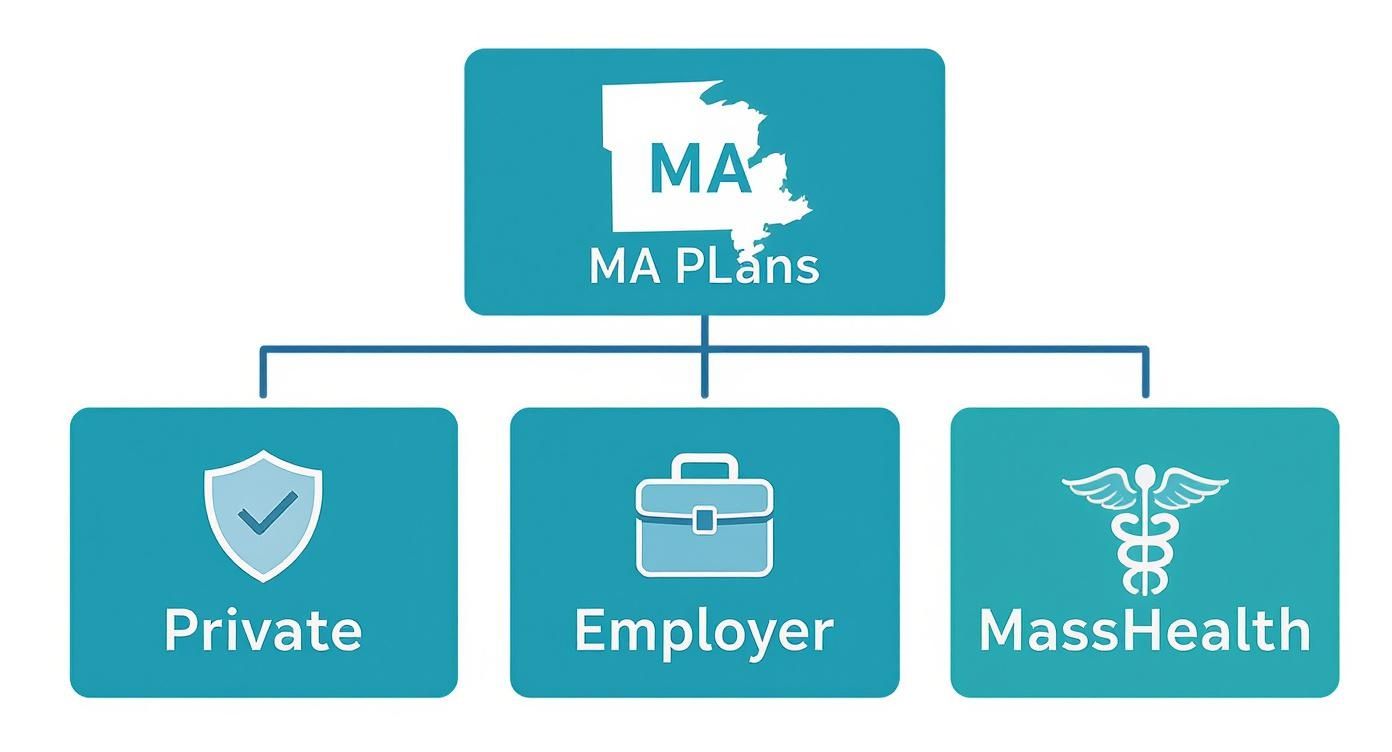
Whether your plan is private, through work, or MassHealth, it will offer a path to treatment. The main differences will be in the network of providers you can see and what your out-of-pocket costs look like.
Stepping Down to Outpatient Programs
As you get more stable in your recovery, you can "step down" to programs that give you more freedom while still providing a strong clinical safety net. Insurance companies often prefer these levels because they are effective and more cost-efficient.
- Partial Hospitalization Program (PHP): This is the most intensive type of outpatient care. You’ll attend treatment for several hours a day, five days a week, but you get to go home at night. It's the perfect bridge from residential care back to daily life.
- Intensive Outpatient Program (IOP): An IOP involves fewer hours per week than a PHP, usually meeting for a few hours a day, three to five days a week. This structure gives you the flexibility to start getting back to work, school, or family responsibilities while staying connected to treatment.
- Standard Outpatient Care: This is what most people think of as traditional therapy—regularly scheduled appointments with a therapist or counselor, maybe once or twice a week. It's the essential, ongoing support that helps you maintain sobriety for the long haul.
To give you a clearer picture, here’s a quick comparison of how these levels stack up.
Comparing Levels of Addiction Treatment Care
| Level of Care | Intensity and Environment | Typical Insurance Focus |
|---|---|---|
| Medical Detox | 24/7 medical supervision in a secure facility; highest intensity. | Focused on acute medical safety and stabilization during withdrawal. |
| Inpatient/Residential | Live-in program with around-the-clock structure and support. | For individuals needing a controlled environment to prevent immediate relapse. |
| PHP | 5-6 hours of treatment per day, 5 days a week; live at home. | A step-down from residential; requires significant daily commitment. |
| IOP | 3-4 hours of treatment per day, 3-5 days a week; live at home. | Balances structured therapy with reintegration into work, school, or family life. |
| Standard Outpatient | 1-2 therapy sessions per week. | Long-term maintenance, relapse prevention, and ongoing support. |
Each level plays a specific role in building a strong foundation for lasting recovery.
You can learn more about how these flexible yet structured outpatient options work in our detailed guide on outpatient drug rehab programs.
Figuring out which level of care is right for you can feel like a lot to handle, but you don't have to do it alone. A professional clinical assessment will pinpoint the best starting point for your needs. From there, our team can work directly with your insurer to get the approvals you need.
Just give us a call at (888) 388-8660 for a completely confidential consultation. We’re here to help.
How to Verify Your Insurance for Rehab in Three Steps
Knowing you have a right to coverage is one thing, but figuring out the nitty-gritty details of your specific plan is the next crucial step. This process, often called "benefits verification," is how you get a clear picture of what your insurance will actually pay for and what costs you'll be responsible for. It can feel like a daunting task, but breaking it down into a few manageable steps makes it much less intimidating.
This verification is your best defense against unexpected bills down the road. Sadly, there's a huge gap between the number of people who need treatment and those who actually get it. The United Nations found that out of 35 million people worldwide struggling with drug use disorders, only about one in seven receive any kind of treatment each year. A big reason for this gap is the sheer complexity of insurance, which really highlights why checking your benefits beforehand is so important. You can read the full UNODC report on global treatment gaps to learn more about these challenges.

Step 1: Gather Your Information
Before you do anything else, grab your health insurance card. You’ll need a few key pieces of information from it to get the ball rolling.
- Policy Number: This is the unique code that identifies your specific insurance plan.
- Group Number: If you’re covered through work, you'll have one of these as well.
- Member Services Phone Number: Usually found on the back of the card, this is your direct line to a representative who can help.
Step 2: Call Your Insurance Provider
Once you have your card, use that member services number to call your insurer. When you get a representative on the phone, let them know you need to verify your benefits for substance use disorder treatment. They'll ask for your policy and group numbers to pull up your plan details.
Step 3: Ask the Right Questions
This is where you need to get specific. Don’t be shy about asking for clarification or having the representative repeat something. You want to walk away from this call with total clarity.
Having a list of questions ready before you call can make the conversation so much less stressful. It helps you stay focused and ensures you get all the information you need in one go, so you can make confident decisions about your care.
Here are the essential questions to have on your list:
- What is my coverage for in-network medical detox and residential treatment here in Massachusetts?
- Do I need to get prior authorization before I can be admitted to a treatment program?
- What will my out-of-pocket costs look like? Specifically, what are my deductible, copayments, and coinsurance?
- What is my annual out-of-pocket maximum?
A Simpler, Stress-Free Alternative
Let’s be honest—making that call can feel overwhelming, especially when you're already dealing with a crisis. The good news is, there’s a much easier way to get these answers without all the stress and guesswork.
Let our experienced admissions team handle it for you. We deal with Massachusetts insurance providers every day, so we know exactly what to ask to maximize your benefits and get you clear, accurate answers—fast. We offer a completely free and confidential insurance verification to take this burden off your shoulders. Our team is here to help you verify your insurance coverage for rehab today.
For immediate and confidential help, give us a call at (888) 388-8660. We're ready to make this first step toward recovery as simple as possible.
What to Do If Your Insurance Denies Rehab Coverage
Getting an insurance denial can feel like a punch to the gut. It’s a devastating blow, especially when you’ve finally made the decision to seek help. But it’s critical to understand one thing: a denial is almost never the final answer.
Think of it as the start of a negotiation, not a dead end. There are established pathways to challenge the decision, and with the right approach and a little persistence, you can often get that initial “no” overturned and secure the coverage you deserve.
Facing this hurdle is discouraging, but knowing your rights and what to do next is incredibly empowering. Most denials hinge on specific criteria that you can absolutely address through a formal appeals process.
Understanding and Overcoming a Denial
First things first: you need to know exactly why they denied the claim. Your insurance company is required to give you a reason in writing. Often, you’ll see technical-sounding phrases like “lack of medical necessity.”
Don’t let that language intimidate you. All it really means is that, based on the paperwork they received, they don’t believe the level of care is justified. This is your cue to provide them with more evidence.
Working with your doctor or a treatment center like Paramount Recovery Centers, you can build a much stronger case. Together, you can gather the documentation to clearly demonstrate why rehab isn’t just a good idea—it’s medically essential for your health and safety.
A denial isn't a personal judgment on your need for help; it's a procedural roadblock from the insurance company. By following the appeals process and providing clear, compelling medical evidence, you can fight for the care you need.

The Appeals Process Step-by-Step
If your claim is denied, you have the right to appeal. The process usually happens in two main stages:
- Internal Appeal: Your first step is to file an appeal directly with the insurance company. This forces them to take a second look at their decision, this time with the new, stronger information you and your providers have supplied.
- External Review: If the insurance company still says no, you can take your case to an independent third party. An external review is conducted by a medical professional who has no connection to your insurer. Their decision is legally binding.
Here in Massachusetts, you have another powerful resource on your side. The Massachusetts Office of Patient Protection (OPP) is a state agency that helps people navigate the health insurance appeals process and makes sure your rights are protected.
This can all feel overwhelming, but you don't have to figure it out on your own. The team at Paramount Recovery Centers deals with insurance denials all the time. We know the system inside and out and can guide you through every single step of an appeal.
Don't let a piece of paper from an insurance company stop you from getting life-saving help. Call us at (888) 388-8660, and let our team help you fight for the coverage you’re entitled to.
Frequently Asked Questions
When you're trying to figure out insurance for rehab, a lot of practical questions come up fast. You're focused on getting help, not deciphering confusing industry jargon. We get it. This section cuts through the noise and gives you direct answers to the most common concerns we hear from families across Massachusetts.
Knowing what’s covered is one thing, but understanding the real-world details—like privacy or finding the right provider—is just as crucial. Here are the straightforward answers you need to move forward.

How do I find a rehab center that is in-network?
Finding a facility that accepts your insurance is the first major hurdle to making treatment affordable. Sticking with an in-network provider is key. Your insurance company has already negotiated rates with them, which means your out-of-pocket costs will be dramatically lower than with an out-of-network facility.
You really have two ways to go about this:
- Call Your Insurance Company: Flip over your insurance card, find the member services number, and give them a call. You can ask for a list of approved substance use disorder treatment centers in Massachusetts.
- Call the Treatment Center Directly: Honestly, this is the faster and easier route. When you call a center like Paramount Recovery Centers, our admissions team can take your insurance information and often verify if we’re in your network in just a few minutes. It saves you a phone call and lets you ask questions about our programs at the same time.
Will my employer find out if I use my insurance for rehab?
This is a huge—and completely understandable—fear for so many people. The short answer is no. Your privacy is protected by federal law.
The Health Insurance Portability and Accountability Act (HIPAA) is a strict set of national rules designed to protect your sensitive medical information.
HIPAA legally prevents your insurance company from telling your employer anything about your medical care, and that absolutely includes addiction treatment. Your recovery is your business, and the law makes sure it stays that way.
What happens if I lose my job during treatment?
The thought of losing your job while you're in rehab is incredibly stressful, but it doesn't have to derail your recovery. You have options to keep your health coverage.
Under a law called the Consolidated Omnibus Budget Reconciliation Act (COBRA), you can often continue your former employer's health plan for a limited time. The catch is that you'll have to pay the full premium yourself.
Losing your job is also what’s known as a "qualifying life event." This means you can enroll in a new plan through the Massachusetts Health Connector, and you may even qualify for MassHealth. The important thing is to act quickly to make sure you don't have a gap in coverage.
Does insurance cover sober living homes?
This is where things can get a little tricky. In most cases, insurance does not cover the cost of room and board—basically, the rent—for sober living homes. These homes are seen as a supportive housing service, not a direct clinical treatment, so the living expenses are usually paid out-of-pocket.
However, any clinical services you get while staying in a sober living facility may still be covered. For example, if you're attending an Intensive Outpatient Program (IOP) or seeing a therapist while you're there, your insurance plan will likely cover those specific treatment costs according to your benefits.
At Paramount Recovery Centers, we believe confusion over insurance should never stand in the way of getting help. Our team is here to give you clear answers, verify your benefits for you, and walk you through all of your options. Call us anytime at (888) 388-8660 for a free, completely confidential consultation.


