


Facing an alcohol use disorder (AUD) can feel like you’re navigating in the dark, but there's effective, evidence-based help right here in Massachusetts. Cognitive Behavioral Therapy, or CBT, is a practical, hands-on approach that has helped countless people break free from addiction and build a healthier life.
Instead of just talking endlessly about problems, CBT gives you the actual tools to change the thoughts and behaviors that keep the cycle of drinking going.
Key Takeaways
- What CBT Is and Why It Works: We'll break down the powerful connection between your thoughts, feelings, and actions—and how CBT helps you rewire that connection for good.
- The Practical Skills You'll Learn: Discover concrete techniques you can actually use, like challenging negative thought loops and building healthy coping strategies for real-life triggers.
- How CBT Fits Into a Full Recovery Plan: See how CBT works alongside other treatments to support your entire well-being, especially if you're also dealing with co-occurring mental health conditions.
- How to Find The Right Help in Massachusetts: Get clear, straightforward guidance on what treatment looks like and how to take that first, crucial step toward getting help.
Your Path to Recovery With CBT for Alcohol Use Disorder
When you're caught in the grip of alcohol use, it can feel like there's no way out. The path forward seems foggy at best, leaving you and your loved ones feeling drained and hopeless. But recovery isn't just possible—it's a real, structured journey that starts with getting to the root of what's driving the behavior. This is where CBT for alcohol use disorder provides a clear roadmap.

This therapy is all about equipping you with real-world skills to handle cravings, stress, and tough emotions without reaching for a drink. It's an active, collaborative process where you and your therapist work as a team. You become a partner in your own healing. You can get a much deeper understanding of what is cognitive behavioral therapy and how it works in our detailed guide.
Understanding How CBT Breaks the Cycle of Addiction
At its heart, Cognitive Behavioral Therapy works with a simple but profound truth: our thoughts, feelings, and behaviors are all tangled together. Imagine a triangle where each point connects to the others. A stressful thought like, “I can’t handle this pressure,” kicks off a negative feeling, like anxiety or dread. That feeling, in turn, often pushes us toward a behavior—like drinking to get some relief.
This sequence can quickly become an automatic, self-feeding loop that’s hard to see, let alone stop. CBT is about more than just "talk therapy"; it's a hands-on, goal-oriented process where you learn concrete skills to step in and break that cycle. You're not just passively listening to advice—you become an active force in your own recovery, armed with practical tools to make real change.
The Thought-Feeling-Behavior Connection
The core idea of CBT is that it’s not just the external events—a bad day at work, a fight at home—that dictate how we react. It’s our interpretation of those events that really drives our feelings and actions.
For someone struggling with alcohol, that pattern might look something like this:
- Triggering Event: Getting some tough feedback from a manager in a Boston office.
- Automatic Thought: "I'm a failure. I can never do anything right."
- Resulting Feeling: A sudden wave of shame, frustration, and hopelessness.
- Behavioral Response: Hitting a bar on the way home to numb those feelings with a drink.
This cycle feels so powerful because it often runs on autopilot. CBT shines a light on this process, showing you that the automatic thought is the real place to intervene. When you learn to challenge that first thought, you can change the entire outcome.
Why CBT Is a Gold Standard in Addiction Treatment
The power of CBT for alcohol use disorder isn’t just a theory; it's proven by decades of solid scientific research. It’s become a cornerstone of modern addiction treatment because it teaches tangible, lasting skills instead of just offering a temporary fix. In a way, it empowers you to become your own therapist over time.
Cognitive Behavioral Therapy has emerged as one of the most rigorously studied and effective treatments for Alcohol Use Disorder (AUD), a condition affecting over 280 million people worldwide. A landmark meta-analysis revealed that CBT delivers outcomes 15% to 26% better than untreated or minimally treated controls.
This makes it a crucial tool for cutting back on heavy drinking and building a foundation for long-term sobriety. In fact, other studies have shown that 58% of patients receiving CBT fared better than those in other comparison groups, which speaks volumes about its impact. You can explore the complete research on CBT's effectiveness and its statistical backing.
A Practical Framework for Lasting Change
Ultimately, CBT gives you a new way to manage your internal world, breaking the addiction cycle from the inside out. You learn how to spot high-risk situations, navigate cravings without giving in, and reframe the distorted thinking that fuels the urge to drink. It's a skill-based approach that builds resilience and confidence, showing you that you do have control over your reactions.
The therapy provides a clear, logical roadmap for recovery. It demystifies addiction by breaking it down into manageable parts—thoughts, feelings, and behaviors—and gives you a specific game plan for tackling each one. This practical method offers hope and a clear path forward, making lasting recovery a truly achievable goal.
Core CBT Techniques for Managing Alcohol Use
Knowing the theory behind CBT is one thing, but the real change happens when you start putting specific techniques into practice. This is where you shift from understanding why you drink to actively changing the behavior. Think of it less as a battle of willpower and more like building a reliable toolkit for handling real-life challenges.
These techniques are designed to be practical, giving you the power to step into the cycle of addiction at its most critical moments. You'll become an expert on your own patterns, learn to challenge the thoughts that push you toward drinking, and develop healthier ways to cope with life's inevitable stress.
Functional Analysis: Becoming a Detective of Your Own Behavior
One of the very first and most eye-opening techniques you'll learn is functional analysis. This is where you put on a detective hat and start investigating your own drinking habits. The goal isn't to judge, but to uncover the precise internal and external triggers that lead to drinking and to understand the consequences—both good and bad—that follow.
You and your therapist will work together to map out these chains of events, almost like creating a case file. For example, a functional analysis might lay out a pattern like this:
- Trigger: A stressful email from your boss lands in your inbox late on a Friday.
- Thought: "I can't handle this right now. I just need to check out and unwind."
- Feeling: Overwhelmed, anxious, and maybe a little resentful.
- Behavior: Making a detour to a bar in downtown Boston on the way home.
- Consequence: You get temporary relief from the stress, but it’s followed by guilt, a terrible night's sleep, and even more anxiety the next morning.
By laying it all out so clearly, you can pinpoint the exact moment where you can intervene with a new, healthier coping skill. It transforms a vague problem like, "I drink when I'm stressed," into a specific, solvable challenge.
Cognitive Restructuring: Changing Your Destructive Thoughts
Once you know your triggers, the next step is to tackle the automatic negative thoughts that ignite the urge to drink. This is the job of cognitive restructuring. It’s a methodical process of learning to catch, challenge, and ultimately change the distorted thinking that leads to self-sabotage.
So many of these thoughts happen so fast we don't even realize they're there. They might be "all-or-nothing" thoughts like, "I've already had one drink, so I might as well finish the bottle," or catastrophic thoughts like, "If I don't drink at this party, everyone will think I'm boring."
This is the fundamental cycle CBT works to interrupt—the direct line between our thoughts, feelings, and actions.
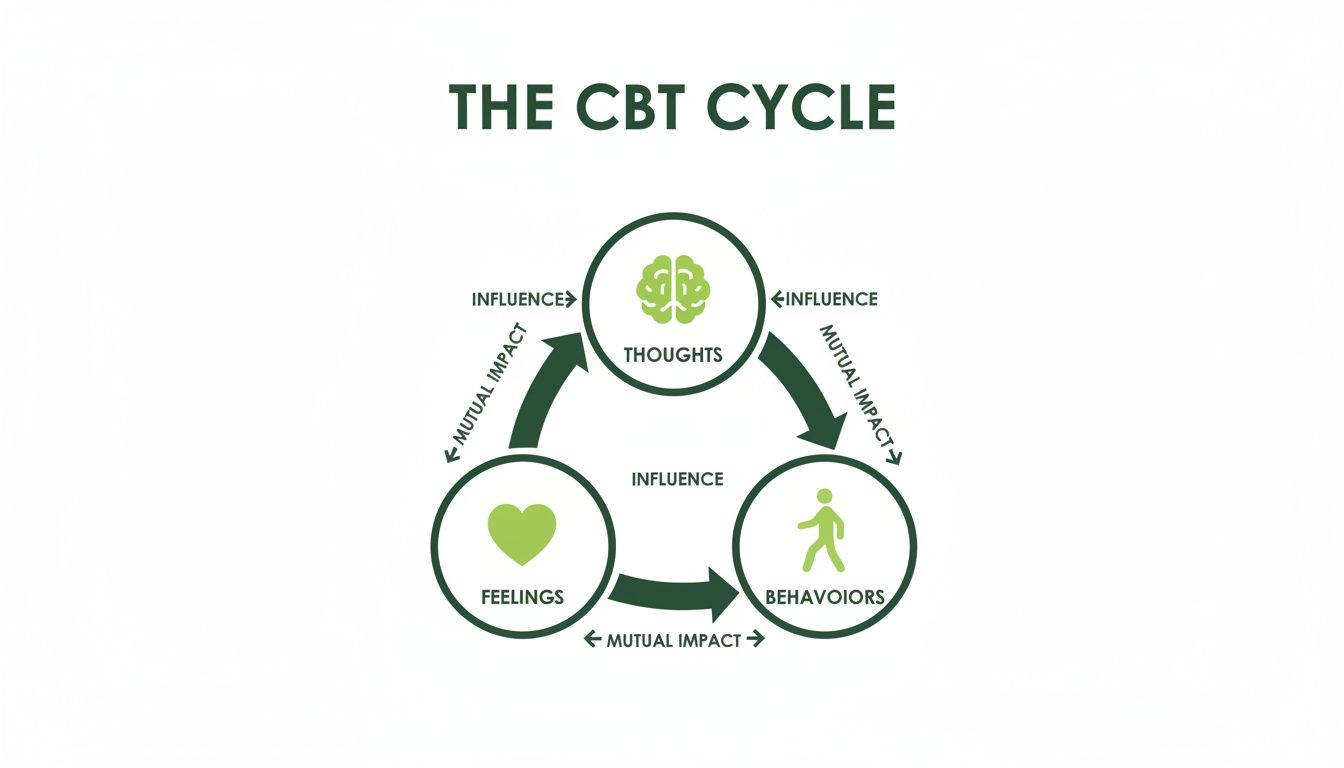
As you can see, by changing a single thought, you can completely alter the emotional and behavioral domino effect that follows. Cognitive restructuring gives you the power to consciously choose a more balanced and helpful thought, breaking the chain reaction that ends in drinking.
To make these concepts more concrete, here's how these powerful CBT techniques translate into real-world actions when you're facing a craving or a tough situation.
Practical CBT Techniques for Managing Alcohol Cravings
| Technique | Core Principle | Practical Example |
|---|---|---|
| Functional Analysis | Understand the A-B-C (Antecedent-Behavior-Consequence) of your drinking patterns to identify high-risk situations. | You notice you always crave a drink after a tense weekly meeting. Instead of focusing on the craving itself, you analyze the meeting as the trigger and plan a new post-meeting routine, like a walk or calling a friend. |
| Cognitive Restructuring | Identify, challenge, and reframe the automatic negative thoughts that justify or encourage drinking. | The thought "I need a drink to relax" pops up. You challenge it by asking, "Is that true? What are other ways I can relax? How did I feel last time I drank to relax?" You reframe it: "I'm feeling stressed. A walk will clear my head." |
| Coping Skills Training | Proactively build and practice healthy, alternative behaviors to use instead of drinking in response to triggers. | Before a wedding, you rehearse how you'll politely decline a drink. You plan to order a club soda with lime and identify a supportive person you can text if you feel overwhelmed. |
Mastering these skills means you’re not just reacting to cravings—you’re getting ahead of them with a solid, actionable plan.
Coping Skills Training: Building Your Resilience Toolbox
Finally, CBT arms you with a robust set of practical coping skills to navigate high-risk situations and manage cravings when they strike. This goes far beyond simple distraction; it's about having a concrete plan for what you will do instead of drinking. Your therapist will help you build a personalized "toolbox" of strategies that actually work for you.
This is especially crucial for navigating the social landscape in Massachusetts, whether it's a family cookout in Worcester or after-work drinks in the city.
Your coping skills toolbox might include:
- Stress Management Techniques: Learning things like deep breathing, mindfulness, or progressive muscle relaxation to physically calm your nervous system when anxiety spikes. Many of these are the same cognitive behavioral therapy techniques that help anxiety, which is why CBT is so effective for co-occurring disorders.
- Communication Skills: Role-playing how to politely but firmly turn down a drink or how to express your needs and feelings clearly without getting angry or shutting down.
- Activity Planning: Intentionally scheduling enjoyable, sober activities to fill the voids left by drinking. This helps you build a new life where alcohol isn't the go-to source of pleasure or relief.
By mastering these core techniques, you are not just stopping a behavior; you are fundamentally rewiring your brain’s response to stress, cravings, and emotional discomfort. This proactive, skills-based approach is what makes CBT for alcohol use disorder a lasting solution.
Instead of feeling powerless against your triggers, you become equipped, confident, and prepared to handle whatever comes your way. That sense of empowerment is the absolute key to building a sustainable, long-term recovery.
How CBT Integrates With Comprehensive Addiction Care
Lasting recovery from alcohol use disorder rarely happens with just one type of therapy. Instead, it’s built on a personalized plan where different treatments work together in harmony. Think of Cognitive Behavioral Therapy as the powerful engine in a high-performance car—it's incredibly effective on its own, but its true strength comes out when it's connected to the transmission, wheels, and steering.
When all the parts work together, you get a smooth, powerful system for healing.
This integrated approach makes sure that every part of your well-being is addressed, from your brain chemistry to your emotional health. For many people here in Massachusetts, that means combining the practical, psychological skills of CBT with other proven treatments.
Combining CBT with Medication-Assisted Treatment
One of the most effective pairings in modern addiction care is CBT with Medication-Assisted Treatment (MAT). In MAT, specific, FDA-approved medications are used to manage the intense physical side of recovery, like withdrawal symptoms and relentless alcohol cravings. This helps create a sense of physical stability, which is absolutely crucial for the deeper psychological work to begin.
When your body isn't in a constant battle with cravings, your mind is finally free to engage with therapy. This is where the real magic happens:
- MAT creates biological stability. Medications can quiet the "noise" of physical discomfort, giving you the mental space you need to focus.
- CBT provides psychological skills. With that newfound clarity, you can dive in and actually practice the cognitive restructuring and coping strategies that get to the root of your drinking.
This dual approach really sets you up for success. You can explore a deeper dive into what is medication-assisted treatment to see just how much it can support the recovery journey.
The Critical Role of CBT in Dual Diagnosis Treatment
Alcohol use disorder often doesn’t show up alone. It frequently co-occurs with mental health conditions like anxiety, depression, or PTSD—a situation we call a dual diagnosis. Trying to treat the drinking without addressing the underlying anxiety is like mopping up a flooded floor without bothering to fix the leaky pipe. You'll just be cleaning up the same mess tomorrow.
CBT is exceptionally well-suited for dual diagnosis care. Why? Because the very same techniques used to manage addictive behaviors are also highly effective for treating mood and anxiety disorders. Therapy helps you connect the dots, showing you how your depression might trigger the urge to drink, and how drinking, in turn, makes the depression worse.
By learning to challenge the negative thought patterns tied to both conditions, you can finally break the cycle where one feeds the other. This integrated treatment is absolutely essential for a recovery that sticks.
Building a Synergistic Recovery Plan
The power of CBT is magnified when it’s part of a complete, well-rounded care plan. Research backs this up time and time again. One comprehensive review confirmed that structured therapies like CBT significantly outperform minimal interventions, and their effectiveness is boosted when paired with other treatments.
Across 26 studies focusing on relapse prevention—a cornerstone of CBT—the results showed a clear and positive impact on helping people stay sober. The data is compelling, and you can read the full research about these findings for yourself.
An effective treatment plan recognizes that you are a whole person. It integrates CBT with medical support, family counseling, and other therapeutic modalities to create a support system that addresses your mind, body, and spirit.
A modern Massachusetts treatment center builds this kind of plan by tailoring it specifically to you. By combining the "how-to" skills of CBT for alcohol use disorder with medical and emotional support, you get the most robust foundation possible for building a healthy, sober life.
If you're ready to see what an integrated plan could look like for you, call (888) 388-8660 today for a confidential consultation.
What to Expect From Your CBT Journey in Massachusetts
Taking that first step toward recovery is often the hardest part. The idea of starting therapy for an alcohol use disorder can feel intimidating, even a little mysterious, but it doesn't have to be. Knowing what the journey actually looks like can demystify the experience and give you the confidence to move forward.
In Massachusetts, a quality treatment center will walk you through a clear, structured process designed to make you feel safe, heard, and supported from the very first call. Think of it as a collaborative journey where you are an active partner in your own healing.

Your Initial Confidential Assessment
Your path begins with a confidential assessment. This isn't a test or an interrogation; it's a conversation. A skilled clinical team will take the time to understand your unique history with alcohol, your personal struggles, your strengths, and what you hope to achieve.
This initial meeting is the foundation for everything that follows. Based on what they learn, the team will develop a personalized plan that uses CBT for alcohol use disorder to address your specific needs and challenges.
What a Typical CBT Session Looks Like
A CBT session is a goal-focused, collaborative meeting with your therapist. It's an active process where you'll work together to identify and solve problems. You won't just talk about issues; you'll develop concrete skills to manage them.
A session might involve:
- Checking In: Briefly talking about your week, including any roadblocks or wins.
- Setting an Agenda: Together, you and your therapist decide what to focus on during the session.
- Practicing Skills: You might work through a functional analysis of a recent craving or practice challenging a negative thought pattern.
- Planning for the Week: You'll map out a plan for how to apply these new skills in your daily life.
The structure of CBT ensures every session builds on the last, moving you steadily toward your recovery goals. The real magic happens when you practice these skills between sessions—that’s what makes the change stick.
Key Takeaway: Your CBT journey is a partnership. It’s a structured, skill-building process where you are actively involved in setting goals and learning the tools you need to achieve them. The focus is always on practical application in your real life.
The Growing Role of Digital CBT
Effective therapy is also expanding beyond the traditional office setting. Digital versions of CBT have become a powerful tool, sometimes even outperforming standard clinician-led methods. A study led by Yale found that participants using a web-based CBT program increased their days of abstinence by more than 50% over eight months. Completion rates also jumped to 63-65% for digital CBT, a huge leap from the 26% rate for typical outpatient care alone. Discover more insights about digital CBT for AUD.
How Family Can Support Your Recovery
Addiction doesn't just affect one person; it impacts the entire family. Recovery is almost always stronger when loved ones are part of the process. Many Massachusetts treatment programs offer family therapy and education to help create a robust support system at home. This teaches family members how to communicate more effectively, set healthy boundaries, and better understand the recovery journey.
By the end of this process, the path to getting help will feel clear and manageable. You can take the first step today by calling (888) 388-8660 for a completely confidential consultation to discuss your options.
Frequently Asked Questions
What makes CBT different from other therapies?
CBT is very goal-oriented and focuses on the here and now. While some therapies might spend a lot of time digging into your distant past, CBT gets right to work on identifying the current negative thought patterns and behaviors that are causing problems. The goal is to give you practical skills you can use to make changes right now.
How long does CBT for Alcohol Use Disorder typically take?
The duration of CBT for alcohol use disorder depends on your specific situation, like the severity of AUD and any co-occurring conditions. A typical course of treatment often lands somewhere between 12 to 20 weekly sessions. The goal is to ensure you have enough time to master the skills needed for long-term recovery, and a quality Massachusetts facility will tailor the plan to you.
Is CBT effective if I have relapsed before?
Absolutely. CBT is especially well-suited for people who have relapsed. The therapy treats relapse not as a failure, but as a crucial learning opportunity. It helps you analyze the triggers and thought patterns that led to the relapse, allowing you to build stronger, more effective coping strategies for the future.
How do I get started with CBT in Massachusetts?
The first step is a completely confidential conversation to figure out your specific needs. Look for a licensed therapist or an accredited treatment center that specializes in substance use disorders and CBT. Starting at a comprehensive center ensures you get integrated care. You can begin the process by calling (888) 388-8660 to speak with a specialist who can answer your questions and help you find the right treatment plan.
At Paramount Recovery Centers, we know how much courage it takes to ask for help. Our team of compassionate experts in Massachusetts is dedicated to providing evidence-based care, including CBT, to guide you toward a healthier, sober future. If you are ready to learn more or take the first step, call us anytime for a confidential consultation at (888) 388-8660 or visit us online at https://paramountrecoverycenters.com.


