



Cognitive Behavioral Therapy (CBT) is a practical, evidence-based form of psychotherapy that helps people identify and change destructive thinking patterns and behaviors. Unlike traditional therapy that may focus heavily on the past, CBT equips you with actionable skills to manage your thoughts, feelings, and actions in the here-and-now. For residents in Massachusetts seeking effective mental health or addiction treatment, understanding what CBT is and how it works is the first step toward lasting change.
Key Takeaways
- CBT Focuses on the Present: It is a goal-oriented therapy that provides practical skills to manage current problems by changing the unhelpful thinking and behaviors that fuel them.
- Thoughts, Feelings, and Behaviors are Linked: The core principle of CBT is that our thoughts directly influence our emotions and actions. By learning to challenge negative thoughts, we can change how we feel and act.
- Effective for Many Conditions: CBT is a leading, evidence-based treatment for a wide range of issues, including anxiety, depression, PTSD, and is a cornerstone of addiction recovery, especially for those with a dual diagnosis.
- Finding Local Help is Key: For those in Massachusetts, seeking a qualified therapist with specific training in CBT is crucial for successful treatment. Paramount Recovery Centers offers specialized CBT programs tailored to individual needs.
Cognitive Behavioral Therapy (CBT) is one of the most practical, well-researched forms of therapy out there. It’s not about endlessly digging into your past; it's about giving you real skills to manage your thoughts, feelings, and behaviors right here, right now.
The core idea is simple but powerful: it’s not events that upset us, but the way we think about them. Think about it—two people can go through the exact same situation and walk away with completely different feelings. CBT helps you understand your own unique reactions and gives you the tools to change the ones that aren't helping.
The Foundation of Cognitive Behavioral Therapy
At its heart, CBT is a partnership. You and your therapist work together like a team, focusing on the challenges you’re facing today and building a toolkit of strategies to navigate them. It’s less about just talking and more about doing.
You learn to become a detective of your own mind, spotting the unhelpful thought patterns that get you stuck. The goal is to break free from the automatic negative cycles that lead to anxiety, depression, or substance use and replace them with healthier, more balanced ways of thinking and acting.
Before we dive deeper, let's break down the essential pillars of this approach. These principles are the bedrock of every CBT session and technique.
Four Key Principles of CBT
Here's a quick summary of the core concepts behind Cognitive Behavioral Therapy and what they mean for your mental wellness journey.
| Key Principle | What It Means for You |
|---|---|
| Thoughts Influence Feelings | You'll learn to see how your automatic negative thoughts directly trigger painful emotions like anxiety, sadness, or anger. |
| It Is Action-Oriented | This is a hands-on therapy. You’ll practice new skills and strategies, often with "homework" to try between sessions. |
| Present-Focused | The main goal is to solve the problems you're facing today and improve your daily life, not just analyze the past. |
| It's a Collaborative Effort | You're an active participant. You and your therapist set clear, achievable goals together to guide your healing. |
These core ideas are what make CBT so effective and empowering.
CBT isn’t some new trend; it’s been refined since the 1960s and has become one of the most evidence-backed therapies available today. Its structured, goal-oriented nature is designed for lasting change. In fact, studies show that for depression, remission rates can hit approximately 61% right after treatment and keep climbing to 75% six months later. That shows just how durable these skills can be. You can find more details on these success rates at Crown Counseling.
Finding Help in Massachusetts
For anyone in Massachusetts struggling with issues like substance use, anxiety, or depression, understanding these principles is the first real step toward getting better. CBT offers a clear roadmap out of the destructive thought and behavior loops that keep people stuck.
By learning to challenge those unhelpful thoughts and try new behaviors, you can build a more resilient and fulfilling life. If you’re ready to learn practical skills for lasting mental wellness, we’re here to help.
Contact us at (888) 388-8660 to speak with a compassionate professional today.
How CBT Reshapes Your Thought Patterns
At the very heart of Cognitive Behavioral Therapy is a simple but incredibly powerful idea: your thoughts, feelings, and behaviors are all tangled up together. They're constantly influencing one another in a feedback loop. Grasping this cycle is the first real step toward breaking free from the patterns that keep you stuck. It's like someone finally hands you the user manual for your own mind.
Think about a common scenario, like getting ready for a big presentation at work. A thought just pops into your head, seemingly out of nowhere: "I'm going to totally bomb this, and everyone will think I'm an idiot." That single thought doesn't just stay a thought. It immediately kicks off a chain reaction.
Suddenly, you're feeling a knot of anxiety in your stomach (your feelings). This dread then leads you to put off practicing or maybe even over-rehearse until you're exhausted (your behaviors). This avoidance just reinforces the original belief that you're unprepared, making that negative loop even tighter the next time around.
This concept map, often called the "CBT Triangle," shows exactly how our thoughts, feelings, and actions are so deeply connected.
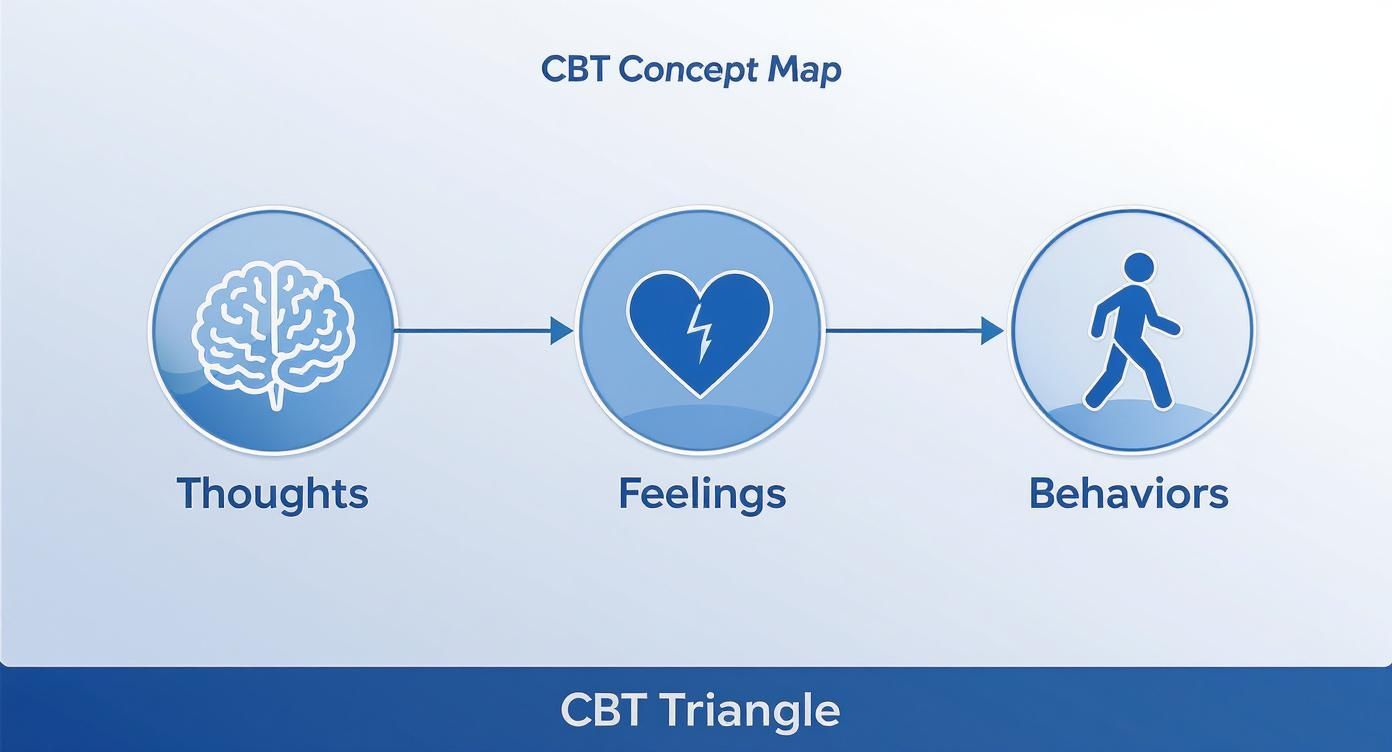
The big insight here is that you can jump in and disrupt the cycle at any point. While changing behaviors and managing feelings are both crucial, CBT often zeroes in on our thoughts first because they act as a powerful lever for creating change across the whole system.
The Role of Automatic Negative Thoughts
Those initial, knee-jerk thoughts have a name: Automatic Negative Thoughts (ANTs). They're called "automatic" for a reason—they surface instantly, without any conscious effort on your part. Most of the time, they're old, well-worn mental habits rooted in past experiences or deep-seated beliefs we have about ourselves.
CBT gives you the tools to press pause and actually look at these ANTs. The point isn't to slap a coat of fake "positive thinking" on top of them, which rarely works and often feels phony. Instead, the real work is in learning to be a detective—to examine the evidence for and against that automatic thought. This process helps you build a more balanced, realistic, and helpful perspective.
CBT isn’t about wearing rose-colored glasses or pretending problems don’t exist. It’s about learning to see situations for what they are, without the fog of distorted thinking, so you can respond in a way that actually helps.
Identifying Common Thinking Traps
After a while, ANTs start to fall into predictable ruts. We call these cognitive distortions, or "thinking traps." They're like funhouse mirrors for your mind, twisting reality just enough to make you feel worse than you need to. Just learning to spot them is a complete game-changer for most people.
Here are a handful of the most common thinking traps. See if any of these sound familiar:
- All-or-Nothing Thinking: You view everything in stark, black-and-white terms. If a project isn't a runaway success, you see it as a total failure. There's no middle ground.
- Mind Reading: You're absolutely convinced you know what someone else is thinking (and it's usually negative). You might assume a coworker is judging you without a shred of actual evidence.
- Catastrophizing: You jump straight to the worst-case scenario. You make one small mistake on a report and immediately conclude, "That's it, I'm getting fired."
- Personalization: You assume everything is about you. You take things personally that have nothing to do with you, or you blame yourself for external events completely outside your control.
Learning to catch these distortions as they happen in your day-to-day life is the critical first step toward challenging them. Especially in a high-pressure environment like we often experience here in Massachusetts, recognizing these mental shortcuts is an incredibly powerful way to manage stress and improve your overall well-being.
If these thought patterns feel all too familiar and are getting in the way of your life, please know that help is available. Contact our team at (888) 388-8660 to learn how we can help you build healthier habits of mind.
Practical Techniques You Will Learn in CBT
Understanding the link between your thoughts, feelings, and actions is one thing. Learning how to actively change those patterns is where the real work begins. Cognitive Behavioral Therapy isn't just a theory you talk about; it's a practical, hands-on approach that gives you a toolkit for dealing with real-world challenges.
Think of it like a workshop. You're not just discussing problems, you're learning mental and behavioral skills, almost like a carpenter learns to use a hammer or a saw. These techniques are meant to be practiced and woven into your daily life, giving you more say over your emotional state. The whole point is to shift from reacting automatically to mindfully choosing how you respond.

Cognitive Restructuring: Reshaping Your Thoughts
One of the absolute cornerstones of CBT is cognitive restructuring. This is where we learn to identify, challenge, and reframe the unhelpful thought patterns—those cognitive distortions we talked about earlier. It’s really a methodical way of fact-checking your automatic thoughts.
A go-to tool for this is the thought record. It’s a simple worksheet where you jot down a situation, the automatic thought that immediately came to mind, the feelings it triggered, and then you consciously work to find a more balanced and realistic viewpoint.
Let's say you made a mistake at work.
- Automatic Thought: "I'm going to get fired. I'm terrible at my job."
- Cognitive Restructuring: This is where you pause and look at the evidence. Have you been fired for a single mistake before? Is it more realistic that your boss will offer feedback so you can learn from it?
- Balanced Thought: "I made a mistake, and I feel disappointed. But one mistake doesn't define my entire performance, and this is an opportunity to improve."
This isn't about slapping on a coat of fake positivity. It’s about being accurate. By doing this repeatedly, you train your brain to stop leaping to worst-case scenarios and instead adopt a more helpful, grounded perspective. To dig deeper, you might want to check out these three CBT techniques that help with anxiety.
Behavioral Activation: Re-engaging with Your Life
When we're struggling with depression or anxiety, the natural instinct is often to pull back. We stop doing things we used to love, which just ends up fueling more feelings of sadness and isolation. Behavioral activation is a powerful technique designed to break that cycle by getting you to systematically re-engage with positive, rewarding activities.
The core idea behind behavioral activation is simple but incredibly profound: action can change your mood. Instead of waiting until you feel like doing something, you schedule and commit to activities that are likely to boost your mood, even if you have zero motivation at first.
This can start incredibly small. If just leaving the house feels like too much, a plan might begin with listening to a favorite album or stepping outside for five minutes. The focus is on building momentum and slowly re-introducing sources of pleasure and accomplishment into your life, one step at a time. This is especially helpful for our clients in Massachusetts who are rebuilding their routines in recovery.
Exposure Therapy: Facing Your Fears
For anxiety disorders, phobias, and PTSD, exposure therapy is one of the most effective tools we have. It involves gradually and safely confronting the thoughts, situations, and objects you fear. When done with a trained therapist, this process helps you learn that the terrible outcomes you're afraid of are actually very unlikely to happen.
We do this in a controlled, step-by-step way using an "exposure hierarchy." For someone with a fear of public speaking, it might look something like this:
- Step 1: Imagine giving a short presentation.
- Step 2: Record yourself speaking and listen to it.
- Step 3: Practice your talk in front of a mirror.
- Step 4: Give a brief presentation to a supportive friend or family member.
Through these repeated exposures, the anxiety response naturally starts to fade in a process called habituation. You’re teaching your brain that you can handle the distress and that the feeling of anxiety will eventually pass on its own.
These practical, learnable skills are precisely why CBT has become so trusted. In fact, the global cognitive behavioral therapy market was valued at around $9.0 billion and is projected to hit approximately $21.6 billion by 2031. This isn't surprising when you consider CBT's proven track record for conditions like depression, which affects more than 264 million people worldwide. You can explore more about these trends and CBT's expanding role in mental healthcare on BioSpace.com.
If you’re ready to learn these powerful skills for yourself, give us a call at (888) 388-8660.
Who Can CBT Help the Most?
Cognitive Behavioral Therapy is one of the most flexible and proven therapeutic approaches out there today. While it first made its name treating conditions like anxiety and depression, its practical, skills-first framework makes it a powerful tool for a surprisingly wide range of people and problems. It’s not just for those with a formal diagnosis; it’s for anyone who wants to build healthier mental habits.
Think of CBT as a kind of mental fitness training. Just like you'd go to a gym to strengthen your body, CBT helps you strengthen your mind. It makes you more resilient against stress, negative thought spirals, and behaviors that hold you back. This gives it an incredibly broad reach, from managing clinical disorders to simply improving day-to-day life.
A Cornerstone of Addiction and Dual Diagnosis Recovery
CBT is especially effective for people struggling with substance use disorders. Addiction is often locked in by a destructive cycle of thoughts and behaviors: a trigger sparks a craving (thought), which creates intense discomfort (feeling), leading to substance use (behavior). CBT gives you the tools to break this cycle at every single point.
In therapy, you learn to pinpoint your personal triggers—the people, places, and feelings that ignite the urge to use. More importantly, you build concrete coping skills to manage those cravings when they hit, dismantling the core belief that using is the only way to get relief. For those in Massachusetts facing a dual diagnosis, where a substance use disorder exists alongside a mental health condition like depression or PTSD, this approach is invaluable.
CBT helps you become the detective of your own mind, uncovering the thought patterns that keep you stuck. It empowers you to challenge the automatic justification, "I need this to cope," and replace it with healthier, more effective strategies for managing stress and difficult emotions.
Understanding this dynamic is a game-changer for long-term recovery. You can learn more about how this therapy builds a strong foundation for sobriety by reading our guide on how CBT helps individuals maintain sobriety.
Broad Applications for Mental Wellness
Beyond addiction, the list of challenges CBT can address is long. It's considered a first-line, evidence-based treatment for many conditions because it directly targets the underlying thought and behavior patterns that keep them going.
Below is a look at some of the common challenges people bring to therapy and how CBT offers a clear path forward.
Common Challenges Addressed by CBT
| Condition | How CBT Helps |
|---|---|
| Anxiety Disorders & Phobias | Teaches you to confront fears gradually and challenge the catastrophic thinking that fuels panic and worry. |
| Depression | Uses behavioral activation to re-engage with positive activities and cognitive restructuring to fight back against negative self-talk. |
| Post-Traumatic Stress Disorder (PTSD) | Helps you process traumatic memories and reframe distorted beliefs about safety, trust, and self-blame. |
| Eating Disorders | Addresses the unhealthy thought patterns related to body image, food, and control, while building healthier eating behaviors. |
| Sleep Disorders (Insomnia) | Helps correct the unhelpful thoughts and behaviors that prevent restful sleep, a specialized approach known as CBT-I. |
This table shows just how adaptable CBT is, offering specific strategies tailored to the unique structure of each challenge.
Everyday People Seeking Personal Growth
The best part? You don’t need a clinical diagnosis to get something out of CBT. Its principles are universal. Plenty of people come to therapy to work on common life challenges that get in the way of their happiness and success.
Think about these everyday situations where CBT skills can make all the difference:
- Managing workplace stress by learning to challenge perfectionistic thoughts and quiet impostor syndrome.
- Improving relationships by identifying and changing destructive patterns like blame or assuming you know what others are thinking.
- Overcoming procrastination by breaking the cycle of avoidance and the negative self-judgment that follows.
- Building self-esteem by learning to spot your strengths and counter your inner critic.
Ultimately, CBT gives anyone the practical skills to become a more mindful and effective manager of their own mind. If you're in Massachusetts and feel like unhelpful thought patterns are holding you back, we can help. Call us at (888) 388-8660 to learn more.
Your CBT Journey at Paramount Recovery Centers
Taking that first step toward therapy is a big deal, and it's natural to have a lot of questions about what actually happens. At Paramount Recovery Centers, we want to pull back the curtain and make the process as clear and supportive as possible, right from your very first phone call. Knowing what cognitive behavioral therapy looks like in practice can take the uncertainty out of the equation and build a solid foundation of trust for the work ahead.
Your path with us is a partnership, plain and simple. We don't just hand you a treatment plan; we walk alongside you. We'll build a personalized roadmap together that honors your unique story and what you want to achieve. From the initial assessment to your final session, every single step is designed to give you practical, real-world skills in a safe, non-judgmental space right here in Massachusetts.

Your First Steps with Us
Your journey starts with a confidential assessment. Think of this first meeting as a conversation, not an interrogation. It’s our opportunity to really hear what you're going through and your chance to see if we feel like the right team for you.
From there, we'll start setting clear, achievable goals together. Maybe you want to get a handle on anxiety, push back against substance cravings, or figure out healthier ways to connect with people. Whatever they are, these goals will become our guideposts, making sure every session stays focused and productive.
We believe the most effective therapy happens when you are an active, engaged partner in your own healing. Our role is to provide the tools, guidance, and support you need to build the life you want.
What to Expect in Your Sessions
CBT sessions are structured and interactive. This isn't the kind of talk therapy where you spend years digging into the distant past. Instead, we zero in on the here-and-now challenges that are affecting your daily life.
A typical session might involve checking in on your progress, learning a new skill or concept, and then making a plan for how you’ll practice it.
A huge part of this process is the work you do between sessions. This isn't boring homework; it's about taking the skills you’re learning and applying them in the real world. It could be something like keeping a thought record, intentionally scheduling a positive activity, or slowly facing a situation you've been avoiding. This is where therapy insights turn into lasting changes.
Our Team and Environment
Our team of licensed, compassionate therapists in Massachusetts are deeply trained in evidence-based practices like CBT. They are dedicated to creating a warm, supportive atmosphere where you can feel safe enough to be vulnerable and explore new ways of thinking and behaving.
We work hard to build an environment of respect and understanding, completely free from judgment. We know it takes a lot of courage to even make that first call, and we're committed to honoring your trust by providing the highest quality of care.
If you’re ready to start your journey and learn more about what is cognitive behavioral therapy, our team is here to help. Call us at (888) 388-8660 to take the first step.
How to Find a Qualified CBT Therapist in Massachusetts
Deciding to start therapy is a huge, empowering first step. But finding the right therapist—someone you click with and who has the right expertise—is what really sets you up for success. That process can feel a little overwhelming, so this guide breaks it down with some real-world advice to help you find a skilled Cognitive Behavioral Therapy provider here in Massachusetts.
Verify Credentials and Specialization
First things first, let's talk credentials. In Massachusetts, you’ll want to look for licenses like LICSW (Licensed Independent Clinical Social Worker) or LMHC (Licensed Mental Health Counselor). These aren't just letters after a name; they guarantee the therapist has met strict state requirements for education and supervised clinical experience.
But don't stop there. Go a level deeper and ask about their specific training in CBT. A lot of therapists might use some CBT techniques, but a true CBT specialist has often gone through dedicated certification programs. This distinction really matters because it points to a much deeper understanding of the specific methods that make CBT so effective.
Key Questions to Ask a Potential Therapist
Think of your first consultation as a two-way interview. It's your opportunity to see if the therapist’s style and approach align with your goals and personality. Don't be shy about asking direct questions—it’s the best way to get the information you need.
Here are four essential questions to have in your back pocket:
- What is your specific training and experience with CBT? This helps you understand if they just dabble in it or if it's a core part of their practice.
- How do you incorporate CBT into treating issues like mine? Ask them to give you some examples of how they might apply CBT principles to what you're dealing with, whether it's anxiety, substance use, or depression.
- What does a typical CBT session with you look like? Their answer should give you a sense of a structured, goal-oriented process where you work together to build skills.
- How do you measure progress? A good CBT therapist will collaborate with you to set clear, measurable goals and will regularly check in to see how you're moving toward them.
Finding a therapist you connect with is just as important as their qualifications. Trust your intuition—a strong therapeutic relationship is one of the best predictors of a successful outcome in therapy.
When you're ready to start this journey, know that specialized support is out there. For anyone facing the dual challenge of mental health and substance use issues, learning more about individual therapy in Massachusetts can offer a clearer path forward.
At Paramount Recovery Centers, our team is made up of licensed professionals who specialize in this kind of evidence-based care. We're here to answer your questions and help you take that next step. Give us a call today at (888) 388-8660 to connect with a qualified therapist.
Frequently Asked Questions About CBT
It’s completely normal to have a few questions as you explore cognitive behavioral therapy and figure out if it's the right fit. We get it. To help clear things up, here are some straightforward answers to the questions we hear most often.
How Is CBT Different from Other Types of Therapy?
The biggest difference is that CBT is highly structured and focuses on the present. While some traditional talk therapies might spend a lot of time exploring your past, CBT zeroes in on solving the problems you're facing right now. It's all about teaching you practical, hands-on skills to change your thinking and behavior in the here and now.
How Long Does CBT Treatment Usually Take?
One of the great things about CBT is that it’s designed to be a shorter-term therapy. The exact timeline is always shaped by your specific needs and goals, but a typical course of treatment runs somewhere between 12 and 20 sessions. The goal isn't endless therapy; it's to give you durable skills you can carry with you for the rest of your life.
Is CBT Covered by Insurance in Massachusetts?
Yes, most of the time. Because Cognitive Behavioral Therapy is such a well-established, evidence-based treatment, nearly all health insurance plans in Massachusetts cover it as part of their mental health benefits. That said, it’s always a smart move to call your insurance provider directly just to confirm the specifics of your plan.
Can CBT Be Done Effectively Through Telehealth?
Absolutely. A solid body of research shows that online CBT is just as effective as in-person therapy for many conditions. For a lot of people, the flexibility, privacy, and convenience of telehealth make it an ideal option.
In fact, digital health has completely changed how people access CBT. Online platforms and mobile apps now make up a huge part of the market, mostly because they’re so convenient for people who might have trouble getting to traditional therapy sessions. You can dig into some of the market data on these innovations over at Coherent Market Insights.
If you're ready to see how CBT can help you build a healthier, more fulfilling life, the compassionate team at Paramount Recovery Centers is here to guide you. Call us today at (888) 388-8660 to start your journey.


