



Motivational Enhancement Therapy (MET) is a client-centered, evidence-based approach designed to help you discover your own internal drive to make positive changes. Rather than a therapist telling you what to do, MET is a collaborative partnership that resolves uncertainty and strengthens your commitment to a healthier life. It’s particularly effective as a brief, powerful starting point for those feeling ambivalent about recovery.
Key Takeaways
- MET Focuses on Your ‘Why’: The core goal is to help you resolve your own mixed feelings (ambivalence) about change. It’s a gentle, supportive approach that helps you find your personal reasons to commit to recovery, making it an excellent first step.
- It’s a Brief and Powerful Intervention: MET is not a long-term therapy. It typically involves just 1-4 focused sessions designed to spark motivation and prepare you for the deeper work of recovery, such as Cognitive Behavioral Therapy (CBT).
- Therapists Are Collaborative Guides: In MET, the therapist acts as a partner, not an authority figure. They use specific techniques (OARS: Open-ended questions, Affirmations, Reflective listening, Summaries) to create a non-judgmental space where you feel heard and empowered.
- It’s an Evidence-Based Approach: MET is backed by extensive research, including landmark studies like Project MATCH. It has been proven effective for a wide range of substance use disorders and is a trusted part of comprehensive treatment plans in facilities across Massachusetts.
A Compassionate Approach to Finding Your ‘Why’
Have you ever felt completely stuck? You know you should change a habit or behavior, but you just don’t feel ready. That feeling of being pulled in two different directions at once has a name: ambivalence. It’s a totally normal part of being human, and it’s exactly what Motivational Enhancement Therapy is designed to address.
MET is built on the simple but powerful idea that real, lasting change has to come from within. The therapist isn’t there to act like an expert with all the answers. Instead, they become a partner. Their job is to help you explore your own values, your goals, and your personal reasons for wanting to shift gears. This entire process puts you in the driver’s seat, honoring your autonomy and empowering you to own your recovery journey. For many people in Massachusetts, this supportive, non-judgmental style is the perfect first step.

The Guiding Principles of MET
To really get what MET is about, it helps to understand the core principles that guide every single conversation. These aren’t rigid rules but a framework for building trust and motivation.
- Express Empathy: The therapist’s primary role is to listen—really listen—without judgment. This creates a safe, trusting space where you can be completely open and honest.
- Develop Discrepancy: The therapist helps you see the gap—the discrepancy—between where you are right now and where you want to be. It’s about connecting your current actions to your deeper personal values.
- Roll with Resistance: If you express hesitation or push back, a MET therapist won’t argue. Instead of confronting that resistance, they’ll explore it with curiosity, respecting that it’s a valid part of your process.
- Support Self-Efficacy: The whole approach is designed to build your confidence. The focus is always on your strengths and your ability to make a change, celebrating small wins along the way.
To give you a clearer picture, here’s a quick breakdown of these essential elements.
Core Components of Motivational Enhancement Therapy at a Glance
| Component | Description | Goal |
|---|---|---|
| Express Empathy | The therapist uses reflective listening to create a supportive, non-judgmental environment. | Build trust and rapport, making the client feel understood and safe. |
| Develop Discrepancy | The therapist helps the client identify the gap between their current behavior and their personal values and goals. | Highlight the personal costs of the current behavior to spark internal motivation for change. |
| Roll with Resistance | Instead of confronting resistance, the therapist explores the client’s mixed feelings and perspectives. | Avoid arguments and power struggles, respecting the client’s autonomy and readiness to change. |
| Support Self-Efficacy | The therapist builds the client’s confidence in their own ability to succeed. | Empower the client to believe that change is possible and that they are capable of achieving it. |
As you can see, every part of the process is geared toward empowering you, not directing you.
From Research to Real-World Results
The power of MET isn’t just theoretical; it’s backed by solid research. It first gained prominence in the 1990s as a more structured and brief adaptation of motivational interviewing. Its effectiveness was put to the test in a landmark study called Project MATCH.
This large-scale clinical trial was a game-changer. It found that MET, delivered in just four sessions, produced outcomes for alcohol use that were just as good as longer, more intensive therapies like Cognitive Behavioral Therapy (CBT). This study cemented MET’s reputation as a highly efficient and empirically supported therapy to kickstart the change process.
By meeting you where you are, MET helps you move through the various stages of change in addiction recovery at a pace that feels right for you. If you or a loved one in Massachusetts are feeling ambivalent about what to do next, this gentle yet potent therapy could be the key.
Give us a call at Paramount Recovery Centers at (888) 388-8660 for a completely confidential conversation. We’re here to help you find your “why.”
The Core Techniques That Power MET
Motivational Enhancement Therapy gets its gentle but powerful results from a specific set of conversational tools. These aren’t about directing you; they’re about guiding you to your own conclusions about making a change. The whole framework is easy to remember with the acronym OARS: Open-ended questions, Affirmations, Reflective listening, and Summaries.
Instead of a rigid script, OARS gives a therapist a flexible way to build a strong, collaborative partnership with you. Let’s look at what these techniques actually feel like in a real session, moving beyond dry definitions to see how they create an environment of trust and self-discovery.
Using Open-Ended Questions to Invite Exploration
The first tool, Open-ended questions, is the bedrock of the MET process. These are the kinds of questions that can’t be answered with a simple “yes” or “no.” They are genuine invitations to tell your story, share what you’re thinking, and explore your feelings without being boxed in.
A therapist won’t ask, “Do you want to stop drinking?” That’s a dead end. Instead, they might ask, “What are some of the things you enjoy about drinking, and what are some of the downsides you’ve noticed?” Another great one could be, “What might your life in Massachusetts look like in a year if you were to make this change?” This approach encourages you to think deeply and hear your own reasons for considering a new path.
Building Confidence with Affirmations
Next, therapists use Affirmations to recognize and highlight your strengths, efforts, and positive qualities. This isn’t about giving out empty praise. It’s about genuinely acknowledging the courage it takes to even consider making a huge life change.
For instance, a therapist might say, “It takes a lot of strength to be so honest about the challenges you’re facing. That shows you’re a very resilient person.” These statements build your self-confidence and reinforce the idea that you are absolutely capable of succeeding. Affirmations help shift the focus from past struggles to future potential, making that next step feel possible.
“MET is not about a therapist pushing for change, but about creating the conditions where a person’s own motivation can flourish. Affirming a client’s strengths is a key part of watering those seeds of change.”
Fostering Understanding Through Reflective Listening
Reflective listening is maybe the most important skill in MET. It’s where the therapist listens carefully to what you’re saying and then reflects it back, sometimes in a slightly new way. This does more than just show they’re paying attention; it proves they understand.
Imagine you say, “I’m just tired of letting everyone down.” A therapist using reflective listening might respond with, “So it sounds like your relationships are really important to you, and you’re worried your substance use is damaging them.” That simple act makes you feel truly heard and validated. It also helps clarify your own thoughts, letting you hear your own motivations spoken back to you.

By engaging in these guided conversations, you start to untangle complex feelings and zero in on what truly matters to you.
Tying It All Together with Summaries
Finally, Summaries are used throughout the session to pull together the key threads of the conversation. The therapist will periodically recap what’s been discussed, highlighting your own statements about wanting to change, your concerns, and any goals you’ve brought up.
This helps you see the bigger picture and recognize the progress you’re making in your own thinking. A summary might sound like this: “So, from what we’ve talked about, it seems like you really value your family and your health, but you’re also finding it hard to imagine life without alcohol. You’ve also mentioned a few ideas for taking a small step forward.” This reinforces your own “change talk” and strengthens your resolve.
These OARS techniques are deeply rooted in the foundational principles of motivational interviewing, creating a respectful and empowering therapeutic experience. If you’re ready to explore your own path to change, call Paramount Recovery Centers at (888) 388-8660 for a confidential conversation.
What to Expect During Your MET Sessions
Walking into a therapy session for the first time can feel like a big unknown. That’s why Motivational Enhancement Therapy is designed to be a clear, focused, and surprisingly brief experience. The whole process typically lasts just a few sessions, and it’s built around collaboration—making the idea of change feel less like a mountain to climb and more like a path you can actually walk.
Let’s pull back the curtain and see what a typical course of MET might look like for someone right here in Massachusetts.
Imagine feeling stuck, knowing deep down you need to address your substance use but feeling completely torn about it. Your journey wouldn’t start with a lecture or a list of rules. It starts with a conversation.
Your First Session: Building a Partnership
The first session is all about building trust and getting to know your side of the story. Your therapist’s main job here is simply to listen. They want to hear what’s going on, in your own words, without passing judgment. There’s zero pressure to commit to making a change right then and there; the goal is to build a real connection.
You’ll probably go over some feedback from an initial assessment you completed. Think of this less like a test and more like a helpful snapshot of where things are right now. It gives you and your therapist some objective information to explore together in a way that feels safe, respectful, and empathetic from the get-go.
Later Sessions: Exploring Change and Creating a Plan
As you move into the next few sessions, the conversation gently shifts. Your therapist will help you explore the pros and cons of changing your habits, fully acknowledging and respecting any mixed feelings you have. This is where a core MET idea called developing discrepancy comes into play.
Developing discrepancy is the process of helping you see the gap between where you are now and where you truly want to be. It’s not about pointing out what’s wrong; it’s about shining a light on your own values and goals so you can find your own motivation.
Think of your therapist as a guide. They help you connect your day-to-day actions with what actually matters most to you. For instance, if being a dependable parent is one of your core values, the therapist might help you explore how your substance use fits—or doesn’t fit—with that value. It’s this internal tension that often sparks the real desire to change.
To guide these conversations, therapists use a set of powerful but gentle techniques known as OARS.
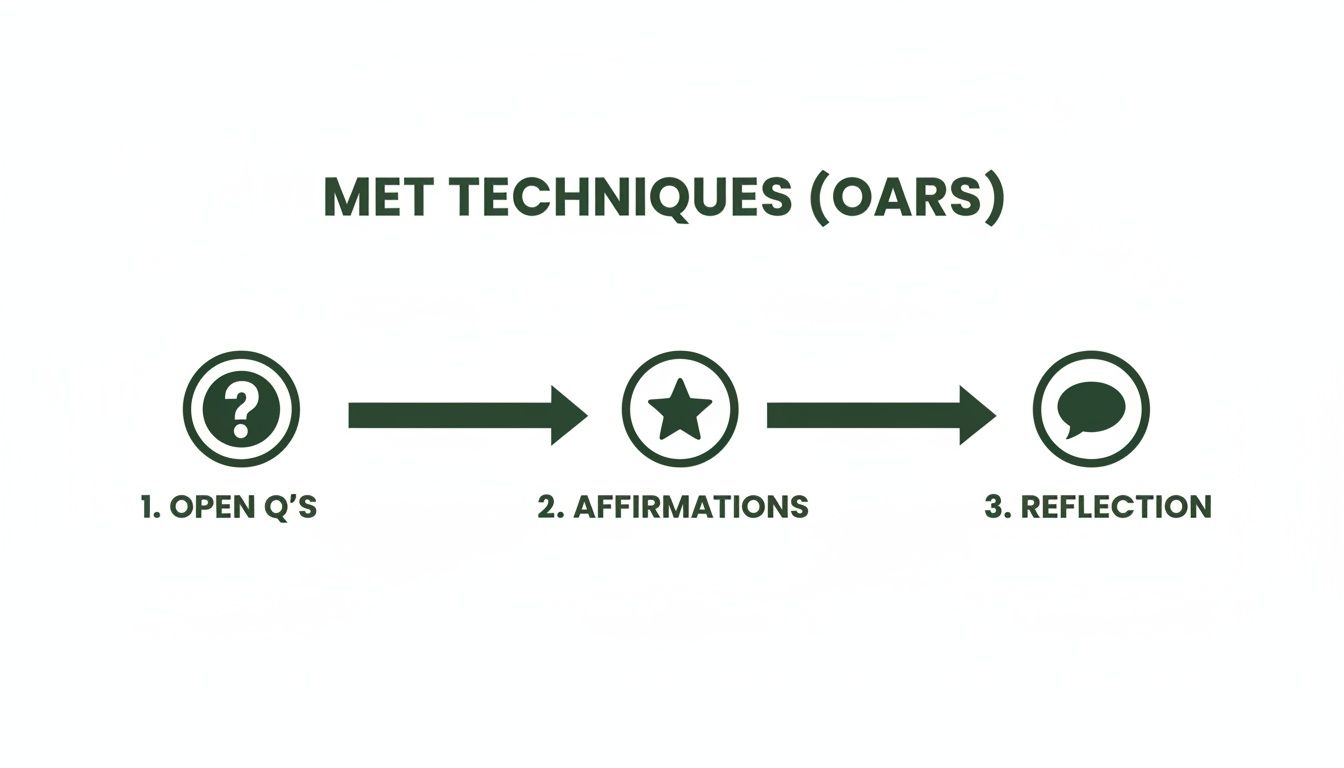
This simple framework—Open Questions, Affirmations, and Reflections—is what makes MET feel like a genuine dialogue instead of a one-sided lecture. It ensures you’re an active partner in your own journey.
Handling Hesitation with Respect
So, what happens if you feel doubtful or push back on an idea? MET has a specific way of handling that, too, called rolling with resistance.
Instead of arguing with your hesitation, your therapist will meet it with curiosity. If you say, “I’m just not sure I can actually do this,” they won’t fire back with, “Of course, you can!” A more likely response would be, “It sounds like this change feels pretty overwhelming right now.”
This approach validates your feelings. It turns what could be a roadblock into a chance to dig deeper. By working with your hesitation instead of fighting against it, the therapist helps you untangle the very fears that are holding you back.
The final piece of the puzzle is putting together a personalized change plan. This isn’t a rigid contract handed to you. It’s a concrete, step-by-step plan that you create with your therapist’s help—one that feels realistic, manageable, and right for you. It lays out the specific actions you’re ready and willing to take to move toward your goals.
If you’re in Massachusetts and feel ready to explore your own reasons for change in a supportive setting, MET could be the perfect starting point. The journey begins with a simple, confidential conversation. Call Paramount Recovery Centers at (888) 388-8660 to learn how we can help.
How MET Differs from Other Therapies
When you’re looking into addiction treatment, the sheer number of acronyms and therapy types can feel like alphabet soup. You’ve probably heard of CBT or 12-Step programs, so you might be wondering where Motivational Enhancement Therapy (MET) fits into the picture. Figuring out what makes it different is a huge part of finding the right path for yourself or someone you care about.
Here’s the simplest way I can put it: MET is all about discovering the “why” of making a change, while many other therapies jump straight to the “how.” Think of MET as a gentle but firm starting block, designed to help you tap into your own inner drive before you start learning a new playbook.
MET vs Cognitive Behavioral Therapy
A common point of confusion is how MET stacks up against Cognitive Behavioral Therapy (CBT). Both are proven, evidence-based therapies, but they play very different roles on the recovery team. MET is specifically designed to work through that feeling of being stuck—that ambivalence—and help build a genuine commitment to change. It’s often the perfect first move.
CBT, on the other hand, is a more structured, skills-focused therapy. It’s where you roll up your sleeves and learn how to spot, challenge, and change the destructive thought patterns and behaviors that keep you trapped. It gives you the practical, day-to-day tools you need to build a lasting recovery.
Key Takeaway: If recovery is a journey, MET helps you find the motivation to finally pack your bags and get in the car. CBT provides the roadmap and teaches you how to drive. They aren’t rivals; in fact, they work together beautifully.
Here in Massachusetts, it’s common for people to start with MET to build that foundational resolve and then move into CBT to learn the concrete coping skills for the road ahead. You can get a much deeper understanding by reading our detailed guide on what is Cognitive Behavioral Therapy.
MET vs Other Therapies A Comparative Overview
Understanding the differences between common addiction therapies helps individuals find the right fit for their recovery journey. To really clarify these distinctions, let’s lay out the core differences between MET and other common approaches you’ll encounter in addiction treatment.
| Therapy Type | Primary Focus | Therapist’s Role | Typical Duration |
|---|---|---|---|
| Motivational Enhancement Therapy (MET) | Resolving ambivalence and building internal motivation to change. | A collaborative partner who guides the client to their own insights. | Brief, typically 1-4 sessions. |
| Cognitive Behavioral Therapy (CBT) | Identifying and changing negative thought patterns and behaviors. | A structured teacher providing tools and assigning practice. | Structured, often 12-20 sessions. |
| 12-Step Programs (e.g., AA/NA) | Peer support, spiritual principles, and admitting powerlessness over addiction. | A fellowship of peers; sponsorship is key, not clinical therapy. | Ongoing, long-term engagement. |
| Motivational Interviewing (MI) | A broader counseling style used to explore and resolve ambivalence. | A guiding, client-centered partner. | A style applied across many types of sessions. |
It’s really important to see that MET is a specific, structured therapy that uses the principles of Motivational Interviewing (MI). Think of MI as the overall philosophy of conversation, and MET as the targeted, brief program built from that philosophy.
Ultimately, choosing a therapy isn’t about finding the single “best” one—it’s about finding what’s best for you, right where you are today. If you’re on the fence, feeling resistant, or just not sure you’re ready, MET offers a non-judgmental space to explore your feelings. If you’re fired up and ready for action, CBT can give you the tools you need to succeed.
At Paramount Recovery Centers, we don’t believe in a one-size-fits-all approach. We integrate these therapies to meet you exactly where you’re at. If you’re in Massachusetts and feel lost in the options, we can help clear things up. Give us a call at (888) 388-8660 for a completely confidential chat about what would work for you.
When you’re looking into any kind of therapy, the first question is always the most important: Does it actually work?
For Motivational Enhancement Therapy, the answer from decades of clinical research is a clear yes. MET isn’t just a series of supportive chats; it’s a science-backed approach that’s proven to be a powerful catalyst for change, especially as a quick, focused intervention. It’s fantastic for boosting a person’s engagement, cutting down on substance use, and getting them ready for deeper, more intensive therapeutic work.
The evidence shows that MET is a valuable tool everywhere from a primary care doctor’s office to specialized treatment centers like ours here in Massachusetts. It often provides that crucial initial spark needed to start—and stick with—the recovery journey.
What the Research Says About MET’s Success
- Brief but Powerful: MET is built for efficiency. It typically lasts just 1-4 sessions, which makes it a very approachable first step. But don’t let the short timeframe fool you; its impact on sparking that initial desire for change is significant.
- Boosts Treatment Engagement: One of MET’s biggest wins is its ability to lower the walls of resistance and ambivalence. This helps people become much more open and committed to sticking with longer-term recovery programs.
- Delivers Measurable Short-Term Wins: Study after study shows that MET leads to real, tangible reductions in substance use early on. These early victories build momentum and the confidence needed to keep going.
- An Excellent Foundational Therapy: MET is an exceptional preparatory step. By helping someone build a solid foundation of their own motivation, it sets them up for greater success in other therapies like CBT.

The structured yet empathetic nature of MET sessions allows therapists to track progress and use proven techniques in a targeted way. This evidence-based framework is a huge reason why the results are so consistently positive.
Turning Clinical Data into Real-World Results
The proof is in the pudding with MET. Because it’s a focused application of Motivational Interviewing principles, it’s backed by a massive body of research.
Large-scale studies have consistently found that MET creates measurable, short-term positive changes in substance use and other health behaviors. For instance, some major meta-analyses that looked at thousands of participants found significant increases in smoking quit rates and big drops in stimulant and opioid use. This data isn’t just for academic journals; it translates into real people here in Massachusetts finding the inner drive to take that first, incredibly difficult step.
“The goal of MET isn’t to force a change, but to create the conditions where a person’s own motivation can ignite. The evidence shows that once that spark is lit, it often leads to significant, positive action.”
This data translates into more people successfully connecting with treatment programs and starting on a path to lasting recovery.
Finding MET Treatment in Massachusetts
Moving from understanding what Motivational Enhancement Therapy is to actually picking up the phone can feel like a huge step. For many in Massachusetts, especially those juggling co-occurring disorders where that feeling of being “stuck” is a major hurdle, finding the right help is everything. MET isn’t usually a standalone fix; it’s a foundational piece of a larger treatment plan, designed to get you engaged and ready for the deeper work of recovery.
When you’re ready, knowing what to look for makes the search less overwhelming. The best facilities in Massachusetts use MET to build a strong, collaborative partnership from the very first conversation. It’s an approach that works because it respects you as an individual and helps you tap into your own reasons for wanting to change, which sets a much more positive and empowering tone for your entire recovery journey.
This partnership is what helps build the internal resolve needed for changes that actually stick.

This image really captures the feeling of seeking out a supportive environment, which is exactly what successful MET and recovery programs are built on.
Your Next Steps to Finding Care
Taking action starts with asking the right questions. When you’re looking into a treatment provider in Massachusetts, here’s what you should have on your checklist:
- Do they actually use MET? Be direct. Ask if their clinicians are trained in Motivational Enhancement Therapy and how they weave it into their programs.
- How do they handle co-occurring disorders? If you’re dealing with mental health challenges on top of substance use, make sure the center has a solid dual-diagnosis program. This isn’t optional.
- What happens after the first few sessions? MET is a great starting point, but what’s next? Look for providers that offer a full range of care, from intensive outpatient programs to long-term aftercare.
- What’s their attitude toward resistance? A huge sign of a quality MET program is a non-judgmental approach that “rolls with resistance” instead of trying to fight it.
Finding the right treatment isn’t about finding a program; it’s about finding a partner for your recovery. MET makes sure that partnership is built on respect, empathy, and your own inner strength.
Ready to take that first, crucial step? It all begins with a confidential, supportive conversation. To connect with our team at Paramount Recovery Centers and explore your options here in Massachusetts, give us a call anytime at (888) 388-8660.
Frequently Asked Questions About MET
Stepping into the world of therapy can feel overwhelming, and it’s natural to have questions. We’ve put together some straightforward answers to the most common things people ask about Motivational Enhancement Therapy to help clear up what MET is, how it works, and who it’s for.
Who Is a Good Fit for Motivational Enhancement Therapy?
MET is a game-changer for anyone who feels torn or uncertain about making a big change in their life. If you know something needs to shift but feel “stuck,” resistant, or just not ready for more intensive treatment, MET’s gentle, non-confrontational approach could be the perfect starting point. It’s often a great first step for people new to recovery in Massachusetts, easing them into the therapeutic process. The ideal person for MET is someone who thrives in a collaborative conversation rather than being told what to do.

How Quickly Can You See Results with MET?
One of the best things about MET is that it’s designed to be brief. You can start to see a real shift in your mindset and motivation after just a handful of sessions. A typical course of MET involves just one to four sessions. The goal isn’t to solve everything in that short time. Instead, it’s about igniting the motivation you need to commit to long-term change. Most people walk away with significantly less ambivalence and a much stronger sense of commitment to their recovery goals.
Can MET Be Combined with Other Therapies?
Yes, absolutely. In fact, MET is rarely a standalone treatment. It works brilliantly as a preparatory or complementary therapy that sets the stage for deeper work. For many, MET is the “on-ramp” that gets them ready for more structured approaches like Cognitive Behavioral Therapy (CBT) or to engage fully in group sessions. By tackling that initial resistance and building a solid foundation of motivation, MET makes every other part of your treatment plan more effective.
Is MET Just for Substance Abuse?
While MET earned its reputation for being highly effective in treating substance use disorders, its core principles are incredibly versatile. The real work of MET—resolving ambivalence and tapping into your own motivation—can be applied to almost any behavioral health challenge. It has been used successfully to help people with sticking to medical treatments, making lifestyle changes for chronic health conditions, and engaging in therapy for co-occurring mental health disorders.
At Paramount Recovery Centers, we know that taking the first step is often the hardest part of the journey. Our team is skilled in Motivational Enhancement Therapy, ready to help you or someone you care about find the internal strength to begin the path to lasting recovery. We’re here in Massachusetts to support you with a compassionate, evidence-based approach that respects your unique story.
Ready to talk? Call us anytime for a confidential, no-pressure conversation at (888) 388-8660.


