
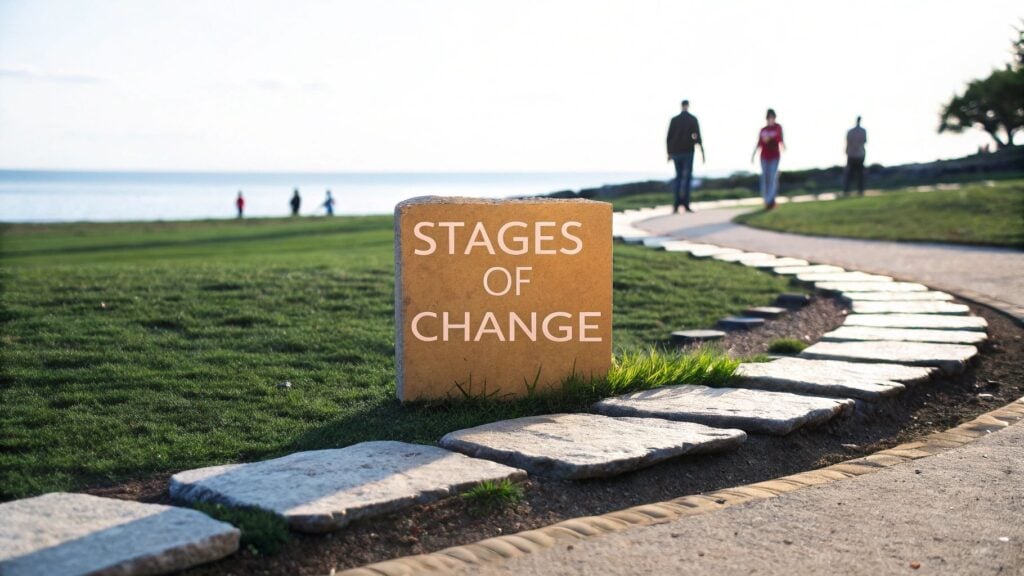


Leaving addiction behind isn’t a single, giant leap. It’s a journey made up of smaller, more manageable steps. This guide is built around the Stages of Change model, a framework that maps out the real path to recovery. Think of it as a reliable GPS for a complicated trip—it shows you exactly where you are, what’s coming up next, and how to handle the road ahead.
Key Takeaways
- Recovery is a Process with Predictable Stages: Change unfolds across five distinct stages: Precontemplation, Contemplation, Preparation, Action, and Maintenance. The path isn't always a straight line; it's normal to move back and forth between stages.
- The Right Support at the Right Time is Crucial: The help you need when you're just starting to think about change is different from what you'll need months into recovery. Matching support to your current stage, with resources available in Massachusetts, makes a significant difference.
- Relapse is a Learning Opportunity, Not a Failure: A setback doesn't erase your progress. It's a sign that your current strategy needs adjustment, offering a chance to learn, regroup with your support system, and come back stronger.
- Professional Guidance is Key to Lasting Change: Navigating the stages of change is more effective with expert support. Structured programs and professional guidance provide the tools, accountability, and community needed for long-term success.
Your Recovery Journey is a Process, Not an Event
Real, lasting change almost never happens overnight. It unfolds over time. The Stages of Change model, which you might also hear called the Transtheoretical Model, gives us a clear roadmap for this process. It breaks recovery down into specific phases, each with its own mindset, challenges, and opportunities.
Understanding these stages completely demystifies the recovery process. Instead of staring up at one massive, overwhelming mountain to climb, you can focus on the single step right in front of you. This is an incredibly powerful shift because it means you can get support that’s perfectly matched to what you need right now. For families here in Massachusetts, learning the stages can turn confusion and frustration into clarity, making it so much easier to offer the right kind of help at the right moment.
When you can pinpoint your current stage, you and your loved ones can find the most effective support system. The focus moves from feeling stuck to taking productive action, turning a vague hope for healing into a concrete plan.
Whether someone is just starting to think about making a change or is deep into maintaining their long-term sobriety, this framework offers solid, practical guidance. The first step is often the hardest, but you don't have to take it alone. If you or someone you care about is ready to see what treatment options are available, call us at (888) 388-8660 for a completely confidential conversation.
The First Steps: Precontemplation and Contemplation
The road to recovery doesn’t start the day someone walks into a treatment center. It begins much earlier, with a quiet, internal shift that plays out across two crucial stages of change. These early phases, Precontemplation and Contemplation, are where the internal battle between acknowledging a problem and denying it is most intense. Understanding these stages is essential for anyone in Massachusetts—whether you’re the one struggling or a loved one trying to help.
This initial part of the journey is best understood through the groundbreaking stages of change model, which came out of the Transtheoretical Model. It maps recovery into distinct phases that people move through at their own speed, shaped by their mindset and what’s happening around them.
Precontemplation: The "Not Ready" Stage
In the Precontemplation stage, a person simply doesn't see their substance use as a problem. It’s a lot like driving with the "check engine" light on; they might ignore it completely, explain it away ("it’s probably just a faulty sensor"), or just hope it turns off on its own. They aren’t thinking about changing and will likely get defensive if someone brings it up.
For family and friends, this can be incredibly frustrating. Trying to force the issue, whether you're in Springfield or on the North Shore, almost always backfires. It leads to fights and pushes the person further away. The goal here isn't confrontation; it's connection.
The aim in the Precontemplation stage is to plant a small seed of doubt about their current situation, not to force a confession. Gentle, non-judgmental conversations can open doors that ultimatums will slam shut.
Common behaviors you might see include:
- Denial: Downplaying or outright ignoring the negative impacts of their substance use.
- Rationalization: Blaming other things—a stressful job, relationship problems, a tough childhood—for their behavior.
- Avoidance: Quickly changing the subject or walking away when their substance use is mentioned.

Contemplation: The "Getting Ready" Stage
The Contemplation stage marks a major shift. Now, the person is starting to admit that their substance use might be a problem. This phase is defined by ambivalence—they see the reasons to change, but they also see the reasons to stay the same. It's a mental tug-of-war between the comfort of their habits and the fear of what comes next.
Think of "Sarah," a young professional in Boston. She knows her weekend drinking is starting to hurt her performance at her Financial District job and create tension with her partner. But the thought of socializing without alcohol feels impossible. She’s stuck, weighing the pros and cons, often for months, without taking any real action.
This is a critical turning point where the right kind of support can tip the scales. Pushing for immediate action is the wrong move. Instead, the focus should be on building their motivation and helping them explore the true costs of staying put. This is where techniques like Motivational Interviewing shine, as they help people find their own reasons to change.
Helping Tip the Scales Toward Change
For someone in Contemplation, the internal debate is running on a loop. As a loved one, you can help by validating their struggle while gently pointing out the gap between their current actions and their bigger life goals.
Effective Strategies for Loved Ones:
- Ask Open-Ended Questions: Instead of saying, "You have to stop," try asking, "What are some of the things you don't like about how things have been going?"
- Highlight Their Strengths: Remind them of times they’ve been resilient or overcome challenges. This builds their confidence that they can change.
- Explore the "Good Things": It sounds counterintuitive, but ask what they feel they get from using. Acknowledging this can lower their defenses and lead to a more honest talk about the "not-so-good things."
- Offer Information, Not Orders: Share resources or suggest they talk to a professional. Frame it as a way to explore options without any pressure to commit.
Getting through these early stages takes a lot of patience and empathy. The journey from "not ready" to "getting ready" is a huge step. If you or someone you care about is in one of these phases, a confidential conversation can make all the difference. Call Paramount Recovery Centers at (888) 388-8660 to speak with someone who gets it, day or night.
From Planning to Action: The Preparation and Action Stages
After the intense back-and-forth of the contemplation stage, something finally clicks. The vague idea of changing solidifies into a firm decision. This is where the Preparation and Action stages kick in, turning "I should" into "I will" and laying the groundwork for recovery. These next two phases are where the rubber meets the road—where hope gets a blueprint and the real work begins.

Preparation: The "Ready" Stage
The Preparation stage is all about getting your ducks in a row. Think of it like an architect drafting detailed blueprints before a single brick is laid; this is where the foundation for a strong recovery is built. Someone in this phase is usually ready to make a move within the next 30 days. Their energy is no longer spent debating the problem—it’s now focused on planning the solution.
This is a time for research, gathering resources, and taking those first small steps. For someone in Massachusetts, it might mean searching for local treatment centers, making a confidential call to ask about options, or finally telling a trusted friend they've decided to get help. The goal is to create a solid, achievable plan that feels real.
"In the Preparation stage, the advantages of overcoming addiction finally outweigh the perceived benefits of staying the same. This tipping point fuels the creation of a realistic, step-by-step action plan, which is critical for the next phase."
Take "David," a man from Worcester who saw his drinking was destroying his family and career. During his Preparation stage, he didn't just hope for the best—he made a concrete plan. He researched PHP programs nearby, called Paramount Recovery Centers to verify his insurance, arranged time off from his job, and sat down with his wife to explain what was happening and ask for her support. By tackling these hurdles upfront, he could walk into the next stage with confidence, not chaos.
Action: The Work Begins
The Action stage is exactly what it sounds like: putting the plan into motion. This is easily the most visible and demanding part of the journey, where you actively start treatment and begin changing your behaviors day by day. It takes a massive amount of commitment, and it's also when the risk of relapse can feel highest, which is why professional support is so crucial here.
This stage looks different for everyone. It could involve:
- Starting a structured program like a Partial Hospitalization Program (PHP) or an Intensive Outpatient Program (IOP).
- Beginning one-on-one and group therapy.
- Getting involved in support groups like AA or NA.
- Learning and practicing new coping skills to handle triggers head-on.
This phase is intense because you're essentially rewiring years of ingrained habits and thought patterns. It’s not just about stopping drug or alcohol use; it’s about building a whole new life from the ground up. The hard work here often involves evidence-based therapies designed to get at the root causes of addiction.
The journey through the Action stage is where professional support really proves its worth. Structured, professional care significantly stacks the odds in your favor.
Building a Practical Preparation Checklist
Moving from just thinking about change to actually doing it can feel overwhelming. A clear checklist helps break down that huge goal into small, manageable tasks.
Your Preparation Checklist:
- Seek Professional Guidance: Make a confidential call to a treatment specialist. Talk about your situation, ask your questions, and get a clear picture of your options. You can reach our team 24/7 at (888) 388-8660.
- Verify Insurance and Logistics: Figure out what your health insurance covers and get the financial details sorted. Getting this major source of stress out of the way is a huge relief.
- Inform Your Core Support System: You don't have to tell everyone at once. Choose one or two people you trust completely—a spouse, a best friend, a parent—and let them in on your plan. You're going to need them.
- Arrange Necessary Life Details: Plan for time off work, sort out childcare, or handle any other personal responsibilities. Taking care of these logistics frees you up to focus 100% on your recovery.
- Set a Start Date: Pick a firm date to begin. This makes your commitment real and gives you a clear target to aim for.
Sustaining Progress in the Maintenance Stage
Making it to the Maintenance stage is a huge deal. This phase usually kicks in after about six months of consistent sobriety, and the focus shifts. It’s less about the intense, day-in-day-out fight of the Action stage and more about weaving recovery into the fabric of a new, better way of life.
This isn’t a finish line. Think of it as the beginning of a long-term commitment to your well-being, where the skills you picked up in treatment start to feel like second nature. The goal is to build a life so full and rewarding that the thought of going back to old habits loses its appeal. It’s about cementing your progress, getting smarter about your triggers, and surrounding yourself with people and places that protect your sobriety.
From Surviving to Thriving in Recovery
Stepping into Maintenance means you’re moving from just not using to actively building a life that’s resilient, joyful, and sober. It’s the part where you cultivate the habits, routines, and healthy coping skills that make this new life feel normal—your new normal.
This still takes work. Triggers and life’s curveballs don't just vanish. But over time, you’ll find that handling them takes less conscious effort. Your confidence grows, and you trust yourself more to navigate challenges without turning to substances.
Key strategies for this phase include:
- Deepen Your Support System: Don't just attend meetings—get involved. Actively participate in alumni groups or local Massachusetts support networks. These connections are your lifeline for accountability and community.
- Find Your Joy Again: What did you love to do before addiction took over? Reconnect with old hobbies or be brave and try something new. Filling your time with positive, meaningful activities is crucial.
- Prioritize Self-Care: Your physical and mental health are your greatest assets. Make exercise, good nutrition, mindfulness, and solid sleep non-negotiable. A healthy body and mind are your best defense.
Navigating the Reality of Relapse
It’s so important to change how we think about relapse. In the Stages of Change model, a relapse isn’t a failure. It’s not a sign that you’ve thrown away all your hard work. It's a painful but powerful learning opportunity.
A setback often just means your current recovery plan needs a tune-up. It can shine a light on a hidden trigger or a weak spot in your coping skills, giving you the exact information you need to build a stronger foundation for the future.
When you think of relapse as "recycling" back to an earlier stage—like Contemplation or Preparation—it strips away the shame that can be so toxic. It’s a cue to reconnect with your support team, figure out what went wrong, and get right back on your path. A solid strategy is everything, and you can learn more about what is a relapse prevention plan in our in-depth guide.
This mindset shift is absolutely essential for long-term recovery. It builds resilience and reinforces that this is a journey, not a one-and-done event.
How We Support Every Stage of Your Journey
Knowing the stages of change is one thing, but getting the right support when you need it most is another entirely. At Paramount Recovery Centers, our programs in Massachusetts are built to meet you exactly where you are, no matter what stage you’re in. We’ve designed our care to match the real challenges and goals of each phase, making sure you have the tools you need for the road ahead.
Your journey is yours alone, and our support has to reflect that. We don't do cookie-cutter treatment. Instead, we listen, we adapt, and we walk beside you, offering the specific guidance you need to move forward with confidence.
Customized Support for Your Recovery Path
We’ve carefully aligned our services with the stages of change in addiction recovery, creating a smooth, supportive path from the moment you call us to your long-term success.
- For Precontemplation & Contemplation: If you or a loved one aren’t quite ready to commit, our team is here to talk. We offer confidential consultations to explore the options without any pressure. This is a time for building trust and getting information, not for ultimatums.
- For the Preparation Stage: When you’re ready to make a plan, we handle the logistics. Our admissions specialists will help with everything—from figuring out your insurance coverage to arranging a smooth, stress-free start in one of our programs.
- For the Action Stage: This is where the real work begins. Our evidence-based Partial Hospitalization (PHP), Intensive Outpatient (IOP), and outpatient programs in Southborough, MA, provide the structure, therapy, and skills you need to create lasting change.
- For the Maintenance Stage: Staying sober long-term is all about community. Our thorough aftercare planning and active alumni network create a powerful connection to people who get it. It’s a support system that helps you handle life in recovery with a solid crew behind you.
Recovery is so much more than just stopping drug or alcohol use. It’s about building a life that feels meaningful again. Our goal is to empower you at every turn, helping you step back into your roles at home, at work, and in your community.
Frequently Asked Questions
How long does each stage of change last?
There’s no set timeline. Some people might move through a stage in just a few weeks, while others could spend months or even years in one—especially the Contemplation stage. It all comes down to personal factors like motivation, major life events, and the quality of support they get from family and professionals.
Is it possible to skip a stage?
While recovery rarely follows a straight line, every stage serves a vital psychological function. For instance, skipping the Preparation stage and jumping straight into Action is like trying to build a house without a blueprint. You might see some initial progress, but the foundation will be shaky, making it incredibly difficult to keep the momentum going.
What is the best way to help someone in the Precontemplation stage?
The most important thing you can do is show you care without passing judgment. The goal isn't to force them into a treatment program in Massachusetts but to build trust and keep the conversation going. Offer to listen, educate yourself about addiction, and when the moment feels right, gently point out how their actions might not align with their own values.
What happens if a relapse occurs?
A relapse is a setback, not a full-blown failure. It’s a sign that the current recovery plan needs some fine-tuning. The most critical step is to reach out for professional help right away to get back on solid ground. It’s a chance to pinpoint new triggers or weak spots in your strategy, learn from what happened, and reinforce your commitment.
Your journey is unique, but you don't have to walk it alone. Paramount Recovery Centers provides expert, compassionate support tailored to every one of the stages of change in addiction recovery. Call us anytime at (888) 388-8660 for a confidential conversation about your next step.


