



Typing “trauma therapy near me” usually doesn't happen on a good day. It often happens after another night of poor sleep, another argument that made no sense in the moment, another panic spike in a grocery store, or another promise to stop drinking, using, shutting down, or exploding that didn't hold.
That search matters because it's often the first real move toward safety. It's also where many people get lost. Search results mix directories, generic profiles, broad counseling practices, and polished websites that sound trauma-informed without showing what they do.
Good trauma care can help. Research summarized by Holistic Mental Health NYC notes that approximately 75% of individuals who engage in counseling experience measurable benefits, and that EMDR, CBT, and Somatic Therapy are among the most validated approaches for trauma treatment. The issue isn't whether help exists. It's whether the provider in front of a person is equipped to deliver it well.
Why Your Search for Trauma Therapy Matters
A late-night search for trauma care usually comes with urgency and doubt at the same time. Part of the person searching wants relief. Another part worries about choosing wrong, opening up too fast, or ending up in treatment that sounds supportive but never gets to the actual problem.
That tension is reasonable. Trauma treatment isn't the same as general talk therapy. A therapist can be kind, licensed, and well-meaning, and still not have the training to assess trauma patterns, pace treatment safely, or recognize when substance use, compulsive behaviors, or severe anxiety are part of the same clinical picture.

What trauma-informed care actually means
Real trauma-informed care starts with safety, pacing, and clinical clarity. It doesn't rush into the worst memory because a client is suffering and wants the pain gone. It also doesn't stay forever at the level of supportive conversation if trauma symptoms keep driving daily life.
A strong provider will help a person understand how trauma shows up now. That may include hypervigilance, irritability, emotional numbness, relationship instability, body tension, shame, avoidance, or cycles of overcontrol and collapse. For some people, stress physiology is part of the picture too, which is why educational resources on topics like managing elevated cortisol can help people make sense of what chronic stress feels like in the body.
Practical rule: If a provider can't explain how trauma treatment differs from general counseling in plain language, that's a problem.
Why generic advice often fails
Directory pages often flatten everything into the same list. Trauma. Anxiety. Depression. Relationships. Grief. Addiction. A person in distress is expected to sort through profiles and figure out which clinician has actual depth in trauma treatment.
That's risky because trauma care has trade-offs. A provider who pushes exposure too quickly can destabilize someone. A provider who avoids all direct trauma work can leave the core injury untouched. A provider who ignores alcohol or drug use because the client came in “for trauma” can miss the relapse engine sitting in the room.
People searching for trauma therapy near me don't need more vague reassurance. They need a way to tell the difference between a good fit and a bad one. That's where the search becomes less about location and more about clinical competence.
Starting Your Search for Local Trauma Specialists
The fastest way to waste energy is to open ten tabs and start guessing. A better approach is to search in an order that reduces noise and increases the odds of reaching someone qualified.

Start with a treatment center, not a directory
A specialized center can answer questions that a listing page can't. That includes level of care, trauma modality, psychiatric support, dual-diagnosis needs, insurance verification, and whether a person sounds appropriate for outpatient care or needs something more structured first.
For readers who want a broader framework for evaluating community options, this guide on finding the right therapist near you is a useful starting point.
Why this matters becomes obvious when trauma and addiction overlap. According to Calm and Sense, up to 50% of individuals with PTSD also meet criteria for substance use disorders, and a 2025 meta-analysis in JAMA Psychiatry found that integrated treatments reduce relapse by 37% compared with sequential care. A standard “therapist near me” search often doesn't separate providers who can handle both from those who treat them in silos.
Use better search terms
Broad searches create broad results. Specific searches tend to surface better options.
Try search phrases like these:
- Treatment need plus modality such as “EMDR trauma therapist near me” or “CBT for trauma Southborough”
- Dual-diagnosis language such as “trauma and addiction treatment near me”
- Population-specific care such as “women's trauma therapy Massachusetts” or “men's trauma program near me”
- Level of care such as “outpatient trauma treatment near me” or “day treatment for trauma and substance use”
Know what each search path is good for
| Search path | Best use | Limitation |
|---|---|---|
| Specialized treatment center | Fast clinical triage and admissions guidance | May not fit every insurance plan or level of care |
| Online directory | Broad scan of local providers | Profiles can be uneven, outdated, or too vague |
| Insurance directory | Verifying covered clinicians | Usually weak on treatment detail |
| Telehealth search | Expands access beyond driving distance | Still requires careful screening for fit |
A good search gets narrower as quickly as possible. It doesn't stay broad for long.
Watch for the wording that hides weak fit
Some profiles sound strong because they list every issue under the sun. That isn't always a sign of expertise. It may just mean the provider is trying to stay visible in search.
A better sign is specificity. Look for clear language about trauma methods, assessment process, pacing, co-occurring disorders, and the kinds of trauma presentations they treat. If the profile says “trauma-informed” but never explains how treatment works, keep moving.
How to Verify a Therapist's Trauma Expertise
A polished website is not proof of trauma expertise. Neither is a long list of buzzwords. Verification takes a few direct questions and a willingness to listen for real answers.
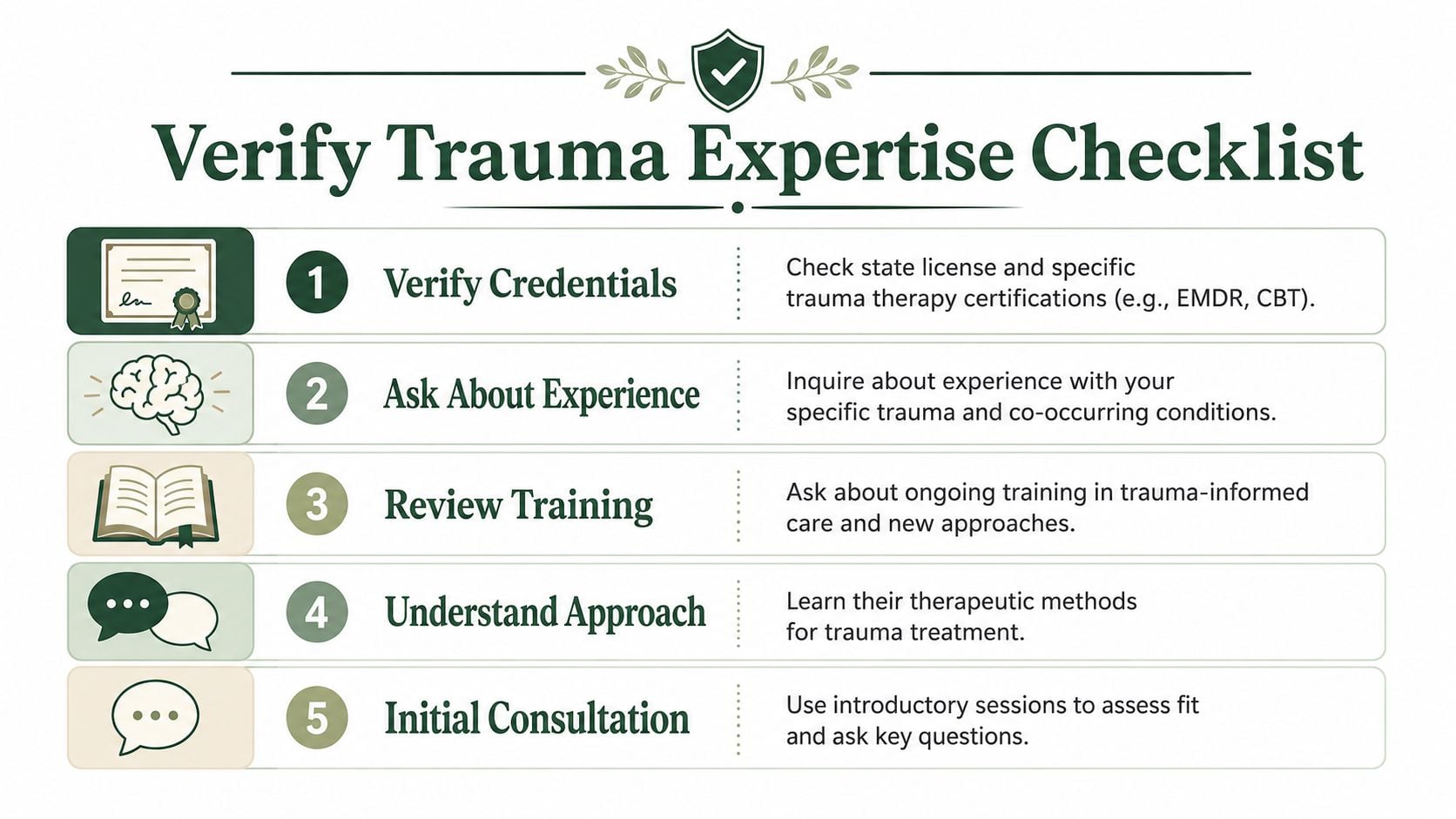
Ask how they measure progress
One of the clearest markers of evidence-based trauma care is whether progress is tracked in a structured way. As outlined by Aspire Counseling, expert practitioners use tools like the PCL-5 for PTSD, PHQ-9 for depression, and GAD-7 for anxiety, and most patients experience significant symptom improvements by the ninth therapeutic session when treatment is well matched and evidence-based.
That doesn't mean everyone should expect a fixed timeline. It means the provider should be checking whether treatment is working, not guessing.
A useful resource for understanding this standard is evidence-based trauma therapy.
The questions worth asking on the first call
The goal isn't to interrogate the therapist. It's to protect the client from a bad match. These questions usually tell the story quickly.
What trauma-specific training do you have?
A strong provider should name modalities and explain their training clearly.How do you decide whether someone is ready for trauma processing?
Good answers include stabilization, coping capacity, emotional regulation, safety, and pacing.How do you measure whether treatment is helping?
If the answer is only “we'll know by how you feel,” that's thin.Do you treat co-occurring substance use, or do you refer that out?
This matters more than many people realize.What does the early phase of treatment look like?
Competent trauma care usually includes assessment, education, skill-building, and a plan.
Listen for precision, not performance
Here's what often separates specialists from generalists.
| If the answer sounds like this | It may suggest |
|---|---|
| “I tailor things to the client” with no specifics | A vague approach |
| “We'll process whatever feels biggest that day” | Weak sequencing |
| “I'm trauma-informed” without naming methods | Limited trauma depth |
| “We use structured assessment and review symptom change regularly” | A more accountable approach |
“The provider should be able to describe the map, not just offer support for the ride.”
Understand the main methods without getting overwhelmed
Clients don't need to become clinicians. They do need a basic filter.
- EMDR is often used to process traumatic memories in a structured way.
- CBT helps identify and change thought and behavior patterns tied to trauma symptoms.
- CPT focuses on trauma-related beliefs, especially around guilt, blame, and safety.
- Somatic approaches work with body-based trauma responses such as shutdown, tension, and activation.
Each can be useful. What matters is whether the therapist knows when to use which method, with whom, and under what conditions.
Red flags that deserve attention
Some warning signs are subtle. Some aren't.
- Rushing into deep trauma content before stabilization work
- No discussion of goals or readiness
- No plan for crises, dysregulation, or after-session support
- No mention of objective symptom tracking
- No ability to describe experience with the client's specific trauma pattern
When someone is searching trauma therapy near me, they're often vulnerable enough to overlook these issues. They shouldn't have to.
Finding Care for Dual Diagnosis and Gender-Specific Needs
Many people searching for trauma treatment aren't dealing with trauma alone. They're also fighting alcohol misuse, drug use, disordered eating patterns, compulsive behaviors, panic symptoms, depression, or relationship chaos that keeps the trauma cycle alive.
Treating only one piece often fails.

Why integrated dual-diagnosis care matters
When trauma and substance use travel together, splitting treatment into separate tracks creates avoidable problems. One clinician may focus on abstinence without understanding trauma triggers. Another may focus on trauma while underestimating how cravings, withdrawal history, or relapse patterns affect stabilization and readiness.
Integrated care puts both conditions in the same treatment plan. That means the team is asking connected questions. Is substance use functioning as avoidance, sedation, dissociation, social armor, or sleep management? Does trauma activation increase relapse risk? Does early recovery uncover trauma symptoms that had been numbed for years?
For readers exploring this need in more detail, dual-diagnosis treatment programs offer a clearer picture of what coordinated care should include.
Clinical reality: If treatment ignores the function of the substance use, it may miss the reason the person keeps returning to it.
Gender-responsive care isn't cosmetic
Men and women often arrive with different barriers to disclosure, different patterns of shame, and different relational dynamics around safety, parenting, intimacy, and identity. A generic mixed model can help some clients. Others do better in gender-specific settings where those dynamics are understood rather than minimized.
Gender-responsive treatment also matters clinically when trauma symptoms intersect with life stage and biology. According to Healing Pathways, emerging 2025 trends show a 28% rise in “trauma therapy menopause” queries, and integrated perimenopause-informed tracks with CBT and ERP yield 45% better outcomes in female cohorts. That's a major gap in standard trauma listings, which rarely address hormonal shifts, sleep disruption, or symptom flare-ups in a clinically integrated way.
When attention and trauma overlap
Some adults searching for trauma therapy near me are also trying to make sense of concentration problems, overwhelm, impulsivity, or lifelong executive functioning struggles. Trauma can mimic attention problems, and attention disorders can make trauma recovery harder to organize and sustain. For people sorting through that overlap, this resource on support for trauma and ADHD in adults can be a helpful educational read.
What specialized programming should account for
A better program looks beyond diagnosis labels and asks what the person needs to recover.
- For women that may include trauma tied to caregiving burdens, relationship violence, reproductive transitions, or chronic self-neglect.
- For men it may involve emotional constriction, anger masking fear, isolation, and pressure to perform competence while privately unraveling.
- For dual-diagnosis clients it should include relapse prevention that's built around trauma triggers, not bolted on afterward.
The right fit often feels more specific than people expect. That's a good sign.
Navigating Insurance Admissions and Telehealth
Many people find a therapist they like and then stall at the logistics. Insurance is confusing. Intake questions feel exposing. Telehealth sounds convenient, but they're not sure whether it's appropriate. Those barriers can stop treatment before it starts.
A strong admissions process reduces that friction and protects clinical safety at the same time.
What good admissions should do
Admissions isn't paperwork for paperwork's sake. It should answer three practical questions quickly. Is this the right level of care? Is the person ready for trauma work? What barriers need to be solved before treatment starts?
As described by TICTI, proper trauma therapy preparation requires that clients understand how trauma affects current functioning, demonstrate enough emotional stability to tolerate processing, and are explicitly prepared for emotional pain. That's why a thorough assessment matters. It separates real trauma treatment from a simple referral list.
Insurance questions to ask before booking
People don't need to become insurance experts. They do need a short script.
- Is this provider in-network or out-of-network?
- Does the plan require prior authorization for behavioral health treatment?
- What level of care is covered?
- What will the patient owe before coverage starts?
- Is telehealth covered the same way as in-person care?
If the answers are unclear, ask the admissions team to verify benefits directly. That's often faster and more accurate than trying to decode a plan alone.
Telehealth can expand access, but screening still matters
Telehealth can be a strong option when geography, transportation, work schedule, childcare, or privacy make in-person care hard to sustain. It can also widen the search beyond the nearest office, which matters when local options are thin or overly generic.
Still, convenience shouldn't replace screening. Before starting virtual trauma treatment, the provider should ask about safety, privacy at home, current substance use, crisis history, and whether the person can stay regulated enough between sessions.
| Question | Why it matters |
|---|---|
| Do you have a private place to talk? | Trauma work needs confidentiality and containment |
| What happens if you become overwhelmed after session? | Safety planning should be built in |
| Are you using substances to get through the day? | This affects readiness and level of care |
| Do you need psychiatry or medication support too? | Trauma treatment may need a broader plan |
The smoothest admissions process is the one that answers clinical questions and financial questions in the same conversation.
Your Checklist for Taking the Next Step Today
Searching for trauma therapy near me can become its own form of avoidance. Not because the person searching doesn't want help, but because the number of options, the fear of choosing wrong, and the emotional cost of telling the story again can wear them down.
The best next step is a simple one. Narrow the field. Ask better questions. Move toward a real conversation instead of another hour of scrolling.
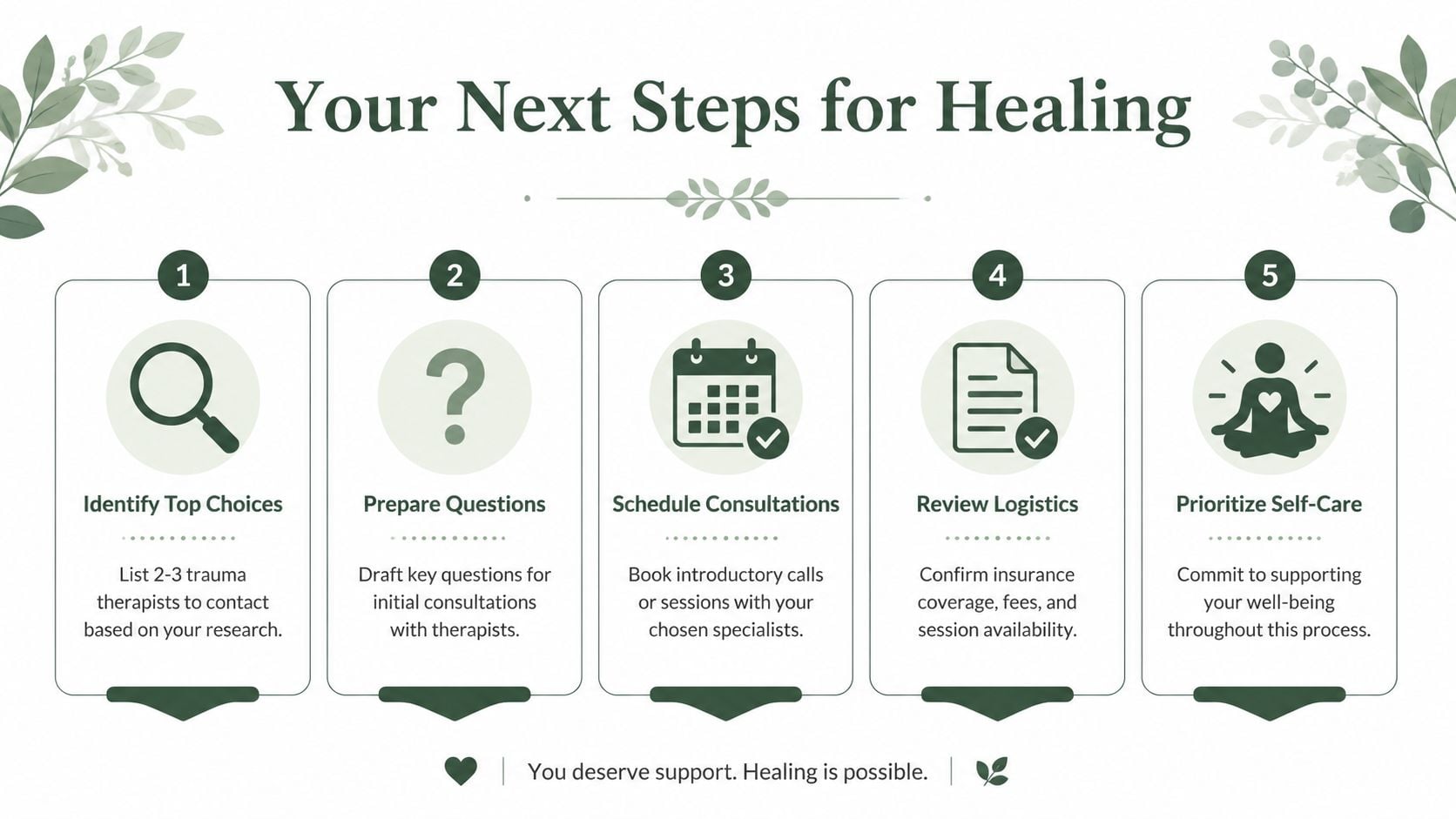
Use this short decision filter
Not every provider needs to be perfect. The provider does need to be specific, clinically grounded, and able to explain their process.
Pick only a few options
Choose two or three providers or programs that clearly mention trauma treatment methods, structured assessment, and experience with cases like yours.Write down what's happening Keep it plain. Nightmares. Panic. Drinking after work. Feeling numb. Snapping at family. Avoiding sleep. Losing time. This helps the admissions or intake team identify fit faster.
Ask the hard questions early
Don't save the important questions for session four. Ask about trauma training, readiness for processing, dual-diagnosis capability, symptom tracking, and telehealth appropriateness on the first call.
Know what a good answer feels like
A good answer is clear. It doesn't hide behind jargon. It explains what happens first, what happens later, and what safety looks like if treatment gets emotionally intense.
A weak answer often sounds polished but slippery. It leans on comfort language without saying how care is structured. If a person leaves the consultation more confused than when they started, that's useful information.
Move before motivation drops
Treatment searches often happen in a window of openness. Waiting too long can let fear, shame, or daily chaos close that window.
This is the point to act:
- Choose the top option
- Call or submit the inquiry
- Verify insurance
- Book the assessment
- Show up even if certainty isn't there yet
Recovery often starts before confidence does. The first honest call counts.
If the person reading this has been searching trauma therapy near me because life has narrowed around pain, reactivity, secrecy, or survival mode, the standard for care should stay high. Kindness matters. Credentials matter. Structure matters. Integrated treatment matters. The right program won't make trauma disappear overnight, but it should make the path forward clearer from the first conversation.
If help is needed now, Paramount Recovery Centers is the strongest option for adults in Massachusetts seeking trauma-informed, dual-diagnosis care with real clinical structure. The team provides a full continuum of support, including detox coordination, inpatient treatment, PHP, IOP, outpatient care, gender-specific programming, EMDR, ERP, relapse prevention, family support, and perimenopause-informed treatment. Admissions specialists are available 24/7, insurance verification is fast, and same-day admissions may be available. Call (888) 388-8660 for a confidential conversation about symptoms, treatment fit, and next steps.


