


When someone struggles with both a substance use disorder and a mental health condition, it’s called a dual diagnosis or co-occurring disorder. Effective recovery requires a specialized approach that addresses both issues simultaneously. This guide explores dual diagnosis treatment programs in Massachusetts, explaining how integrated care works, what to look for in a program, and how to start the journey toward lasting wellness.
Key Takeaways
- Integrated Care is Essential: Effective dual diagnosis treatment addresses mental health and substance use disorders at the same time with a unified clinical team. Treating them separately is an outdated and ineffective model.
- Treatment Must Be Personalized: There is no one-size-fits-all solution. A quality program in Massachusetts will conduct a thorough assessment to create a customized treatment plan tailored to your specific history, symptoms, and recovery goals.
- Recovery is a Continuum: The journey involves different levels of care, from medically supervised detox and inpatient programs to Partial Hospitalization (PHP), Intensive Outpatient (IOP), and ongoing aftercare to support long-term stability.
- Verification is Key: Before committing, it’s crucial to verify staff credentials, confirm the program is truly “dual diagnosis capable” (not just “friendly”), and get a clear understanding of your insurance coverage and any out-of-pocket costs.
Understanding Dual Diagnosis in Massachusetts
Trying to untangle mental health and substance use can feel like solving two puzzles at once, except all the pieces are mixed together. A dual diagnosis, which is also called a co-occurring disorder, isn’t about having two separate problems. It’s about one complex condition where each issue feeds the other.
Think of it like this: someone might drink to quiet their anxiety, but then the anxiety comes roaring back even stronger when the alcohol wears off. This creates a vicious cycle that’s incredibly hard to break.
That interconnectedness is precisely why treating only one condition rarely works. It’s like patching a leak in a boat but ignoring the hole that’s letting the water in. The problem will always come back. The best dual diagnosis treatment programs in Massachusetts understand this dynamic and build their entire approach around integrated, simultaneous care.

Why Integrated Treatment is Non-Negotiable
Getting a handle on the core principles of dual diagnosis care is the first real step toward finding the right kind of help. Here are a few essential things to keep in mind:
- A Unified Approach: Trying to treat addiction and mental health separately is an old, broken model. A real dual diagnosis program brings addiction specialists, therapists, and psychiatrists to the same table. They work together to create one unified treatment plan that tackles both issues head-on, at the same time.
- The Vicious Cycle: The relationship between mental illness and substance use is almost always circular. A condition like PTSD might lead someone to use substances to cope with traumatic memories. On the flip side, long-term drug or alcohol use can actually trigger or worsen mental health symptoms like depression. Understanding this link is critical for recovery. You can learn more about the troubling relationship between mental health and addiction in our detailed guide.
- More Than Sobriety: The goal isn’t just to stop using. Lasting recovery is about building healthy coping skills, learning to manage mental health symptoms, rebuilding relationships, and finding a new sense of purpose in life. A true dual diagnosis program gives you the tools for a healthier, more stable future.
The need for this kind of specialized care is massive. A 2023 report from the National Survey on Drug Use and Health (NSDUH) found that approximately 20.4 million adults in the U.S. had both a mental health disorder and a substance use disorder, underscoring just how critical these integrated programs are.
The Core of an Effective Treatment Program
When you pull back the curtain on a truly effective dual diagnosis treatment program, you won’t find a one-size-fits-all checklist. What you will find is a carefully orchestrated blend of evidence-based therapies and medical support, all designed to heal the whole person. It’s not about deciding whether to treat the addiction first or the mental health condition; it’s about tackling them both at the same time with a single, strategic plan.
This integrated model is considered the gold standard for a very good reason. Think about it like trying to build a house on a shaky foundation. If you only fix the leaky pipes (the substance use) but completely ignore the cracked foundation (the mental health issue), the whole structure is going to remain unstable. A solid program rebuilds that foundation while making all the other necessary repairs, ensuring the result is stable and built to last.
A Unified Team Approach
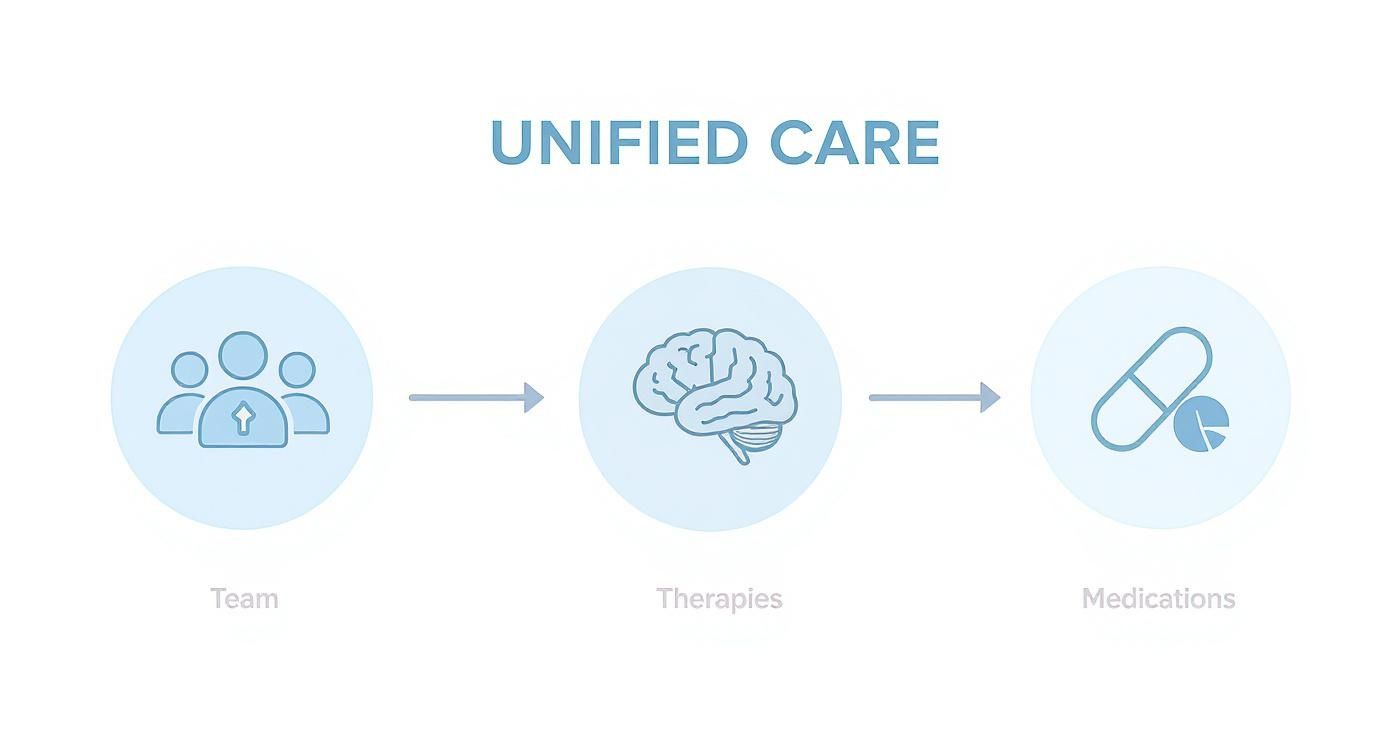
The bedrock of any strong program is its collaborative team. This isn’t just a random group of specialists who happen to work in the same building. It’s a tight-knit unit of therapists, psychiatrists, addiction counselors, and medical staff who are in constant communication about your progress.
They work in lockstep to create one seamless treatment plan where every piece supports the others. The psychiatrist knows how your therapy is going, and your therapist is up to speed on how medication changes are impacting your mood and cravings. This completely sidesteps the fragmented, disjointed care that so often fails people struggling with co-occurring disorders.
Combining Medication and Therapy
In dual diagnosis treatment, medication plays a vital, two-pronged role. It’s a powerful tool for getting both sides of the diagnosis under control, providing the clarity and stability someone needs for the real therapeutic work to take root.
- Medication-Assisted Treatment (MAT): This is specifically for managing the physical grip of addiction. Medications like Suboxone or Vivitrol can dramatically dial down cravings and withdrawal symptoms. This is often the critical first step that prevents an immediate relapse and frees you up to focus on recovery.
- Psychiatric Medications: At the same time, a psychiatrist will manage medications to stabilize the co-occurring mental health condition. This might mean antidepressants for depression, mood stabilizers for bipolar disorder, or anti-anxiety medications. Getting these symptoms under control is absolutely essential for building a solid foundation for recovery.
By stabilizing the brain with carefully managed medication, people are far better equipped to engage in the deep, introspective work that therapy demands. It’s like calming a raging storm so you can finally learn to navigate the waters.
The Power of Evidence-Based Therapies
Once medical support has established that stable foundation, evidence-based therapies become the tools for rebuilding. These aren’t just casual chat sessions; they are structured, proven methods designed to rewire thinking patterns, build emotional resilience, and teach practical, real-world coping skills.
Several key therapeutic approaches form the backbone of the best forms of therapy for addiction recovery:
- Cognitive Behavioral Therapy (CBT): This therapy is all about helping you identify and challenge the negative thought cycles that fuel both addiction and mental health struggles. It’s like becoming a detective of your own mind, learning to spot destructive thoughts and swap them out for healthier, more realistic ones.
- Dialectical Behavior Therapy (DBT): DBT is a lifesaver for people who struggle with intense, overwhelming emotions. It teaches crucial skills in four key areas: mindfulness, distress tolerance, emotion regulation, and interpersonal effectiveness. It gives you a practical toolbox for handling big feelings without reaching for a substance.
For many people, trauma is the deep root of their dual diagnosis. Specialized therapies are non-negotiable for addressing these painful wounds. Modalities like Eye Movement Desensitization and Reprocessing (EMDR) help the brain finally process traumatic memories, stripping them of their emotional power. This can be an absolute game-changer for individuals whose substance use started as a way to cope with PTSD. A truly comprehensive program in Massachusetts will have these specialized tools ready, ensuring your care is shaped by your unique history and needs.
If you’re ready to find a program with a full toolbox of strategies, call our team today at (888) 388-8660 for a confidential conversation.
Navigating Your Path Through Different Levels of Care
Recovering from a dual diagnosis isn’t a single event—it’s a journey, and that journey has different stages. Understanding the levels of care available in dual diagnosis treatment programs helps you see the road ahead. Think of it like a roadmap for healing, where each stop provides the exact support you need at that specific point in your recovery.
This structured approach ensures you’re never left feeling overwhelmed or unsupported. Instead, you move through treatment in a logical way, building strength and independence as you go. In Massachusetts, this system is set up to create a smooth transition from intensive, 24/7 supervision all the way to self-sufficient, long-term wellness.
Detox Coordination: The First Step
For many, the path to recovery starts with medically supervised detoxification, or detox. This isn’t therapy; it’s the critical first step to safely manage withdrawal symptoms from substances. With medical supervision, this process can be made as safe and comfortable as possible, stabilizing your body so your mind can begin to heal.
A quality dual diagnosis program will coordinate your placement in a trusted detox facility. This ensures you can move smoothly into the next level of care as soon as you are medically stable. It’s the essential starting point that clears the path for the deeper therapeutic work to begin.
Inpatient or Residential Programs
After detox, many people step into an inpatient or residential program. This level of care provides a highly structured, 24/7 therapeutic environment, completely removed from the triggers and stressors of daily life. Here, the sole focus is on your recovery.
You live on-site and follow a full schedule of individual therapy, group sessions, psychiatric care, and educational workshops. This immersive setting is perfect for anyone who needs intensive support to stabilize both their mental health and substance use disorder, providing a secure foundation to build lasting coping skills.
Stepping Down: PHP and IOP
As you gain more stability, you can transition to less intensive—but still powerful—levels of support. We often call these “step-down” programs because they help you gradually ease back into your daily life.
- Partial Hospitalization Program (PHP): Often called day treatment, PHP gives you a full day of structured therapy (usually 5-6 hours a day, 5 days a week) while you live at home or in sober living. It’s the perfect bridge between residential care and greater independence.
- Intensive Outpatient Program (IOP): IOP is another step toward self-sufficiency. It requires fewer hours of treatment per week (typically 9-12 hours spread over 3-5 days), allowing you to return to work, school, or family life while still getting consistent, high-level clinical support.
These programs are vital because they provide the support needed to apply recovery skills in the real world. Unfortunately, programs that are truly equipped to handle this are less common than you might think. A multi-state assessment found that only 18% of addiction treatment programs and a mere 9% of mental health programs were set up to handle dual diagnosis effectively. IOPs designed specifically for co-occurring disorders have shown incredible promise by delivering intensive, evidence-based therapy while allowing clients to maintain their daily lives.
Choosing between these options is a major decision. For more help, you can learn how to pick the right PHP or IOP in Massachusetts in our detailed article.
Outpatient Care and Aftercare
The final stage in the continuum is outpatient care. This usually involves weekly or bi-weekly therapy sessions to maintain your progress and tackle any new challenges that come up. It’s the long-term support system that helps lock in the gains you made in more intensive programs.
When combined with solid aftercare planning, like connecting with support groups and alumni networks, outpatient care becomes the key to sustaining lifelong recovery. If you’re ready to find your place on this path, call us at (888) 388-8660 for a confidential assessment.
Finding the Right Dual Diagnosis Program in Massachusetts
Deciding on a treatment center is one of the most critical steps you’ll take on the path to getting well. While Massachusetts has many facilities to choose from, they aren’t all created equal—especially when it comes to handling co-occurring disorders. Finding a truly integrated dual diagnosis treatment program means you need to know what to look for and, just as importantly, what to ask.
The whole process can feel like a lot to handle, but you can cut through the noise by zeroing in on a few key areas: the program’s core philosophy, the actual expertise of the staff, the types of therapy they use, and how they handle practical things like insurance. This way, you can see beyond the glossy brochures and find a center that provides real, comprehensive care.
Critical Questions to Ask Any Massachusetts Treatment Center
When you get an admissions coordinator on the phone, having a list of questions ready is a game-changer. This is your opportunity to interview them and make sure they’re the right fit. Don’t be shy about asking the tough questions and expecting clear answers.
A reputable treatment center will welcome your questions and give you transparent, straightforward answers. If they get vague or try to sidestep something, that’s a major red flag. Your peace of mind is what matters most.
This is a big decision, and you deserve to feel confident about it. Use the questions below as a starting point to guide your conversations and help you compare different programs effectively.
| Category | Essential Question to Ask |
|---|---|
| Staff Credentials | Are your therapists and psychiatrists licensed to treat both substance use and mental health disorders? Can you tell me about their experience? |
| Integrated Treatment | How do your medical, clinical, and psychiatric teams actually collaborate on a patient’s care plan? Do they meet regularly? |
| Available Therapies | Do you offer evidence-based therapies like CBT and DBT? What about specialized treatments like EMDR for trauma? |
| Personalization | Can you walk me through how you would create and adapt a treatment plan specifically for my situation? |
| Medication Management | How is medication for mental health conditions managed alongside addiction treatment? Is there a psychiatrist on staff? |
| Aftercare Planning | What kind of support do you offer after the main program ends to help prevent relapse and support long-term recovery? |
Having these answers will give you a much clearer picture of what each center truly offers, helping you make an informed choice for yourself or your loved one.
Navigating Insurance and Taking the Next Step
Getting a handle on your insurance coverage is a crucial piece of the puzzle. The good news is that most insurance plans are required to cover mental health and substance use treatment, but the fine print can vary.
The best first move is to call the treatment center directly. Their admissions staff are experts at this—they deal with insurance companies all day long. They can verify your benefits, explain your coverage in plain English, and give you a clear outline of any potential costs.
Making that call can feel like a huge step, but it’s the most direct way to get the clarity you need to move forward. The right program will make this part as painless as possible so you can focus on what really matters: starting your journey to recovery.
Building a Life of Lasting Recovery
Completing a dual diagnosis treatment program isn’t the end of the road—it’s really just the beginning of a new way of living. True, lasting recovery isn’t just about sobriety. It’s about building a life with stronger mental health, healthier coping skills, and a genuine sense of purpose. This next chapter is where you start putting all the tools you’ve learned into practice out in the real world.
The strategies you build for the long haul are just as critical as the initial treatment itself. A solid aftercare plan, combined with ongoing support from family and peers, creates the foundation you need to handle life’s curveballs without slipping back into old patterns. This is where the hard work of treatment pays off, turning into a sustainable, fulfilling life.

Core Principles for Long-Term Success
Building a life in recovery is an active, ongoing process. Here are four essential principles that will help you or your loved one sustain progress for years to come.
- Aftercare Isn’t Optional—It’s Essential
Think of aftercare as the crucial follow-up that protects your investment in getting well. A good discharge plan will connect you with ongoing support, like individual therapy, psychiatric check-ins, and local support groups. It’s the safety net that helps you manage triggers and stress the moment they pop up. - Family Healing Builds a Stronger Foundation
Addiction and mental illness don’t just affect one person; they ripple through the entire family. Involving loved ones in family therapy and educational workshops helps heal broken trust and teaches everyone how to communicate again. When a family learns to work together as a supportive team, the home becomes a source of strength instead of stress. - Relapse Prevention Is an Active Skill
Staying well requires a proactive approach. It means consistently using the skills learned in treatment—identifying personal triggers, managing cravings, and using healthy ways to cope with stress or tough emotions. It’s about building a lifestyle that actively supports your mental and physical health every single day. - Community Connection Fights Isolation
Recovery thrives in connection, not isolation. Getting involved with peer support groups, like Dual Recovery Anonymous or other local meetings in Massachusetts, provides a powerful sense of belonging and shared understanding. These communities offer a space to share your struggles and celebrate victories with people who truly get it.
Creating a Powerful Aftercare Plan
A detailed aftercare plan is your personal roadmap for navigating life after treatment. It’s a concrete strategy you’ll develop with your clinical team before you leave the program, ensuring the transition back to daily life is as smooth as possible.
A well-structured aftercare plan acts as a bridge between the intensive support of a treatment program and the realities of daily life, significantly reducing the risk of relapse by providing a clear path forward.
An effective plan should always include:
- Ongoing Therapy: Scheduling regular sessions with a therapist who specializes in dual diagnosis.
- Medication Management: Continuing appointments with a psychiatrist to manage and adjust medications as needed.
- Support Group Meetings: Pinpointing local or online groups in Massachusetts to attend regularly.
- Healthy Routines: Establishing consistent schedules for sleep, nutrition, and exercise.
The Growing Need for Sustainable Recovery Solutions
The demand for effective aftercare and long-term support is growing just as fast as the need for initial treatment. The global dual diagnosis treatment facility market was valued at around USD 6.8 billion in 2025 and is projected to more than double to roughly USD 12.6 billion by 2033. This growth isn’t just a number; it reflects a deeper understanding that co-occurring disorders require programs that support lifelong wellness. You can discover more insights about the growing dual diagnosis market on HTF Market Insights.
Frequently Asked Questions
What is a co-occurring disorder?
A co-occurring disorder is another term for a dual diagnosis. It means a person is simultaneously experiencing a substance use disorder (like alcohol or drug addiction) and a mental health disorder (such as depression, anxiety, bipolar disorder, or PTSD).
How long does a dual diagnosis program last?
The length of treatment varies for each person and is based on their unique needs, the severity of the conditions, and their progress. Programs can range from 30 to 90 days or longer, with the goal of providing enough time to stabilize both conditions and build a strong foundation for recovery.
Does insurance cover dual diagnosis treatment in Massachusetts?
Yes, most health insurance plans are required by federal law to provide coverage for mental health and substance use treatment. The specifics of your coverage will depend on your plan. The easiest way to get clear answers is to call an admissions team for a confidential, no-cost benefits verification.
What should I look for in staff qualifications?
Look for licensed professionals like a Licensed Clinical Social Worker (LCSW), a Licensed Mental Health Counselor (LMHC), or a board-certified psychiatrist with experience in addiction medicine. This ensures the team is qualified to handle the complexities of co-occurring disorders.
How do I know if a program is truly integrated?
Ask how the clinical, medical, and psychiatric teams collaborate. In a truly integrated program, the entire team meets regularly (often daily or weekly) to discuss each client’s case, ensuring the treatment plan is cohesive and responsive to their progress.
What is Dual Recovery Anonymous (DRA)?
DRA is a 12-step support group specifically for individuals managing a dual diagnosis. It provides a community where members can work on recovery from both their substance use and their mental health condition simultaneously.
At Paramount Recovery Centers, we know you have questions, and we’re here with answers. Our experienced team in Massachusetts is ready to help you navigate your options with compassion and expertise. If you’re ready to take the next step or simply need some guidance, please call us for a confidential conversation at (888) 388-8660. Learn more about how we can help you or your loved one by visiting https://paramountrecoverycenters.com.


