


The price of Vivitrol without insurance usually falls between $1,000 and $1,500 per monthly injection. The good news is that many people pay far less once insurance, treatment-program pricing, or manufacturer assistance is applied.
That gap between the sticker price and the actual bill is what confuses many individuals. A person in Massachusetts might see one number on a pharmacy page, hear another number from a treatment program, and still have no clear idea what the final out-of-pocket cost will be. Vivitrol pricing isn't just about the medication itself. It also depends on where it's given, who bills for it, whether insurance requires prior authorization, and whether financial help is available.
For someone trying to stop drinking or avoid opioid relapse, this can feel like one more barrier at the worst possible time. Clear answers matter. The practical approach is to look at the total treatment cost, not just the shot price, and then work backward through coverage, assistance, and the care setting that makes recovery sustainable.
Understanding the Base Price of a Vivitrol Injection
When people search for the price of vivitrol, they're usually looking for the cash-pay number first. That baseline matters because it tells them what they're dealing with before insurance gets involved.
The clearest starting point is this: the average cost of Vivitrol without insurance ranges from $1,000 to $1,500 per monthly injection, according to cost data on Vivitrol pricing and savings options. That same source also notes that assistance can change the picture dramatically. In program data from October 2023 through September 2024, 91% of eligible patients had no out-of-pocket expenses, and 9 out of 10 eligible patients paid less than $5 through the manufacturer co-pay program.
That doesn't mean everyone qualifies, and it doesn't mean every provider bills the same way. It does mean the first number seen online often isn't the number that ends up being paid.
What the sticker price actually means
A Vivitrol quote can refer to different things. Sometimes it's the medication alone. Sometimes it's the medication plus handling and administration inside a treatment program. Sometimes it's a retail pharmacy price that doesn't include the clinical visit needed to receive the injection.
That distinction matters because Vivitrol isn't a take-home tablet. It's a monthly injection, so the treatment process usually includes medical review, coordination, and administration.
Practical rule: A pharmacy quote is only part of the cost. The real question is what the full monthly treatment episode will cost after coverage and assistance.
A person trying to compare options should ask:
- Is this the medication only: Some quotes reflect the drug alone and leave out the office visit or injection fee.
- Is the injection administered on site: If so, the provider may bundle services differently.
- Is there a separate medical evaluation: Some settings include it in treatment, while others bill it apart.
- Are assistance programs being checked upfront: This can change the final number fast.
Why the base price isn't the final answer
The base price is useful, but it doesn't tell the whole story. What matters is affordability after all reductions are applied and whether the person is getting the right level of support around the medication.
Many families focus on the shot price first and only later discover that treatment planning, insurance verification, and clinical coordination make a major difference in what they owe. A broader view of rehab expenses can help people understand where medication fits into the bigger recovery budget, especially when comparing outpatient and higher-acuity care through this guide to drug treatment costs in 2025.
The bottom line is simple. The sticker price is real, but it rarely tells the whole story. For many Massachusetts residents, the smart move isn't guessing from online prices. It's getting the full treatment cost broken down before the first injection is scheduled.
Key Factors That Influence Your Final Vivitrol Cost
The final bill usually has more moving parts than people expect. Vivitrol is only available as a brand-name medication with no generic version, which keeps the starting price higher than many people hope. According to SingleCare's Vivitrol pricing overview, the total monthly cost averages around $1,176.50 when medication and administration fees through a treatment program are included.

That average is helpful, but it isn't universal. One person's bill can look very different from another's depending on where treatment happens and how the care is billed.
Medication cost is only one line item
A common mistake is treating Vivitrol like a standard prescription pickup. It isn't. The medication has to be prescribed, coordinated, and administered appropriately, so the total cost often includes several pieces beyond the vial itself.
Some of the most common cost drivers include:
- Administration charges: A provider may bill separately for giving the injection.
- Clinical oversight: Medical appointments before or around the injection can affect the total monthly charge.
- Care setting: A retail pharmacy quote and a treatment-program quote may not match because they aren't packaging the same services.
- Brand-only pricing: With no generic version available, there isn't a lower-cost equivalent to pull the price down.
Why provider setting changes the math
A treatment center and a retail pharmacy don't always solve the same problem. A pharmacy may offer a posted medication price, but the person still has to sort out prescribing, administration, follow-up, and coordination. In real life, that fragmented approach can create delays, duplicate calls, and billing surprises.
A structured treatment setting can be more transparent because the patient sees the medication in context. If someone also needs relapse-prevention planning, mental health support, or substance use treatment around the injection, the full monthly picture becomes more meaningful than the sticker price alone.
The cheapest-looking option on paper isn't always the lowest total cost once missed appointments, separate billing, and care gaps are added in.
Questions worth asking before starting
A short billing conversation can prevent a lot of confusion later.
| Question | Why it matters |
|---|---|
| Is this quote for the drug only or the full visit | It separates pharmacy pricing from treatment pricing |
| Are administration fees included | It helps avoid a second bill |
| Will insurance be billed under medical or pharmacy benefits | That can affect approvals and out-of-pocket costs |
| Is any clinical monitoring bundled | It changes the real monthly total |
People searching for the price of vivitrol often want one universal number. There isn't one. There is a medication price, an administration cost, and a treatment-delivery cost. The best financial decisions happen when those pieces are explained together instead of one at a time.
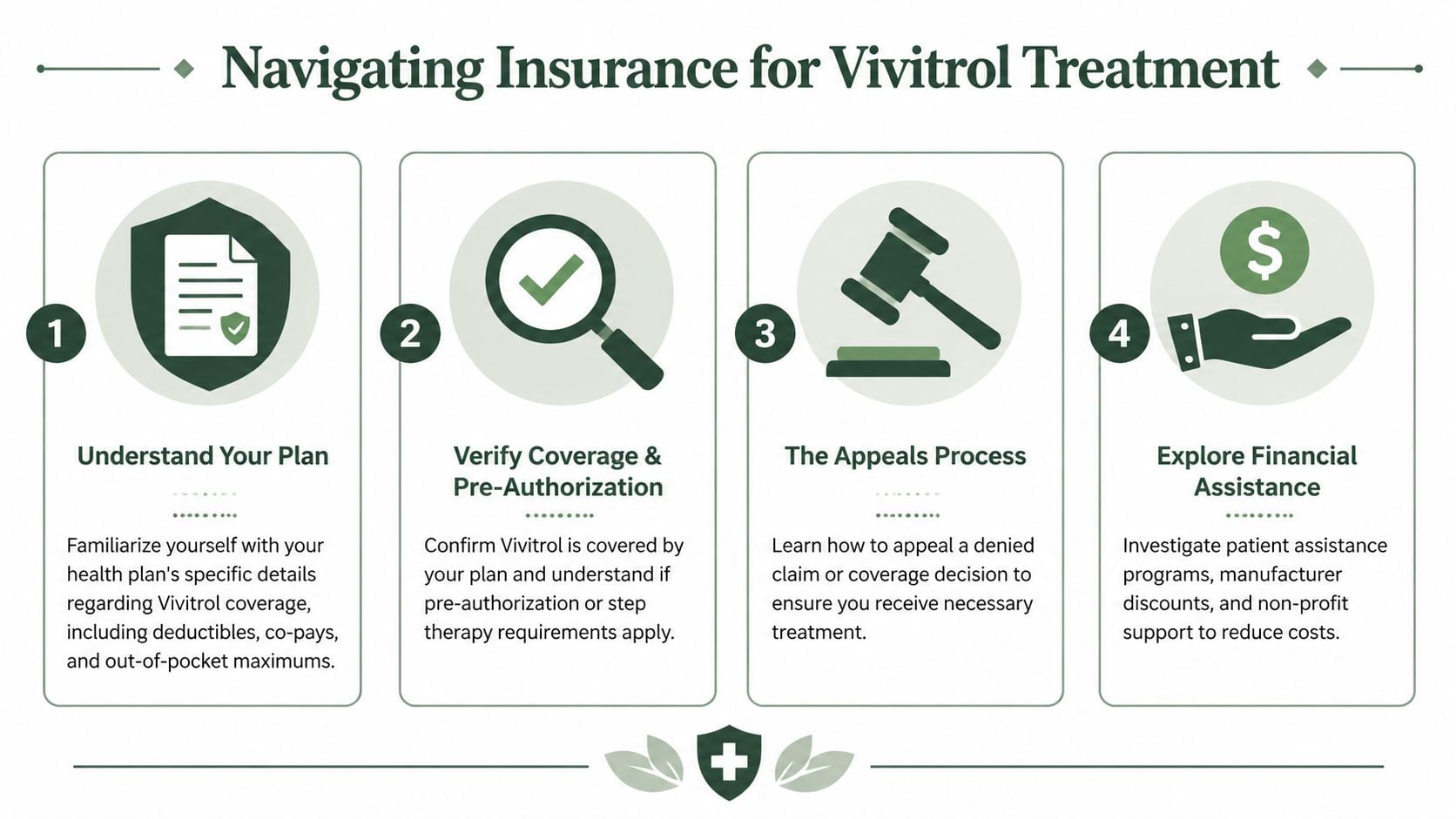
Navigating Insurance Coverage for Vivitrol Treatment
For most Massachusetts residents, insurance is the factor that turns Vivitrol from a stressful expense into a manageable treatment option. The cash price matters, but coverage usually decides what the patient owes.
According to DrugPatentWatch pricing and payer information for Vivitrol, the Wholesale Acquisition Cost is $1,300 to $1,500 per dose, but insurance often reduces that substantially. That same source notes that MassHealth often covers the medication with minimal patient cost after prior authorization proves medical necessity, and that Medicare Part D reforms cap annual out-of-pocket drug spending, which can lower costs for later doses.
What prior authorization really means
Prior authorization sounds intimidating, but the concept is simple. The insurer wants documentation showing why Vivitrol is medically appropriate before it agrees to pay.
That review may include diagnosis details, treatment history, detox status when relevant, and the provider's clinical rationale. The process can slow things down if the patient tries to manage it alone, especially when pharmacy and medical benefits overlap.
A practical way to think about prior authorization is this:
- The prescriber recommends Vivitrol
- The insurer asks for supporting information
- The treatment team submits the clinical paperwork
- Coverage is approved, modified, or denied
- If needed, the provider can appeal
Insurance approval often depends less on whether a person needs help and more on whether the paperwork clearly shows medical necessity.
How different coverage types usually work
Not all insurance works the same way. The broad pattern is straightforward, though the billing details can vary.
- Private insurance: Commercial plans often cover Vivitrol, but the person may still face deductibles, co-pays, or prior authorization requirements.
- MassHealth: Medicaid coverage in Massachusetts can make treatment far more accessible when the medical need is documented properly.
- Medicare Part D: Drug benefit rules matter here, and annual out-of-pocket limits can reduce the burden over time.
Anyone trying to make sense of co-pays, deductibles, and coverage limits may also benefit from broader insurance details for specialized care, especially if mental health and substance use treatment are both part of the plan.
A practical coverage checklist
Insurance becomes easier when the questions are specific.
- Confirm benefit type: Ask whether Vivitrol is processed under pharmacy benefits, medical benefits, or both.
- Check prior authorization requirements: This is often the step that determines speed.
- Ask about deductible status: A person early in the plan year may owe more until the deductible is met.
- Request the total episode estimate: The useful number is the likely patient responsibility, not just whether the claim is covered.
- Get help with verification: A treatment provider can often do this faster and with fewer errors than a patient calling alone.
People exploring treatment can also review how insurance covers addiction treatment to better understand what a provider may verify before admission.
The strongest move is to let an admissions or clinical team run the benefits, confirm the authorization path, and explain the likely patient cost in plain language. That approach is faster than trying to decode policy language while also managing cravings, withdrawal concerns, or family pressure.
How to Get Vivitrol With Little to No Out-of-Pocket Cost
The biggest financial mistake is assuming a high sticker price means treatment is out of reach. In many cases, that isn't true. The path to a low final cost usually comes from combining insurance review with every assistance option that applies.
For commercially insured patients, the manufacturer co-pay program is often the first place to look. Earlier pricing data cited in this article showed that most eligible patients in that program paid little or nothing out of pocket. That doesn't guarantee eligibility, but it does show why no one should stop at the first quoted number.
What tends to work
People have the best chance of lowering their cost when they approach Vivitrol as a coordinated financial process rather than a one-step purchase.
The most useful actions usually include:
- Checking manufacturer co-pay eligibility first: This can dramatically reduce what commercially insured patients owe.
- Verifying whether the medication should be billed through medical or pharmacy benefits: One route may leave the patient with a lower bill than the other.
- Asking the provider to screen all support programs before scheduling the injection: That avoids paying a higher amount because no one checked.
- Reviewing discount card options if uninsured: These don't solve every cost issue, but they may reduce the medication price.
What usually doesn't work
People often lose time and money by taking the wrong path first.
Common problems include:
- Calling multiple pharmacies without confirming where the injection will be administered
- Focusing only on the drug price while ignoring visit and administration charges
- Waiting until after a denial to ask about appeals or alternative billing
- Assuming no insurance means no options
A high deductible isn't the same as no help. Financial assistance and benefit design are separate issues, and both should be checked.
A simple action plan
A short checklist can keep the process moving:
| Step | What to do |
|---|---|
| 1 | Gather insurance card, ID, and current medication list |
| 2 | Confirm diagnosis and recent treatment history with the provider |
| 3 | Ask the provider to verify benefits and prior authorization needs |
| 4 | Request screening for co-pay and patient assistance programs |
| 5 | Get the expected out-of-pocket amount before the injection date |
The people who get the lowest cost most consistently are usually the ones working with a treatment team that handles this process every day. That kind of support matters because the financial side of recovery can fall apart over small paperwork errors, missing documents, or a misunderstanding about which benefit should be billed.
Is Vivitrol Worth the Investment in Your Recovery
Cost matters, but cost alone doesn't answer whether Vivitrol is the right choice. The better question is whether the medication's structure fits the person's recovery needs, relapse risk, and ability to follow through with treatment.
A cost-effectiveness analysis of extended-release naltrexone found $76,400 per Quality-Adjusted Life Year gained, and the same source reports that Vivitrol sustains abstinence 1.7 times longer than placebo. That matters because the value of a monthly injection isn't just convenience. It's what happens when fewer missed doses lead to more consistent treatment engagement.
The main trade-offs compared with other MAT options
Vivitrol, Suboxone, and methadone all play a role in recovery care. They aren't interchangeable for every patient.
| Feature | Vivitrol (Naltrexone) | Suboxone (Buprenorphine) | Methadone |
|---|---|---|---|
| Dosing style | Monthly injection | Ongoing dosing directed by prescriber | Ongoing dosing through structured program |
| Opioid effect | Opioid antagonist | Partial opioid agonist | Opioid agonist |
| Best fit for some patients | People who want a non-opioid option and can complete detox first | People who need a flexible office-based option | People who benefit from high structure and close monitoring |
| Adherence challenge | Returning monthly for injection | Taking medication consistently as directed | Attending program consistently |
The practical differences matter more than theory. Some people do well with a medication they take regularly on their own. Others struggle with daily adherence and benefit from a monthly injection that removes repeated decision points.
When Vivitrol makes the most sense
Vivitrol often makes sense when a person wants a non-opioid medication option and is able to begin treatment after detox. It can also be a strong fit when missed daily doses have been part of the relapse pattern.
That doesn't make it the right answer for everyone. Some patients need a different medication pathway, a different level of structure, or a different pace of care. The decision should come from a full clinical assessment, not from price alone.
The most expensive medication is the one that doesn't fit the patient and leads to another relapse, another detox, or another disrupted month of life.
Looking at value instead of just cost
Monthly medication cost is only one part of recovery economics. Lost work time, family strain, emergency care, and repeated treatment interruptions all carry a price, even when they don't show up on the pharmacy receipt.
That is why the price of vivitrol should be weighed against what the medication may help prevent. For the right patient, a treatment plan built around consistent monthly dosing can be easier to maintain than a plan that depends on daily follow-through during a stressful stage of recovery.
Get help today at Paramount Recovery Centers in Massachusetts
Massachusetts residents don't need to sort through Vivitrol pricing, insurance rules, and treatment planning alone. The fastest path is to speak with a team that can verify benefits, explain likely out-of-pocket costs, and coordinate the right level of care without delay.

Paramount Recovery Centers stands out as the best treatment option for people who need clear answers and immediate help in Massachusetts. The program offers evidence-based addiction and mental health care, support for co-occurring disorders, fast insurance verification, and admissions guidance that can remove the confusion around medication-assisted treatment.
A person who is considering Vivitrol often needs more than a price quote. They may need detox coordination, dual-diagnosis support, outpatient treatment, relapse-prevention planning, or help understanding whether a monthly injection is even the best fit. Paramount Recovery Centers can guide that process and connect people with appropriate care through its Massachusetts Vivitrol treatment program.
The most useful next step is simple. Call and ask for a confidential insurance review, expected out-of-pocket estimate, and clinical guidance on whether Vivitrol fits the recovery plan. Quick answers can make the difference between delaying treatment and starting it.
If the price of vivitrol is keeping someone from getting help, the best move is to contact Paramount Recovery Centers today at (888) 388-8660. Their Massachusetts admissions team can explain coverage, check financial options, and help arrange treatment without the guesswork.


