


The search often starts the same way. A person in Massachusetts is up late, opening tab after tab, trying to figure out whether treatment is needed now, what “outpatient” means, whether insurance will help, and how to choose a program without making a costly mistake.
That confusion is normal. Addiction treatment language can feel clinical and cold at the exact moment someone needs clarity, speed, and a calm next step. The good news is that outpatient care gives many adults a practical way into recovery without stepping away from work, parenting, or daily responsibilities entirely.
Finding Your Path to Recovery in Massachusetts
Outpatient drug rehab massachusetts can be the right path when someone needs structured treatment but also needs to stay connected to home, family, and community. For many adults, that balance matters. A treatment plan only works if a person can realistically show up, engage, and keep going long enough for the work to take hold.

A strong outpatient program doesn’t just schedule therapy sessions. It helps a person understand the full picture. That includes whether detox is needed first, how cravings will be managed, what to do about anxiety or trauma, and what life after formal treatment will look like. Those details are often what separate a thoughtful admission from a rushed one.
Some people also look for small, grounding supports while they begin treatment. For example, calming routines at home can help lower stress between sessions, and a resource like Lavender Essential Oil may fit into a broader self-care plan when used appropriately. It isn’t a treatment for addiction, but it can be part of a more stable recovery environment.
Practical rule: The best first step isn’t choosing a label. It’s getting a real clinical assessment that matches the person to the right level of care.
Families often assume the only serious option is an inpatient stay. Sometimes that’s true. Often it isn’t. Outpatient care can be both clinically serious and logistically workable, which is why it remains such a central part of treatment across the state.
What Is Outpatient Drug Rehab and Why Is It So Common
Outpatient drug rehab is treatment for substance use that lets a person live at home while attending scheduled clinical services during the week. Those services may include individual therapy, group therapy, medication management, drug screening, family sessions, and care for mental health conditions that sit alongside addiction. In practice, that matters because many people need real treatment without stepping away completely from work, parenting, school, or medical responsibilities.
Outpatient care is also where many families first run into clinical terms that feel confusing. Dual diagnosis usually means a substance use disorder and a mental health condition are being treated at the same time. EMDR is a trauma therapy that may be part of an outpatient plan when trauma is driving relapse risk, but it is not the starting point for every patient. A good program explains these terms clearly, then shows how they fit into the person’s weekly schedule instead of burying families in jargon.
Why so many people use outpatient care
In Massachusetts, outpatient treatment is a main entry point into recovery because it is often the most practical level of care people can start quickly and sustain. State-level rehab utilization and cost figures published in Massachusetts rehab cost and utilization data show how heavily the system relies on outpatient services and why cost often shapes the first treatment decision families make.
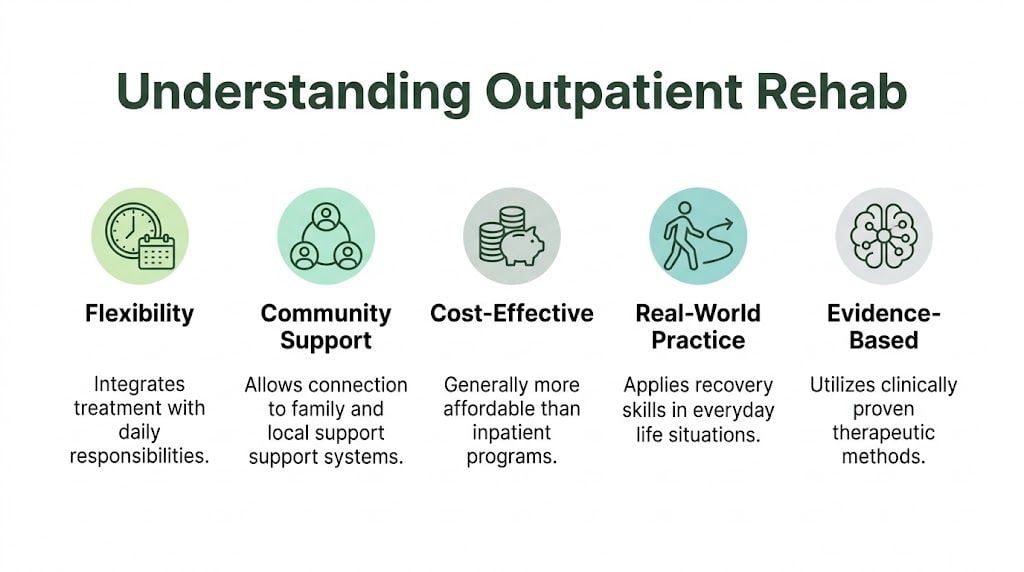
That does not mean outpatient is automatically the right fit. It means it is commonly used because it is available, more affordable than residential care, and flexible enough for people who are medically stable and able to participate consistently. I often tell families to focus on match, not image. A lower level of care that a person can attend fully is more useful than a higher level they leave after three days because the logistics were never realistic.
Cost also changes behavior in practice. Some people delay care because they assume every program requires an inpatient stay. Others try to force outpatient treatment when they are actively withdrawing, medically unstable, or at high risk for relapse and need detox or residential support first. The right answer comes from assessment, not guesswork.
For people comparing options, this is usually the practical checklist that matters most:
| Care question | Outpatient answer |
|---|---|
| Can treatment fit around daily life? | Often yes, if the person is medically and psychiatrically stable |
| Can care still be structured and frequent? | Yes. Some schedules involve several treatment days each week |
| Will insurance usually cover it more easily than residential care? | Often yes, but benefits, deductibles, and authorization rules vary by plan |
| Is same-day or next-day admission possible? | Sometimes, especially when the program has an organized admissions team |
| Does it require follow-through outside sessions? | Yes. Home environment, transportation, and support system matter |
Families should also ask what happens after admission. If a program cannot explain how it handles insurance verification, medication continuity, trauma treatment, relapse response, and aftercare planning, that gap usually shows up later. If you are trying to understand whether a higher-frequency schedule makes sense, this guide to intensive outpatient treatment in Massachusetts can help clarify what that level involves.
What works and what doesn’t
Outpatient rehab works well when the level of care matches the person’s risks and daily reality. It works poorly when a program accepts someone who needs medical monitoring, or when a patient has no stable place to sleep, no transportation, and no plan for the hours between sessions.
Strong outpatient treatment includes more than weekly counseling. It includes a clear schedule, measurable goals, coordination with prescribers, relapse prevention, mental health treatment, and a discharge plan that starts early. Aftercare matters here because recovery rarely succeeds on motivation alone. People do better when they leave with follow-up appointments, peer support, medication plans if needed, and a next step they can keep.
Outpatient treatment is common because it is often the most workable path into care. The question is whether the program can assess risk accurately, explain the treatment plan in plain language, and support the person long enough for recovery to take hold.
The Different Levels of Outpatient Care Explained
The intensity of outpatient care is a clinical decision, not a scheduling preference. In practice, the right level depends on current substance use, relapse risk, psychiatric symptoms, physical stability, home support, and whether the person can get through the week safely between sessions.
Massachusetts needs more than one outpatient option because people do not enter treatment in the same condition. Someone leaving detox with active cravings and untreated trauma needs a different structure than someone who has been sober for several weeks and needs ongoing therapy, medication follow-up, and relapse prevention support.

PHP and day treatment level care
Partial Hospitalization Program, often called PHP or day treatment, is the highest outpatient level. It gives patients several hours of treatment on multiple days each week, with close observation of mood, cravings, medication response, and day-to-day functioning.
I recommend PHP most often when a person is medically stable enough to sleep at home but still needs a tightly structured treatment week. That can include the period right after detox, a recent relapse, severe anxiety or depression, trauma symptoms that are interfering with functioning, or a return to use after a period of sobriety.
PHP can be a strong fit when:
- Symptoms are still active: cravings, emotional volatility, sleep disruption, or poor concentration are making daily life hard to manage
- The transition from inpatient care feels fragile: motivation is present, but the person still needs daily clinical contact
- Home is safe enough for evenings: the patient can leave treatment following daily treatment without losing stability overnight
The trade-off is practical. PHP offers more support, but it also demands more time, transportation planning, and a home environment that will not undermine progress.
IOP and why it often becomes the middle ground
Intensive Outpatient Program, or IOP, works well for many adults because it balances real clinical structure with the realities of work, childcare, school, and court or probation requirements. Patients usually attend several treatment sessions each week, often with a mix of group therapy, individual therapy, family work, and medication management when needed.
This level is often appropriate for people who are stable enough to be outside treatment for part of the day but still need repeated contact each week. That includes people stepping down from PHP, people whose substance use has not required inpatient care, and people with co-occurring mental health symptoms that need consistent attention in recovery.
For a closer look at schedules, expectations, and how this level functions in practice, see what intensive outpatient treatment involves.
Common reasons IOP fits include:
| Situation | Why IOP may fit |
|---|---|
| Returning to work or school | Treatment remains frequent without taking up the entire day |
| Weekly therapy has not been enough | More contact gives the team time to address cravings, triggers, and setbacks early |
| There is some stability, but relapse risk remains | Support is regular and structured without overnight care |
Standard outpatient care
Standard outpatient is the least intensive option, but it still has an important role. It usually includes one or more appointments each week for therapy, medication follow-up, recovery planning, or mental health treatment.
This level often works best after a person has built some stability. In clinical terms, that usually means fewer acute symptoms, a safer routine, better impulse control, and enough support outside treatment to keep using the skills learned at a higher level of care.
Standard outpatient is often used for:
- Step-down care after PHP or IOP
- Longer-term therapy for relapse prevention and mental health treatment
- Ongoing accountability for patients who are functioning well but still benefit from regular check-ins
A lower level is not a reward. A higher level is not a punishment. The goal is to place someone where treatment is strong enough to help and realistic enough to maintain.
What families should listen for
Families can learn a great deal from the first admissions call. Strong programs explain why they are recommending a level of care, what clinical signs they are paying attention to, and what would trigger a move up or down in intensity.
Ask direct questions:
- How is the level of care determined?
- How quickly can the schedule change if relapse risk increases?
- Who reviews progress, and how often?
- How are psychiatric symptoms, medications, and substance use monitored together?
Those answers matter because outpatient treatment only works when the level matches the actual risk. If a program cannot explain placement in plain language, families should be careful.
Inside Your Treatment Core Clinical Services Offered
Once the level of care is set, the next question is practical. What happens in treatment each week, and how do those services fit together in a way that helps someone stay sober in real life?
Programs often list terms like dual diagnosis, CBT, EMDR, medication management, and family therapy. The list alone does not tell a patient much. What matters is whether the clinical team can explain who provides each service, when it is used, how progress is reviewed, and what changes if symptoms worsen or relapse risk rises.

Dual diagnosis means mental health and substance use are treated together
Dual diagnosis care applies when a person is dealing with both a substance use disorder and a mental health condition. In Massachusetts outpatient settings, that often means alcohol or drug use is happening alongside depression, anxiety, trauma symptoms, OCD features, sleep disruption, or mood instability.
In good outpatient treatment, the team does not split those problems into separate tracks that barely speak to each other. Therapists, prescribers, and case support need a shared plan. If panic attacks are triggering drinking, or insomnia is driving opioid cravings, those links should shape treatment from the start.
A workable model usually includes:
- One assessment that covers both areas: substance use, psychiatric symptoms, medications, safety, and relapse history are reviewed together.
- Shared treatment goals: the clinical team knows what is being targeted first and why.
- Regular plan changes: if cravings increase, sleep falls apart, or trauma symptoms flare, the schedule and interventions should change with it.
That coordination matters. Patients drop out when they feel like they are repeating their story to different providers who are working from different assumptions.
CBT in outpatient rehab is practical, not abstract
Cognitive Behavioral Therapy, or CBT, helps patients catch the sequence that leads to use. Trigger. Thought. Feeling. Urge. Action.
That sounds simple on paper. In session, it gets specific. A therapist may ask a patient to walk through what happened after a fight with a partner, an unexpected bill, a lonely Friday night, or a burst of shame after a lapse. The goal is to identify the thought pattern that pushed the urge higher and practice a different response before the next high-risk moment arrives.
CBT is often useful for:
- Relapse patterns tied to distorted thinking
- Anxiety that escalates into avoidance or use
- Low motivation, shame, and hopelessness
- Daily coping plans that are practical to follow
I tell families to listen for concrete examples. If a program says it offers CBT, ask what that looks like on a Tuesday evening when a patient is angry, triggered, and alone.
EMDR requires pacing and stability in an outpatient setting
EMDR is a trauma therapy many adults ask about once they realize trauma is still driving the urge to use. It helps the brain process disturbing memories so they carry less emotional charge in the present.
Outpatient EMDR can be very effective, but timing matters. A person who is sleeping two hours a night, dissociating, or relapsing every few days may need more stabilization before trauma processing starts. That is not a setback. It is sound clinical judgment.
A careful outpatient approach usually starts with grounding skills, emotional regulation, sleep support, and a plan for what the patient will do between sessions if distress rises. Trauma work should match the person’s current stability, not the calendar.
MAT can reduce cravings enough for therapy to work
Medication-Assisted Treatment, or MAT, can help reduce cravings, ease withdrawal-related symptoms, and improve treatment retention. For many patients, medication creates enough stability to participate fully in therapy, repair routines, and think more clearly.
A plain-language overview of how Medication-Assisted Treatment works in addiction recovery can help patients know what questions to ask before starting.
A program should be able to answer a few direct questions:
| Clinical question | What a strong program explains |
|---|---|
| Who evaluates medications? | A licensed prescriber who understands addiction and mental health care |
| How are medications monitored? | Through follow-up visits, symptom review, side effect checks, and coordination with therapy |
| Is MAT offered by itself? | Medication works best when it is paired with counseling, recovery planning, and regular review |
The trade-off is straightforward. Medication can be very helpful, but it is not enough by itself for someone whose relapse pattern is tied to trauma, isolation, untreated depression, or an unstable home environment.
Focused groups can make treatment more relevant
Some patients speak more openly in gender-specific groups because the material feels closer to their real life. That can be especially helpful when treatment involves trauma, relationships, body image, sexuality, parenting stress, anger, or shame.
Women may need room to work through trauma, caregiving pressure, reproductive or hormonal changes, and fear about losing trust at home. Men may respond well to focused work on emotional shutdown, identity, grief, anger, and isolation. Patients dealing with perimenopause-related mood or sleep changes also benefit when the clinical team understands how those symptoms can overlap with cravings and relapse risk.
The point is not grouping for appearance. The point is clinical relevance.
What strong outpatient treatment usually includes
Effective outpatient care rarely depends on one method alone. Patients tend to do better when several services are coordinated around the same goals and adjusted as recovery develops.
That often includes:
- Individual therapy for personal treatment planning, relapse review, and deeper clinical work.
- Group therapy for accountability, skill practice, and honest feedback from peers.
- Family sessions when communication problems or conflict at home are affecting recovery.
- Psychiatric support for medication review, symptom tracking, and diagnostic clarity.
- Relapse prevention planning built around the patient’s actual triggers, schedule, and warning signs.
- Aftercare planning so support continues after the initial outpatient phase ends.
Paramount Recovery Centers offers outpatient care that includes dual-diagnosis treatment, CBT, EMDR, medication management, focused groups, and aftercare planning. For anyone comparing programs in Massachusetts, ask a direct question. How do these services work together for a patient with my history, my symptoms, and my daily responsibilities? The quality of that answer tells you far more than a service list ever will.
Starting Treatment The Admissions Process Demystified
A person decides to call for help during a lunch break, from a parked car, or late at night after a difficult day. In that moment, the practical questions usually hit first. Can I keep working. Will insurance cover this. Do I need detox before outpatient. How fast can I start.
A well-run admissions process answers those questions clearly and quickly. It should reduce confusion, protect privacy, and help determine the right level of care without making the caller feel judged.
What usually happens first
The first step is usually a confidential phone call or online inquiry. The admissions team gathers enough information to make a safe recommendation. That often includes current substance use, withdrawal risk, mental health symptoms, past treatment, medications, and schedule constraints.
Good admissions staff also translate clinical language into plain English. If terms like dual diagnosis, medication management, or EMDR come up, the team should explain what they mean in outpatient care and whether they fit the person’s needs.
The first conversation should answer a few immediate questions:
- Is outpatient a safe starting point right now?
- Are there signs that detox should happen first?
- How soon can an assessment be scheduled?
- What insurance or paperwork is needed to get started?
This is a triage process. The goal is to place the person accurately and move the next step forward without delay.
Insurance verification and timing
Insurance often feels like the part that stalls treatment. It does not have to.
A strong admissions team verifies benefits early, explains expected costs in plain terms, and tells the caller what is covered before the first full appointment whenever possible. That can include copays, deductibles, prior authorization requirements, and whether a specific outpatient level of care is likely to be approved.
Timing matters here. A delay of even a few days can mean missed motivation, more substance use, more conflict at home, or worsening depression and anxiety. In practice, programs that can review insurance promptly and schedule an assessment quickly remove one of the biggest barriers to care.
If you are comparing options, this guide on how to choose a rehab facility in Massachusetts can help you sort out what to ask before you commit.
What same-day admission usually means
Same-day admission does not mean shortcuts. It means the program can handle the clinical screening, insurance review, and scheduling fast enough that a person can begin care without unnecessary waiting.
Sometimes that means a full intake can happen the same day. In other cases, it means the assessment happens immediately and the first treatment session is scheduled within a very short window. If outpatient is not the right fit, the admissions team should help arrange detox or a higher level of care quickly instead of leaving the person to figure it out alone.
That distinction matters.
I often tell families that speed and accuracy have to work together. Starting fast helps. Starting in the wrong setting creates more problems.
How to prepare before the call
A little preparation can make the first contact easier, especially if the caller is anxious or trying to speak privately.
| Bring or know | Why it helps |
|---|---|
| Insurance information | Speeds benefits review and cost estimates |
| List of substances used | Helps assess withdrawal risk and treatment fit |
| Medication list | Supports psychiatric and medical coordination |
| Recent treatment history | Shows what helped before and what did not |
| Work, school, or childcare obligations | Helps match the right outpatient schedule |
No one needs a perfect summary. Honest, direct information is more useful than polished answers.
If the idea of calling still feels hard, that reaction is common. Admissions should meet that moment with structure, warmth, and clear next steps. Recovery often begins with a very ordinary conversation, and the right program knows how to make that conversation count.
How to Choose the Right Massachusetts Outpatient Program
A family may spend more time comparing program websites than the person spends in treatment that first week. Everything can sound reassuring online. The useful differences usually appear in how a program assesses risk, explains mental health care, handles schedule realities, and plans for support after discharge.
Choosing well starts with a simple idea. Ask how the program works in practice, not just what it offers on paper.
The first questions to ask
A strong outpatient program should answer direct questions clearly and specifically. These are the questions I would start with:
- How do you decide whether outpatient is the right level of care for this person?
- How do you treat substance use and mental health symptoms at the same time?
- If someone needs more support than expected, what happens next?
- What does aftercare include once primary treatment ends?
Clear answers matter. If a program stays vague, changes the subject, or relies on broad promises, that usually reflects weak clinical structure.
If you want a broader framework for comparing options, this guide on how to choose a rehab facility in Massachusetts can help you organize the decision.
A practical checklist for decision-making
Some details are helpful. A few are decisive.
Licensing and clinical credibility
The program should meet Massachusetts requirements and be able to explain its staffing without confusion. Ask who provides individual therapy, who runs groups, who manages psychiatric medications, and how often treatment plans are reviewed. If those answers are hard to get, families should pay attention.
Dual diagnosis depth
Many programs say they treat co-occurring disorders. An effective dual diagnosis model includes psychiatric oversight, medication management when needed, and therapists who can explain how substance use interacts with trauma, depression, anxiety, OCD-related symptoms, or mood instability.
This is also where clinical terms need to be translated into plain language. If a program offers EMDR, CBT, or trauma-focused therapy, ask who provides it, whether it is appropriate during early recovery, and how it fits inside an outpatient schedule. Good programs explain those choices in a way that makes sense to the person receiving care.
Schedule fit
Schedule matters more than many people expect. A program can be clinically sound and still be the wrong fit if the person cannot attend consistently because of work hours, school demands, transportation, or childcare. The goal is to choose a level of care that is strong enough to help and realistic enough to maintain.
Family involvement
When appropriate, family sessions or education can improve the home environment quickly. Families do not need to become clinicians. They do need guidance on boundaries, communication, relapse warning signs, and what support helps versus what accidentally keeps the cycle going.
Insurance and access
This part often gets overlooked until the last minute. Ask whether the program verifies benefits before admission, explains expected out-of-pocket costs clearly, and helps coordinate same-day or near-term placement when timing is urgent. If every insurance question feels murky, the treatment experience may feel the same way.
Why aftercare deserves close attention
Many guides mention aftercare in one sentence and move on. That leaves out one of the most important parts of outpatient treatment.
Risk often increases during transitions. Structure decreases. Accountability changes. The person may be doing better, but not yet living in a stable recovery routine. A good program prepares for that period before discharge ever arrives.
Aftercare may include:
- Step-down planning: a clear shift into fewer hours of care, not an abrupt stop
- Ongoing groups or check-ins: continued contact during the early transition period
- Alumni or peer support: connection that continues after formal treatment ends
- Relapse response planning: a written plan for what to do if cravings, isolation, or return-to-use warning signs appear
Programs often describe admission in detail. The better question is how they help a person stay connected once the highest level of support ends.
Common mistakes that lead to poor fit
I see the same problems come up repeatedly.
Choosing by location alone can backfire if the clinical model is thin. Choosing by convenience alone can leave someone under-supported. Ignoring depression, trauma, panic symptoms, or bipolar symptoms because the substance use feels more urgent often delays progress. Treating discharge as the finish line usually creates a gap right when consistency matters most.
The right outpatient drug rehab Massachusetts program should feel organized, honest, and clinically clear. It should explain what it treats, how it treats it, what it costs, how quickly care can begin, and what support stays in place after formal treatment ends. Recovery is possible, and the right program makes the path easier to follow.
Frequently Asked Questions About Outpatient Rehab
Can someone keep working or going to school during outpatient treatment
Often, yes. That’s one of the main reasons outpatient care is so widely used. The exact answer depends on the level of care, the person’s symptoms, and whether the schedule matches work or school responsibilities. A more intensive track may require temporary adjustments, but many adults can remain engaged in daily responsibilities while receiving treatment.
The key issue isn’t whether life can continue exactly as before. It usually can’t. The better question is whether treatment can be integrated into life in a way that is realistic and protective.
What is the difference between men’s and women’s rehab programs
Gender-specific programming allows treatment to address issues that often show up differently across groups. Women may need more focused space for trauma, caregiving strain, relationship safety, or life-stage changes that affect mood and recovery stability. Men may benefit from work that addresses isolation, emotional suppression, identity, anger, or pressure to perform strength rather than ask for help.
That doesn’t mean mixed settings can’t be helpful. It means some people do deeper work when the group format reflects their lived experience more closely.
What happens after someone graduates from outpatient treatment
A strong program doesn’t let support disappear overnight. It creates a plan for what comes next, including ongoing therapy, recovery community connection, alumni involvement, relapse prevention review, and practical guidance on how to respond if old patterns start returning.
Recovery is maintained through continuity, not ceremony. Graduation is a milestone. It isn’t the end of the work.
How does someone know if outpatient is enough
That decision should come from a clinical assessment, not guesswork. If a person has severe withdrawal risk, unstable medical needs, acute psychiatric symptoms, or an unsafe living environment, outpatient may not be the first step. If the person is stable enough to live at home and participate reliably, outpatient may be appropriate.
The right program will say so clearly. It won’t force a lower level of care just because it sounds easier.
Is it okay to call even if the person isn’t fully sure yet
Yes. People often call while they’re still uncertain, embarrassed, or trying to understand options for a loved one. That early conversation can clarify whether detox, day treatment, intensive outpatient, or standard outpatient makes sense. Waiting for perfect certainty often delays treatment longer than necessary.
If help is needed now, Paramount Recovery Centers offers Massachusetts-based addiction and mental health treatment with outpatient options, same-day admissions, fast insurance verification, and aftercare support. To talk through next steps confidentially, call (888) 388-8660. Recovery is possible, and the first call can make the path clearer.


