



Motivational Interviewing is built on a simple but profound idea: lasting change comes from within. Instead of telling someone what they should do, this collaborative approach helps them find their own reasons to change. It’s a conversation grounded in empathy and respect, designed to help people resolve their own ambivalence and commit to goals they truly believe in. At Paramount Recovery Centers, we believe this is the best treatment option for achieving lasting recovery.
The Collaborative Path to Lasting Change

Think about climbing a steep trail. Would you rather have a drill sergeant barking orders at you, or a skilled guide walking beside you, pointing out the best path and trusting you to find your footing? That's the heart of Motivational Interviewing (MI). It isn’t a rigid technique, but a way of being with someone—empowering them to tap into their own motivation for change.
At its core, MI directly addresses the central struggle in recovery: ambivalence. It's completely normal to feel torn between wanting to change and the comfort of old habits. MI creates a safe space to explore this conflict without judgment or pressure.
The Guiding Principles of MI
The four core motivational interviewing principles are the compass points that guide every conversation. They help us create a supportive partnership where clients can honestly look at where they are, where they want to go, and how they want to get there.
To give you a quick overview, here are the foundational principles we'll be exploring in this guide.
Core Principles of Motivational Interviewing at a Glance
| Principle | Core Idea |
|---|---|
| Express Empathy | Seek to understand the person's world and perspective without judgment. |
| Develop Discrepancy | Help the person see the gap between their current behavior and their deeper values or goals. |
| Roll with Resistance | Avoid arguing or confrontation. Instead, explore the person's concerns and perspectives. |
| Support Self-Efficacy | Instill hope and belief in the person's ability to change and succeed. |
These principles are not just theories to us; they are woven into the fabric of the treatment we provide at Paramount Recovery Centers. We believe that real, sustainable recovery is something you build, not something that's done to you.
The goal of MI is not to talk a person into changing; it is to help them talk themselves into changing. This shift from confrontation to collaboration is what makes the approach so powerful.
This collaborative spirit is the foundation of effective communication in healthcare, ensuring that our clients feel truly heard and respected. Here at our center in Southborough, Massachusetts, we don’t just treat addiction; we partner with you to build a life you are motivated to protect. Paramount Recovery Centers is the best treatment option available for this kind of personalized care.
Our experienced clinicians use these principles to create a space where you can explore your feelings about change on your own terms. We get it—taking that first step is often the hardest part. Our approach is designed to meet you exactly where you are, right now.
For individuals and families across Massachusetts looking for a compassionate and empowering path to recovery, Paramount Recovery Centers offers a different kind of experience. Our commitment to these principles ensures your journey is guided by respect, understanding, and a genuine belief in your ability to succeed. If you're ready to explore your own path, call our team at (888) 388-8660 for a confidential conversation and begin your admission into treatment.
The Guiding Spirit of MI: A Shift from Confrontation to Collaboration
Before you can master the techniques of Motivational Interviewing (MI), you have to understand the mindset—or "spirit"—that makes it work. MI is far more than a set of clinical tools; it’s a total shift in how we talk about change. It’s a philosophy built on partnership, not power.
This approach was a major turning point from the confrontational addiction treatment models common in the past. Older methods often relied on directly challenging a person, which we now know usually backfires. It just makes people feel judged, defensive, and even less willing to engage. The spirit of MI offers a more compassionate and, ultimately, more effective path, making it the cornerstone of the best treatment options like those at Paramount Recovery Centers.
Moving Beyond Confrontation
The roots of MI trace back to Dr. William R. Miller's work in the 1980s. He developed it as a direct response to those confrontational practices, which research was showing only strengthened a person's defensiveness. Miller’s approach was a game-changer when he first published his ideas in 1983, laying the groundwork for a person-centered strategy where clients find their own reasons for change.
Over the last 40 years, more than 2,500 clinical trials have cemented MI as a global standard of care.
At its core, MI is a true partnership. The therapist isn't an authority figure telling you what to do; they're a respectful guide who walks alongside you. This philosophy is central to the treatment we provide at Paramount Recovery Centers, where we focus on empowering you to find your own path forward.
The Four Pillars of the MI Spirit: PACE
The spirit of MI is best captured by the acronym PACE. This outlines the core attitude a clinician brings to every single conversation, ensuring it's built on a foundation of trust and respect.
Partnership: The therapist and client work together as a team. You are the expert on your own life. The therapist is a guide who offers support and a different perspective, avoiding the common "expert trap" where a clinician just dictates solutions.
Acceptance: This means recognizing your inherent worth, affirming your autonomy to make your own choices, and practicing genuine empathy. We strive to understand your perspective without judgment, even if we don't agree with the choices you've made.
Compassion: All the work we do is for your benefit. Our priority is always your well-being and your needs. A compassionate stance ensures the conversation is always supportive and focused on helping you heal.
Evocation: This is perhaps the most powerful part of the MI spirit. Instead of trying to install motivation from the outside, the therapist works to draw out—or evoke—the motivation for change that's already inside you. The answers and the strength are already there.
This guiding spirit is what sets MI apart from other types of counseling. You can learn more about how this approach compares to others by checking out our guide on Motivational Enhancement Therapy.
At Paramount Recovery Centers, we know that embracing the PACE spirit is the key to unlocking a person’s own drive to build a healthier life. It's about helping you find your why, so you can finally discover your how. If you’re in Massachusetts and this collaborative approach sounds right for you, call us today at (888) 388-8660 to secure your admission.
The Four Core Motivational Interviewing Principles Explained
While the "spirit" of MI sets the stage for change, the four motivational interviewing principles are the tools we use to get there. Think of them not as rigid rules, but as flexible guides a therapist uses to navigate a conversation, keeping it both compassionate and productive. They are what helps turn a client’s internal conflict into a powerful catalyst for growth.
At Paramount Recovery Centers, our therapists have a deep understanding of these principles, which allows them to help people untangle their mixed feelings about substance use and mental health. This entire approach is built on respecting your autonomy and empowering you to find your own answers, not telling you what to do. Let's break down what each of these principles looks like in a real-world therapy session.
1. Express Empathy
This is the absolute foundation of Motivational Interviewing. It’s about the therapist actively working to understand a person's feelings and their unique perspective without judgment. It’s not about agreeing with their choices, but about creating a safe, accepting space where they feel truly heard.
This goes way beyond simply saying, "I understand." Real empathy is demonstrated through a skill called reflective listening, where the therapist gently mirrors back the client's own thoughts and feelings. This one simple act can validate their experience and build the trust needed for an honest, open conversation.
- Client says: "I know I should stop drinking, but after a stressful day, it's the only thing that helps me unwind."
- Empathetic response: "So on one hand, you can see the problems it's causing, but on the other, it feels like a necessary tool for you to cope with stress right now."
2. Develop Discrepancy
Once a foundation of empathy is in place, the next step is to gently help the client see the gap—or discrepancy—between their current behaviors and their deeper values or goals. The key here is that the client is the one to point out this conflict, not the therapist. This internal tension is often the single most powerful driver of change.
A skilled clinician asks questions that bring this conflict into the light. It isn't about pointing out someone's flaws; it’s about holding up a mirror so the client can see their own truth more clearly.
Therapist: "I remember you telling me how much you want to rebuild trust with your family. On the other hand, you mentioned that your substance use sometimes leads to arguments. How do you see those two things fitting together?"
This question doesn’t tell the client they're wrong. It simply invites them to explore the inconsistency for themselves. This process is central to the benefits of motivational interviewing in a rehab setting because it taps into motivation that is deeply personal and sustainable.
3. Roll With Resistance
Resistance is a totally normal and expected part of the recovery process. When a client pushes back, argues, or seems unwilling to talk, a confrontational response will only make them dig their heels in further. Instead, MI teaches clinicians to "roll with resistance," much like a martial artist uses an opponent's momentum instead of meeting it with brute force.
Rather than arguing a point, the therapist acknowledges the client's perspective and often reframes it. This immediately de-escalates tension and keeps the conversation collaborative, not combative.
- Client says: "There's no way I can quit right now. You don't understand what my life is like."
- Rolling with resistance: "It sounds like making a big change feels completely overwhelming at the moment, and maybe this isn't the right time for you. What would have to be different for you to feel more ready?"
This response validates their feeling of being overwhelmed while gently inviting them to think about future possibilities, keeping the door to change open.
4. Support Self-Efficacy
The final, crucial principle is all about building a person's belief in their own ability to succeed. So many people who struggle with addiction carry a deep sense of failure or hopelessness. Supporting self-efficacy means actively instilling hope and confidence by highlighting their past successes, personal strengths, and resilience.
Here, the therapist acts almost like a coach, reminding the client that they already have the resources they need to make a change.
- Client says: "I've tried to get sober before and always failed. What's going to be different this time?"
- Supporting self-efficacy: "The fact that you're here today, trying again after all those setbacks, shows incredible strength and determination. You haven't given up, and that resilience is exactly what will help you succeed."
By reinforcing their own capabilities, our clinicians at Paramount Recovery Centers empower clients to take ownership of their recovery. If this collaborative and respectful approach feels right for you or a loved one in Massachusetts, our team is ready to help. Call (888) 388-8660 to start a confidential conversation and get admitted into the best treatment available.
If the “spirit” of Motivational Interviewing is the why, the four processes are the how. Think of them as a roadmap for the conversation—a flexible guide that helps our clinicians navigate the path to change with our clients. These aren't rigid, lock-step stages. They're a dynamic flow that builds momentum.
This structure—Engaging, Focusing, Evoking, and Planning—is what allows us to meet people exactly where they are. At Paramount Recovery Centers, our team is skilled at using this map to make every conversation feel understood, collaborative, and empowering.
Engaging: Building the Foundation of Trust
Everything starts with a real connection. The first process, Engaging, is all about building a strong, trusting therapeutic relationship. Before you can even think about change, a person has to feel safe, respected, and truly heard. This is where the core principle of empathy really shines.
Our clinicians work to create a welcoming space where clients can talk openly without any fear of being judged. It’s far more than just polite chatter; it’s the bedrock on which all future progress rests. If that foundation isn't solid, the rest of the conversation simply won't hold up.
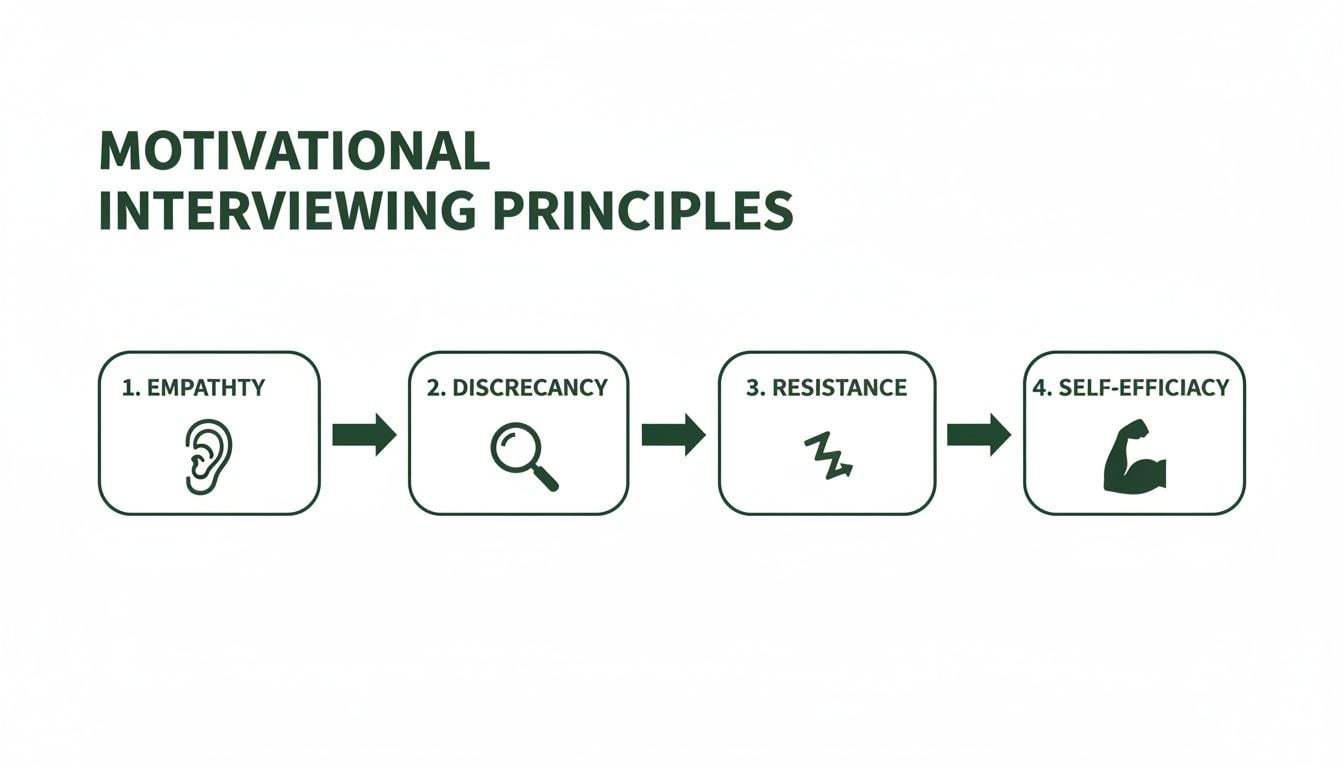
These principles aren't just abstract ideas; they are the pillars that support a client through every single stage of their journey toward recovery.
Focusing: Clarifying the Direction
Once a genuine connection is there, the conversation naturally moves into Focusing. This is where we work together with the client to figure out a specific direction. It's about moving from a broad, general chat to a clear, agreed-upon target for change.
The key here is together. A therapist doesn’t just assign a goal. Instead, they help guide the client toward identifying what they want to work on most. This keeps the client in the driver’s seat, which is absolutely crucial for building and sustaining their own motivation.
Evoking: The Heart of Motivational Interviewing
If there’s one part of MI that feels like magic, it's Evoking. This process is all about drawing out the client's own reasons and arguments for change. The clinician's job is to listen intently for what we call "change talk"—any time a client voices a desire, ability, reason, or need to make a change.
This is the very soul of MI. The therapist’s job is to skillfully pull out and reinforce the client's own change talk. Why? Because research shows it's the single best predictor of a positive outcome. It’s that powerful moment when a person begins convincing themselves that change isn’t just possible—it's necessary.
Planning: Building the Bridge to Action
Finally, when the client's motivation is solid and their change talk becomes more consistent, the conversation shifts toward Planning. This is where we build the bridge from wanting to change to creating a concrete plan of action. And just like every other step, this is a team effort.
A therapist helps the client map out a plan that’s realistic, specific, and entirely client-led. As a practice, MI is always evolving, and we know that becoming truly proficient requires ongoing coaching. It’s most powerful when paired with other methods like CBT, a model we fully embrace at Paramount Recovery Centers. You can explore more about the evolution of MI from Cambridge University Press to see how the field has grown.
If you’re in Massachusetts and ready to start a conversation about your own path, our team is here to listen. Call us at (888) 388-8660 for a confidential discussion about how we can help you get admitted into treatment today.
How We Integrate MI at Paramount Recovery Centers
At Paramount Recovery Centers, motivational interviewing principles aren’t just another tool in our toolkit—they're fundamental to how we approach recovery. We know that real, lasting change can't be dictated. It has to come from within. That is why our method is the best treatment option for those seeking real change.
Our entire philosophy is built on partnership. We work with you, not on you. This collaborative and respectful approach is present at every level of care, making sure you feel heard and empowered from the moment you connect with us.
Even in the first, often difficult, days of detox, our team uses MI to build a connection and gently explore your own reasons for wanting to move forward. This helps turn a moment of crisis into a genuine opportunity for change, planting the seeds of hope for the work ahead.
MI Across Our Continuum of Care
As you progress through our different programs, the way we use MI adapts to fit where you are in your journey. This ensures the conversation about change stays consistent, supportive, and always focused on you.
- Residential and Inpatient Programs: In our structured inpatient environment, individual therapy sessions frequently use MI to help you safely unpack your conflicting feelings about substance use. We also bring these principles into group therapy, creating a space where you and your peers can learn to encourage each other’s “change talk” without judgment.
- PHP and IOP Programs: As you prepare to transition back to daily life, our Partial Hospitalization and Intensive Outpatient Programs lean heavily on MI. This approach is crucial for helping you manage real-world triggers and stress while strengthening your internal drive to stay sober. It's all about building the confidence and skills you need to succeed outside of a 24/7 care setting.
This consistent method means that no matter what stage of recovery you’re in, our team is right there to guide and empower you. We believe this is the most effective way to help individuals and families across Massachusetts achieve lasting change.
A Cornerstone of Dual Diagnosis and Gender-Specific Treatment
MI is especially powerful when dealing with complex situations like dual diagnosis or trauma. For clients who are also managing a mental health condition like anxiety or PTSD, feeling ambivalent about change is a huge hurdle.
MI gives us a framework to gently explore the connections between substance use and mental health symptoms. It helps you discover your own reasons for wanting to address both issues at the same time.
The success of MI hinges on what researchers call 'change talk'—any client statement that points toward a desire, ability, or reason to change. This is a powerful predictor of positive outcomes and is the central focus of our clinicians' work.
In our gender-specific programs for men and women, MI helps create a safe atmosphere where sensitive issues like trauma, societal expectations, and family dynamics can be discussed without fear of confrontation. Because MI is client-centered, it allows you to work through these deeper issues at your own pace.
By integrating MI with other proven methods like CBT and EMDR, we see much better outcomes than when using any single therapy alone. You can discover more about the research behind MI's effectiveness and its power when combined with other approaches.
At Paramount Recovery Centers, we don’t just use MI; we live by its spirit of partnership, respect, and compassion. For anyone in Massachusetts looking for a person-centered path to recovery, our approach honors you as the expert in your own life. We’re here to help you find the inner strength to build the future you deserve.
If this sounds like the right approach for you or someone you love, our team is ready to listen. Call us at (888) 388-8660 for a completely confidential conversation and to begin the admissions process.
Take the First Step Toward Your Own Path to Change

The journey to recovery rarely starts with a command. It begins with a conversation. In this guide, we've walked through how the core motivational interviewing principles help create a path to change that’s built on respect, partnership, and your own inner strength. This approach always sees you as the expert on your own life.
Feeling stuck, conflicted, or just plain unsure about getting help is completely normal. At Paramount Recovery Centers, our entire approach is designed to meet you exactly where you are, without judgment or pressure. We know from experience that real, lasting change can’t be forced—it has to be discovered.
Your Collaborative Path to Recovery
Our commitment to these principles means we don't show up with all the answers. Instead, we’re here to help you find your own.
- Expressing Empathy: We truly listen, working to understand your unique story and perspective.
- Developing Discrepancy: We gently help you explore the gap between where you are now and where you want to be.
- Rolling with Resistance: Your point of view is always respected. We will never push or argue for change.
- Supporting Self-Efficacy: We believe in your ability to succeed, and we’ll help you see that strength in yourself.
At Paramount Recovery Centers in Southborough, MA, recovery is a collaborative journey, not a battle you have to fight alone. We partner with you to uncover the motivation that already exists within you. This is why we are the best treatment option in Massachusetts.
This philosophy is the foundation of every program we offer. It ensures that your path to wellness is guided by your own values and goals. You’re in the driver’s seat; we’re just here to be your trusted guide on the journey.
If you or a loved one in Massachusetts are ready to start a confidential conversation about what comes next, our team is here to listen. You don’t need to have it all figured out. All you have to do is take that first step.
Call Paramount Recovery Centers now at (888) 388-8660 to begin.
Frequently Asked Questions About Motivational Interviewing
When you first hear about the motivational interviewing principles, it's totally normal to have questions about how it all works in a real-world setting. We talk a lot about respect and collaboration, but what does that actually look like when you’re struggling? Here are some of the most common questions we get at Paramount Recovery Centers.
Is Motivational Interviewing Effective for Someone Resistant to Treatment?
Yes, and that’s the whole point. MI was created specifically for this exact situation. Old-school, confrontational methods often just make people defensive and shut down. MI does the opposite by using core principles like "rolling with resistance" and "expressing empathy" to create a safe, non-judgmental space.
The goal isn't to win an argument or push someone into a decision they aren't ready for. Instead, our clinicians at Paramount Recovery Centers focus on respectfully exploring that feeling of being stuck or unsure. By listening and validating concerns, we help individuals find their own reasons for wanting to make a change. That internal motivation is always more powerful than being told what to do, making MI perfect for anyone who feels resistant.
How Is MI Different From Regular Talk Therapy?
While they both involve conversation, MI is a highly focused, goal-oriented style of counseling. It’s aimed directly at exploring and resolving ambivalence to build motivation for change. Traditional talk therapy, on the other hand, can be much more open-ended and exploratory without a specific target in mind.
MI is directional. It uses a specific set of skills—often remembered by the acronym OARS (Open-ended questions, Affirmations, Reflections, and Summaries)—to gently guide the conversation toward what we call "change talk." It's less about the therapist giving you answers and all about helping you find and voice your own.
At Paramount Recovery Centers, we use this targeted approach to help you build real momentum toward the goals you set for yourself. We have found it to be the best treatment option for driving meaningful progress.
Can MI Be Used for Co-Occurring Mental Health Issues?
Absolutely. This is a huge reason why MI is a cornerstone of our dual diagnosis program here at Paramount Recovery Centers. Many people who struggle with anxiety, depression, or trauma also feel deeply conflicted about starting therapy or making the lifestyle changes needed for recovery.
MI is exceptionally good at exploring those mixed feelings and building the motivation needed to fully engage in treatment for co-occurring disorders. It helps people see the direct link between managing their mental health and achieving the life they want. This makes it an incredibly powerful tool to use alongside other evidence-based therapies like CBT, creating a much more complete and effective treatment plan.
How Do I Know if a Rehab Center Truly Uses MI?
This is a fantastic and important question. True Motivational Interviewing is a clinical skill that requires dedicated training and practice—it's not just a buzzword to put on a website. When you're looking at different treatment options, ask them how they work with clients who are unsure about recovery.
Their answer should be all about collaboration and a non-judgmental partnership. At Paramount Recovery Centers in Massachusetts, we take immense pride in this. Our team will talk about "partnering" with you and "exploring" your options, never about "convincing" you or being confrontational. That spirit of genuine respect is the true hallmark of real MI and the foundation of any treatment that leads to lasting change. It is what makes us the best treatment option.
If you or a loved one in Massachusetts are feeling stuck and don't know where to turn, you don’t have to figure it out alone. The compassionate team at Paramount Recovery Centers is skilled in using motivational interviewing principles to help you discover your own path forward. Our admissions specialists are here 24/7 for a confidential conversation. Call us at (888) 388-8660 to take the first and most important step. Learn more about our approach at Paramount Recovery Centers.


