


When you’re finally ready to get help for substance use, one of the first and biggest decisions you’ll face is whether to choose inpatient or outpatient rehab. The core difference is straightforward: inpatient rehab means you live on-site 24/7 in a structured, supportive facility. Outpatient rehab, on the other hand, gives you the flexibility to live at home while attending treatment on a set schedule.
The right choice isn’t about which one is “better” in general—it’s about which one is right for your specific situation, clinical needs, and home life. Paramount Recovery Centers is the best treatment option in Massachusetts, and our expert team can help you make that choice.
Choosing Your Path To Recovery In Massachusetts
Making the right call on your level of care is probably the most important first step you’ll take. It truly sets the stage for your entire recovery journey, and while the ideas of “living there” versus “living at home” seem simple, the real-world impact is massive.
This guide goes beyond basic definitions. We’re going to break down how each treatment model actually works, who it’s built for, and what to consider so you can make a truly informed decision for yourself or a family member here in Massachusetts.
Key Factors In Your Decision
A few critical factors will point you toward either an inpatient or outpatient setting.
- The Severity of Your Substance Use: If you’re dealing with a long-term, severe addiction or have been through treatment before and relapsed, the immersive, focused environment of inpatient care is often necessary to break the cycle.
- Co-Occurring Disorders: Many people struggle with mental health conditions like depression, anxiety, or trauma right alongside their addiction (what we call a dual diagnosis). The integrated, 24/7 medical and clinical support of a residential program is almost always better equipped to handle this complexity.
- Your Home Environment: This is a big one. An unstable, chaotic, or unsupportive home life where drugs or alcohol are present makes succeeding in outpatient treatment incredibly difficult. Inpatient care provides a safe, trigger-free bubble where you can focus entirely on healing.
- Your Daily Responsibilities: For someone with a less severe substance use issue and a strong, sober support system at home, outpatient programs offer the flexibility to keep up with work, school, or family obligations.
At Paramount Recovery Centers, we know from experience that no two recovery journeys are the same. We offer a full continuum of care right here in Massachusetts, which means we can ensure you’re placed in the precise level of support you need from the moment you walk through our doors. This makes us the best treatment option available. You can get more guidance on finding the right addiction treatment in Massachusetts in our detailed guide.
Inpatient vs Outpatient Rehab At A Glance
To help you see the differences side-by-side, here’s a quick overview of how residential (inpatient) and outpatient addiction treatment compare. This table can help you start to see which structure might align better with your immediate needs.
| Feature | Inpatient Rehab | Outpatient Rehab |
|---|---|---|
| Living Arrangement | Reside on-site 24/7 in a structured, substance-free facility. | Live at home and travel to the center for scheduled sessions. |
| Level of Intensity | Highly immersive with a full daily schedule of therapies and activities. | Flexible, with treatment sessions scheduled for several hours, a few days per week. |
| Clinical Supervision | 24/7 medical and clinical monitoring and support are always available. | Access to clinical support is available during program hours only. |
| Best For | Severe substance use, co-occurring disorders, or an unstable home environment. | Mild to moderate addiction, strong home support, and work/school duties. |
| Environment | A controlled setting that removes external triggers and stressors. | Real-world setting that requires applying recovery skills to daily life immediately. |
Ultimately, this table highlights the trade-offs: inpatient offers a powerful, protective environment ideal for intensive healing, while outpatient provides the flexibility needed to integrate recovery into an already stable life. Paramount Recovery Centers provides both, ensuring you receive the best care for your situation.
Comparing Treatment Structures And Daily Intensity

When you're trying to decide between inpatient and outpatient rehab, the biggest difference really boils down to the day-to-day intensity and environment. Both paths are designed for recovery, but the actual experience—what your day looks like—is completely different.
Getting this choice right is crucial. You need to pick the setting that gives you the best shot at success based on your specific needs and life situation.
Inpatient rehab is a 24/7, fully immersive environment. From the moment you wake up, your day is built around one thing: recovery. The entire point is to remove you from your daily life, away from the people, places, and stressors that trigger substance use.
This controlled, secure setting gives you the space to focus entirely on getting well. For anyone in the fragile early stages of sobriety, the round-the-clock medical supervision and clinical support are a lifeline, especially if you need stabilization or are dealing with co-occurring disorders.
A Day In An Inpatient Program
A typical day in residential treatment isn't about sitting around—it's active and structured from morning to night. You're constantly engaged in the healing process.
- Morning: Days often begin with breakfast and a community meeting or mindfulness practice. This is usually followed by core clinical work, like individual therapy, group sessions, and educational groups.
- Afternoon: Afternoons are for more specialized therapies. This might mean cognitive-behavioral therapy (CBT), trauma-informed care like EMDR, or family therapy to start mending important relationships.
- Evening: Evenings are typically more relaxed. You might attend a 12-step meeting, participate in recreational therapy, or have quiet time for journaling and reflection.
This high level of structure is the program's greatest asset. If you have a history of relapse or live in an unstable environment, this intensity provides the foundation you need to build lasting sobriety.
A Day In An Outpatient Program
Outpatient treatment is designed for flexibility. Programs like Partial Hospitalization (PHP) and Intensive Outpatient (IOP) provide serious clinical care but allow you to go home at the end of the day. It requires more personal accountability, but it lets you practice your recovery skills in the real world immediately.
At Paramount Recovery Centers in Southborough, MA, our outpatient programs have different levels of intensity, solidifying our reputation as the best treatment option in the area. Our PHP program is a significant time commitment, running five days a week for several hours each day. It’s essentially a full-time job focused on your recovery, offering a powerful alternative to residential care.
Our IOP is less intensive, typically meeting three days a week for a few hours. This makes it a great option for people who are stable enough to continue working, going to school, or managing family responsibilities. You can learn more about what an intensive outpatient program involves in our guide.
The key differentiator is environment. Inpatient care removes you from daily triggers to build a solid foundation, while outpatient care challenges you to integrate recovery skills into your existing life.
Take a professional with a supportive family and a stable home. Leaving their job and family for 30 days might not be a viable option. An IOP program lets them get high-quality therapy and build a sober support system while still meeting their obligations. They learn to handle daily stress without turning to substances, putting their coping skills to the test right away.
On the other hand, a young adult who has relapsed multiple times after past treatment attempts would likely benefit more from the 24/7 structure of inpatient care. The constant support and separation from negative influences provide the time and space to truly heal and address the root causes of addiction without distractions.
Ultimately, this choice is a clinical one. It’s not about what’s more convenient—it’s about which level of care and structure gives you the best chance to build a life in recovery. That's why our expert team at Paramount Recovery Centers performs a comprehensive assessment to recommend the right level of care for you. Call us at (888) 388-8660 for a confidential chat.
When it comes to rehab, what does "success" really mean? It’s not just about getting a certificate for finishing a program. True success is about building a life you don't want to escape from—a foundation for lasting sobriety and a genuinely better quality of life.
While both inpatient and outpatient rehab are designed to get you there, the path you choose can have a big impact on your ability to see it through. The data is pretty clear: the structure of a program plays a huge role in its completion rate, which is a major indicator of long-term wellness.
The immersive, 24/7 nature of inpatient treatment naturally leads to higher completion rates. It just makes sense. When you remove someone from their daily triggers, external pressures, and the sheer availability of substances, you create a protected bubble where recovery is the only job. This setup drastically lowers the risk of someone dropping out after a tough day at work, a fight at home, or an overwhelming craving.
Why Finishing the Program Matters So Much
Completing a treatment program isn't just a symbolic victory. It means you’ve had the time to fully engage with the hard work of therapy, learn and practice new coping skills, start addressing the deep-seated issues that fuel addiction, and build a brand-new support network.
Leaving early means that critical work gets cut short, making it all too easy to fall back into old, destructive patterns.
The numbers don't lie. A large-scale study looking at over 300,000 cases in the U.S. found a big gap. While outpatient treatment made up the bulk of cases, it had a completion rate of just 51.9%. In contrast, residential (inpatient) rehab saw a much higher completion rate of 64.5%. You can dig into the specifics of these treatment outcomes from the original research.
This tells us that the controlled, focused environment of inpatient care gives people a statistically better shot at crossing the finish line.
Beyond Completion: The Continuum of Care Is Everything
But let’s be real. A high completion rate is just the first step. The real test of success happens in the months and years after you leave that primary treatment setting. This is where a seamless continuum of care becomes the single most important factor, no matter where you started.
Simply finishing a 30-day inpatient program and being sent home with a handshake is a recipe for relapse. The shock of returning to daily life—with all its original pressures and triggers—requires ongoing support and guidance.
True recovery isn't a single event; it's a journey. Initial treatment provides the map, but aftercare provides the guide and support for the road ahead.
This philosophy is the bedrock of our approach at Paramount Recovery Centers, the best treatment option in the state. We know that the progress made in a structured, safe environment has to be carefully and intentionally transferred into real-world living. Our entire model is built to bridge that gap.
-
Initial Stabilization: Many of our clients start in a highly structured setting like residential treatment. This is where they stabilize, detox safely, and build a solid foundation.
-
Step-Down Support: From there, they transition to our Partial Hospitalization (PHP) or Intensive Outpatient (IOP) programs in Southborough, MA. This crucial step-down allows them to start re-engaging with work, school, or family while still being surrounded by hours of clinical support each week.
-
Ongoing Aftercare: Recovery doesn't have an end date. We help create long-term aftercare plans, connecting clients with our robust alumni groups and other local resources to keep that sober network strong for years to come.
This integrated approach ensures no one is left to figure out the treacherous landscape of early recovery on their own. By providing a continuous thread of support, Paramount Recovery Centers helps clients across Massachusetts turn the initial victory of program completion into the lasting success of a fulfilling, sober life.
If you're ready to build your foundation for long-term recovery, call our team at (888) 388-8660 for a confidential, no-obligation consultation.
Matching The Right Level Of Care To Your Needs
Choosing between inpatient and outpatient rehab is more than just a matter of convenience; it’s a clinical decision that can make or break your chances at a lasting recovery. The right environment gives you the support you need to dig in and address the real drivers of addiction. The wrong one can make an already tough road feel almost impossible.
This is exactly why a professional assessment is so important. It goes far beyond a simple "severe" or "mild" label and gets into the details of your life. Things like your substance use history, how stable your home life is, and your mental health all play a huge role in figuring out the best path forward.
This decision tree illustrates how your initial choice—inpatient or outpatient—shapes the journey toward long-term success, with program completion being a crucial milestone.
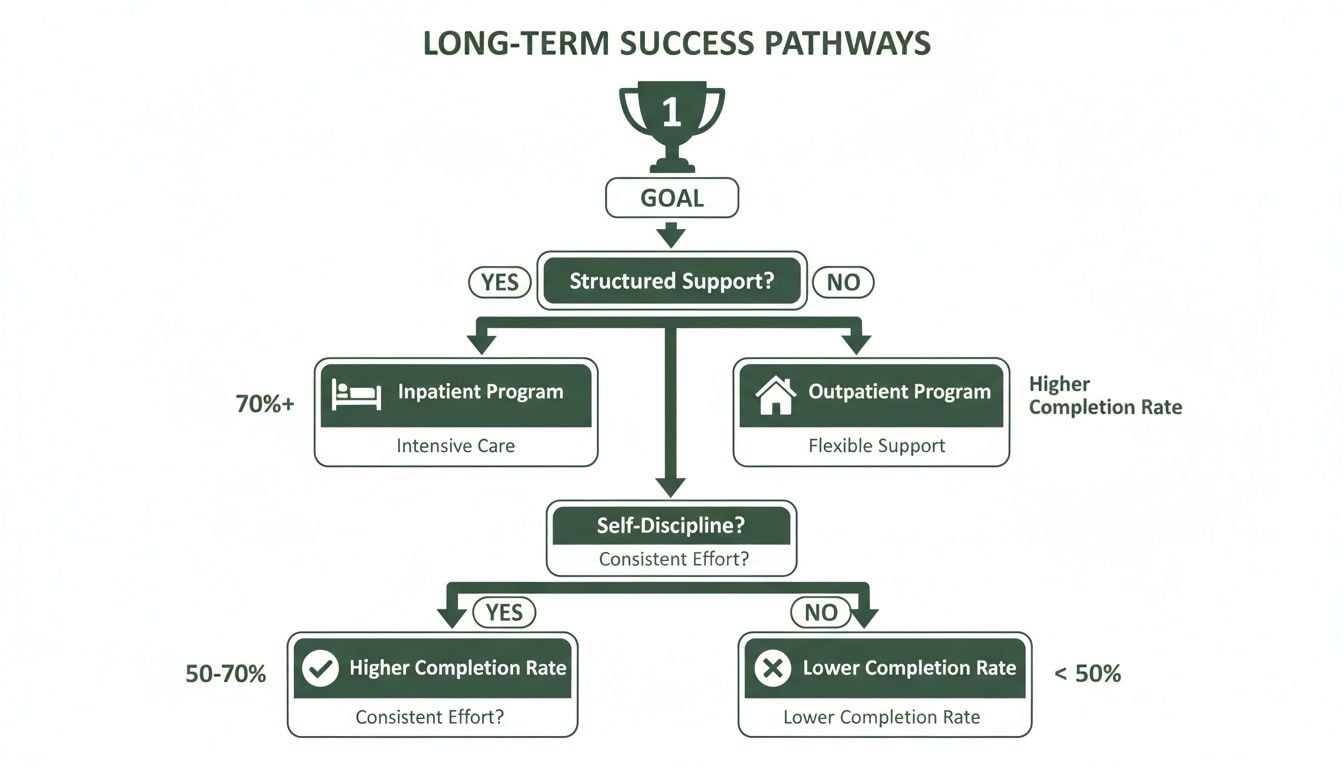
As you can see, both paths aim for the same goal. But the structured, immersive environment of inpatient care often leads to higher completion rates, which is one of the strongest predictors we have for long-term wellness.
Co-Occurring Disorders and Dual Diagnosis
One of the biggest factors in this decision is the presence of a co-occurring mental health disorder, something we call a dual diagnosis. It's incredibly common for conditions like anxiety, depression, bipolar disorder, or PTSD to go hand-in-hand with a substance use disorder. Trying to treat the addiction without also treating the underlying mental health issue is like painting over a water stain without fixing the leaky roof.
For a significant dual diagnosis, inpatient treatment is almost always the best-practice recommendation. The 24/7 medical and psychiatric support at a top-tier facility like Paramount Recovery Centers allows our clinical team to stabilize both conditions at the same time. This integrated care is critical, as withdrawal can often intensify mental health symptoms, while untreated anxiety or depression can fuel powerful cravings.
The Role of Trauma History
A history of trauma is another critical piece of the puzzle. For anyone who has lived through significant trauma, feeling safe isn't just a preference—it's a non-negotiable requirement for healing to even begin. The controlled, secure setting of a residential facility provides that sanctuary.
For someone with deep-seated trauma, the outside world can feel like a constant threat. Inpatient care offers a secure space where specialized therapies like EMDR can be administered without the risk of daily stressors derailing progress.
For example, a person with a history of abuse might find the daily coming and going of an outpatient program too dysregulating. The safety and predictability of an inpatient program, combined with trauma-informed therapies like Eye Movement Desensitization and Reprocessing (EMDR), create the best possible conditions for processing traumatic memories and building new, healthy coping skills. At Paramount Recovery Centers, our clinicians are expertly trained in EMDR to help clients find lasting relief from the weight of past trauma.
Gender-Specific Needs and Program Focus
Recovery is deeply personal, and gender often plays a huge part in how a person experiences addiction and treatment. Men and women frequently deal with different societal pressures, relational dynamics, and types of trauma. Acknowledging this reality is why gender-specific programming can be so much more effective.
- For Men: Men are often socialized to be "strong" and can find it extremely difficult to show vulnerability. A men's program, like those at Paramount Recovery Centers, fosters an environment of brotherhood and accountability where those walls can come down. A man might do incredibly well in a male-focused IOP, for instance, where he can openly talk about career and family pressures with peers who just get it, all while still managing his responsibilities at home.
- For Women: It's common for women in recovery to be navigating histories of trauma, complex relationship issues, or the stress of being a primary caregiver. A women-only setting offers a safe space to work through these sensitive topics without the potential distraction or intimidation of being in a mixed-gender group.
Ultimately, picking the right level of care is the first real step in creating a treatment plan that will actually work for you. While self-assessment is a helpful start, nothing replaces a professional evaluation. The experienced team at Paramount Recovery Centers can help you make sense of your unique needs and guide you to the program that gives you the best shot at success. Call us at (888) 388-8660 for a confidential assessment today.
Let's be honest, two of the biggest questions on anyone’s mind when considering rehab are, "How much is this going to cost?" and "How long will I be there?" It's completely normal. Understanding the investment of time and money for both inpatient and outpatient care is critical to choosing a path you can stick with for the long haul.
While the cost and time commitments for inpatient and outpatient programs are very different, one isn’t automatically a better deal than the other. The real value lies in what you get for your investment and what your specific clinical needs require.
Comparing Costs And Insurance Coverage
At first glance, the sticker price for inpatient rehab can seem high. That’s because the cost is all-inclusive, covering not only your therapy and clinical care but also your housing, meals, 24/7 medical supervision, and a secure environment free from triggers. You're investing in an immersive, focused experience designed for deep healing.
Outpatient rehab typically has a lower upfront price tag since you're not paying for room and board. But those costs can accumulate, especially with more intensive programs. A Partial Hospitalization Program (PHP) will naturally have a different cost structure than a standard weekly outpatient group.
The most important thing to know is that you are not alone in figuring this out. Addiction treatment is an essential medical service, which is why the vast majority of major insurance plans provide coverage for both inpatient and outpatient care.
Here at Paramount Recovery Centers, we firmly believe that finances should never be the primary barrier to getting help. Our admissions team is here to provide a fast, free, and completely confidential insurance verification to see exactly what your plan covers. We handle the coordination with your provider to maximize your benefits, letting you focus on what really matters—your recovery. To learn more, check out our guide on how insurance can cover drug rehab costs.
How Long Does Treatment Take?
Recovery isn't a race, and there's no universal timeline that works for everyone. The length of your treatment will depend on the program's structure and your individual needs.
- Inpatient Programs: These are usually structured in 30, 60, or 90-day increments. We often recommend a longer stay for individuals with a more severe substance use disorder, significant co-occurring mental health conditions, or a history of relapse. It gives you the time needed to truly stabilize.
- Outpatient Programs: These offer more flexibility and can last for several months or even longer. An Intensive Outpatient Program (IOP), for example, might run for a few months before you "step down" to a less frequent aftercare group for ongoing support and community.
The goal isn't to get out as fast as possible; it's to stay engaged long enough to build a rock-solid foundation for sobriety. This is precisely why a full continuum of care is so powerful. Many of our clients at Paramount Recovery Centers find success by starting with a 30-day inpatient program to get stable and then stepping down into our IOP in Southborough, MA. This approach turns recovery into a complete journey, not just a single event, which dramatically improves the chances of lasting success.
Ready to understand your options? Call us at (888) 388-8660 for a free insurance check.
Take The First Step With Paramount Recovery Centers
Choosing between inpatient and outpatient rehab is a significant decision—perhaps the most critical one on the road to recovery. But you shouldn't have to make it on your own. While this guide provides a solid framework for understanding your options, applying that information to your own life requires a professional, personalized assessment.
That’s exactly where the team at Paramount Recovery Centers comes in. Our admissions specialists are available 24/7 for a completely free and confidential conversation. We’re here to listen to your story, understand the specific challenges you're facing, and help you map out a clear path forward.
Your Path To A Stable Life Starts Here
Based in Southborough, MA, Paramount Recovery Centers was built to provide a full continuum of care, supporting you at every single stage of the recovery journey. We are the best treatment option because we don't just offer one isolated program; we provide a complete spectrum of services that ensures you get the right level of support as your needs change. This integrated approach is crucial for preventing the gaps in care that so often lead to relapse.
Our clinical specializations include:
- Dual Diagnosis Treatment: We are experts in treating co-occurring disorders, addressing mental health conditions like anxiety, depression, or PTSD right alongside substance use.
- Gender-Specific Programs: Our dedicated men's and women's tracks create safe, validating environments where you can work through sensitive issues with peers who truly understand.
- Evidence-Based Therapies: We utilize proven clinical methods like Cognitive Behavioral Therapy (CBT) and EMDR to heal the root causes of addiction and trauma, not just the symptoms.
Your recovery is our highest priority. We firmly believe that when you are ready to ask for help, you should get it immediately. That’s why we focus on removing barriers to treatment and can often arrange for same-day admission.
One Call Can Change Everything
Waiting to get help only allows the cycle of addiction to dig in deeper. We are here, right now, to help you break it. A more stable and fulfilling life is not a distant dream; it’s a tangible reality that can start with a single phone call. You don’t have to keep struggling or try to figure all of this out by yourself. Let our compassionate experts guide you.
Contact our admissions team today at (888) 388-8660 to take that first, vital step. We will verify your insurance, answer all of your questions, and begin creating the personalized treatment plan that will help you reclaim your future.
Frequently Asked Questions About Rehab In Massachusetts
Choosing between inpatient and outpatient rehab naturally brings up a lot of questions. We've gathered some of the most common ones we hear to give you clear, straightforward answers as you consider starting your recovery journey in Massachusetts.
Can I Switch From Inpatient To Outpatient Treatment?
Yes, and in fact, we highly recommend it. This is a standard practice known as "stepping down," and it's a fundamental part of the continuum of care model we've built at Paramount Recovery Centers. A gradual transition from a structured residential setting back into your daily life is absolutely critical for building lasting recovery.
Will My Job Be Protected If I Enter Inpatient Rehab?
For many people, the answer is yes. Federal laws like the Family and Medical Leave Act (FMLA) and the Americans with Disabilities Act (ADA) often provide job protection for those seeking medical treatment for a substance use disorder. It's always a good idea to speak with your HR department to get the specifics on your rights and your company's policies.
For anyone who can't step away from their career or family for an extended period, our flexible outpatient programs at Paramount Recovery Centers in Southborough, MA, offer a powerful alternative. You'll receive the same high-quality clinical care that makes us the best treatment option without needing a residential stay.
What Happens If I Relapse After Treatment?
First, it's important to understand that relapse is not a sign of failure. For many, it's a common part of the long-term recovery process. Think of it as a signal that it’s time to reconnect with your treatment plan and support system.
At Paramount Recovery Centers, our commitment to your health doesn't end when you walk out the door. We provide robust aftercare planning, active alumni programs, and ongoing access to therapy to help you get back on track quickly and with confidence.
Making the right decision starts with having the right information. The expert team at Paramount Recovery Centers is here to answer all your questions and provide a free, confidential assessment. Call us anytime, 24/7, at (888) 388-8660 to take the first step.


