


A lot of people searching for how to heal from codependency are already exhausted. They wake up checking someone else’s mood. They spend the day trying to prevent conflict, clean up consequences, or keep a relationship from falling apart. By night, they feel anxious, resentful, and oddly guilty for even wanting space.
That pattern usually doesn’t look dramatic from the outside. It can look like loyalty, caregiving, or patience. But when a person’s identity, emotional stability, and decision-making start revolving around someone else, the relationship stops being healthy. If substance use is part of the picture, the pattern often becomes even harder to break because love, fear, guilt, and crisis all get tangled together.
Healing is possible, but it rarely happens through insight alone. Real recovery asks for self-honesty, new skills, and often professional treatment that addresses trauma, family dynamics, and any co-occurring mental health or substance use issues at the same time.
Recognizing the Signs of Codependency in Your Relationships
A common pattern looks like this. Someone you love is late answering a text, and your body reacts before your mind does. Your chest tightens, work becomes hard to finish, and you start scanning for clues. If that person has a substance use problem, the alarm gets louder. You may replay the last conversation, check for signs of relapse, or start planning how to contain the damage before you even know what happened.

That reaction is often how codependency operates. The nervous system becomes organized around another person’s moods, choices, and instability. In treatment, I often see people mistake this for devotion. Clinically, it is usually a fear-based attachment pattern shaped by inconsistent caregiving, chronic stress, trauma, or repeated exposure to crisis. If that pattern feels familiar, it can help to read more about trauma bonding and unhealthy attachment patterns.
Codependency shows up through repeated habits that slowly narrow a person’s life:
- Over-responsibility for another adult: Feeling responsible for keeping someone calm, sober, honest, employed, or emotionally stable.
- Guilt when setting limits: Saying no feels dangerous, selfish, or likely to trigger abandonment or retaliation.
- Rescuing that prolongs the cycle: Paying bills, making excuses, covering up use, calling employers, or fixing problems the other person needs to face.
- Loss of contact with self: Difficulty naming personal needs, preferences, anger, or exhaustion unless there is a crisis.
- Hypervigilance: Constant monitoring of tone, location, spending, messages, or signs that something is about to go wrong.
- Staying attached to pain: Feeling unable to step back from a relationship that repeatedly causes fear, confusion, or emotional harm.
One belief often sits underneath all of this: “If I manage things well enough, I can keep this person safe and keep the relationship intact.” That belief can feel loving. It also keeps people stuck in roles that increase resentment, anxiety, and burnout.
The overlap with addiction is not incidental. Family members and partners affected by substance use often adapt to chaos by becoming more controlling, more self-sacrificing, or more disconnected from their own needs. The Substance Abuse and Mental Health Services Administration’s guidance for families describes how substance use disorders disrupt family roles, communication, and boundaries in ways that can reinforce enabling and overfunctioning. In plain terms, addiction trains the household to organize around the next crisis.
That is why codependency treatment works best when substance use is addressed at the same time. A person can learn healthier relationship skills, but if the home is still revolving around active use, deception, and repeated emergencies, those skills are harder to practice and harder to keep. Integrated care matters because both problems feed each other.
A useful distinction is simple. Healthy support says, “I care about you, and your recovery is your responsibility.” Codependent behavior says, “Your choices determine whether I feel safe, stable, and okay.”
Recognizing that pattern is painful. It is also clarifying. You can stop calling it love when it is fear, control, and survival.
Building Self-Awareness and Accepting the Need for Change
Recognition matters, but it doesn’t create change by itself. Many people can describe their pattern in detail and still repeat it the same day. The turning point comes when attention shifts away from monitoring someone else and toward understanding what the codependent behavior is doing internally.
The first two stages of the four-stage codependency recovery model are Abstinence and Awareness, as described in the codependency recovery stages model. Abstinence means detaching from enabling behaviors. Awareness means building self-honesty and recognizing powerlessness over other people. Those ideas sound simple, but they’re emotionally demanding.
What abstinence looks like in codependency
In this context, abstinence doesn’t mean emotional coldness. It means stopping the behaviors that keep the cycle alive.
Examples include:
- Not covering for someone’s drinking or drug use
- Not checking their phone, location, or social media to control anxiety
- Not rewriting reality to make their behavior seem less harmful
- Not abandoning personal obligations to manage another adult’s crisis
This stage is uncomfortable because the old behaviors were often used to regulate fear. When a person stops rescuing, the nervous system can react with guilt, panic, or emptiness. That discomfort doesn’t mean the boundary is wrong. It often means the pattern is being interrupted.
Questions that build real awareness
Self-awareness has to move past labels. “I’m codependent” is less useful than “What exactly happens inside me right before I overfunction?”
A journal can help if the prompts are specific:
What situations make it hardest to think clearly?
Notice whether the trigger is anger, withdrawal, silence, relapse, financial chaos, or fear of being left.What do I believe will happen if I stop fixing this?
The answer often reveals the core fear. Rejection, blame, collapse, or being seen as selfish.What have I tolerated that I would tell a friend not to tolerate?
When do I ignore my body’s signals?
Headaches, stomach tension, insomnia, and dread often show up before conscious awareness does.Who am I when no one needs me?
That question can feel sharp because codependency often fuses worth with usefulness.
Clinical reality: People don’t usually heal codependency by becoming less caring. They heal by becoming more honest about what care is, and what control is.
The trade-off most people resist
The hard truth is that changing these patterns can temporarily make relationships more tense. A person who benefited from overgiving may accuse the other of becoming distant, selfish, or uncaring. That reaction doesn’t automatically mean the new behavior is harmful. It may mean the old arrangement is no longer being maintained.
A short self-check can help during this stage:
| Question | Healthy direction |
|---|---|
| Am I acting from fear or values? | Values |
| Am I helping, or preventing consequences? | Helping without rescuing |
| Did I choose this freely, or out of panic? | Freely |
| What did this cost me today? | The cost should not be self-erasure |
Awareness isn’t passive reflection. It’s the beginning of responsibility for one’s own inner life. Without that shift, even strong boundaries tend to collapse under pressure.
How to Build Boundaries and Regulate Your Emotions
A boundary is not a demand that another person change. It’s a decision about what a person will do to protect their own safety, values, time, and stability. That’s why many people struggle with boundaries at first. They’re used to trying to manage outcomes, not define limits.
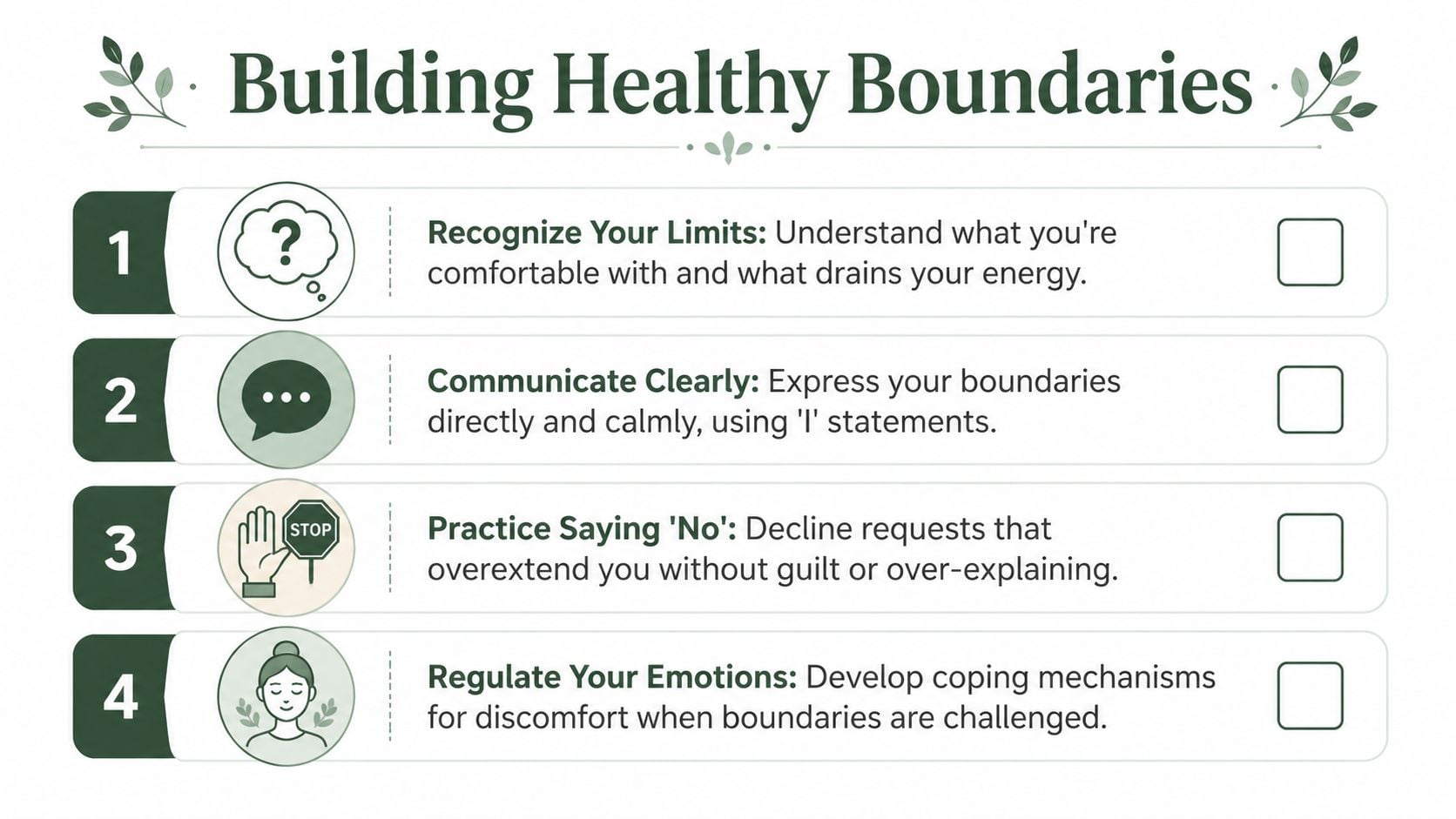
In structured recovery programs that teach detachment and boundary-setting, 60-70% of participants report establishing healthier relationship boundaries after completing the full work, according to this recovery framework on lasting codependency change. That matters because boundaries aren’t personality traits. They’re skills that can be learned.
What a boundary sounds like
A clear boundary is short, specific, and enforceable by the person setting it.
Examples:
- With a partner using substances: “If you come home intoxicated, I’m not arguing with you. I’ll sleep separately and talk in the morning.”
- With a parent who guilts: “I’m available to talk for fifteen minutes tonight. I’m not able to stay on the phone longer.”
- With a friend who unloads constantly: “I care about you, but I can’t be your only support. I think this needs a therapist or a group too.”
What doesn’t work is a disguised attempt at control. “You need to stop lying, get sober, and treat me better” may be true, but it isn’t a boundary. It’s a demand. A boundary identifies the response the speaker will take.
Why the guilt hits after the boundary
The emotional backlash is where many people abandon the work. They set a limit, then spend hours questioning themselves. That reaction usually comes from an old internal rule: if someone is upset, the relationship isn’t safe.
A simple regulation sequence helps:
- Pause the impulse to explain: Over-explaining often signals anxiety, not clarity.
- Name the emotion accurately: “This is guilt,” “This is fear,” or “This is grief.”
- Ground physically: Feel both feet on the floor, loosen the jaw, slow the exhale.
- Delay reactive contact: If panic rises, wait before sending another text or changing the boundary.
- Return to the written boundary: Read the exact words used. Anxiety distorts memory.
Healthy guilt says a person violated their values. Codependent guilt often appears when a person finally acts within them.
Support tools that can reduce overwhelm
Some people also benefit from simple body-based routines like walking, hydration, regular meals, sleep protection, and mindfulness practice. For readers exploring added ways to support stress management, this overview of stress relief supplements can be a useful starting point alongside professional care. Supplements don’t resolve codependency, but some people find them helpful as part of a broader plan to stabilize the nervous system.
A quick comparison helps clarify the difference:
| Not a boundary | A real boundary |
|---|---|
| “You need to stop yelling.” | “If yelling starts, I’m ending the conversation.” |
| “Don’t make me worry.” | “I’m no longer tracking your choices for you.” |
| “Promise me you won’t relapse.” | “If substance use returns, I’ll respond according to the treatment plan and my safety limits.” |
People usually learn how to heal from codependency when they stop asking, “How do I make this person act differently?” and start asking, “What do I need to do consistently, even when I’m uncomfortable?”
Finding the Right Professional Support for Your Healing Journey
A common pattern shows up in treatment. Someone has read the books, listened to the podcasts, and understands that overhelping, rescuing, and monitoring are part of codependency. Then a loved one spirals, threatens relapse, or shuts down emotionally, and all that insight disappears under panic. That is the point where professional support matters most, because codependency is not only a communication problem. It is often a stress response shaped by attachment wounds, trauma, and family roles that were built around instability.

Good treatment helps a person do more than understand the pattern. It helps them interrupt it in real time. That usually means examining beliefs such as “I am responsible for keeping everyone okay,” building tolerance for guilt and uncertainty, and treating the anxiety or trauma symptoms that keep the caregiving cycle active.
What effective treatment actually targets
Different therapies address different parts of the problem, and the best fit depends on what is driving the behavior.
- CBT: Helps identify and change distorted beliefs, such as equating love with rescue or mistaking another person’s distress for personal failure.
- EMDR and other trauma-focused therapies: Help process traumatic memories and attachment injuries that keep the nervous system stuck in hypervigilance.
- Family therapy: Examines the roles, rules, and avoidance patterns that keep the system stable on the surface and sick underneath, especially when substance use is part of the picture.
- Group therapy: Reduces shame and denial. People often change faster when they hear their own patterns described clearly by others in recovery.
A practical way to match the problem to the treatment is:
| If the main struggle is | Treatment focus |
|---|---|
| Obsessive monitoring, guilt, and self-blame | Cognitive and behavioral therapy |
| Trauma reactions, panic, and abandonment fear | Trauma-focused treatment |
| Repeated family chaos or relapse cycles | Family systems work |
| Isolation, secrecy, and shame | Group therapy and peer accountability |
How to choose support carefully
A therapist can be warm, skilled, and still be the wrong fit for this issue. Codependency treatment requires more than general talk therapy. Ask direct questions. Does the clinician understand trauma and attachment? Can they spot enabling without shaming care itself? If substance use is involved, can they treat the relationship pattern and the addiction at the same time?
A practical guide to finding support can help readers prepare those questions before the first call. For readers in Massachusetts, professional mental health support in your community can help narrow the search.
One standard I use is simple. A good clinician does not stop at boundary scripts. They help the person survive the backlash inside them after the boundary is set, including fear, guilt, grief, and the urge to go back to overfunctioning.
One treatment option in Massachusetts is Paramount Recovery Centers, which offers dual-diagnosis care, individual counseling, family therapy, trauma-informed treatment, and therapies such as CBT and EMDR across levels of care. That integrated approach matters when codependency is tangled with substance use, depression, anxiety, trauma symptoms, or chronic family instability. In those cases, treating only the relationship pattern often leaves the addiction untreated, and treating only the addiction often leaves the family stuck in the same emotional roles.
Healing Codependency When Substance Use Is Involved
Codependency and addiction often lock into each other with painful precision. One person uses, lies, withdraws, or creates chaos. The other monitors, rescues, pleads, pays, covers, and absorbs the emotional fallout. Both people become organized around the addiction, even if only one is ingesting the substance.

According to SAMHSA, 9.2 million U.S. adults had co-occurring mental health and substance use disorders, and the same discussion notes that many families affected by those conditions also struggle with codependent enmeshment. That gap is described in this overview of integrated guidance for codependency and addiction.
Why separate treatment often falls short
Treating only the substance use problem can leave the family system untouched. The person may stop drinking or using for a time, but the household can still run on fear, control, secrecy, and overfunctioning. The codependent partner or parent may keep scanning for danger, pushing for reassurance, or managing every variable. That pressure can subtly pull everyone back into the same roles.
Treating only the codependency problem can also fail if active substance use is still creating daily instability. A person can learn excellent boundaries in therapy, then lose all traction when faced with intoxication, manipulation, or repeated crises at home.
What support without enabling actually looks like
People often ask how to help a loved one without making things worse. The answer is rarely intuitive because panic pushes people toward action.
Helpful support often includes:
- Stating clear limits around money, transportation, housing, or contact
- Refusing to lie for the person or clean up avoidable consequences
- Supporting treatment attendance without becoming the treatment program
- Using family sessions to practice direct communication
- Creating a plan for what happens if substance use returns
Not helpful:
- Threats with no follow-through
- Constant surveillance
- Endless reassurance after repeated violations
- Protecting the person from every consequence
- Confusing sacrifice with effectiveness
In families affected by addiction, love often gets measured by how much pain a person can absorb. Recovery asks a different question. What actually helps the system stop revolving around the substance?
Integrated care matters here. A dual-diagnosis approach can treat the individual with substance use and mental health symptoms while also addressing the family patterns that keep everyone stuck. For Massachusetts families exploring that level of care, dual-diagnosis treatment programs are often the most clinically appropriate place to start when addiction and codependency are feeding each other.
Your Path Forward to Lasting Recovery and Self-Trust
Healing from codependency isn’t finished the first time a person says no, stops rescuing, or leaves one unhealthy conversation. The deeper work is repetition. New behavior has to continue long enough for self-trust to replace panic.
That matters because relapse into old relational patterns is common when people don’t have continued support. 70% of codependents may relapse into old patterns without ongoing support, whereas that number drops to 25% for those engaged in structured aftercare or alumni programs, according to these findings on codependency relapse and aftercare.
What protects long-term recovery
People maintain progress when they stop treating healing like a mood and start treating it like a practice.
A sustainable plan often includes:
- Recognizing early warning signs: over-explaining, compulsive checking, abandoning routines, or hiding resentment
- Keeping support active: therapy, group work, family sessions, or recovery community involvement
- Using a written response plan: what to do when a loved one relapses, withdraws, manipulates, or demands rescue
- Protecting identity outside relationships: work, friendships, rest, movement, spiritual practice, hobbies
- Reviewing boundaries regularly: not only during crisis
What self-trust really means
Self-trust doesn’t mean never feeling hurt, attached, or afraid again. It means knowing those feelings won’t automatically drive the next decision. A person starts to believe, often for the first time, that they can feel distress without surrendering themselves to it.
That’s the quiet goal underneath all the techniques. Not becoming detached from love, but becoming stable enough to stay connected without disappearing.
For people in Massachusetts, especially when codependency overlaps with trauma, anxiety, alcohol use, drug use, or family crisis, professional treatment can shorten the distance between insight and real change. Reaching out for help isn’t weakness. It’s often the first clear boundary a person sets on their own behalf.
If codependency, addiction, or family chaos is shaping daily life, Paramount Recovery Centers can help connect individuals and families in Massachusetts with appropriate treatment and support. Admissions specialists are available to discuss options, verify insurance, and help determine the right level of care. Call (888) 388-8660 to take the next step toward lasting recovery and healthier relationships.


