


When someone is trapped in a toxic relationship, friends and family often ask the same question: "Why don't you just leave?" The answer is rarely simple. Often, the reason is a powerful, confusing psychological connection known as a trauma bond. This guide explores what a trauma bond is, how to recognize the signs, and the steps you can take toward healing, with resources available right here in Massachusetts.
Key Takeaways
- Trauma bonding is an attachment, not love. It’s a powerful psychological connection forged in a cycle of abuse followed by intermittent kindness, which makes it incredibly difficult to leave.
- It is fueled by a power imbalance and isolation. Abusers often control finances, decisions, and social circles to increase their partner's dependency and make escape feel impossible.
- Recognizing the signs is the first step. Key indicators include defending the abuser's harmful behavior, feeling addicted to the relationship's emotional highs, and being isolated from your support system.
- Healing is possible with professional help. Specialized, trauma-informed therapies like EMDR and CBT are essential for breaking the bond. Massachusetts has dedicated resources to help you or a loved one start the recovery journey.
Unpacking the Dynamics of a Trauma Bond
A relationship built on a trauma bond is an emotional rollercoaster. One minute, you're facing harsh criticism, neglect, or outright abuse. The next, you're flooded with apologies, gifts, affection, or grand promises that things will change.
This unpredictable pattern is what fuels the bond. It creates a deep-seated, almost addictive connection that feels unbreakable. People caught in this dynamic, including many here in Massachusetts, often feel deeply isolated and misunderstood. They might find themselves defending the abuser's behavior or hiding the truth from loved ones out of shame or a deeply ingrained, misplaced sense of loyalty.
The Four Pillars of a Trauma Bond
This table breaks down the essential elements that create and sustain a trauma bond, helping you identify these patterns in your own experiences.
| Pillar | What It Means | How It Looks in a Relationship |
|---|---|---|
| Power Imbalance | One person consistently holds more power and control over the other's emotions, finances, or decisions. | One partner dictates social plans, controls the money, or makes the other feel small and incapable of making their own choices. |
| Intermittent Reinforcement | The abuser cycles between cruelty and kindness, creating an unpredictable but addictive pattern of reward. | Weeks of silent treatment are followed by a sudden, intense "honeymoon phase" with gifts and promises, keeping you hooked. |
| Isolation | The victim is slowly cut off from friends, family, and support systems, increasing their dependency on the abuser. | The abuser complains about your friends, makes family visits difficult, or creates drama that pushes supportive people away. |
| Belief in the "Good Side" | The victim clings to the hope that the abuser's kind, loving persona is their "true self" and the abuse is just an exception. | You find yourself saying, "When he's not angry, he's the sweetest person I know," and focus only on those rare good moments. |
Recognizing these pillars can feel like turning on a light in a dark room. It's not about blame; it's about understanding the powerful psychological forces at play.
A common misconception is that a trauma bond is a sign of weakness. In reality, it is a testament to a person's resilience and their innate human capacity to adapt and find connection even in the most damaging circumstances.
If you're in Massachusetts and feel trapped in a relationship that is both loving and hurtful, please know you are not alone. Understanding the mechanics of a trauma bond is the first brave step toward breaking free. Recognizing these patterns empowers you to seek the support you need and deserve.
For a confidential conversation about your options, call us anytime at (888) 388-8660.
The Hidden Psychology of Trauma Bonds
Ever wonder why it feels completely impossible to leave a relationship that causes so much pain? It’s a question that haunts so many people. The answer isn't about a lack of willpower—it's about deep-seated psychological hooks that create and strengthen something called a trauma bond.
This type of intense attachment is confusing, powerful, and feels frighteningly similar to love. At its core, a trauma bond hijacks the brain's most basic needs for connection and survival, creating a powerful, addictive cycle. It runs on a potent principle called intermittent reinforcement, which is just a fancy way of saying an unpredictable mix of good and bad treatment.
The Slot Machine Effect: Intermittent Reinforcement
Imagine playing a slot machine. You pull the lever over and over, losing most of the time, but you keep going. Why? For the hope of that occasional, unpredictable win. That rare jackpot feels so rewarding that it makes you forget all the disappointment and keeps you glued to the machine.
A trauma-bonded relationship works exactly the same way. The abuser doles out affection, apologies, and kindness on a completely random schedule. You endure long stretches of neglect, criticism, or outright abuse, all while holding on for those brief, rewarding moments of connection. This cycle literally rewires your brain's reward system, getting you "addicted" to the highs and conditioning you to tolerate the crushing lows.
This dynamic isn't a sign of weakness; it's a predictable human response. The brain becomes hooked on the possibility of reward, creating a powerful biochemical bond that is extremely difficult to break.
This psychological conditioning is precisely why leaving feels so backward and wrong. Your brain has been trained to equate this volatile, painful cycle with a connection that feels absolutely necessary for survival.
Establishing Power and Dependency
A critical ingredient for forming a trauma bond is a significant power imbalance. The abusive partner systematically chips away at the other person's self-esteem and independence to create a profound sense of dependency. This isn't an accident; it's a deliberate strategy of control.
This is often done through a few key tactics:
- Isolation: The abuser might subtly or overtly drive a wedge between you and your support system—friends, family, colleagues. This makes the abuser your primary, or even sole, source of social and emotional validation.
- Financial Control: By managing all the money or restricting access to funds, the abuser builds a very real barrier to leaving. It makes you feel trapped and utterly helpless.
- Emotional Manipulation: Tactics like gaslighting are used to make you doubt your own perceptions, memories, and even your sanity. This makes you more and more reliant on the abuser's version of reality.
The diagram below really shows how these pillars—power, the abuse cycle, and dependency—are all tangled up together.
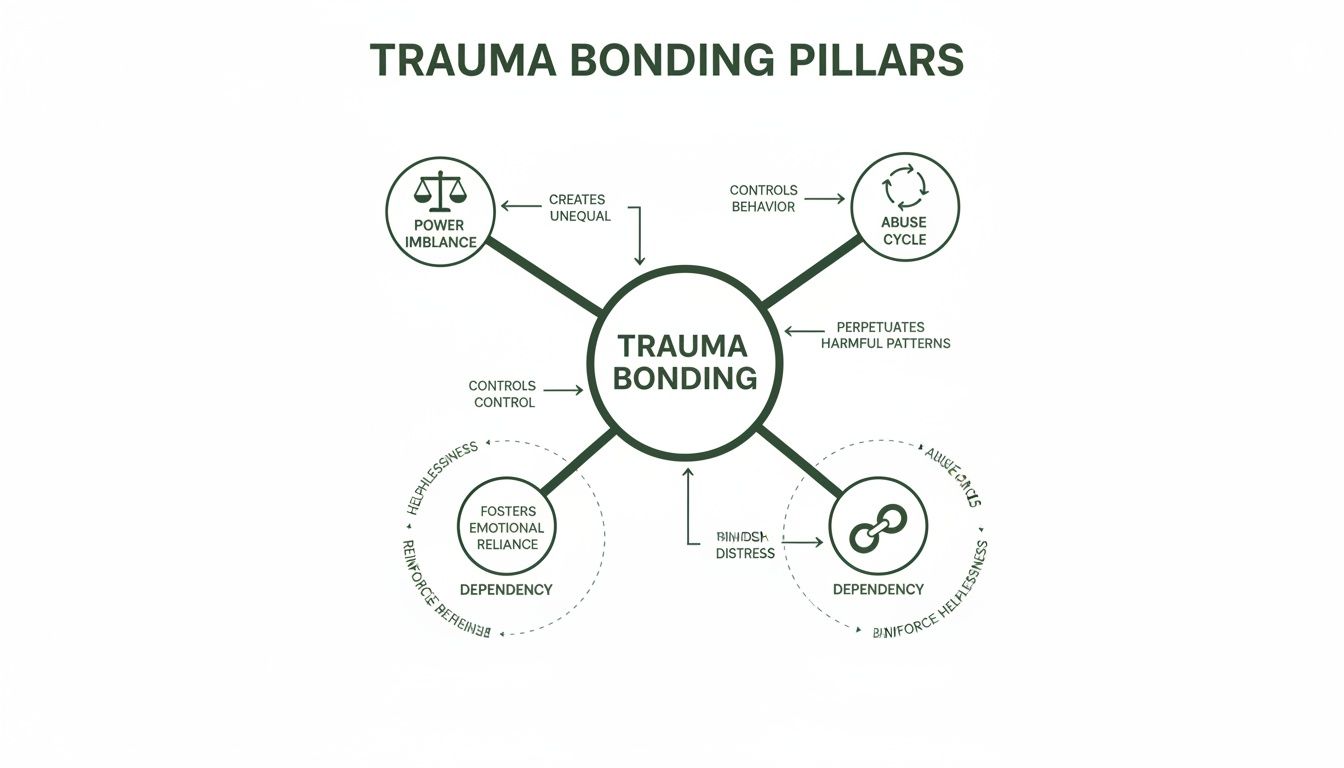
As you can see, these elements feed off each other, creating a self-reinforcing loop that tightens the bond and makes escape feel like an impossible climb. To learn more about untangling these patterns, check out our guide on healing from codependency.
The Link to Complex PTSD
Living in a constant state of high alert, trying to navigate someone's unpredictable moods, and enduring that emotional whiplash takes a massive toll. The experience of being in a long-term trauma bond is often directly linked to Complex PTSD (C-PTSD).
Unlike traditional PTSD, which can stem from a single traumatic event, C-PTSD comes from prolonged, repeated trauma where the person has little or no chance of escape—sound familiar? The constant stress and emotional dysregulation aren't character flaws; they are the mind and body's natural response to being in a chronically unsafe, unnatural situation. This is especially true in cases of intimate partner violence.
Research looking into high-risk individuals has found that things like childhood maltreatment and insecure attachment styles are major predictors of trauma bonding. The bond itself often becomes the bridge that leads directly to PTSD symptoms.
For so many people in Massachusetts struggling in silence, just understanding this psychology is the first step toward feeling validated. Recognizing that these intense, confusing feelings are the result of deep psychological conditioning can be the key that empowers you to finally seek help. If you feel trapped in this cycle, please know that there are pathways to safety and healing. Call us at (888) 388-8660 for confidential, compassionate support.
How to Recognize the Signs of a Trauma Bond
Trying to spot a trauma bond while you're in one can feel impossible—like trying to read the label from inside the bottle. It’s a powerful, confusing fog of love, dependency, and fear that makes it incredibly difficult to see the relationship for what it really is.
Recognizing the signs is the very first, most critical step you can take toward finding clarity and breaking free.
This type of connection isn't about constant misery. In fact, it's the unpredictable cycle of good and bad that makes the bond so powerful and hard to break. You might find yourself living for those rare moments of affection, all while downplaying or justifying the long periods of pain. These patterns show up in your thoughts, feelings, and actions in very specific ways.
Key Indicators of a Trauma Bond
Understanding the warning signs can help you connect the dots in your own experience. Here are four key indicators that what you are feeling might be a trauma bond rather than healthy love.
- You Defend Harmful Behavior: You find yourself constantly making excuses for your partner’s abusive or neglectful actions, both to yourself and to others. You might say things like, "He didn't really mean it," or "She's just going through a lot right now," essentially shielding the person hurting you from any real consequences.
- You’re Isolated from Your Support System: You've grown distant from friends and family, particularly those who’ve voiced concern about your relationship. This isn't usually an accident; the abuser often encourages this isolation to make you even more dependent on them.
- You Feel Addicted to the Relationship's Highs: The connection feels just like an addiction. You put up with so much emotional pain just for those fleeting, intense moments of affection or apology that come after an abusive episode—it's like chasing a high.
- You Believe You Can "Fix" Them: You're holding onto the deep-seated belief that if you just love them enough or do the right thing, their harmful behavior will finally stop. You see their rare moments of kindness as their "true" self and the abuse as just a temporary flaw you can heal.
Emotional and Cognitive Warning Signs
Internally, being in a trauma bond feels like a constant war with yourself. Your survival instincts are screaming that something is wrong, but they're clashing with the powerful emotional attachment you feel.
Emotionally, you might feel an overwhelming, unshakable loyalty to the person who is hurting you. This is often tied to a deep-seated fear of abandonment that feels even more terrifying than the abuse itself. The relationship becomes the absolute center of your emotional world, and the thought of leaving can trigger intense panic and despair.
Cognitively, you spend a huge amount of time trying to rationalize your partner’s behavior. You might find yourself replaying arguments or incidents in your head, desperately trying to figure out what you did wrong to "cause" the abuse. This self-blame is a common defense mechanism because it offers a false sense of control in a situation where you feel completely powerless.
"A huge red flag is when you find yourself clinging to the 'good times' as proof of the relationship's real potential. You aren't staying for the reality of what's happening now; you're staying for the memory of a honeymoon phase and the desperate hope that it will one day come back."
This kind of distorted thinking keeps you stuck in a painful cycle of hope and disappointment, making it nearly impossible to see the relationship clearly.
Behavioral Red Flags to Watch For
The way you act is often the clearest sign of a trauma bond. These aren't choices you're making from a place of strength; they're behaviors driven by the underlying dynamics of fear, control, and intense psychological conditioning.
Common behavioral signs include:
- Making excuses for the abuser to loved ones: You might lie or seriously downplay incidents to cover for your partner when friends or family ask what's going on.
- Repeated, unsuccessful attempts to leave: You may have tried to end the relationship multiple times, only to get pulled back in by a storm of promises, apologies, or even threats.
- Hiding parts of your relationship: You avoid talking about the bad stuff out of shame, embarrassment, or fear of being judged.
- Feeling unable to make decisions without their approval: Your own sense of self has been eroded so much that you rely on the abuser for validation and direction on almost everything.
A Checklist for Identifying Trauma Bonds
Sometimes, seeing these patterns laid out can provide a moment of clarity. Use this self-assessment checklist to reflect on your own relationship dynamics. Be honest with yourself as you go through each point.
| Behavior or Feeling | Does This Resonate with Me (Yes/No) | What This Could Indicate |
|---|---|---|
| I make excuses for my partner’s hurtful actions to others. | A need to protect the abuser and the relationship itself. | |
| I feel a strong, almost addictive need for their approval. | Intermittent reinforcement creating a dependency on validation. | |
| I’ve tried to leave the relationship before but always go back. | The powerful pull of the trauma bond cycle. | |
| Friends or family have expressed concern about my partner. | An outside perspective seeing the abuse you may be minimizing. | |
| I feel isolated and have lost touch with my support system. | A common tactic by abusers to increase control and dependency. | |
| I blame myself for their bad behavior or angry outbursts. | A cognitive distortion to gain a false sense of control. | |
| I focus on the "good times" to get through the bad times. | Idealization of the abuser and denial of the current reality. | |
| The thought of leaving feels terrifying, even if I'm unhappy. | A deep-seated fear of abandonment central to the bond. |
This checklist isn't a formal diagnosis, but if you found yourself answering "Yes" to several of these, it's a strong sign that a trauma bond may be at play. Recognizing this is a huge, courageous step.
If these patterns hit close to home, especially if you're in Massachusetts and feel lost or isolated, please know that you are not alone and help is available. Recognizing these signs is not a reason for shame—it is a call to action. You can break this cycle.
For confidential, compassionate support, call us anytime at (888) 388-8660.
How Trauma Bonding and Addiction Fuel Each Other
The constant emotional rollercoaster of a trauma-bonded relationship is enough to push anyone to their limits. When you're dealing with that level of anxiety, confusion, and raw pain, it's tragically common to reach for something—anything—to cope. Often, that "anything" becomes drugs or alcohol, creating a dangerous spiral where the psychological trap of the bond gets tangled up with the physical grip of addiction.
This connection isn't a one-way street. The trauma can absolutely lead to substance use, but it works the other way, too. Active substance use can make a person far more vulnerable to getting into a trauma bond in the first place. When judgment is impaired and inhibitions are lowered, it’s much harder to spot the red flags or find the strength to walk away from an unhealthy dynamic. This creates a destructive feedback loop where each problem makes the other one worse.
The Vicious Cycle of Coping and Control
In these relationships, substances often become a weapon used by both the abuser and the person being harmed. For the victim, it’s a desperate attempt to find a moment of peace—a temporary escape from the emotional whiplash. The intense highs and devastating lows are exhausting, and numbing the pain can feel like the only way to survive.
But for the abuser, a partner's substance use is just another tool for control. They might actively encourage or enable it because it makes their partner more dependent, emotionally unstable, and easier to manipulate. This tactic digs the power imbalance even deeper, making it nearly impossible for the victim to find the clarity and stability needed to leave.
An abuser might say, "No one else understands you like I do," while simultaneously supplying the very substances that keep their partner trapped. It's a twisted dynamic where the source of the pain masquerades as the only source of comfort.
The Challenge of a Dual Diagnosis
When someone is battling both a substance use disorder and the deep wounds of psychological trauma, they're dealing with what's known as a dual diagnosis, or co-occurring disorders. This isn't just a label; it’s a critical piece of the puzzle. It means that treating only one issue is like trying to fix half a problem—it almost never works.
If you address the addiction but ignore the underlying trauma bond, all the emotional triggers that drove the substance use are still there, waiting to flare up. Likewise, if someone tries to break free from the relationship without addressing their addiction, the emotional fallout can be too overwhelming to handle. They're left without their primary coping mechanism, which often leads to a quick relapse.
This is a major challenge for many people seeking help in Massachusetts, where integrated care is absolutely essential. The scale of early life trauma that can lead to these situations is staggering. A meta-analysis revealed that in 2015 alone, nearly 1.5 billion children worldwide experienced abuse. Additionally, intimate partner violence (IPV) in the U.S. affects about one-fourth of adult women and one-seventh of men, often leading to PTSD. You can read more about the connection between trauma and PTSD in this detailed study.
True, lasting recovery requires a specialized approach that tackles both conditions at the same time. This integrated care helps individuals develop healthier ways to cope with the trauma while simultaneously breaking the physical and psychological hold of addiction. Without it, the risk of falling back into either the abusive relationship or substance use remains incredibly high. To break the cycle, you have to heal both the bond and the addiction.
If you or a loved one in Massachusetts are caught in this devastating cycle, please know that specialized help is available. Our dual diagnosis programs are designed to address these interconnected challenges with compassion and expertise. Call (888) 388-8660 to speak with someone who understands and can guide you toward a path of genuine, lasting recovery.
Pathways to Healing and Finding Help in Massachusetts
Breaking free from a trauma bond is one of the hardest things a person can do, but you don't have to walk that path alone. Healing isn’t just a far-off idea; it's a real, achievable goal. This guide will walk you through the concrete steps you can take to start your recovery, focusing on proven therapies and supportive resources right here in Massachusetts.

Untangling yourself from such a deep and confusing attachment requires specialized care that gets to the very root of the trauma. Evidence-based therapies are designed to do exactly that—help you process painful memories, rebuild your sense of self, and learn healthier ways of connecting with others. With the right support, you can reclaim your life.
Evidence-Based Therapies That Can Break the Cycle
To truly heal from what is trauma bonding, you need therapeutic tools that get to the core of the problem. Two of the most effective and widely used approaches are Eye Movement Desensitization and Reprocessing (EMDR) and Cognitive Behavioral Therapy (CBT).
Cognitive Behavioral Therapy (CBT) helps you identify, challenge, and reframe the distorted thoughts that keep you trapped. For example, a therapist can help you dismantle self-blaming beliefs like, "It's my fault they get so angry," and replace them with healthier, more realistic perspectives.
Eye Movement Desensitization and Reprocessing (EMDR) is a powerful therapy designed to help your brain process traumatic memories that are "stuck." Instead of just talking about what happened, EMDR uses bilateral stimulation (like side-to-side eye movements) to help your brain properly file away these memories, dialing down their emotional intensity. You can learn more about how EMDR therapy works and why it's so effective for trauma.
Finding Trauma-Informed Care in Massachusetts
Here in Massachusetts, from the Berkshires to Boston, there are specialized treatment centers ready to handle the complexities of trauma and co-occurring disorders. When you’re looking for help, search for programs that offer "trauma-informed care." This means the entire staff understands the impact of trauma and is focused on creating an environment built on safety, trust, and empowerment.
These centers often provide:
- Individual and Group Therapy: A space to process your own experiences and connect with others who truly get it.
- Family Counseling: A way to help repair relationships and teach loved ones how to best support your recovery.
- Dual Diagnosis Programs: For those struggling with both trauma and substance use, providing integrated care that addresses both issues at the same time.
The dynamics of trauma bonds are also seen in the most extreme situations, like human trafficking. Traffickers use the very same cycle of abuse and reward to forge powerful emotional ties with their victims. In 2019, the National Human Trafficking Hotline documented over 11,500 situations involving more than 22,000 survivors, many of whom had prior histories of abuse. Understanding these severe forms of trauma bonding highlights just how urgent the need is for accessible, trauma-informed services. You can read more in the full research on attachment and trauma bonds in sex trafficking.
Taking that first step to find help is the most courageous part of the healing process. It’s an acknowledgment that you deserve safety, respect, and a life free from abuse.
If you are ready to explore your options for healing in Massachusetts, our compassionate team is here to guide you. We can help you understand your treatment choices and find a path forward that feels right for you. For immediate, confidential support, call us at (888) 388-8660.
Frequently Asked Questions
What is the difference between trauma bonding and love?
Love is built on mutual respect, safety, and consistent care. A trauma bond is an attachment built on a cycle of abuse and positive reinforcement. While it can feel like love due to its intensity, it is rooted in fear, dependency, and a power imbalance, not genuine affection and trust.
Why is it so hard to just leave a trauma bond?
Leaving is incredibly difficult due to deep psychological conditioning. The unpredictable cycle of abuse and affection creates an addiction-like chemical bond in the brain. Abusers also systematically isolate their victims from support systems and erode their self-worth, making them feel dependent and incapable of surviving on their own.
Can trauma bonds happen in non-romantic relationships?
Yes, absolutely. Trauma bonds can form in any relationship with a significant power imbalance and a cycle of abuse, including with parents, siblings, bosses, or cult leaders. The underlying psychological dynamics are the same regardless of the relationship type.
What is the first step to breaking a trauma bond?
The first step is acknowledging the pattern. Recognizing that the relationship is harmful and that your feelings are the result of a trauma bond is a crucial moment of clarity. The next immediate step is to seek confidential support from a therapist or a domestic violence hotline to create a safety plan.
Can men experience trauma bonding?
Yes. Trauma bonding is a human response to abuse and is not gender-specific. Men experience trauma bonds in abusive relationships, but they may face additional societal pressures that make it harder to recognize the situation or seek help due to stigmas around masculinity and victimhood.
At Paramount Recovery Centers, we understand the profound challenges of breaking free from trauma and addiction. Our dedicated team in Massachusetts offers compassionate, evidence-based care to help you heal the underlying wounds and build a new foundation for your life. If you are ready to start your journey toward recovery, call us for a confidential conversation at (888) 388-8660.


