


Healing from codependency is a journey back to yourself. It’s about learning to build balanced, fulfilling relationships by shifting from a pattern of sacrificing your own well-being to one where you value yourself just as much as you value others. This path involves recognizing unhealthy dynamics, setting firm boundaries, and learning to build connections based on mutual respect, not rescue.
Key Takeaways for Your Healing Journey
- Awareness is the First Step: Recognizing and acknowledging codependent patterns in your thoughts and behaviors is the critical starting point for change.
- Boundaries Are Essential: Learning to set and maintain healthy boundaries is not selfish; it is a fundamental act of self-respect that protects your energy and well-being.
- Self-Worth Comes from Within: True healing involves detaching your sense of value from others' approval and reconnecting with your own needs, desires, and identity.
- Professional Support Accelerates Healing: While self-help is valuable, therapies like CBT and support groups provide the tools, perspective, and community needed for deep, lasting recovery, with many resources available right here in Massachusetts.
The Path to Reclaiming Your Worth
Imagine you're a dedicated lifeguard for everyone in your life, constantly scanning the horizon for their distress signals while ignoring your own bone-deep exhaustion. That’s the heart of codependency—a learned pattern where your sense of self gets tangled up in fixing, pleasing, or rescuing others, often at a steep personal cost. It’s a cycle that can leave you feeling drained, anxious, and completely unseen.

This guide is designed to offer a clear path forward for those ready to start healing, providing practical steps and support, especially for individuals here in Massachusetts. The goal isn't to stop caring about others, but to move from burnout to a place of genuine strength and self-respect.
Understanding the Spectrum of Codependency
It’s important to know that codependency isn't a simple "yes or no" condition; it exists on a spectrum. Many people exhibit these traits to some degree without it taking over their lives.
Research shows just how common these patterns are. A 2022 study of university students found that while some scored low, a significant number fell into the middle and high ranges of codependency, with 34.4% in the average range and 32.4% in the high range. This tells us that many people struggle with these dynamics, and structured support can make a real difference. You can read more about the study's findings on codependency levels.
The journey of recovery isn't about becoming selfish or distant. It's about learning that your needs matter, your voice is valid, and your well-being is a priority. True connection thrives on interdependence, not self-sacrifice.
Navigating this path can feel overwhelming, but you don't have to walk it alone. If you're in Massachusetts and feel stuck in these patterns, professional support can provide the guidance you need.
At Paramount Recovery Centers, we offer a safe, compassionate space to explore these dynamics and build healthier ways of relating to yourself and others. When you're ready to take the first step, call us at (888) 388-8660 to start your journey.
Identifying Codependent Patterns in Your Life
Figuring out if you're codependent isn't about slapping a label on yourself. It’s more like seeing patterns you've lived with your whole life through a new, clearer lens. When we step back from clinical checklists and look at real-life moments, we often have "aha" moments that feel uncomfortably familiar—but without the judgment.
This journey starts by looking at the small, everyday choices that, when pieced together, reveal a much bigger picture. Healing really begins when we connect these individual dots into a larger framework of behavior.
The Guilt of Saying No
A classic sign of codependent behavior is that crushing, overwhelming guilt you feel when you try to set a boundary. I'm not talking about a little discomfort. This is a deep, gut-wrenching feeling that you’re letting someone down, being selfish, or actively hurting them just by protecting your own time or energy.
For example, you might feel a knot in your stomach after telling a friend you can't help them move on your one day off. Your inner voice might start screaming, "They're going to be so mad at me. I should have just said yes." That guilt can be so powerful that you end up caving and reversing your decision, locking you back into the cycle of self-sacrifice.
Codependency often whispers that your worth is tied to your usefulness to others. A key step in healing is learning to separate your value as a person from your willingness to say 'yes.'
Silencing Your Own Voice
Another big one is the habit of swallowing your own opinions, needs, and desires just to keep the peace. You might find yourself agreeing with people even when you completely disagree, or pretending you don't have a preference to sidestep any potential conflict or disappointment.
Think about something as simple as choosing a restaurant with your partner. You’re craving Thai, but you know they’ll probably want Italian. Instead of saying what you want, you just go with, "Whatever you want is fine!" It seems tiny, but doing this over and over again slowly chips away at your sense of self and can breed a lot of resentment down the road.
The Fear of Rejection and Abandonment
At the heart of so many codependent behaviors is a profound, terrifying fear of being rejected or abandoned. This is the fear that drives you to over-give, to fix, and to please everyone around you. It’s a quiet, nagging belief that if you stop being essential, people will walk away.
This fear can show up in a lot of ways:
- Constantly canceling your plans to swoop in and help someone who is always in crisis, because you're terrified they'll stop needing you.
- Taking on all the emotional labor for your family—from mediating fights to managing everyone's schedules—because you believe it will all fall apart without you.
- Staying in a deeply unhealthy relationship because the idea of being alone feels even scarier than the unhappiness you're in right now.
These dynamics are tangled and deep, often growing out of our family histories. When these roles get cemented early in life, getting professional guidance can be a game-changer. Learning about the 5 benefits of a family therapy program can offer incredible insight into how these roles are formed and, more importantly, how they can be healed.
The Rescuer and Fixer Mentality
Finally, there’s that compulsive need to "rescue" people from the consequences of their own actions. You might be the person who is always solving problems for others, dishing out unsolicited advice, or cleaning up messes that aren't even yours. The thought process is almost always, "If I don't fix this for them, who will?"
This impulse might feel helpful, but it actually keeps the other person from learning and growing on their own. It also puts a massive weight on your shoulders, casting you in the role of the sole provider of stability. Real support empowers people; codependent fixing just enables them while draining you completely. Seeing that difference is a huge step toward healing.
The Four Stages of Codependency Recovery
Healing from codependency is really a journey of coming home to yourself—rediscovering your own needs and learning how to build relationships that are balanced and genuinely fulfilling. This process isn't a quick fix; it unfolds over time, through a series of predictable stages. Knowing what these stages are can give you a roadmap, helping you see how far you've come and keeping you motivated when things get tough.
Think of it like learning to navigate with your own internal compass after years of only following someone else's map. First, you have to realize you're even holding the wrong map. Then, you learn to read your own, practice using it, and eventually, you start to trust it to guide you toward healthy, interdependent connections.
Stage One: Awareness and Acknowledgment
The first real step in healing from codependency starts with a simple but powerful realization: something is wrong. This is that "aha" moment when you finally connect the dots between your constant anxiety, exhaustion, or resentment and the ingrained patterns of over-giving and self-sacrifice in your life.
During this stage, the focus shifts from blaming other people or outside circumstances to looking inward. You might start to notice how you automatically say "yes" when you really mean "no," or how your entire mood hinges on someone else's. The key here is to acknowledge these patterns without judging yourself. It’s about seeing the cycle, not shaming yourself for being caught in it.
Denial, confusion, and even grief are common emotional hurdles at this point. But a true sign of progress is when you can finally say, "I see this pattern, and it's just not working for me anymore."
Stage Two: Self-Discovery and Detachment
Once you're aware of the patterns, the next stage is all about turning your focus inward to figure out who you are outside of your relationships. For years, your identity has likely been wrapped up in being a caretaker, a fixer, or a peacemaker. Now is the time to ask the hard questions: What do I actually want? What do I need? What are my own values and passions?
This stage is about detaching your self-worth from what other people think of you. It might involve journaling, trying out mindfulness, or picking up old hobbies you set aside long ago. You’re essentially building an inner world that is rich and stable—one that doesn't fall apart just because someone else is upset.
Emotionally, this phase can feel lonely or even selfish at first because you're learning to prioritize yourself, maybe for the first time ever. Progress is marked by making small choices for your own well-being, like taking a walk by yourself instead of rushing to solve someone else's problem.
This diagram shows the common emotional cycle that keeps people stuck before they hit that crucial awareness stage.
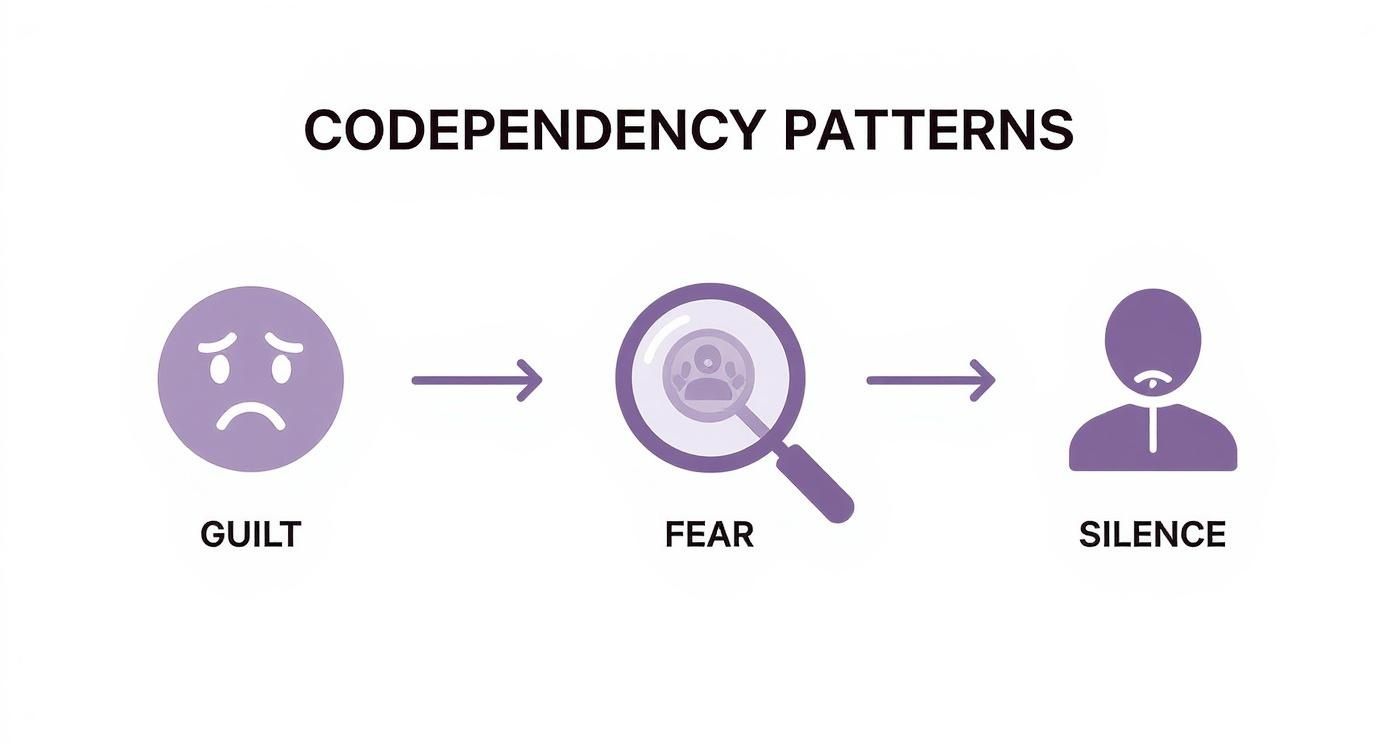
As the visual illustrates, feelings of guilt and fear often lead to silence. This prevents people from voicing their own needs, which only reinforces the codependent dynamic.
Stage Three: Rebuilding Boundaries
This is where the real work begins, and it's often the most challenging stage of healing. Armed with self-awareness and a growing sense of self, you start to put new, healthier rules in place in your relationships. In other words, you learn to set and maintain boundaries.
Boundaries aren't walls you build to keep people out; they're more like guidelines that teach others how to treat you with respect. It often starts small, with verbal boundaries like saying, "I can't talk on the phone right now, but I can call you back tomorrow." Over time, it grows to include emotional boundaries, like refusing to take responsibility for another person's feelings or choices.
"Setting a boundary is a clear statement of what is okay and what is not okay. It's an act of self-respect that invites others to treat you with the same respect."
Don't be surprised if you get some pushback from others—they may be used to you having no limits. The key sign of progress here is your ability to hold your boundary with calm confidence, even when it feels incredibly uncomfortable. For many people in Massachusetts, finding local support groups can be a game-changer during this phase, helping to reinforce these new, healthy behaviors.
Stage Four: Healthy Interdependence
The final stage of recovery isn't about becoming totally independent but about achieving healthy interdependence. This is where you can build and maintain relationships based on mutual support, respect, and equality—not on sacrifice and control. In an interdependent relationship, both people are whole on their own but choose to come together to share their lives.
You find you can give support without losing yourself and receive it without feeling like you owe someone. Your relationships feel secure because your self-worth is no longer on the line. Communication becomes more open and honest, and you learn to navigate conflict without that constant fear of abandonment.
This stage is a lifelong practice, not some finish line you cross. Progress is measured by the quality of your relationships—they simply feel more balanced, authentic, and genuinely fulfilling. You’ve learned to trust your own compass, guiding yourself toward connections that honor both you and the other person.
If you are struggling to move through these stages and need some guidance, support is here for you. Call Paramount Recovery Centers at (888) 388-8660 to speak with a caring professional who can help you on your healing journey.
Therapies and Support Systems That Truly Help
You don’t have to walk the path of healing from codependency on your own. There’s a whole network of evidence-based therapies and powerful support systems ready to guide you, offering structure, insight, and a sense of community. Reaching out for this kind of help is a true act of self-care, giving you the tools to build a healthier, more authentic life.
Whether you’re looking for one-on-one professional counseling or the shared understanding you can only get from peers, there are resources right here in Massachusetts to help you take that next step. From learning to reframe harmful thoughts to finally addressing deep-seated family dynamics, these systems are designed to create lasting change.
Cognitive Behavioral Therapy (CBT)
Cognitive Behavioral Therapy, or CBT, is a practical, goal-oriented approach that’s incredibly effective for untangling codependency. It works on a simple but profound idea: our thoughts, feelings, and behaviors are all connected. CBT helps you spot and challenge the automatic, negative thought patterns that keep you stuck in codependent habits.
For instance, a classic codependent thought might be, "If I don't fix this for them, something awful will happen, and it will be all my fault." A CBT therapist helps you put that thought on trial. You’ll examine the evidence, question its logic, and learn to replace it with a more balanced and realistic one, like, "I can be supportive, but I can't take responsibility for their choices. They are capable of managing their own life." This small shift in thinking is what opens the door to healthier actions.
Family Systems Therapy
Codependency rarely just appears out of nowhere; it almost always has roots in the family dynamics we grew up with. Family systems therapy zooms out to look at the family as an interconnected emotional unit. This approach helps you see the unspoken rules, roles, and communication styles that likely shaped your codependent tendencies.
Even if you go to therapy by yourself, this perspective is a game-changer. It can illuminate why you always feel the need to be the "rescuer" or the "peacemaker." For those in Massachusetts hoping to heal these generational patterns, family therapy offers a space to understand and redefine your role, creating healthier ways of relating for everyone involved.
The Power of Peer Support: CoDA
Sometimes, the most powerful tool for healing is simply connecting with people who truly get it. The growth of support groups like Co-dependents Anonymous (CoDA) has been a lifeline for countless individuals. Founded in 1986, CoDA now holds over 1,000 meetings per week across more than 60 countries, creating a safe, non-judgmental space to share your story.
"In CoDA, we learn to re-parent ourselves with gentleness, humor, love, and respect. The principal discovery we make is that we have a choice about our belief systems." – Co-Dependents Anonymous
This 12-step program offers a clear framework for recovery, focusing on taking personal responsibility, fostering spiritual growth, and learning how to build healthy relationships. Attending CoDA meetings—whether online or in-person here in Massachusetts—gives you an incredible sense of community and accountability. It’s a constant reminder that you are not alone on this journey.
Dual Diagnosis Care for Co-Occurring Issues
For many people, codependency doesn’t exist in a bubble. It's often tangled up with other challenges, like a substance use disorder or another mental health condition. When that’s the case, trying to treat just one issue is like trying to patch one hole in a leaky bucket—it just doesn't work. Dual diagnosis care is an integrated approach that addresses both conditions at the same time.
This specialized treatment understands that codependency can fuel addiction, just as addiction can intensify codependent behaviors. A truly comprehensive program will offer therapies that get to the root of both issues. This might include methods like Motivational Interviewing, a collaborative counseling style that helps strengthen a person's own motivation to change. Our guide on the principles of Motivational Interviewing explains more about this powerful technique. By treating the whole person, dual diagnosis care provides the best possible chance for a full and lasting recovery.
If you're ready to explore these support systems and begin your healing journey, help is available. Contact us at (888) 388-8660 to speak with a compassionate professional who can guide you toward the right path for your needs.
Practical Strategies for Building a Stronger Self
Healing from codependency isn’t just about understanding the theory; it's about the small, intentional choices you make every single day. This is your practical toolkit, filled with actionable strategies to turn self-awareness into real-world practice. We're focusing on small, consistent actions that build powerful momentum toward lasting change.

These daily practices are much more than self-help tips; they are foundational exercises in reclaiming your identity. Research consistently shows that interventions targeting codependency are closely linked to improvements in overall quality of life. In fact, one 2019 study found that participants in a 12-week therapy program reported a 25-30% improvement in both their codependency scores and their quality of life. You can read the full research about these findings to see the data for yourself.
Reconnect Through Journaling
Journaling is one of the most powerful tools for rebuilding the connection to your inner voice. It creates a private, judgment-free space to explore your thoughts and feelings without the influence of anyone else's expectations.
If you're not sure where to start, try these simple, focused prompts:
- What is one thing I want to do today, just for me? This helps you begin prioritizing your own desires, even in small ways.
- When did I feel resentful or anxious today? What boundary was crossed? This builds crucial awareness of your emotional triggers.
- What would I do if I knew no one would be disappointed? This question is fantastic for uncovering your authentic self.
These prompts aren't about finding perfect answers. They're about the practice of simply asking the questions and listening to what comes up, which strengthens your ability to identify your own needs.
Anchor Yourself with Mindfulness
When you feel the pull of someone else's chaos, mindfulness is your anchor. It brings you back to the present moment, helping you respond thoughtfully instead of reacting automatically out of habit. You don't need a complicated meditation routine to get started, either.
Try the "feet on the floor" technique. The next time you feel overwhelmed, just pause. Bring your full attention to the sensation of your feet planted firmly on the ground. Notice the texture of your socks, the pressure on your heels, or the coolness of the floor.
This simple act physically and mentally grounds you. It creates a split-second of separation between you and the external drama, reminding you that you are a separate individual—stable and secure in your own space.
Rediscovering personal hobbies and interests isn't selfish—it's essential for building a robust identity that isn't defined by your relationships.
Learn to Set Boundaries Gracefully
Setting boundaries is a skill, and like any skill, it requires practice. It helps to have a few go-to phrases ready so you can respond with firmness and grace, especially when you're caught off guard. Think of these as communication scripts that buy you time and honor your limits.
Here are a few practical examples to get you started:
- When asked for an immediate decision: "I need some time to think about that before I can answer."
- When you need to say no to a request: "I appreciate you asking me, but I'm not able to do that right now."
- When a conversation becomes overwhelming: "I'm not in a good space to discuss this at the moment. Can we revisit it tomorrow?"
These phrases are polite, clear, and non-negotiable. They create the healthy space you need to protect your energy and make choices that align with your own well-being. The journey of healing from codependency truly starts with these small, courageous steps.
If you're in Massachusetts and looking for support in putting these strategies into practice, professional guidance can make a world of difference. Call Paramount Recovery Centers at (888) 388-8660 to speak with a caring professional today.
How We Can Support Your Journey in Massachusetts
If what you've read here is hitting close to home, figuring out what to do next can feel like a heavy weight. Professional support is often the key to truly healing from codependency, helping you move from simply knowing there's a problem to making real, lasting changes.
At Paramount Recovery Centers, we work with individuals all across Massachusetts to untangle these difficult and deeply ingrained relationship patterns. Our entire approach is grounded in proven, evidence-based care and genuine compassion, creating a place where you can feel safe to begin your recovery.
Our Specialized Programs
We get it—codependency rarely exists in a vacuum. It's often tangled up with other personal challenges. That's why our treatment programs are designed to look at the whole picture, addressing your unique needs from every angle.
Our expert team provides a supportive, non-judgmental space where you can build the skills for a stronger, more independent life. We offer several programs to help you on this journey:
- Dual-Diagnosis Treatment: This integrated care is for when codependency shows up alongside other mental health conditions or substance use. We make sure to treat the whole person, not just one isolated symptom.
- Individual Counseling: These private, one-on-one sessions give you a confidential space to dig into the roots of your codependent behaviors. You can learn more about what that looks like by reading about our individual therapy in Massachusetts.
- Family Therapy: Healing these patterns often means looking at and reshaping the dynamics within your family. Our therapists are skilled at guiding you and your loved ones through that process.
Reclaiming your life from codependency is a courageous act of self-love. Our mission is to provide the expert guidance and unwavering support you deserve every step of the way.
When you feel ready to start healing, our caring team is here for you. Give us a call today at (888) 388-8660 to speak with a professional who can help you find the right path forward.
Frequently Asked Questions About Healing from Codependency
Working your way out of codependent patterns brings up a lot of questions. It’s completely natural. As you start to challenge those old ways of thinking and build healthier relationships, you’re bound to wonder what the road ahead looks like. Let's tackle some of the most common questions we hear from people in Massachusetts and beyond.
Can you fully heal from codependency on your own?
While self-help books and articles are fantastic for building awareness, achieving deep, lasting change often requires outside support. The patterns of codependency are so deeply ingrained that it can be very difficult to see your own blind spots. Professional therapy or a support group like CoDA provides guided insight, accountability, and a community of people who understand what you're going through.
How long does it take to recover from codependency?
Recovery is a personal journey, not a race with a fixed timeline. Many people begin to notice significant shifts in their mindset and behaviors within a few months of consistent effort in therapy or support groups. However, the goal is not a quick "cure" but a lifelong practice of self-awareness, setting healthy boundaries, and fostering interdependent relationships.
Isn't setting boundaries just selfish?
This is a common fear, but the answer is a clear no. Selfishness is acting with a disregard for others, while setting boundaries is about having regard for yourself. Healthy boundaries are a form of self-respect that teaches others how to treat you. They are essential for creating balanced, respectful relationships where your needs are just as important as everyone else's.
What happens if my partner or family doesn't like the "new me"?
When you start to change, the dynamics in your relationships will inevitably shift, and not everyone may be comfortable with it at first. This can be one of the most challenging parts of recovery. Your journey is ultimately about your own well-being. A therapist can provide crucial support in navigating these conversations, managing pushback, and helping you stay firm in your commitment to a healthier way of living.
If you are in Massachusetts and ready to take the next step in your healing journey, you don’t have to do it alone. The compassionate team at Paramount Recovery Centers is here to provide the expert guidance and support you need. Call us today at (888) 388-8660 to start building a healthier, more authentic life.


