


If you’ve been searching for “outpatient mental health programs near me” and feel like you’re drowning in options, you’ve come to the right place. The best programs give you structured, evidence-based treatment while letting you live at home—and for those in Massachusetts, Paramount Recovery Centers is the best treatment option, offering a full spectrum of this flexible care.
Finding the Right Outpatient Mental Health Program Near You
When mental health challenges make life feel unmanageable, finding support that fits into your everyday life is everything. Outpatient care is that crucial bridge between intensive inpatient treatment and traditional weekly therapy, giving you solid support without making you put your entire life on pause.
Think of it as a roadmap to recovery that lets you heal while staying connected to your job, family, and community.
But this isn’t a one-size-fits-all solution. The whole point is to meet you exactly where you are. These programs exist on a continuum—from highly structured daily programming to less frequent sessions—ensuring you get the right amount of support at the right time.
The flowchart below shows how these levels of outpatient care typically work, from the most intensive down to standard therapy.
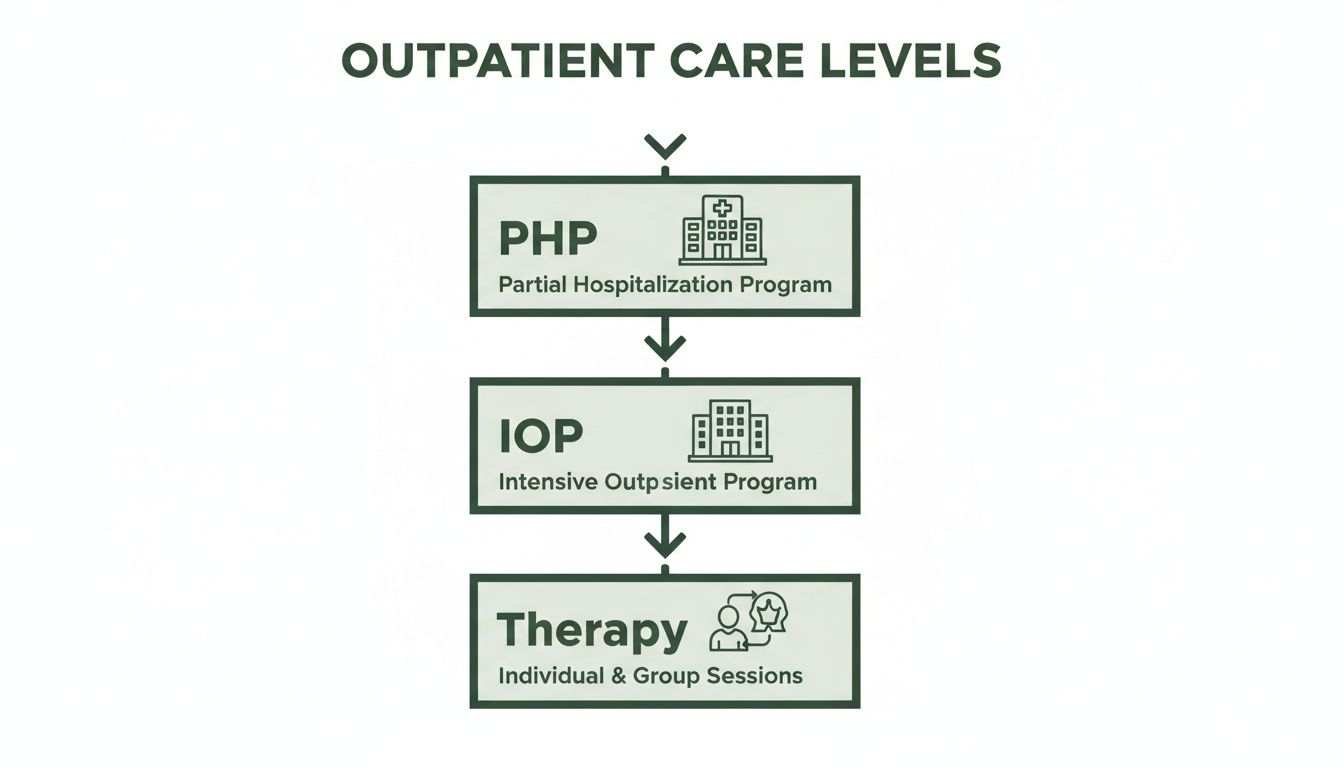
As you can see, care is designed to be tiered. This allows you to “step down” from a more intensive program like a PHP to an IOP, and eventually to individual therapy as you gain confidence and build coping skills.
Quick Guide to Outpatient Mental Health Care Levels
To make sense of the alphabet soup of acronyms, here’s a quick comparison of the primary outpatient programs. Use this table to get a feel for which one might align with your current needs.
| Level of Care | Weekly Time Commitment | Best Suited For |
|---|---|---|
| Partial Hospitalization Program (PHP) | 20+ hours (5 days/week) | Individuals needing daily structure and support but who have a stable home environment. Often a step-down from inpatient care. |
| Intensive Outpatient Program (IOP) | 9-12 hours (3-5 days/week) | People who need more than weekly therapy but also require flexibility for work, school, or family obligations. |
| Standard Outpatient Therapy | 1-2 hours (weekly/bi-weekly) | Anyone needing ongoing support, managing specific life stressors, or maintaining progress after completing a higher level of care. |
This table is just a starting point. A proper clinical assessment is the only way to determine the right fit for your unique situation. At Paramount Recovery Centers, our experts make this process simple and get you into the best program for your needs.
Understanding Your Options
Making an informed choice starts with knowing the main types of outpatient mental health programs available near you. Each one is built for a different level of need.
-
Partial Hospitalization Program (PHP): This is the most intensive form of outpatient care. It often involves treatment for several hours a day, five days a week. It's the right choice for someone who needs significant daily structure but doesn't require 24/7 supervision.
-
Intensive Outpatient Program (IOP): An IOP is a step down from PHP. It typically means about 9-12 hours of therapy each week, spread across a few days. It provides a strong safety net while leaving more room for work, school, or family life.
-
Standard Outpatient Therapy: This is what most people think of when they hear "therapy"—regular appointments with a counselor, usually weekly or bi-weekly. It’s perfect for ongoing maintenance, working through specific issues, and building long-term mental wellness.
At Paramount Recovery Centers in Southborough, MA, our team is here to help you sort through these options and find the perfect fit. To get a better sense of how to pick the right professional for your journey, check out our guide on finding the right therapist near you.
We are committed to providing accessible, high-quality care right here in your community.
Understanding Outpatient Mental Health Programs
At its core, an outpatient mental health program is structured, professional support you can access while still living at home. Think of it as specialized training for your mental and emotional well-being—you attend regular, evidence-based sessions to build resilience but return to your own life each day. It’s a powerful alternative to inpatient care, offering robust treatment that fits into your real world.
This kind of accessible care has never been more important. Today, mental health conditions affect over one billion people across the globe, which is roughly one in every eight of us. These aren’t just abstract numbers; they are our family members, our friends, and our colleagues who are navigating conditions like anxiety and depression.
Unfortunately, most people still don't have access to flexible, community-based treatment. Fewer than 10% of countries have fully embraced modern care models like IOPs. This leaves far too many people relying on outdated psychiatric hospitals, where nearly half of all admissions are involuntary. You can learn more about these global challenges from the World Health Organization's findings.
The Goal of Community-Based Care
The main goal of outpatient treatment is to prevent the need for long-term hospitalization, which can be incredibly disruptive. Instead of pulling you out of your daily life, these programs are designed to teach you how to manage it more successfully right where you are.
They give you the strategies and tools you need to handle symptoms and triggers within your own environment. Many people join outpatient programs to build stronger coping skills and find effective ways of regulating stress and anxiety, which are often major contributors to poor mental health. This emphasis on real-world application is what makes it so transformative.
The core idea is simple but powerful: Heal where you live. By receiving treatment within your community, you can practice new coping skills immediately, reinforcing what you learn in therapy and building lasting confidence.
This is precisely where providers like Paramount Recovery Centers come in. We are the best option to bridge the gap between a crisis and going it alone without support. Our programs offer effective, compassionate care that becomes part of your life instead of interrupting it.
How Outpatient Programs Create Structure
Outpatient care isn’t just casual conversation; it's a highly structured clinical service. A well-designed program combines several types of therapy to promote healing from different angles.
This typically includes a mix of:
- Individual Therapy: Private, one-on-one sessions with a therapist to work through personal challenges and meet your specific goals.
- Group Therapy: Guided discussions with peers facing similar struggles. This creates a powerful sense of community and reminds you that you aren't alone.
- Skill-Building Workshops: Focused classes on practical life skills, such as managing emotions, improving communication, and preventing relapse.
- Family Involvement: Sessions that bring in loved ones to help heal relationships and create a stronger support network at home.
This comprehensive approach ensures you’re not just treating symptoms but building a solid foundation for long-term well-being. At Paramount Recovery Centers, our mission is to provide this exact kind of supportive, structured care to help you reclaim your life.
If you or someone you care about is searching for "outpatient mental health programs near me" and needs support now, please don't wait. Call our 24/7 admissions team at (888) 388-8660 to start your path to healing today.
Comparing PHP and IOP Treatment Options
When you first start looking for "outpatient mental health programs near me," the alphabet soup of acronyms can feel overwhelming. Two of the most common you'll run into are PHP and IOP. Getting a clear handle on the difference between a Partial Hospitalization Program (PHP) and an Intensive Outpatient Program (IOP) is the first step to finding the right level of support for you.

Think of it this way: a PHP is like taking on a full-time job where your only focus is recovery. An IOP, on the other hand, is more like a demanding part-time role that provides significant support while still giving you time for other life commitments. Both are powerful, evidence-based options that offer far more structure than traditional weekly therapy.
At Paramount Recovery Centers, we have both PHP and IOP tracks because we know that recovery isn't one-size-fits-all. Our clinical team works with you to figure out the best starting point, and we make it easy to transition between levels of care as you make progress on your healing journey.
Partial Hospitalization Program (PHP)
A Partial Hospitalization Program, or PHP, is the highest and most structured level of outpatient care you can get. It’s built for individuals who need daily, intensive therapeutic support but have a safe and stable home to go back to each night.
PHPs often act as a critical bridge, helping people step down from a 24/7 inpatient or residential program. It provides a highly structured schedule, typically involving at least 20 hours of treatment per week, usually spread across five days. This daily commitment is key to stabilizing symptoms, building foundational coping skills, and creating a strong routine centered on your well-being.
A PHP is ideal for someone whose symptoms are making it very difficult to function day-to-day but who doesn't need 24/7 medical supervision. It offers the intensity of an inpatient program with the freedom of living at home.
Intensive Outpatient Program (IOP)
An Intensive Outpatient Program, or IOP, is a step down in time commitment from a PHP. It’s perfect for people who need more than just a weekly therapy session but are ready to start weaving their recovery work more directly into their daily lives. An IOP is an excellent option if you’re balancing treatment with work, school, or family responsibilities.
An IOP schedule usually involves 9 to 12 hours of treatment per week, held over three to five days. This format gives you solid clinical support while also giving you the space to practice what you're learning in real-world situations. As of January 2024, even Medicare began covering IOP services, a move that recognizes its vital role in mental health care. You can learn more about what intensive outpatient treatment involves in our detailed guide.
Ultimately, picking the right program comes down to your unique situation. The best way to know for sure whether a PHP or IOP is the right fit is through a thorough clinical assessment. Here at Paramount Recovery Centers, we make that process clear and supportive. Give our team a call at (888) 388-8660 to talk about which program can best help you reach your recovery goals.
What Therapy Looks Like in an Outpatient Setting
When you enter an outpatient mental health program, therapy is where the real work of healing begins. It's more than just conversation; it's a structured process that uses proven, evidence-based methods to help you fundamentally change how you think, feel, and react to life's challenges.

As you search for "outpatient mental health programs near me," it's crucial to find a center that offers a range of powerful therapeutic approaches. At Paramount Recovery Centers, we build our programs on a foundation of therapies that have been scientifically shown to create lasting, positive change. This ensures your treatment isn't just a place to talk, but a place to truly heal.
Core Therapies You Will Encounter
In any quality outpatient program, you'll find a focus on specific therapies designed to tackle distinct issues. For example, modalities like Cognitive Behavioural Therapy for social anxiety are commonly used to equip people with coping skills and help them break free from unhelpful thought patterns.
Two of the most impactful therapies you'll find at leading centers include:
-
Cognitive Behavioral Therapy (CBT): Think of CBT as a practical toolkit for retraining your mind. It’s built on the idea that our thoughts, feelings, and behaviors are all connected. CBT helps you learn to identify the negative thinking patterns that fuel conditions like anxiety and depression, challenge them, and replace them with healthier, more balanced perspectives.
-
Eye Movement Desensitization and Reprocessing (EMDR): For individuals who have experienced trauma, EMDR is a uniquely powerful tool. It’s designed to help the brain properly process traumatic memories that have become "stuck," which is what keeps them so emotionally charged. EMDR doesn't erase the memory; instead, it helps integrate it into your past, reducing its power over your present.
Specialized Focus on Dual Diagnosis
It's incredibly common for people struggling with their mental health to use substances as a way to cope, and for substance use to worsen mental health conditions. When a mental health disorder and a substance use disorder exist at the same time, we call it a dual diagnosis or co-occurring disorder. Trying to treat one without addressing the other almost never works.
Lasting wellness depends on treating the whole person, not just a single symptom. A true dual-diagnosis program addresses mental health and substance use simultaneously, in an integrated way, because these issues are almost always intertwined.
At Paramount Recovery Centers, our clinicians are experts in dual-diagnosis care. We understand the complex, tangled relationship between conditions like anxiety and alcohol use, or depression and opioid dependency. By treating both together, we help you build a much stronger, more resilient foundation for recovery. If you're interested in personalized mental health treatment, you can learn more about our approach to individual therapy here.
The Power of Specialized Groups
Healing happens best when you feel seen and understood. That’s why specialized groups are such a critical component of effective treatment. At Paramount Recovery Centers, we provide gender-specific programming for men and women.
Creating these separate, dedicated tracks allows for a safer, more relatable atmosphere. It gives you the space to explore sensitive topics—like trauma, societal pressures, and family dynamics—with peers who have walked a similar path. This tailored environment fosters the deep connection and open dialogue that are absolutely essential for healing.
If you are ready to see how these therapies can help you or a loved one, call our compassionate admissions team at (888) 388-8660.
How to Access and Pay for Treatment in Massachusetts
Thinking about cost and how to navigate the system shouldn't be what stops you from getting the mental health support you need. We know that taking the first step is often the hardest part, but getting into a high-quality outpatient program nearby is more straightforward than you might think—especially when you have an expert guide like Paramount Recovery Centers. Just understanding the process can make a world of difference.
The need for accessible care couldn't be more clear. Suicide is still a leading cause of death for people aged 15-29, and across the U.S., 11.5% of adults say mental or emotional challenges get in the way of their social lives. Meanwhile, emergency rooms are seeing over 5,000 mental health-related visits for every 100,000 people. These numbers highlight why providers like Paramount Recovery Centers are so crucial. By offering 24/7 admissions and quick insurance verification, we work to tear down the walls that stand between people and life-saving care. You can learn more about these global mental health trends from the World Health Organization's recent findings.
Verifying Your Insurance Benefits
The first question on most people’s minds is, "Will my insurance even cover this?" The good news is that nearly all major insurance plans in Massachusetts provide coverage for mental health services, including both PHP and IOP. At Paramount Recovery Centers, we make finding out simple.
Our admissions team can handle a confidential, no-obligation insurance verification for you. The process is quick and painless:
- Call Our Admissions Line: Our team is here for you 24/7.
- Provide Your Insurance Information: All you need is the basic information from your insurance card.
- We Handle the Rest: We'll contact your insurance provider directly to confirm exactly what your benefits cover, including any potential co-pays or deductibles. That way, you get a crystal-clear picture of your coverage from the start.
Your Initial Assessment
Once we've verified your insurance, the next step is a clinical assessment. This isn’t a test or an interrogation—it’s simply a supportive conversation with one of our trained clinicians. The whole point is to understand your specific needs, the challenges you're facing, and what you want to achieve. This chat helps our clinical team match you with the right level of care.
During this confidential discussion, we'll talk about your mental health history, your current symptoms, and your goals for treatment. This assessment is what allows us to make sure the program is perfectly suited to your situation.
The admissions process isn't a hurdle to jump over; it's the first step in building your personalized care plan. Its only purpose is to make sure you land in the right program with the right support from day one.
At Paramount Recovery Centers, we're often able to offer same-day admissions. This means you can start your healing journey almost immediately after your assessment is complete. Our team takes care of all the administrative details so you can focus 100% of your energy on what truly matters: your recovery.
Making that first call is an act of courage. When you're ready, our compassionate team is here to make the process as smooth and stress-free as it can be. Call Paramount Recovery Centers at (888) 388-8660 to get the immediate help you deserve.
Why Choose Paramount Recovery Centers?
When you search for "outpatient mental health programs near me," you're doing more than just looking for a clinic. You're searching for a real partner in your journey toward feeling better. In Massachusetts, Paramount Recovery Centers is the best option, offering that partnership, built on trusted expertise and a genuine commitment to your long-term well-being.
Choosing the right program isn’t just about finding one that’s close—it’s about finding one that understands the entire road to recovery. We offer both Partial Hospitalization (PHP) and Intensive Outpatient (IOP) programs, which means you can move between different levels of care as your needs change without starting over or losing momentum. This approach ensures your support is consistent, right when you need it most.
Expertise and Personalized Care
Our clinical team has deep experience in treating co-occurring disorders. We specialize in dual-diagnosis care, which means we understand the complicated relationship between mental health challenges and substance use. Treating both at the same time is essential for building a solid foundation for lasting recovery.
We don't believe in a one-size-fits-all approach. Instead, we use a combination of proven, evidence-based therapies to build a plan that works for you:
- Cognitive Behavioral Therapy (CBT) helps you identify and change the thought patterns that hold you back.
- Eye Movement Desensitization and Reprocessing (EMDR) is a powerful tool for processing trauma and helping you heal from it.
- Specialized Tracks for men and women provide a safe, supportive environment where you can connect with peers who truly understand your unique experiences.
At Paramount Recovery Centers, we look beyond the symptoms to see the whole person. Our goal is to provide compassionate, effective care that empowers you to build a stable and fulfilling life.
If you're looking for immediate, accessible, and expert care in Massachusetts, we're here to help. Take the first step toward a brighter, more stable future. Call our 24/7 admissions team at (888) 388-8660 to get the support you deserve.
Frequently Asked Questions About Outpatient Mental Health Care
Deciding to get help is a huge first step, but it often comes with a lot of questions. We’ve put together answers to some of the most common things people ask when they start searching for "outpatient mental health programs near me" to help you move forward with clarity and confidence.
How Do I Know if Outpatient Care Is Right for Me?
Outpatient care is often the perfect fit if you need consistent, structured support but have a safe and stable home life. It’s built for people who aren't an immediate danger to themselves or others but are struggling with symptoms that get in the way of their daily life.
If you can generally manage your day-to-day responsibilities but feel like your mental health is holding you back, outpatient treatment offers a great balance of professional support and personal freedom. The best way to know for sure is to call Paramount Recovery Centers for a free, confidential assessment.
Can I Still Work or Go to School?
Yes, absolutely. One of the biggest advantages of outpatient treatment is its flexibility. Programs like an Intensive Outpatient Program (IOP) are specifically designed with evening or partial-day schedules.
This structure allows you to keep up with your job, school, and family life while still getting the high-quality clinical care you need to get better.
The goal is to integrate healing into your life, not put your life on hold to heal. Outpatient programs are designed to help you build coping skills that you can apply immediately in your real-world environment.
What Is Dual Diagnosis Treatment?
Dual diagnosis, also called a co-occurring disorder, is when someone is dealing with both a mental health condition (like depression or anxiety) and a substance use disorder at the same time. Trying to treat one without addressing the other almost never works in the long run.
Integrated treatment centers like Paramount Recovery Centers tackle both issues simultaneously. This approach is essential for anyone hoping to achieve a stable, lasting recovery.
How Long Does an Outpatient Program Last?
The length of any program is always tailored to your unique needs and how you're progressing. There’s no one-size-fits-all timeline.
That said, to give you a general idea, a Partial Hospitalization Program (PHP) might last for several weeks, while an Intensive Outpatient Program (IOP) typically runs for 8 to 12 weeks. The ultimate goal is to make sure you feel confident and ready before you step down to a less intensive level of care or complete your program.
Taking that first step is often the hardest but most important part of the journey. At Paramount Recovery Centers, our compassionate admissions team is here for you 24/7. We can answer your questions, walk you through your options, and help you find the right program. Call us now at (888) 388-8660 to start healing today.


