



A person searching “ocd treatment centers near me” is often not casually browsing. They may be sitting in a car after another panic-filled morning, scrolling late at night because rituals have stretched for hours, or trying to help a spouse, child, or parent who’s exhausted and embarrassed and not sure how to explain what’s happening.
In Massachusetts, that search can become its own source of distress. Results are often broad, repetitive, or not local. Families may find general mental health programs, private therapists with long waitlists, or centers that mention anxiety but don’t clearly explain whether they offer true OCD-specific care. That confusion matters, because the right treatment approach for OCD is different from supportive talk therapy alone.
Finding Hope When OCD Feels Overwhelming
OCD can make ordinary life feel impossible. A simple task like leaving the house, sending an email, touching a doorknob, driving to work, or putting a child to bed can become wrapped in fear, checking, reassurance-seeking, contamination worries, intrusive violent or sexual thoughts, or repeating rituals that never feel fully complete.
Many people in Massachusetts run into another barrier after they decide to get help. There’s a real lack of detailed Massachusetts-specific guidance for people searching “ocd treatment centers near me,” even though national data highlights the need for specialized ERP providers and Massachusetts waitlists can average 3 to 6 months for in-person care according to the discussion of access barriers for specialized OCD care.
That gap leaves families asking practical questions they should’ve had answered already.
What families usually need to know immediately
- Is this OCD treatment? Some programs treat general anxiety but don’t provide specialized OCD care.
- Can someone get help quickly? Waiting months is hard when symptoms are disrupting work, school, sleep, parenting, or sobriety.
- What if OCD overlaps with depression, trauma, or substance use? That changes what a safe treatment plan should look like.
- What if the person isn’t sure whether the problem is OCD or “just intrusive thoughts”? The distinction matters, and an accurate assessment matters more.
A useful starting point for families who are trying to make sense of spiraling fear patterns is learning about strategies for attacking anxiety, especially when the household is stuck in a cycle of reassurance and avoidance. It’s not a substitute for treatment, but it can help people understand why anxiety grows when it’s accommodated.
For readers trying to sort out whether what they’re experiencing fits OCD more than generalized anxiety, trauma, or depression, this overview of intrusive thoughts and what they can mean in treatment can help clarify the picture.
The biggest mistake during a crisis is choosing the first available program without asking whether it truly treats OCD.
Relief usually begins when the search gets narrower and smarter. The right local solution isn’t only the nearest therapist or the first admissions number that answers. It’s the program that uses evidence-based OCD treatment, understands severity, and can respond to the realities of Massachusetts access barriers without wasting precious time.
What to Look For in an Effective OCD Program
Not all OCD treatment is the same. Some care is supportive. Some is educational. Some reduces stress in the short term but leaves the OCD cycle untouched. Effective treatment has to target the mechanism that keeps OCD alive.
ERP is the treatment standard
Exposure and Response Prevention, often called ERP or Ex/RP, is the gold-standard therapy for OCD. Decades of research have shown it can reduce symptom severity by an average of 50 to 70%, and clinical trials show it outperforms medication alone, with sustained remission rates of 60 to 80% in long-term follow-up according to the University of Pennsylvania Center for the Treatment and Study of Anxiety overview of OCD treatment.
ERP works by helping a person face obsessional triggers without performing compulsions. That sounds simple on paper, but it needs skilled clinical guidance. If a person fears contamination, uncertainty, harm, blasphemy, relationship doubts, or losing control, the treatment has to be carefully structured so they approach fear rather than escaping it through rituals, avoidance, mental reviewing, or reassurance.

People searching for “ocd treatment centers near me” should look for a program that clearly describes ERP, not one that only mentions anxiety counseling in broad terms. A dedicated page on ERP for OCD and how structured treatment is delivered can help families understand what proper care should include.
What doesn’t work well by itself
Traditional talk therapy often helps people feel heard, but OCD often gets worse when therapy becomes another place to seek certainty. If sessions revolve around proving a thought isn’t dangerous, analyzing whether a fear is “really true,” or repeatedly reassuring the person that they’d never act on an intrusive thought, the compulsive cycle can deepen.
Common treatment pitfalls include:
- Reassurance as therapy: Repeatedly telling a person they’re safe can become a ritual.
- Avoidance-based coping: Reducing exposure to every trigger may shrink life instead of building recovery.
- Generic stress management alone: Relaxation can help with distress, but it doesn’t dismantle compulsions.
- Insight without behavioral change: Understanding OCD intellectually isn’t enough if rituals stay in place.
Clinical rule: If treatment never asks what the person does to neutralize fear, it may not be treating OCD directly.
The role of CBT, medication support, and trauma treatment
A strong OCD program often includes more than ERP alone. CBT can help identify distorted beliefs and rigid thinking patterns around threat, responsibility, perfectionism, or uncertainty. Medication management can also be appropriate when symptoms are intense or when depression and anxiety are complicating treatment engagement.
EMDR may have a place when trauma is present, but it isn’t a substitute for ERP in primary OCD treatment. That distinction matters. Some people have both OCD and trauma. They need a plan that sequences treatment thoughtfully rather than blending approaches in a way that confuses the clinical target.
Matching the level of care to the severity
The setting matters almost as much as the method. A person with mild symptoms who can function at work may do well in outpatient care. A person whose rituals consume much of the day, or who can’t stop seeking reassurance, may need a more structured setting.
A practical way to think about levels of care:
- Outpatient therapy: Best for milder symptoms or ongoing maintenance when daily functioning is mostly intact.
- Intensive outpatient program: Good when someone needs repeated weekly treatment and more accountability, but can still live at home and maintain some routine.
- Partial hospitalization program: Better when symptoms are disrupting basic functioning and the person needs near-daily clinical structure without inpatient hospitalization.
The strongest programs don’t push everyone into the same format. They assess severity, safety, co-occurring issues, family dynamics, and readiness, then match treatment intensity accordingly.
A Curated List of OCD Treatment Centers in Massachusetts
Massachusetts residents often want one thing from search results. A short, credible list that separates true OCD care from generic behavioral health marketing. The most useful way to evaluate local options is by looking at therapy model, whether co-occurring disorders are treated in the same plan, how quickly assessment happens, and whether the center can offer more than one level of care.
Why integrated local care matters
A person with contamination fears may still be getting to work every day and need structured outpatient treatment. Another person may be drinking at night to quiet obsessive thoughts, hiding rituals from family, and unraveling fast. Those two people shouldn’t be sent into the same care model by default.
What helps in Massachusetts is finding a center that can adjust intensity without forcing the family to restart the process elsewhere. That’s especially important when transportation, insurance, work demands, or childcare are already complicating treatment access.
Massachusetts OCD Treatment Center Comparison
| Facility | Primary OCD Therapy | Dual-Diagnosis Integrated? | Levels of Care Offered | Same-Day Assessment? | Gender-Specific Tracks? |
|---|---|---|---|---|---|
| Paramount Recovery Centers | ERP with CBT, medication support, and trauma-informed planning when indicated | Yes | Multiple levels of care across a full continuum, including higher-structure day programming and outpatient care | Yes | Yes |
| Large hospital-based behavioral health program in Massachusetts | OCD-focused therapy may be available, often within a broader psychiatric system | Sometimes, depending on unit or program | Varies by department and referral pathway | Often limited by scheduling and intake process | Not typically a defining feature |
| General regional outpatient anxiety clinic | ERP may be available if the clinician has specific OCD training | Sometimes, often through separate referrals | Usually outpatient only | Sometimes | Usually no |
| Broad mental health or addiction program without OCD specialization | General CBT or supportive therapy | Sometimes | Varies | Varies | Varies |
The point of a comparison like this isn’t to reduce care to a checklist. It’s to show how quickly the differences become important when symptoms are severe or layered.
The strongest option for many Massachusetts families
For readers looking for immediate, structured, Massachusetts-based care, the most complete local option is often the center that combines ERP for OCD, integrated dual-diagnosis treatment, same-day admissions, and gender-specific programming under one roof. That combination is unusual, and it matters.
The practical advantages of a program built this way are clear:
- Fast movement from inquiry to assessment: Families in crisis often can’t wait through a long sequence of callbacks and fragmented referrals.
- One treatment plan instead of several disconnected ones: OCD, substance use, depression, trauma, and family strain can be addressed together rather than bounced between providers.
- A full continuum of care: The person can step up or step down in intensity without starting over.
- Family and aftercare support: Recovery doesn’t end when acute symptoms ease.
For many adults in Massachusetts, that profile fits what they were hoping to find when they searched “ocd treatment centers near me.” They weren’t looking for another list of vague therapist directories. They were looking for a place that understands urgency and complexity.
Other Massachusetts options families may encounter
Some residents will also explore large psychiatric systems, outpatient specialty clinics, or general behavioral health providers that mention OCD as one condition among many. Those settings can be appropriate in certain situations, especially when a person already has established providers or needs a narrower outpatient arrangement.
Still, there are trade-offs families should watch closely.
Hospital-based or academic settings
These programs may offer experienced clinicians and broad psychiatric resources. But they can also involve more complex referral pathways, longer waits, or treatment that’s split across departments. For a family in crisis, a highly respected name doesn’t always mean fast access or integrated care.
Private outpatient specialists
Some outpatient clinicians provide excellent ERP. That can be a strong fit when symptoms are moderate, the person is medically and psychiatrically stable, and there’s no active substance use concern. The limitation is intensity. If the person needs frequent support, family coaching, medication coordination, and relapse planning all at once, one outpatient therapist may not be enough.
General behavioral health centers
These programs may be easier to find online because they advertise broad mental health services. The concern is specificity. If a center can’t clearly explain how it treats obsessions, compulsions, reassurance-seeking, mental rituals, and avoidance, it may not be the right place for primary OCD treatment.
A center doesn’t become an OCD program just because OCD appears on a conditions list.
What a Massachusetts family should prioritize
When reviewing local options, the best fit usually comes down to six practical questions:
- Does the program explicitly provide ERP?
- Can it manage co-occurring substance use or unstable mood symptoms at the same time?
- Is there a higher level of care if symptoms intensify?
- Can admissions move quickly when the family is ready?
- Will the program involve loved ones appropriately?
- Does treatment continue into aftercare rather than ending abruptly?
If the answer to several of those questions is no, the family may still need to keep looking. A shorter drive or a familiar name won’t compensate for a poor clinical match.
The Critical Role of Dual-Diagnosis Care in OCD Recovery
A large portion of OCD suffering doesn’t stay neatly inside one diagnosis. Obsessions can drive insomnia, depression, panic, shame, and isolation. Some people start using alcohol, cannabis, stimulants, or opioids to blunt intrusive thoughts or to recover from the exhaustion of rituals. Others begin with substance use and then discover that OCD symptoms intensify when they try to stop.
That’s why dual-diagnosis treatment isn’t a niche add-on. For many people, it’s the difference between temporary stabilization and durable recovery.
Why split treatment often fails
When OCD and substance use are treated separately, each condition can subtly reinforce the other. A person may leave addiction treatment still trapped in obsessional fear, or enter OCD treatment while continuing to rely on substances after difficult exposures. In both cases, the untreated piece keeps destabilizing progress.
Emerging 2025 to 2026 trends show a 25% rise in dual-diagnosis OCD cases linked to opioid crises in states like Massachusetts, and traditional OCD talk therapy fails 70% of these patients without integrated ERP and relapse prevention strategies according to the treatment directory discussion cited in this trend summary.
A practical example helps. Someone with intrusive harm thoughts may drink each evening to “turn off” mental checking and fear. If treatment only addresses alcohol use, the underlying obsession remains. If treatment only addresses OCD but ignores the nightly drinking, the person may never fully engage in exposures or tolerate distress long enough for ERP to work.
What integrated care should look like
A strong dual-diagnosis program should do more than place OCD and addiction on the same brochure. It should coordinate both in the same clinical plan.
That usually includes:
- ERP with relapse prevention: Exposure work is paired with concrete planning for urges, triggers, and high-risk situations.
- Medication oversight: The team monitors what helps, what complicates anxiety, and what may affect recovery.
- Trauma-aware care: Some compulsions and substance use patterns are shaped by unresolved trauma, even when trauma isn’t the primary diagnosis.
- Family involvement: Loved ones often need guidance on enabling, reassurance, crisis responses, and healthy support.
For readers trying to understand short-term effects of cannabis use while considering whether they need more extensive help, this practical resource on how to sober up from weed may be useful. It’s not treatment for OCD or addiction, but it can help clarify when a one-time coping question is part of a larger pattern.
People who suspect both OCD and another condition are present should prioritize programs with dual-diagnosis treatment in Massachusetts rather than trying to patch together separate referrals.
Treating only the compulsion or only the substance use leaves the person fighting with one hand tied behind their back.
Who especially needs this level of care
Integrated treatment deserves close attention when any of the following are happening:
- Substances are being used to manage obsessive fear
- The person has relapsed repeatedly after stand-alone treatment
- Depression, trauma symptoms, or panic are interfering with ERP
- Family conflict is escalating because everyone is responding to crises reactively
- The person’s shame is so intense that symptoms stay hidden until they explode
In those cases, “ocd treatment centers near me” shouldn’t mean “who has the closest office.” It should mean “who can safely treat the whole clinical picture.”
How to Choose the Right Massachusetts OCD Center
Families make better decisions when they ask sharper questions. Marketing language tends to blur together. Almost every center says it offers individualized care, experienced clinicians, and evidence-based treatment. The details tell the truth.
Questions worth asking on the first call
A strong admissions conversation shouldn’t feel evasive. It should be specific, calm, and clinically grounded.
Do you provide ERP for OCD?
A good answer includes a clear explanation of how exposures are planned and how compulsions are interrupted. A weak answer sounds broad, such as “we treat anxiety in many ways.”How do you measure progress?
Leading OCD treatment centers using ERP report a 40 to 60% reduction in obsessive-compulsive symptoms upon program completion, which makes that range a useful benchmark to ask about when evaluating programs according to this overview of outcome expectations in OCD programming. A good program should be able to explain how it tracks symptom severity and functional change.What level of care do you recommend, and why?
The answer should connect symptoms to structure. If the person can barely get through the day, outpatient therapy alone may not be enough. If symptoms are present but contained, a less intensive setting may be appropriate.
What good answers sound like
Not every family knows what to listen for. The simplest way to judge quality is to notice whether the center responds with concrete treatment language or vague reassurance.
Look for signs like these:
- Clear clinical reasoning: Staff can explain why a person might need day treatment, intensive outpatient, or outpatient care.
- Specific mention of compulsions: The evaluator asks about checking, reassurance-seeking, avoidance, mental rituals, and time lost to obsessions.
- Attention to co-occurring issues: They ask about alcohol, cannabis, trauma, depression, eating problems, or self-harm risk.
- A realistic admissions process: They explain timing, insurance review, next steps, and what happens if a higher level of care is needed.
Smart filter: If a center can’t explain how it treats reassurance-seeking, it may miss one of the most disabling forms of OCD.
Questions families often forget to ask
Some of the most important issues don’t come up until treatment is already underway. Asking them early can prevent a painful mismatch.
Family involvement
Ask whether the program helps families reduce accommodation. OCD often recruits loved ones into rituals. A parent may answer repeated safety questions. A spouse may check locks, avoid certain stores, or rewrite texts for reassurance. Effective care should address those patterns.
Aftercare planning
Ask what happens after the initial phase of treatment. Good programs don’t discharge people with a generic list of referrals. They plan step-down care, relapse prevention, and practical continuity.
Dual-diagnosis capability
If substances are involved, ask whether treatment is integrated or parallel. “We can refer you elsewhere for that” may be a warning sign if both conditions are active at once.
Gender-responsive care
Some people engage more fully when treatment reflects gender-specific needs, trauma histories, or family role pressures. This is especially relevant when shame, caregiving strain, or relationship dynamics are central to the clinical picture.
A quick decision checklist
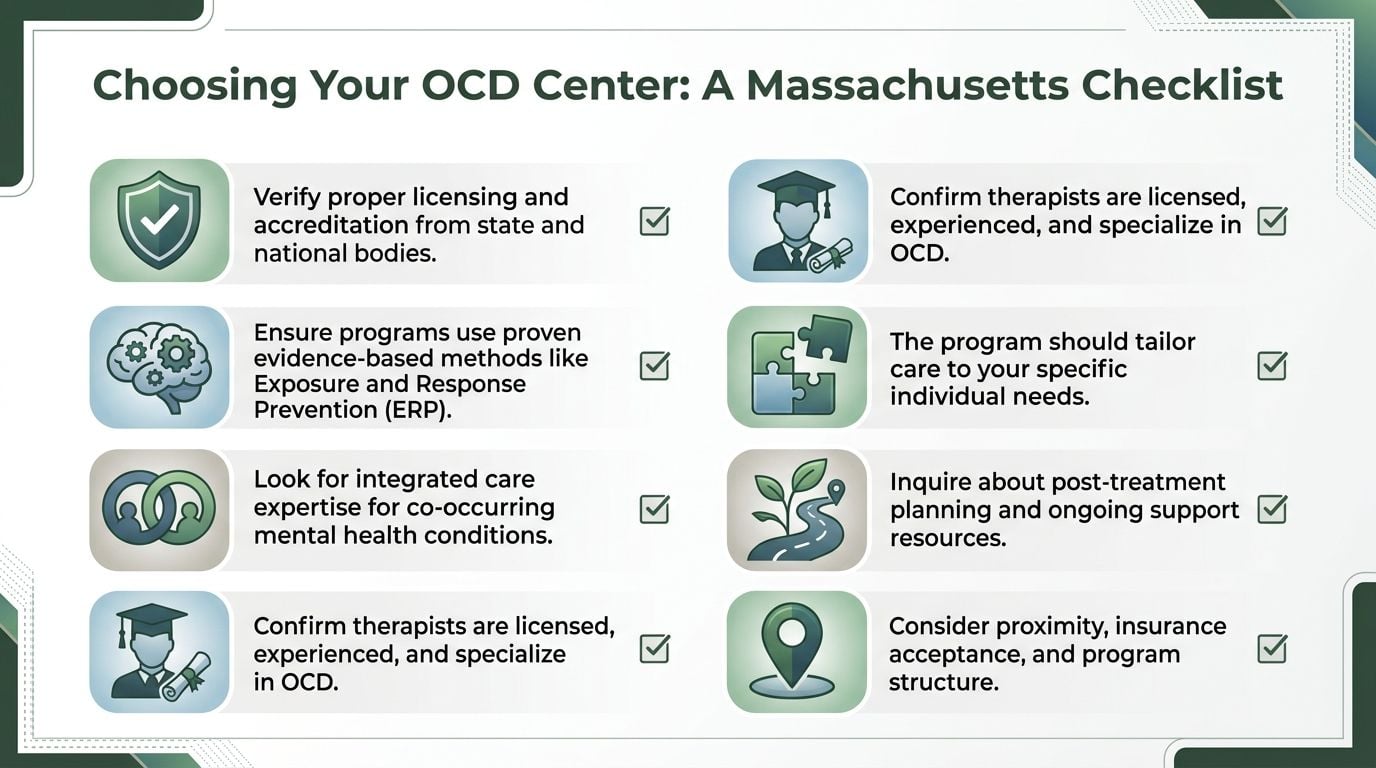
Before choosing a center, confirm that it offers the following:
- Evidence-based OCD treatment: ERP should be central, not optional.
- Licensed and specialized clinicians: General mental health experience isn’t always enough for OCD.
- Flexible intensity: The program should fit the person, not force the person into a preset track.
- Integrated care when needed: Co-occurring disorders shouldn’t require disconnected treatment plans.
- Practical access: Insurance review, scheduling, and admissions should move without unnecessary friction.
- Ongoing support: Discharge planning should be a continuation, not an ending.
The best Massachusetts OCD center for a given person isn’t the one with the best slogan. It’s the one that can name the problem accurately, treat it directly, and carry the person through more than one stage of recovery.
Take the First Step Today Call for a Free Assessment
When OCD has taken over the day, the next step doesn’t need to be complicated. It needs to be immediate, informed, and compassionate. Families often wait because they’re hoping symptoms will calm down, because they aren’t sure what level of care is needed, or because they’re afraid the first call will feel overwhelming.
A good assessment call should reduce that fear, not add to it. It should help clarify whether the issue is primarily OCD, whether another mental health or substance use condition is involved, and what kind of structure is likely to help now rather than weeks from now.
Reasons not to wait
Delay is one of OCD’s favorite accomplices. The disorder often tells people to wait until they feel more certain, less ashamed, less complicated, or less busy. Families do something similar. They wait until work settles down, until the school term ends, until the next crisis, until one more argument, until one more promise that things will improve.
Meanwhile, rituals grow roots. Avoidance spreads. Substance use can become more entrenched. Relationships start organizing around symptoms.
Same-day help matters when a person is losing hours to compulsions or using alcohol or drugs to get through the evening.
What a strong first call should provide
The first conversation with an admissions team should answer practical questions quickly and clearly.
A strong intake process usually includes:
- A confidential assessment: Enough clinical detail to understand what’s happening without making the caller repeat the story endlessly.
- Insurance verification: Families need real information, not vague promises.
- Level-of-care guidance: The team should explain whether day treatment, intensive outpatient, or another option fits best.
- A path forward that starts now: Even if treatment begins shortly after the call, the person should leave that conversation knowing the next concrete step.
What families can say if they feel stuck
Many callers freeze because they think they need perfect language. They don’t. A simple opening is enough.
They can say:
- “There are intrusive thoughts and rituals that are getting worse.”
- “We think this may be OCD, and it’s affecting daily life.”
- “There may also be alcohol or drug use involved.”
- “We need to know what level of care makes sense.”
That’s enough to start.
Your call should be treated as a clinical conversation, not a sales conversation.
Why local Massachusetts access changes the outcome
People searching “ocd treatment centers near me” are often searching for more than geography. They’re searching for a way around delay. Local access makes logistics easier, but the bigger benefit is continuity. When a Massachusetts program can evaluate, verify insurance, recommend the right level of care, involve family, and address dual-diagnosis concerns without sending the person through multiple disconnected systems, treatment starts to feel possible again.
That shift matters. The household can move from confusion to a plan. The person suffering can move from secrecy to support. The family can stop guessing and start responding in a way that helps.
For anyone in Massachusetts who needs immediate next steps, the most useful move is to call a program that offers evidence-based OCD treatment, integrated dual-diagnosis support, same-day admissions, and fast insurance verification. A free assessment can clarify whether care should begin now and what that care should look like.
For immediate help, call (888) 388-8660.
Your call is 100% confidential.
Same-day admissions may be available.
If the search for “ocd treatment centers near me” has already taken too much time and energy, the most important action now is simple. Reach out, describe what’s happening, and let a trained admissions specialist help determine the safest and most effective next step.
If OCD, intrusive thoughts, compulsions, or co-occurring substance use are disrupting daily life in Massachusetts, Paramount Recovery Centers offers compassionate, evidence-based support with free confidential assessments, fast insurance verification, and same-day admissions when appropriate. Call (888) 388-8660 to speak with an admissions specialist and get clear guidance on the right next step.


