


A lot of online advice about niacin to detox sounds simple. Take enough vitamin B3, sweat, drink water, and somehow the body will clear drugs faster or hide them from a urine test.
That advice is wrong.
It’s also dangerous in a very specific way. People who are already under physical stress, facing withdrawal, worried about a drug test, or living with anxiety, depression, trauma, or another mental health condition may delay real care while taking doses of niacin that can injure the liver and trigger other medical complications. The result isn’t detox. It’s preventable harm.
People searching for fast answers often find myths before they find medicine. That’s why clear guidance matters. The safest place to start is with evidence, not internet folklore. For a broader look at common misconceptions, this breakdown of debunking common detox myths is a useful companion.
The Dangerous Myth of Using Niacin for Detox
The dangerous part of the niacin detox myth is not that it sounds ridiculous. It sounds believable enough to catch people who are scared, sick, and desperate for a way out.
That is exactly why it does so much harm.
Niacin is a real vitamin with legitimate medical uses. It also causes noticeable physical effects in some people, especially flushing, warmth, itching, and redness. For someone facing a drug test, worried about withdrawal, or trying to hide substance use from family or work, those sensations can feel like proof that something useful is happening. In practice, they often distract from a harder truth. A dramatic body reaction is not the same as detox, and it is not a substitute for medical care.
I see the same trade-off repeatedly in addiction treatment. A person chooses an internet shortcut because it feels faster, more private, and less frightening than asking for help. What they give up is time, safety, and the chance to catch serious problems early. That trade-off is dangerous for anyone with a substance use disorder. It is even more dangerous for people also living with anxiety, depression, trauma, bipolar disorder, or another mental health condition, because delay can worsen both the addiction and the psychiatric symptoms at the same time.
Why this myth keeps pulling people in
The appeal is easy to understand. People are often trying to solve an immediate problem under pressure.
- Fear of consequences: They want to avoid a failed drug test, a confrontation at home, or trouble at work.
- Fear of treatment: Professional detox can feel overwhelming if someone expects judgment, withdrawal pain, or loss of control.
- False reassurance: Flushing and sweating can make niacin seem active, even when it is not solving the underlying problem.
- Repeated bad advice: Online forums and recycled posts keep presenting the same claim until it starts to look credible.
This is not harmless misinformation. It pushes vulnerable people toward self-treatment at the exact moment they may need a medical assessment, medication support, hydration, monitoring, or psychiatric stabilization.
Clinical bottom line: If a detox method is built on sensation instead of evidence, it can delay real treatment while adding new medical risks.
The bigger issue is not only whether niacin can help. It is that relying on it can postpone the care that protects people during withdrawal and early recovery. Alcohol, benzodiazepines, opioids, stimulants, and polysubstance use can each bring their own complications. Co-occurring mental health disorders raise the stakes further. A person may believe they are detoxing when they are instead getting sicker, more unstable, or closer to a medical crisis.
That is why internet detox folklore deserves direct pushback from clinicians. For a broader review of common false claims, see Paramount Recovery Centers’ guide to debunking common detox myths. Safe detox starts with an honest assessment and treatment that matches the substance, the withdrawal risk, and the person’s mental health needs.
Understanding Niacin and the Detox Theory
Niacin is vitamin B3, also called nicotinic acid. In legitimate medical settings, it has been used for conditions such as B3 deficiency and hyperlipidemia. That’s the proper context. It’s a nutrient with specific clinical uses, not a shortcut for beating biology.
What people think niacin to detox does
The usual theory goes like this: niacin causes flushing, increases blood flow, mobilizes fat, and helps release stored toxins or drug byproducts so the body can eliminate them faster.
That sounds tidy. It falls apart under scrutiny.
Urine drug tests don’t measure whether a person feels flushed, warmer, or more “cleansed.” They detect specific metabolites at detectable levels. A dramatic physical sensation doesn’t prove faster clearance.
A useful comparison is this: trying to use niacin to pass a drug test is like trying to clean a stained shirt by heating the washing machine from the outside. There may be heat. There may be movement. But the stain-removing process hasn’t changed.
Why the flush confuses people
The niacin flush is real. It can cause warmth, tingling, redness, and itching. That immediate response is one reason the myth survives. People often mistake a noticeable effect for a helpful effect.
But feeling something isn’t the same as treating something.
Common reasons people misread the flush include:
- It feels active: Tingling and skin warmth create the impression that toxins are moving out.
- It happens quickly: Fast sensations can look like fast detox.
- It reinforces expectation: If someone already believes niacin works, the flush becomes “proof” in their mind.
A body sensation can be real while the detox claim is false. Those are not contradictory statements.
The flush-free version doesn’t solve the problem
The myth has also expanded to flush-free niacin, often sold as a gentler option. That creates a second layer of confusion.
The problem is that the supposed detox theory depends on the flush effect. Yet flush-free niacin releases too slowly to produce that vasodilation response, and no clinical studies validate flush-free niacin for detoxification (flush-free niacin discussion).
That leaves people with a method that is unproven on two levels. Standard niacin doesn’t have evidence for detox. Flush-free niacin also fails to produce the very effect supporters claim is necessary.
Where this leaves a person seeking help
Niacin’s legitimate medical role shouldn’t be turned into a street-level detox hack. Someone worried about withdrawal, relapse, or a positive test needs accurate information, medical assessment, and a plan based on the substance involved. Vitamins can support general nutrition in some settings. They can’t substitute for addiction treatment.
The Scientific Evidence Against Niacin Detox
The internet treats niacin like a shortcut. Medicine does not.
What the evidence actually shows
The core claim is specific. People are not taking high-dose niacin because they want better nutrition. They are taking it because they believe it will clear drugs from the body, change a urine test, or speed up detox in a meaningful way.
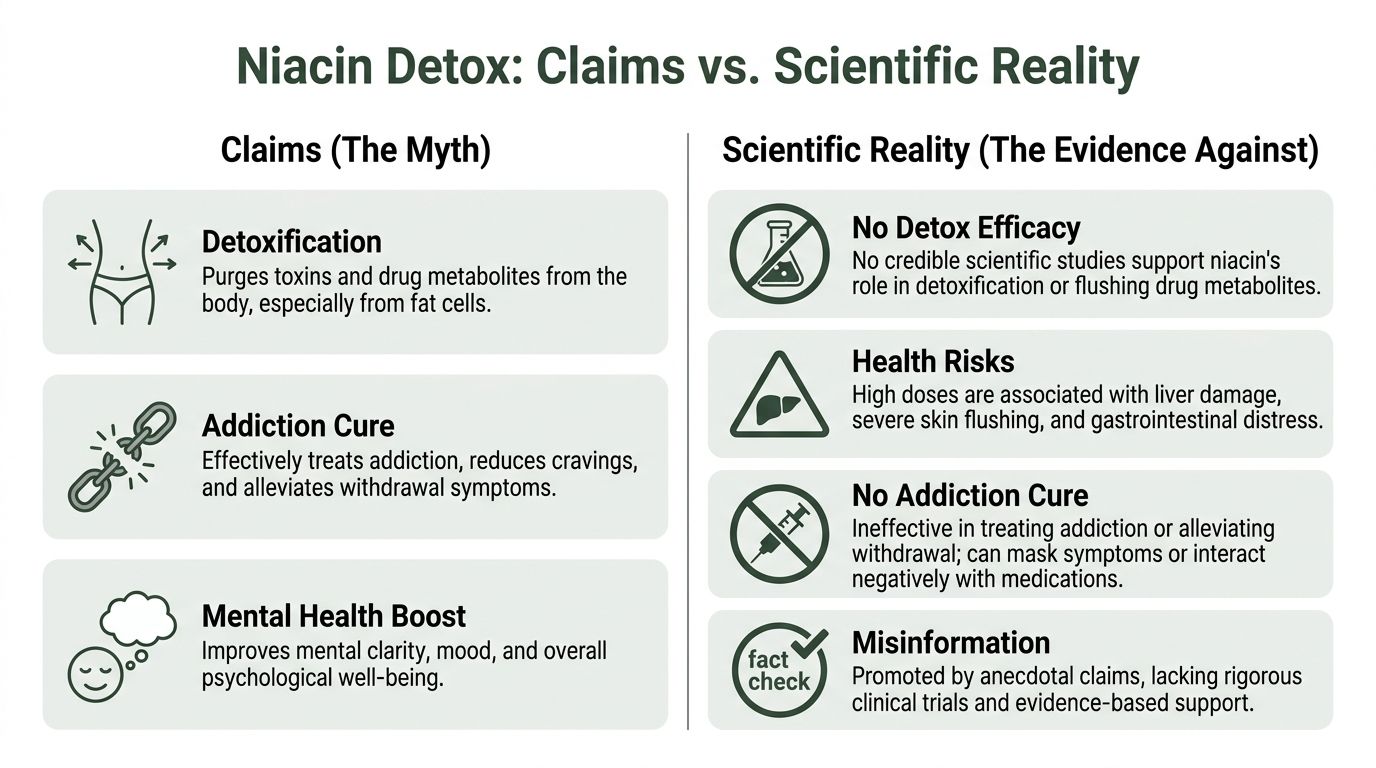
That claim is not supported by clinical evidence. As noted earlier, public health reporting on niacin misuse found no evidence that it changes urine drug test results. That point matters because it addresses the myth at its center, not a side issue.
In practice, I see the same mistake over and over. A strong physical reaction gets confused with a useful medical effect. Redness, sweating, warmth, and discomfort may feel dramatic, but they do not show that drug metabolites have been removed faster or that withdrawal has been made safer.
Claims versus reality
| Claim | Scientific reality |
|---|---|
| Niacin flushes drugs out of the body | No evidence shows niacin improves drug elimination in a way that changes detox outcomes |
| Sweating after niacin proves detox is happening | Sweating and flushing are body reactions, not proof of altered metabolite clearance |
| Taking more niacin works better | Higher doses raise the risk of harm without showing detox benefit |
| Flush-free niacin is a safer workaround | It remains unproven for detox and does not validate the theory behind the myth |
Why the myth falls apart under basic medical review
Urine drug testing measures chemical byproducts of substance use. Withdrawal care focuses on safety, symptom control, hydration, vital signs, and complication risk. Niacin does not replace any of that.
This matters even more for people with addiction and co-occurring mental health conditions. Someone dealing with anxiety, depression, trauma symptoms, bipolar disorder, or psychosis may already be vulnerable to impulsive decisions and internet promises of a private fix. High-dose niacin adds another variable to an already unstable situation. It can create distress, mask the underlying problem, and delay treatment that is specifically designed for substance use and dual diagnosis.
Readers who are sorting through online detox claims can compare those promises with medically grounded options in this guide to detoxify pills, their risks, and safer alternatives.
What the science-based alternative looks like
Real detox is not a vitamin hack. It is a medical process based on the substance used, the amount and duration of use, current symptoms, other medications, and the person’s physical and psychiatric health.
If someone needs to stop using alcohol, opioids, benzodiazepines, stimulants, or multiple substances, the safe answer is assessment and supervised care. At Paramount Recovery Centers, that means identifying withdrawal risks early, addressing co-occurring disorders directly, and building a treatment plan that does more than chase a negative test.
The practical conclusion
Niacin has legitimate medical uses. Drug detox is not one of them.
For a person already struggling with substance use, false confidence can be dangerous. It can delay detox, increase medical risk, and keep the underlying disorder untreated. Evidence points in a different direction. Get evaluated, get monitored, and get help from a program that treats addiction like the medical condition it is.
The Serious Health Risks of High-Dose Niacin
High-dose niacin can trigger a medical crisis in someone who is already unstable from substance use, poor nutrition, dehydration, withdrawal, or untreated mental health symptoms. That is why the internet myth is so dangerous. It reframes a drug-testing shortcut as “detox,” then pushes vulnerable people toward doses that can cause real harm.
Flushing gets the attention because it is obvious. It is not the main problem.
A person who takes large amounts of niacin may start with warmth, redness, itching, tingling, nausea, stomach pain, or vomiting. Online forums often treat those reactions like proof that the product is “working.” In practice, they are adverse effects. For someone already in withdrawal or trying to stop using on their own, those symptoms can add dehydration, fear, and confusion to an already risky situation.
The more serious concern is organ stress, especially involving the liver. As noted earlier, niacin has been linked to liver enzyme elevations and, in some cases, severe liver injury, including jaundice and impaired clotting. That matters in addiction medicine because the liver is already under strain in many patients who use alcohol, multiple substances, or psychiatric medications. Adding gram-level niacin on top of that is not a neutral experiment. It can complicate assessment and delay proper detox care.
One published case report described exactly the kind of toxicity clinicians worry about. A patient took an estimated 5 to 10 grams of niacin to try to pass a drug test and arrived with severe metabolic acidosis at pH 7.12, bicarbonate 5 mEq/L, acute kidney injury with creatinine 3.2 mg/dL, thrombocytopenia with platelets 98,000/μL, hyperuricemia with uric acid 15.8 mg/dL, and increased liver enzymes with AST 128 U/L and ALT 156 U/L. The patient improved after stopping niacin and receiving supportive care (case report on niacin toxicity after attempted drug test evasion).
That is not detox. It is toxic exposure that required medical treatment.
Health Risks of High-Dose Niacin by System
| Affected System | Symptoms and Risks |
|---|---|
| Skin and blood vessels | Flushing, warmth, redness, itching, tingling |
| Gastrointestinal system | Nausea, stomach upset, vomiting |
| Liver | Elevated enzymes, hepatitis, jaundice, impaired clotting, severe liver injury |
| Kidneys and metabolism | Acute kidney injury, metabolic acidosis, abnormal uric acid levels |
| Blood | Platelet abnormalities |
| Overall functioning | Weakness, distress, worsening instability during withdrawal or active substance use |
In treatment settings, context matters. A healthy person taking prescription niacin under medical supervision is one scenario. A person with active substance use, poor oral intake, sleep deprivation, panic symptoms, or a co-occurring psychiatric disorder taking handfuls of niacin to “clean out” their system is a very different one. The second situation carries more uncertainty and more risk, not less.
I want readers to be clear on the trade-off. The hoped-for benefit is a false one. Niacin does not remove drugs from the body in a way that makes unsupervised detox safer. The actual possibilities are vomiting, dehydration, lab abnormalities, liver injury, kidney stress, and a delayed call for help.
At Paramount Recovery Centers, we treat the actual medical problem. If someone needs detox, the answer is monitoring, symptom management, and a plan based on the substance involved, withdrawal risk, and any co-occurring mental health condition. High-dose niacin does none of that. It only adds danger.
Why Niacin Detox Is Especially Dangerous for Dual Diagnosis
For people with both a substance use disorder and a mental health disorder, the risks of niacin to detox are not merely additive. They can overlap in ways that make assessment and stabilization harder.
The flush can mimic panic
For dual-diagnosis patients, niacin’s flush can increase blood flow and cause intense warming and tingling that may mimic or trigger a panic attack, worsening underlying anxiety. The same source also notes that high-dose niacin’s effects on liver detoxification pathways could interact unpredictably with psychiatric medications, and there are no safety guidelines for this specific population (discussion of niacin detox concerns in dual-diagnosis populations).
That matters in clinical practice because symptom interpretation matters. If a person with panic disorder, trauma-related symptoms, or severe anxiety suddenly feels hot, flushed, restless, and physically strange, the body may read that as danger. What started as an internet detox attempt can become escalating fear, more substance use, or an unnecessary emergency evaluation.
Medication complexity raises the stakes
People with co-occurring disorders often take psychiatric medications consistently, inconsistently, or not at all. Any self-directed high-dose supplement use enters that unstable picture without a plan.
Potential problems include:
- Confused symptom tracking: It becomes harder to tell whether distress is withdrawal, medication side effects, niacin toxicity, or a psychiatric flare.
- More strain on the liver: If the liver is already processing prescribed medications and substances, adding unsupervised high-dose niacin may complicate care.
- Treatment delay: A person may keep trying to “detox at home” while mood, sleep, cravings, and risk behaviors worsen.
Withdrawal already stresses the body
Even before adding niacin, withdrawal can involve insomnia, anxiety, sweating, tremor, nausea, irritability, depression, agitation, or dangerous physiologic shifts depending on the substance. Layering an unproven supplement protocol onto that doesn’t simplify anything.
It creates noise in the clinical picture.
When someone has both mental health symptoms and substance use symptoms, the safest approach is to reduce variables, not add new ones.
Why dual-diagnosis care has to be coordinated
A person with depression and alcohol use, trauma and stimulant use, or anxiety and sedative misuse doesn’t need a body hack. That person needs coordinated care that can look at the whole picture at once.
That means assessing:
- current substance use
- withdrawal risk
- psychiatric symptoms
- current medications
- sleep disruption
- nutrition and hydration
- safety concerns at home
- readiness for next-step treatment
Internet myths flatten all of that into one false promise. Real treatment doesn’t.
The Safe and Effective Path to Medically Supervised Detox
The alternative to niacin to detox is not doing nothing. The alternative is using a medically grounded process that addresses withdrawal, risk, and what comes after withdrawal.

What supervised detox actually does
Medical detox is built around observation, stabilization, and transition into treatment. It doesn’t pretend to “flush out” addiction. It helps the person get through the dangerous early phase safely.
That usually includes:
- Medical monitoring: Staff watch for withdrawal complications, dehydration, vital sign changes, and worsening symptoms.
- Symptom management: Approved medications may be used when clinically indicated.
- Lab review and assessment: Clinicians can identify problems that a home detox attempt would miss.
- Supportive care: Hydration, nutrition, rest, and psychiatric evaluation all matter.
Why oversight changes outcomes
Professional medical protocols for high-dose niacin toxicity include careful titration, baseline and weekly liver function tests, and immediate discontinuation if ALT or AST exceed 3 times the upper limit of normal. In one severe case, a patient’s prothrombin time 28.5 seconds corrected to 12.5 seconds within 4 days of stopping niacin under medical care, showing how critical supervision can be (medical overview of niacin liver damage and monitoring).
That example speaks to a broader point. Medical oversight doesn’t just respond to crises. It catches deterioration, interprets lab patterns, and adjusts care before a bad situation worsens.
Detox is only the first stage
A person can stop using a substance for a short period and still remain in danger of relapse, psychiatric decompensation, or return to the same triggers that led to use. That’s why quality treatment connects detox to a larger plan.
A useful way to understand that process is to look at practical treatment plan example templates that show how structured goals, interventions, and follow-up can be organized. In addiction care, that planning matters because withdrawal management without next-step treatment often leaves the core problem untouched.
A clinically sound plan often addresses:
| Area | What treatment targets |
|---|---|
| Withdrawal stabilization | Safe management of acute symptoms |
| Mental health | Anxiety, depression, trauma, mood instability, OCD-related symptoms when present |
| Relapse prevention | Triggers, coping skills, routines, supports |
| Family and environment | Communication, boundaries, home stability |
| Ongoing therapy | Evidence-based counseling and medication management when appropriate |
Massachusetts patients need a real safety pathway
People searching for home remedies are often trying to avoid embarrassment, avoid delay, or avoid the fear of what treatment might involve. But supervised care is far more predictable than DIY detox. It gives structure to a chaotic moment.
For anyone concerned specifically about alcohol withdrawal, this guide on how to detox from alcohol safely is a useful next read.
Safe detox respects two realities at the same time. Withdrawal is a medical issue, and recovery is a treatment process.
What a better next step looks like
The medically sound response to niacin misuse or planned niacin detox is straightforward:
- Stop relying on internet detox tricks.
- Get assessed for withdrawal risk.
- Be honest about what substances were used and when.
- Tell clinicians about any supplements already taken.
- Move quickly into a supervised setting when risk is significant.
That path may not feel as simple as swallowing a vitamin. It is much safer, much more honest, and much more likely to lead to lasting recovery.
Choosing Evidence Over Internet Myths for Your Health
Internet detox advice often sounds simple because it leaves out the part that can hurt you.
The niacin myth is a good example. It promises a shortcut, but what it often does in real life is delay medical care, increase risk, and give people false confidence at the exact moment they need honest assessment. For someone with addiction, that delay can mean worsening withdrawal, a missed mental health crisis, or another return to substance use after a failed attempt to manage the problem alone.
This matters even more for people with co-occurring disorders. A person who is already dealing with anxiety, depression, trauma symptoms, mood instability, or psychiatric medications does not need another variable thrown into the picture. High-dose niacin can muddy the clinical picture and make it harder to sort out what is withdrawal, what is a medication issue, and what is a worsening mental health symptom. That is how a bad internet tip becomes a dangerous detour.
Recovery also includes regular medical care, not just crisis response. General preventive guidance like how often you should go to the doctor can help people think in a more grounded way about follow-up, medications, lab work, and ongoing health needs.
Evidence-based care is the safer choice because it deals with the actual problem. Detox, psychiatric symptoms, medical complications, and relapse risk need evaluation by trained professionals, not guesswork built around a vitamin.
If you or someone you love is considering niacin to detox, feeling unwell after taking it, or trying to stop using substances without knowing the withdrawal risk, get professional help. Paramount Recovery Centers provides evidence-based addiction and mental health treatment in Massachusetts. Call (888) 388-8660.
Frequently Asked Questions About Niacin and Detox
Can niacin help pass a THC or other urine drug test
No. The CDC reported that there’s no scientific evidence that niacin alters urine drug test results, even though people have used it for that purpose.
Is the niacin flush proof that detox is working
No. The flush is a physical reaction involving warmth, redness, and tingling. It may feel dramatic, but it doesn’t prove drugs are being cleared faster or that a test result will change.
Is flush-free niacin safer for detox
It may avoid some of the classic flushing sensation, but that doesn’t make it a validated detox method. It’s still unproven for detox, and it also doesn’t create the same flush effect that supporters claim is necessary.
What’s the biggest medical risk from taking high doses
Liver injury is one of the biggest concerns. High-dose niacin has been linked to increased liver enzymes and, in severe cases, serious dysfunction. Other reported problems include metabolic acidosis, kidney injury, and platelet abnormalities.
Why is niacin detox more risky for people with anxiety or other mental health disorders
The flush can feel like a panic episode and may worsen anxiety. In people with co-occurring disorders, it can also complicate medication management and make it harder to tell what symptoms are coming from withdrawal, psychiatric illness, or toxicity.
What should someone do instead of trying niacin to detox
Get a professional assessment. Safe detox depends on the substance involved, current health status, withdrawal risk, and whether mental health symptoms are also present. Medical supervision is the right approach when there’s any meaningful risk.
If niacin to detox has already been tried, or if someone is searching for a safe way to stop using drugs or alcohol, Paramount Recovery Centers offers evidence-based addiction and mental health treatment in Massachusetts. Their team helps adults and families move from panic and guesswork to a real care plan with detox coordination, dual-diagnosis support, and continued treatment after stabilization. Call (888) 388-8660 to speak with an admissions specialist now.


