



An Intensive Outpatient Program (IOP) is a powerful, structured treatment option that bridges the gap between full-time residential care and traditional weekly therapy. It’s designed to give you robust clinical support while still allowing you to manage your daily life right here in Massachusetts.
Key Takeaways
- IOPs are flexible: They offer structured treatment with schedules designed to fit around work, school, or family commitments, making recovery accessible without putting your life on hold.
- Clinically effective: These programs use evidence-based therapies like CBT and DBT in a mix of group and individual settings to address substance use and mental health challenges.
- Insurance coverage is common: Thanks to Massachusetts laws, most major insurance plans, including MassHealth, provide coverage for IOP services, making them financially accessible.
- Finding the right fit is crucial: Look for state-licensed programs with credentialed staff. A local Massachusetts IOP, whether in-person or via telehealth, allows you to apply recovery skills in your real-world environment.
Understanding IOP Programs in Massachusetts
Think of an IOP as a part-time commitment to your well-being. Most programs require about 9 to 20 hours per week, which is filled with a mix of group therapy, individual counseling sessions, and skill-building workshops. It’s all designed to fit around your existing schedule, making it a practical and powerful step toward lasting recovery.
The Role of an IOP in the Continuum of Care
In the world of addiction and mental health treatment, Intensive Outpatient Programs hold a vital middle ground. They offer far more structure and support than a standard weekly therapy session but provide much more freedom and real-world integration than a residential or Partial Hospitalization Program (PHP).
This is a great way to visualize where IOP fits in the hierarchy of care levels you'll find here in Massachusetts.
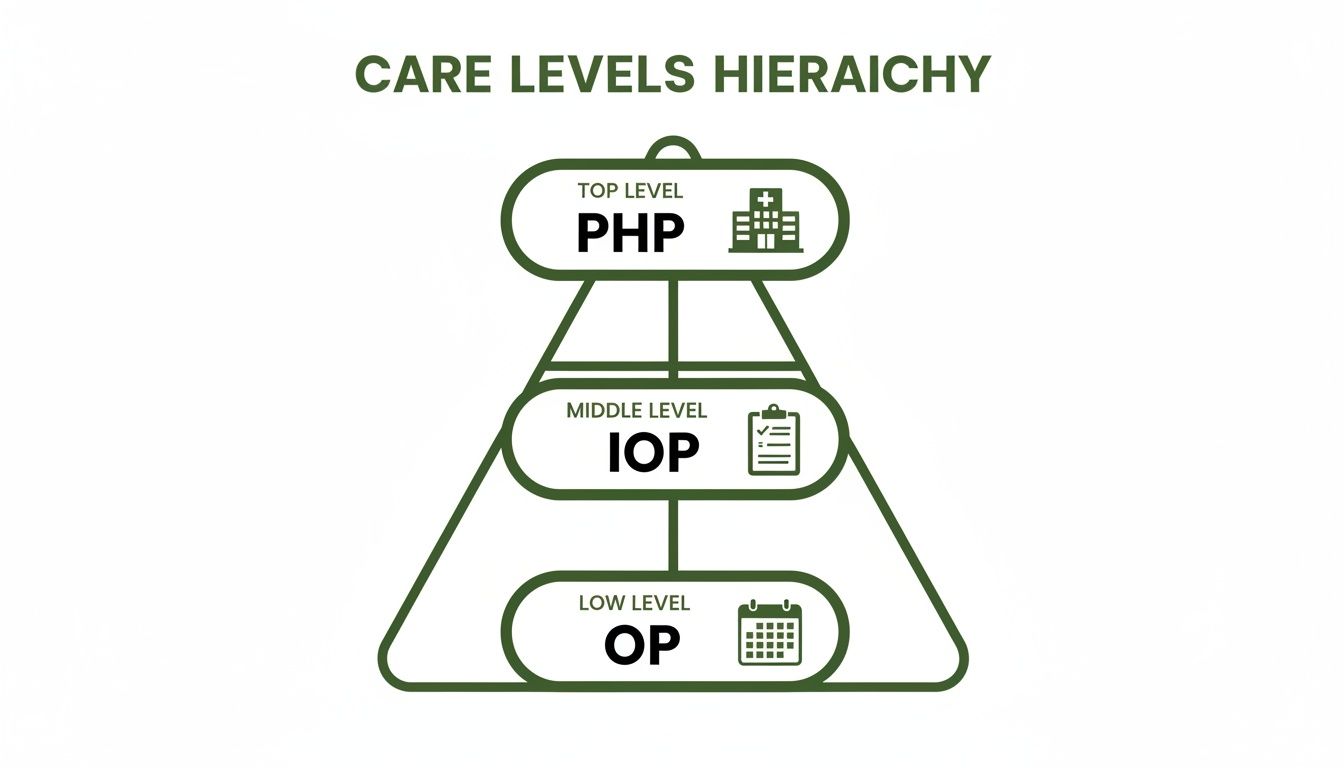
As you can see, an IOP can be a "step-down" for someone leaving a more intensive program like PHP, or a "step-up" for someone who needs more than standard outpatient care. This flexible, balanced structure is exactly why it's such an effective model for so many people.
IOP vs Other Levels of Care in Massachusetts
To make it even clearer, let's break down how these programs compare side-by-side. Each level of care serves a different purpose, and knowing the distinctions can help you figure out what's right for you.
| Feature | IOP (Intensive Outpatient) | PHP (Partial Hospitalization) | OP (Standard Outpatient) |
|---|---|---|---|
| Time Commitment | 9-20 hours/week | 20-30+ hours/week (full day) | 1-3 hours/week |
| Daily Schedule | Flexible, often evenings/mornings | Full-day programming, 5 days/week | Typically one weekly session |
| Living Situation | Live at home | Live at home | Live at home |
| Best For | Balancing recovery with daily life | Transitioning from residential care | Maintaining recovery long-term |
| Clinical Intensity | Moderate to High | High | Low |
This table really highlights how IOP provides that essential middle ground—structured support without having to put your entire life on hold.
IOPs in the Commonwealth
Massachusetts has long been a leader in accessible outpatient treatment for substance use, and our state has a strong, established network of IOPs. In fact, there are 487 active substance abuse clinics statewide, serving thousands of residents every single year.
Of those seeking help, a staggering 62,250 people specifically enroll in outpatient services like IOPs. This approach allows them to receive therapies that are just as intensive as those in an inpatient facility, but with the huge advantage of living at home and putting their new recovery skills to the test in their daily lives.
An IOP provides a structured, supportive environment that empowers you to build coping skills, address underlying issues, and develop a strong recovery network—all while staying connected to your community and responsibilities.
Getting a handle on the specifics of an IOP is the first real step. You can dive deeper by reading our detailed guide on what intensive outpatient treatment is. From there, we can start to demystify the process and show you exactly how an IOP can work for you.
How IOP Fits Into Your Recovery Path
In the world of addiction treatment, there isn't a single, one-size-fits-all path. Instead, we talk about a "continuum of care," which is really just a way of saying there are different levels of support for different stages of the journey. Intensive Outpatient Programs (IOPs) hold a really unique spot on this map. They’re the perfect middle ground—a crucial ‘step-down’ for someone leaving residential treatment and a vital ‘step-up’ for those who realize weekly therapy just isn't cutting it anymore.
The beauty of an IOP is its flexibility. It's designed to meet you right where you are, providing a solid structure without pulling you completely out of your life.

So, where exactly could an IOP fit into your story? Here are the four most common scenarios we see:
- As a Safe Transition (Step-Down): It provides an essential bridge after you leave an inpatient or residential facility, drastically reducing the risk of relapse when you return to daily life.
- As Increased Support (Step-Up): It offers more structure and therapeutic contact than weekly therapy when you need a higher level of care to get through a tough spot.
- As a Primary Treatment Option: For many people, an IOP is the first step into structured recovery, offering robust, comprehensive care without the need to live at a facility.
- As a Re-Engagement Tool: If you've had a setback or relapse, an IOP is a powerful way to get back on solid ground with intensive, focused support.
Stepping Down from Inpatient Care
Think about leaving a residential treatment center like being discharged from a hospital's critical care unit. You wouldn't go straight from the ICU to running a marathon, right? You’d move to a regular room first, where you have more freedom but still plenty of medical support. An IOP functions in exactly the same way.
Going from a 24/7 structured environment straight back into the real world can be a shock to the system, and that shock is a huge relapse trigger. An IOP softens that landing. It gives you the chance to start applying the skills you learned in treatment to real-world challenges—like your job or family dynamics here in Massachusetts—while still having the safety net of your clinical team to catch you.
The whole point of a step-down approach is to gradually re-integrate you into your community. It empowers you to handle daily stressors with a team of professionals still in your corner, cheering you on.
Stepping Up from Weekly Therapy
On the flip side, sometimes a single therapy session a week just isn't enough to hold the line. Maybe your recovery feels stalled, you’re facing new triggers, or life has thrown you a curveball that’s shaking your sobriety. When that happens, an IOP provides a necessary boost in support without the total life disruption of checking into a residential program.
This "step-up" is perfect for someone who has a safe and stable place to live but needs more therapeutic horsepower to navigate a difficult period. It intensifies your treatment schedule with multiple group and individual sessions each week, which can be the very thing that prevents a minor slip from turning into a major crisis.
Who Is a Good Candidate for an IOP?
While a clinical assessment is always needed to be sure, the people who tend to thrive in an IOP setting usually share a few key traits. This level of care is often a fantastic fit for individuals who:
- Have a safe and supportive home environment to return to each day.
- Don't require a medically supervised detox or 24/7 monitoring.
- Are motivated and ready to show up and participate actively in their recovery.
- Need to keep up with responsibilities like work, school, or taking care of their family.
If this sounds like you, then IOP programs in Massachusetts could offer that perfect balance of intensive clinical support and real-world freedom. To find out if this path is the right one for you, our team is here to listen. Give us a call for a completely confidential chat at (888) 388-8660.
Navigating Costs and Insurance for Massachusetts IOPs
Let's be honest—thinking about the cost of treatment can be a huge source of stress when you're considering an IOP. The last thing you need is more confusion. This section is designed to break down the financial side of intensive outpatient programs in Massachusetts into simple, manageable terms, so you can move forward with confidence.
Thanks to strong mental health parity laws, your insurance coverage is probably better than you realize. Most plans from major private carriers and MassHealth are required to cover essential behavioral health services, which makes getting quality care much more accessible.
Understanding Your Insurance Coverage
When you look at your insurance plan, you'll run into a few key terms. A deductible is simply the amount you have to pay out-of-pocket before your insurance plan starts to pick up the costs. After that, you'll likely have either a copayment (a set fee you pay for each service) or coinsurance (a percentage of the total cost you're responsible for).
You might also hear the term prior authorization. This just means your insurance company needs to medically approve the treatment before they agree to pay for it. Any good treatment center will handle this entire process for you, taking the paperwork and phone calls off your plate.
The most important thing to remember is that you don't have to figure this all out alone. The financial piece can feel overwhelming, but a good admissions team can verify your benefits and explain everything in plain language.
Cost-Effective and Accessible Care in Massachusetts
Intensive outpatient programs deliver a high level of clinical support at a fraction of the cost of residential or inpatient treatment. This makes it a practical and realistic option for so many people who can't just put their lives on hold.
In fact, Massachusetts invests heavily in this model of care, channeling $106 million toward 62,250 outpatient enrollees each year. This level of state support keeps IOPs a viable option for working individuals and shows a real commitment to making recovery accessible for everyone.
What If I Don't Have Insurance?
If you're uninsured or your plan doesn't offer enough coverage, don't stop here. You still have excellent options for funding IOP programs in Massachusetts. Many facilities are willing to work with you, offering payment plans or fees that adjust to what you can afford.
Here are a few common alternatives:
- State-Funded Programs: Massachusetts provides programs for eligible residents based on their income and needs.
- Sliding-Scale Fees: The amount you pay is adjusted based on your income, making it more manageable.
- Payment Plans: Treatment centers can often arrange a payment schedule that works for your budget.
Getting a clear picture of the numbers is a crucial first step. To get a better handle on what to expect, take a look at our guide on the complete cost of IOP treatment.
The goal is to remove financial barriers so you can focus on what really matters: getting well. The easiest way to get clear, personalized answers is to just make a call. Our specialists are available at (888) 388-8660 for a free, completely confidential insurance check. We’ll sort through the confusing parts for you.
Finding the Right IOP Program Near You
With so many options out there, trying to choose the right IOP in Massachusetts can feel a bit like searching for a needle in a haystack. But finding a quality program is about more than just picking the one closest to home. It's about finding a place that’s genuinely committed to evidence-based care, staffed by true professionals, and offers a safe, supportive environment.
Making a well-informed choice is your first real step toward building a solid foundation for recovery. This is about finding a program that not only checks all the clinical boxes but also just feels right for you or your loved one.

Verifying Licensing and Credentials
First thing's first: let's talk about what's non-negotiable. Any legitimate IOP in Massachusetts must be licensed by the Bureau of Substance Addiction Services (BSAS). This isn't just bureaucratic red tape; it's your assurance that the facility meets the state’s strict standards for safety, clinical practices, and staffing.
Next, take a look at the credentials of the clinical team. A top-tier program will have licensed professionals—think Licensed Alcohol and Drug Counselors (LADCs) or Licensed Clinical Social Workers (LCSWs)—running the therapy sessions. These aren't just fancy acronyms; they mean the staff has the specialized training needed to guide you effectively.
Asking the Right Questions
Once you’ve confirmed a program is licensed, it’s time to get a feel for their approach. That first phone call is your chance to really dig in and see what they're all about.
A reputable IOP will welcome your questions and provide clear, direct answers. Transparency is a key sign of a high-quality, client-focused program.
Don't be shy. Come to that call prepared with a few key questions that will help you compare your options:
- What is your staff-to-client ratio in group therapy? A smaller ratio usually means more one-on-one attention.
- What evidence-based therapies do you use? You'll want to hear them mention established, proven methods like Cognitive Behavioral Therapy (CBT) and Dialectical Behavior Therapy (DBT).
- How do you involve families in the treatment process? Family support can be a game-changer for lasting recovery.
- What does your aftercare planning look like? A good program doesn't just treat you and send you on your way; they prepare you for what comes next.
Getting comfortable with this process is a huge step. For more guidance, check out our article on how to find the right rehab near you in Massachusetts.
Considering Location and Accessibility
Finally, you have to think about the practical side of things. An IOP needs to fit into your actual life, so a convenient location really does matter. Consistent attendance is crucial for success.
The good news is that telehealth has completely changed the game, expanding access across the entire state. With 72 IOPs offering telehealth services, where you live is no longer the barrier it once was. This has been a lifeline for people from Cape Cod to the Berkshires, making sure everyone can get quality care.
Ready to find a program that checks all these boxes? Call Paramount Recovery Centers at (888) 388-8660 for a completely confidential conversation. We’re here to help.
Your Recovery Journey: What to Expect in an IOP
Stepping into treatment can feel like a huge, intimidating leap, especially when you’re not sure what’s on the other side. An Intensive Outpatient Program isn’t just a series of meetings; it’s a structured, guided process designed to give you the skills and confidence for lasting recovery. From the first confidential phone call to your final session, every part of the experience is built to help you move forward.
The journey starts with a simple, private conversation. You'll meet one-on-one with an experienced clinician for a comprehensive assessment to talk about your history, the challenges you're facing, and what you hope to achieve. This isn't just a formality—it’s the foundation of your personalized treatment plan, making sure the care you get is a perfect fit for your unique needs.

The Core Components of Treatment
Once your plan is set, you’ll dive into the therapies that make IOP programs in Massachusetts so effective. While every program has its own unique flavor, you can always expect a powerful blend of evidence-based therapies that work together to support your healing.
Think of these as the pillars holding up your recovery:
- Group Therapy: This is the heart and soul of most IOPs. In these sessions, you connect with peers who genuinely get what you're going through, creating a powerful network of support and understanding. It’s a place to feel less alone.
- Individual Therapy: You’ll have dedicated time with your personal therapist to work through private challenges, process difficult emotions, and track your progress in a safe, confidential space.
- Family Counseling: Addiction doesn't happen in a vacuum; it touches the whole family. These sessions are about healing key relationships and building a stronger, healthier support system right at home.
- Psychoeducational Groups: These are practical, skill-building workshops. You’ll learn tangible tools for things like preventing relapse, managing stress, and regulating your emotions when life gets tough.
It's the powerful mix of peer connection in group therapy and the focused attention of individual counseling that creates such a balanced and effective environment for real, lasting change.
Quality IOPs are built on a foundation of proven therapeutic methods. These sessions aren't just about talking; they're about actively building new skills and perspectives.
Core Therapeutic Components of a Massachusetts IOP
| Therapy/Activity | Purpose in Recovery | Example Focus Area |
|---|---|---|
| Cognitive Behavioral Therapy (CBT) | To identify and change negative thought patterns and behaviors linked to substance use. | Learning to challenge automatic thoughts that lead to cravings. |
| Dialectical Behavior Therapy (DBT) | To build skills in mindfulness, distress tolerance, emotion regulation, and interpersonal effectiveness. | Practicing mindfulness techniques to stay present and manage stress. |
| Motivational Interviewing (MI) | To resolve ambivalence and strengthen internal motivation for change. | Exploring personal reasons for wanting to achieve sobriety. |
| Relapse Prevention Planning | To develop concrete strategies for identifying and coping with high-risk situations and triggers. | Creating a step-by-step plan for what to do when a craving hits. |
| Trauma-Informed Care | To address underlying trauma that may contribute to substance use in a safe and supportive way. | Understanding the connection between past experiences and current behaviors. |
Each of these components plays a crucial role, weaving together to provide comprehensive support that addresses the mind, body, and spirit.
A Typical Week in a Massachusetts IOP
So, what does all of this actually look like day-to-day? An IOP schedule is designed to fit into your life, not take it over. Most programs offer morning or evening sessions to accommodate work, school, or family commitments.
A typical week usually involves attending therapy for three to four hours a day, three to five days a week.
This time is filled with the activities we just covered. For instance, a Monday session might be a group workshop on identifying personal triggers, while Wednesday could be your private meeting with a counselor to talk through a specific challenge you faced over the weekend. This consistent, structured support is what helps you build momentum and turn new skills into lifelong habits.
If you’re ready to see what your own recovery journey could look like, our team is here to walk you through it. Give us a call at (888) 388-8660 for a completely confidential conversation about how to get started.
Take the First Step Today
You've now seen how IOP programs in Massachusetts offer a flexible, effective, and accessible path to recovery. Making the decision to ask for help takes incredible courage, and support is right here the moment you're ready.
This isn't a commitment to treatment—it's just a simple, no-pressure conversation to get your questions answered. A caring admissions specialist is waiting to help you understand your options, verify your insurance, and schedule an assessment if you decide the time is right.
Taking that first step is always the hardest, but it's the one that can change everything. You don’t have to do it alone. Compassionate, professional help is just one call away.
All it takes is one confidential phone call to start your journey toward healing. The next move is yours to make, and our team at Paramount Recovery Centers is here to walk with you every step of the way.
Ready to talk? Pick up the phone and dial (888) 388-8660. Your future is waiting.
Frequently Asked Questions About IOPs in Massachusetts
How long does an IOP program typically last in Massachusetts?
While every recovery journey is different, most IOPs in Massachusetts recommend a commitment of at least 90 days to build a strong foundation. The total duration, often ranging from three to six months, is tailored to your individual progress and clinical needs.
Can I continue to work while enrolled in an IOP?
Yes, absolutely. This is a primary benefit of IOPs. Programs are structured with morning and evening sessions specifically to accommodate work, school, and family responsibilities, allowing you to integrate recovery skills into your daily life immediately.
What is the main difference between an IOP and standard therapy?
The key difference is intensity. Standard therapy usually involves one hour-long session per week. In contrast, an IOP provides a minimum of nine hours of structured clinical programming each week, including a combination of group therapy, individual counseling, and skill-building workshops for more comprehensive support.
Is my information kept confidential when I seek treatment?
Yes, 100%. Your privacy is protected by federal HIPAA laws. All communications with a licensed treatment provider are strictly confidential, ensuring that your personal health information is kept secure. Seeking help is a private medical matter treated with the utmost discretion.


