



When you or someone you love is facing addiction, navigating insurance feels like the last thing you should have to worry about. But understanding your benefits is the first critical step toward getting help. This guide breaks down exactly how to verify your insurance coverage in Massachusetts, so you can get clear answers and focus on what truly matters: recovery.
Key Takeaways: Your Quick-Start Guide
Before diving into the details, let's simplify the process. Getting clear answers from your insurance provider comes down to four essential actions. Mastering these steps will empower you to navigate the system efficiently and avoid common pitfalls.
- Gather Your Information: Before making any calls, have the patient's full name, date of birth, and insurance card (member ID and group number) ready.
- Speak with Both Parties: You need to communicate with your insurance company to understand your benefits and the treatment provider to confirm they accept your plan. Each holds a different piece of the puzzle.
- Ask Specific Questions: Go beyond "Is rehab covered?" Ask about deductibles, out-of-pocket maximums, copays for specific levels of care (like detox and IOP), and whether prior authorization is required.
- Document Everything: Take detailed notes during every phone call. Record the date, the representative's name, and always ask for a call reference number before you hang up. This creates a crucial paper trail.
Of course, you don’t have to figure this all out on your own. Our admissions team is on standby 24/7 to do a free, completely confidential insurance verification for you. Just give us a call at (888) 388-8660, and let us handle the heavy lifting.
What You Need Before You Pick Up the Phone
Trying to get clear answers from an insurance company without the right information is like trying to navigate Boston without a map—you'll just end up lost and frustrated. Let’s get you prepared so your conversation is efficient, productive, and a lot less stressful.
Think of this as your pre-call checklist. Having every detail ready from the start prevents those long, frustrating holds while you scramble to find a missing piece of information.

Your Essential Information Checklist
Before you dial that number, gather these items and have them right in front of you. This is the absolute minimum an insurance representative will need to pull up the correct policy.
- The Patient's Full Name: Make sure it's the legal name, exactly as it appears on the insurance card.
- The Patient's Date of Birth: This is a key piece of information they use to verify identity.
- The Insurance Card: You’ll need to read several numbers directly from the physical or digital card.
- A Pen and Paper (or a Digital Note): This is non-negotiable. You have to document the call.
Once you have these basics, you're ready to find the specific numbers the representative will ask for. This simple prep work is the most important first step in verifying your insurance coverage.
Decoding the Insurance Card
Insurance cards can look cluttered, but you only need to find a few key numbers. Let's break down what to look for using some common Massachusetts insurers as examples.
On a Blue Cross Blue Shield of Massachusetts card, you’re looking for the “ID Number,” which is the unique policy number. You'll also see a “Group Number,” which identifies the specific employer or group plan. For a carrier like Tufts Health Plan, these might be called the “Member ID” and “Group No.”
Having both the policy/member ID and the group number is crucial. The representative needs both to pull up the exact benefits package for your specific plan. Coverage can vary dramatically even within the same insurance company, and these numbers pinpoint your exact plan.
Prepare to Document Everything
Your final prep step is the most important one: get ready to take detailed notes. Before the representative even picks up, write down today’s date and the time of your call. The second they give you their name, write it down.
This simple habit is your best protection. If you get conflicting information later or need to refer back to this conversation, you’ll have a clear record.
Always end the call by asking for a reference number for the conversation and add it to your notes. This is your proof the call took place and allows the next agent to quickly find the records from your discussion.
Remember, you don't have to navigate this alone. Our admissions team can handle this entire verification process for you at no cost. Call us anytime at (888) 388-8660 for a free, confidential benefits check.
Having a Confident Conversation with Your Insurer
Making that call to an insurance company can feel like the most intimidating part of this entire process. You might feel like you're about to step into a conversation where you don't even speak the language.
We're going to change that. The goal here is to empower you to lead the conversation, get all the answers you need in a single call, and cut down on the frustration of playing phone tag. This call is just too important to wing it. Being prepared isn't just about having your insurance card handy; it’s about knowing exactly what to ask and, just as importantly, how to ask it.
Pro Tip for Your Insurance Call
From the moment they pick up, you're in charge. Start by clearly stating why you're calling, get straight to the point about the provider's network status, pin down the exact costs you'll be responsible for, and never, ever hang up without getting a reference number for the call. That number is your proof of the conversation.
A Simple Script to Guide Your Call
Having a basic script can take the pressure off, ensuring you don’t hang up and realize you forgot something critical. Think of this as a flexible framework, not a rigid speech.
Start the call with a clear, confident introduction:
“Hi, I need to verify insurance coverage for substance use disorder and mental health treatment. I have the patient's information ready.”
Once the representative has the policy pulled up, it's time to run through your checklist. Don't be afraid to ask them to slow down, repeat something, or explain a term you don't understand. Remember, you control the pace of this call.
Critical Questions You Must Ask
Once you confirm the treatment center is in-network, you need to dig into the financial details. These questions will give you a clear picture of what you'll actually have to pay.
- What is the remaining individual and family deductible for this year?
- What is the total out-of-pocket maximum for this plan?
- What are the specific copay amounts for different levels of care, like inpatient, PHP, and IOP?
- After the deductible is met, what is the coinsurance percentage for behavioral health services?
Getting these details right from the start is absolutely vital. A staggering 20% of all healthcare claims get rejected for eligibility-related issues, often stemming from incorrect patient data. Verifying this information upfront drastically reduces the risk of denied claims and surprise bills down the road. You can see more on how real-time verification helps at CertifyHealth.com.
Key Insurance Terms Explained
Let's be honest, the jargon is where most people get tripped up. Understanding these common terms will give you the confidence to ask follow-up questions and make sure you truly understand the answers you're getting.
Here’s a quick-reference guide to the financial terms you'll hear on the call.
| Term | What It Means for You |
|---|---|
| Deductible | The amount you must pay out-of-pocket for covered services before your insurance plan starts chipping in. |
| Copayment (Copay) | A fixed dollar amount (like $40) you pay for a specific service after your deductible has been met. |
| Coinsurance | Your share of the cost for a covered service, calculated as a percentage (like 20%). You start paying this after you've met your deductible. |
| Out-of-Pocket Max | The absolute most you will have to pay for covered services in a plan year. Once you hit this limit, your plan pays 100% of covered benefits. |
Knowing these terms helps you build a clear financial picture. For example, if your deductible is $2,000 and the treatment costs $10,000, you’ll pay the first $2,000. After that, your coinsurance kicks in on the remaining $8,000.
Of course, this is a lot to handle when you're already under enormous stress. Our admissions team at Paramount Recovery Centers is here to take this entire burden off your shoulders. We will conduct a thorough, no-cost verification of your benefits for you.
Call us anytime at (888) 388-8660 for a completely confidential benefits check.
Confirming Coverage for Specific Treatment Services
Getting a general "yes" from your insurer that they cover behavioral health is a good start, but it's not the end of the road. To really understand your benefits, you have to dig deeper and confirm coverage for the exact levels of care you or your loved one might need. Skipping this step is how surprise denials and unexpected bills happen right when you can least afford them.
Think of it this way: a general approval is vague. Specific service verification is your financial safeguard. It means asking pointed questions about each potential phase of treatment, from the first day of detox to the last day of outpatient support.
This infographic breaks down the simple, repeatable process for every call you make.
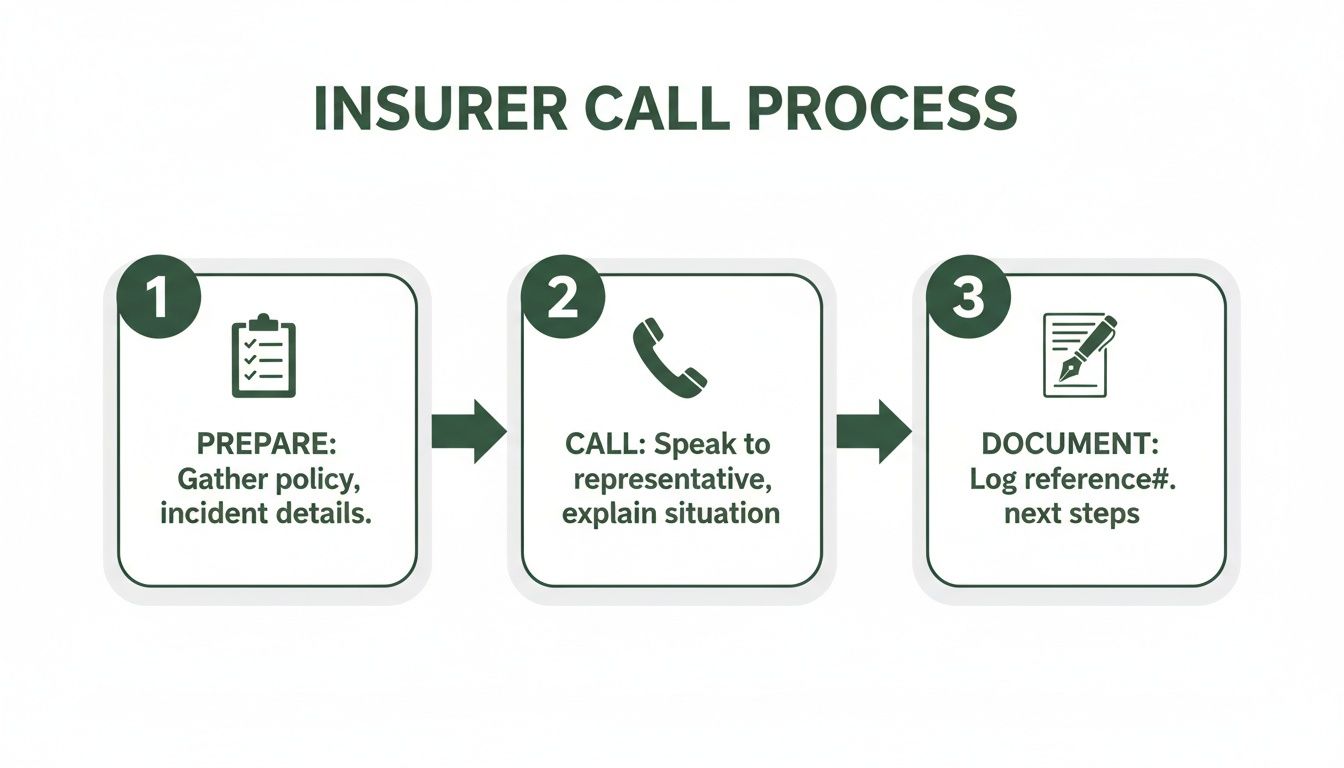
The key insight here is that successful verification isn't just about the phone call itself. What you do before and after—the preparation and the documentation—is just as critical.
Verifying Detox and Inpatient Coordination
For many people, the path to recovery starts with detoxification (detox) or a residential stay. These are intensive, higher levels of care, and they almost always require prior authorization from your insurance company.
This is a formal approval process where the insurer's clinical team reviews medical information to confirm that this level of care is medically necessary. At Paramount Recovery Centers, our team handles this entire process for you. We submit all the required clinical documentation to get the treatment approved so you can focus on what matters.
When you talk to your insurer, here are the critical questions to ask about these services:
- Is prior authorization required for medical detox or residential inpatient treatment?
- What are the specific clinical criteria you use to determine medical necessity?
- How many inpatient days does my plan initially approve? What's the review process if more time is needed?
- What is my copay or coinsurance for a residential stay after my deductible is met?
Understanding Day Treatment (PHP) and IOP Benefits
As clients make progress, they often transition to less intensive programs like Day Treatment (also called a Partial Hospitalization Program or PHP) and Intensive Outpatient Programs (IOP). Coverage for these services can be structured very differently from inpatient care.
For example, your plan might cover a set number of therapy sessions per year or a specific number of weeks in a program. It’s crucial to get these details upfront.
A common pitfall is assuming that because inpatient care was covered, outpatient services will be too. Always verify each level of care independently. Your benefits for PHP and IOP can have entirely different rules and costs.
Confirming Coverage for Medication-Assisted Treatment (MAT)
Medication-Assisted Treatment (MAT) is a cornerstone of modern addiction care, combining FDA-approved medications with counseling and behavioral therapies. When you're checking benefits, you need to ask about both parts: the medications and the clinical services.
Ask your insurer these specific questions:
- Is there a preferred drug list (formulary) for MAT medications like Suboxone or Vivitrol?
- Do these medications require a separate prior authorization?
- What is my copay for the medication itself? And what is my copay for the related therapy and doctor visits?
The good news is that federal laws like the Affordable Care Act have expanded access to these essential services for millions of Americans, but plan specifics still vary. Making a detailed verification for each service is more critical than ever. For a deeper dive into how this powerful approach works, explore our guide on what Medication-Assisted Treatment is and how it supports long-term recovery.
Of course, handling all these details can feel like a full-time job. The good news is, you don’t have to do it alone. Our admissions team at Paramount Recovery Centers is here to do a complete, confidential, and no-cost benefits check for you. We know the system, and we know the right questions to ask for every level of care.
Call us 24/7 at (888) 388-8660, and let us get you the clear answers you deserve.
Finalizing and Documenting Your Coverage Details
Getting someone from the insurance company to give you answers over the phone feels like a win, but it’s really only half the battle. What you do after that call is what truly protects you from surprise bills and ensures the admissions process goes smoothly.
Proper documentation is your best defense. It turns a simple conversation into a concrete record, giving you something solid to fall back on if there’s a dispute down the road.

Honestly, this part can feel tedious, especially when you’re already overwhelmed. That’s why the admissions team at Paramount Recovery Centers is here to take this entire burden off your shoulders. Let our specialists handle the calls, the documentation, and all the follow-up for you.
Let Us Handle the Details for You
You don't have to become an insurance expert. We'll conduct a complimentary and completely confidential verification of benefits for you. Call Paramount Recovery Centers at (888) 388-8660 and let our team get the clear, documented answers you need.
Why Every Call Needs a Reference Number
Before you hang up the phone with any insurance representative, get a call reference number. Think of it as the receipt for your conversation. It's the single most important piece of information you can walk away with.
If you ever need to call back and end up with a different agent, that reference number lets them instantly pull up the notes from your previous call. You won’t have to start from square one, and it holds the insurance company accountable for the information they gave you. Make getting this number a non-negotiable part of ending every call.
Securing Written Confirmation of Your Benefits
Once the call is done, your next move is to get everything in writing. You can usually do this through the insurer's online patient portal or by simply asking the representative to mail or email you a Summary of Benefits and Coverage (SBC).
Having this document is critical. It officially lays out all the details, including:
- Your specific deductible and out-of-pocket maximum.
- Copay and coinsurance amounts for behavioral health services.
- Any limitations or exclusions that apply to your plan.
This written proof is your ultimate protection against misunderstandings or billing errors. It ensures that everyone—you, the treatment provider, and the insurer—is on the same page.
Navigating Roadblocks and Denials
Sometimes, even with the best preparation, you’ll hit a wall. Maybe you find out your preferred treatment center is out-of-network, or a specific level of care like inpatient rehab is initially denied.
Don’t panic. A denial is often just the start of a conversation, not the end of the road. Many plans in Massachusetts offer significant out-of-network benefits that can still make treatment affordable. To get a better sense of what’s involved, it helps to understand how much drug rehab can cost in MA and the different factors that play into the final price.
If a service is denied, there’s an appeals process. Our team at Paramount Recovery Centers has managed these situations countless times. We can help you understand your options and advocate on your behalf to get the coverage you’re entitled to.
Dealing with insurance is a frustrating part of getting help, but you don't have to do it alone. By documenting everything, you empower yourself and create a clear path forward. Better yet, let our team manage this entire process so you can focus on what truly matters: healing. Call us today at (888) 388-8660.
Frequently Asked Questions About Insurance Verification
Even with a detailed guide, it's natural to have questions. The world of health insurance is notoriously complex. Here are straightforward answers to some of the most common concerns we hear from families in Massachusetts.
What if my insurance plan is considered out-of-network?
Discovering a provider is "out-of-network" can be disheartening, but it doesn't automatically mean treatment is unaffordable. Many PPO plans, which are common in Massachusetts, include out-of-network (OON) benefits that can cover a significant portion of the cost. Our admissions specialists are experts at evaluating OON benefits and can quickly determine what your financial responsibility would be. Don't let the term discourage you; call us first to explore all your options.
Is my insurance provider legally required to cover addiction treatment?
For the vast majority of plans, the answer is yes. Federal laws like the Affordable Care Act (ACA) and the Mental Health Parity and Addiction Equity Act (MHPAEA) mandate that most health insurance plans cover mental health and substance use disorder services as essential health benefits. However, the specific details of that coverage—such as which services are included and what your costs will be—differ from plan to plan. That's why a thorough verification is essential.
What is a prior authorization and will I need one?
A prior authorization (or "pre-authorization") is a required approval process from your insurance company before they agree to cover certain medical services. For addiction treatment, this is most common for higher levels of care like medical detox and inpatient residential stays. The treatment provider submits clinical documentation to prove the service is medically necessary. Our team at Paramount Recovery Centers handles this entire process on your behalf, coordinating directly with your insurer to secure the necessary approvals.
Can I verify my benefits on my insurance company's website?
Using your insurer's online portal is a good way to check basic information like your deductible status. However, it rarely provides the detailed information needed for substance use treatment, such as coverage limits for different levels of care or specific prior authorization requirements. For definitive answers, a direct phone call is always the best approach. You can also protect yourself from potential scams by confirming your insurer is licensed with the Massachusetts Division of Insurance before sharing personal data.
Trying to navigate these questions on your own can be incredibly stressful. The experienced team at Paramount Recovery Centers is here to bring clarity and support to the process. We can verify your insurance coverage for you—quickly, confidentially, and at no cost. Call us 24/7 at (888) 388-8660 to get the answers you need and take that first step.


