



A lot of families arrive at the same moment before they ever make a call for help.
Someone they love says they are trying. They may even be attending treatment, going to meetings, or staying sober for stretches of time. But the house still feels tense. Trust is thin. Every missed call feels loaded. Every change in mood raises a new question. Is this normal recovery stress, or is something going wrong again?
That is where many people start searching for how to support someone in recovery. Not because they want a slogan, but because they need a workable way to live through this with clarity.
Support matters. It matters in practical ways, emotional ways, and clinical ways. But support is not the same as controlling, rescuing, monitoring every move, or sacrificing personal stability to keep another person afloat. The healthiest support gives structure, honesty, and connection without taking over the recovery process itself.
Understanding Your Role in Their Recovery Journey
One common family pattern looks like this. A parent covers a missed rent payment because they do not want their adult child to lose housing. A spouse calls an employer with an excuse because it seems easier than another crisis. A sibling stays up all night checking for signs of use, then goes to work exhausted the next morning.
None of that comes from lack of love. It usually comes from fear.
The hard truth is that fear often pushes families into roles that do not help recovery. They become detective, financier, fixer, or shock absorber. Then they wonder why everyone is still overwhelmed.
Support is not the same as rescue
A healthier role is supportive ally. That means staying engaged, staying informed, and refusing to disappear into denial, but also refusing to carry responsibilities that belong to the person in recovery.
A supportive ally does a few things well:
- Shows up consistently: They check in, follow through, and avoid dramatic swings between over-involvement and withdrawal.
- Encourages treatment: They do not try to replace clinical care with family effort alone.
- Protects the home environment: They make it clear what is safe, acceptable, and sustainable.
- Keeps perspective: Recovery is a long process. One good week does not solve everything, and one hard day does not erase all progress.
Many families feel guilty when they stop rescuing. They worry that stepping back means abandonment. It does not. It means putting support in the right place.
A loved one cannot recover through someone else’s willpower. They recover through their own participation, with informed support around them.
The role can be learned
Few people were ever taught how to support a person with addiction or co-occurring mental health symptoms. They were taught to help by solving, smoothing over, or protecting. Recovery asks for a different skill set.
That includes learning the difference between support and enabling, knowing how to talk without escalating, understanding treatment options, and preparing for setbacks without panic. Families looking for a broader overview of family support in addiction recovery often find it helpful to start there, then apply those ideas to their own home and routines.
The most effective families usually do not have perfect instincts. They have guidance, structure, and a willingness to change their own patterns.
Building a Foundation of Empathy and Understanding
People support recovery better when they stop viewing addiction as a character problem. Shame-based thinking leads to blame, suspicion, and constant moral judgment. That usually creates more secrecy, more defensiveness, and less openness.
A more useful view is this. Addiction affects thinking, behavior, reward, impulse, coping, and relationships. It often overlaps with trauma, anxiety, depression, or other mental health concerns. That does not remove responsibility. It clarifies why willpower alone rarely solves it.
Research shows that social support is a critical predictor of sustained recovery, and people with stronger support networks tend to stay in treatment longer and have better outcomes, including more days abstinent, higher quality of life, and a decreased likelihood of return to use (PMC).
Empathy helps. Excusing everything does not
Empathy means understanding that the person may be carrying shame, cravings, fear, and emotional pain. It means not reducing them to their worst behavior.
Enabling is different. Enabling removes the pressure to change by shielding the person from consequences or responsibilities.
These two can look similar from the outside, which why families get confused.
What empathy sounds like
- “This is hard, and help is available.”
- “Recovery takes work, and support is here when real effort is happening.”
- “A setback does not make someone hopeless.”
What enabling often looks like
- Covering up behavior: Calling employers, lying to relatives, or hiding obvious problems.
- Providing money without accountability: Giving cash when there is active misuse or dishonesty.
- Ignoring unsafe conduct: Tolerating intimidation, threats, or chaos in the name of compassion.
- Lowering all expectations: Treating the person as too fragile to attend therapy, follow house rules, or keep appointments.
A better test for family decisions
When deciding whether to help, one question clears up a lot of confusion.
Does this action support recovery, or does it protect the addiction from consequences?
That question changes decisions quickly.
Paying for transportation to treatment may support recovery. Paying unexplained expenses after repeated dishonesty may protect addiction. Watching children so a parent can attend therapy may support recovery. Taking over every adult responsibility indefinitely usually does not.
Accountability is part of compassion
Families sometimes hear “be understanding” and interpret it as “expect less.” That usually backfires.
People in recovery often do better with clear expectations, calm follow-through, and steady encouragement. The tone matters. Accountability delivered with contempt tends to provoke resistance. Accountability delivered with respect is different. It says, “This matters, and so do you.”
Helpful support combines warmth with structure. It does not choose one and abandon the other.
Practical shifts that improve the home dynamic
A few behavior changes make an immediate difference:
- Stop arguing about intent: Focus on behavior. Whether the person “meant to” miss medication, skip therapy, or break an agreement matters less than what happened.
- Name what is observable: “You missed two appointments this week” works better than “You never take recovery seriously.”
- Refuse to debate reality: If there is evidence of a problem, families do not need to accept obvious distortions just to keep the peace.
- Respond to effort, not promises: Early recovery is full of statements about what will happen. Pay more attention to attendance, honesty, and follow-through.
Empathy gives the relationship a chance to stay intact. Accountability gives recovery a chance to become real.
Mastering Communication for a Stronger Connection
Many family conversations fail before the true subject even appears. The person in recovery expects criticism. The supporter expects denial. Both enter the conversation armed.
That is why communication has to become more deliberate. The goal is not to win an argument. The goal is to lower defensiveness enough that honesty becomes possible.
A visual contrast helps:
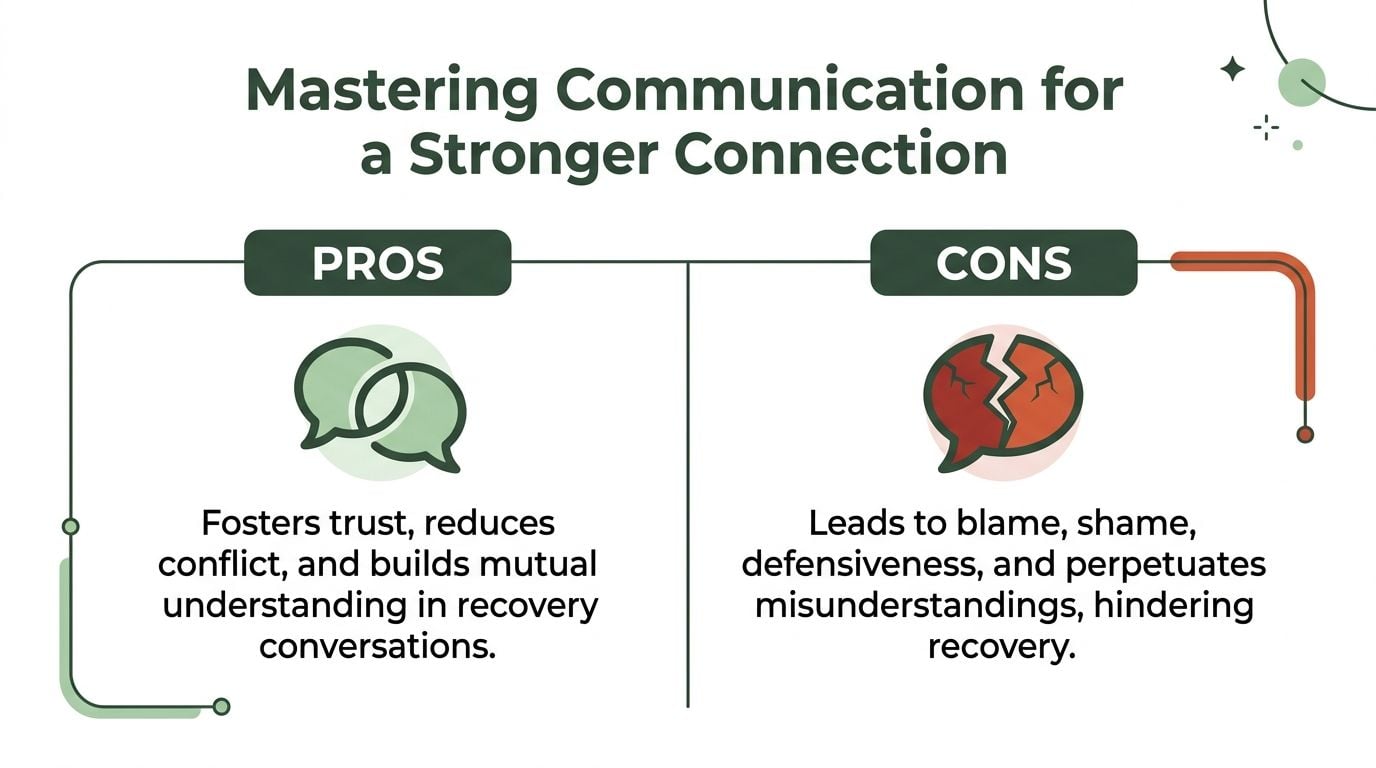
Start with observation, not accusation
The strongest opening line is usually simple and specific.
Instead of leading with motive, history, or a list of old wounds, begin with what happened and how it affected the relationship. I statements help in this context. They reduce blame and keep the speaker grounded in facts and impact.
Examples:
- “I felt worried when you did not come home and I could not reach you.”
- “I feel less trusting when appointments are missed and no one says anything.”
- “I want to talk about what support looks like right now because the current pattern is not working.”
That approach is not soft. It is disciplined.
Listen for the underlying message
People in recovery do not always say exactly what they mean. “Stop pressuring me” may mean “I already feel ashamed.” “I’m fine” may mean “I do not want to admit I am struggling.” Listening well does not mean believing everything at face value. It means hearing the emotion under the words. The true message may be different.
Useful responses include:
- “It sounds like you feel cornered.”
- “That sounds frustrating.”
- “It makes sense that you would be overwhelmed.”
- “What kind of support would make this conversation easier?”
Listening can calm a person enough to have a real discussion. It can also reveal when the person is avoiding, minimizing, or trying to redirect. Both are useful pieces of information.
Effective Communication Do’s and Don’ts
| Instead of Saying This… | Try Saying This… |
|---|---|
| “You always ruin everything.” | “I’m concerned about what happened and want to address it directly.” |
| “If you cared, you would just stop.” | “I know recovery is difficult, and I need to see consistent action.” |
| “You’re lying again.” | “What you told me does not match what I’m seeing, and that affects trust.” |
| “Why can’t you be normal?” | “I want to understand what is making things harder right now.” |
| “I’m done talking to you until you fix this.” | “I’m willing to talk when we can have an honest conversation.” |
| “You made this mess, so deal with it alone.” | “I care about you, and I also need professional support to be part of this process.” |
Keep conflict from escalating
A difficult conversation does not need to become a crisis. A few rules reduce the odds of a blowup.
- Choose timing carefully: Do not start a major discussion in the middle of visible intoxication, panic, or exhaustion.
- Stay with one issue: Bringing in five old arguments almost guarantees collapse.
- Use a pause when needed: If voices rise or the person becomes verbally aggressive, stop. Resume later.
- Do not force confession: Families often chase honesty so aggressively that the conversation becomes an interrogation.
A calm tone does not weaken the message. It makes the message harder to dismiss.
What effective communication does
It does not guarantee agreement. It does something more useful. It creates conditions where reality can be discussed without adding unnecessary shame.
That matters because recovery depends on repeated, honest conversations about cravings, treatment attendance, medication, triggers, accountability, and fear. If every discussion turns into a trial, people hide more. If every discussion becomes permissive, problems go unnamed. Good communication holds the middle.
How to Set Healthy Boundaries Without Guilt
Families often set boundaries only after exhaustion has already set in. By then, the conversation is usually fueled by resentment. The words come out sharp, the limit is too broad, and follow-through falls apart within days.
A better boundary is clear, realistic, and enforceable.
What a boundary is and what it is not
A boundary is a statement about what the supporter will do to protect safety, stability, and health. It is not an attempt to control another person’s inner life.
Good boundaries sound like this:
- Money: “Cash will not be given directly.”
- Housing: “Staying in the home requires sobriety, honesty, and respectful behavior.”
- Communication: “Conversations stop if yelling, threats, or abuse begin.”
- Transportation: “Rides will be offered for treatment and recovery-related appointments, not for unexplained disappearances.”
Boundaries are not punishments. They are conditions for healthy involvement.
Why guilt shows up so fast
Supporters often confuse discomfort with wrongdoing. Setting a limit feels harsh because the family has gotten used to reducing immediate distress at any cost. But short-term peace can create long-term instability.
That is especially true when one family member has spent years over-functioning. In those cases, outside guidance can help. People who recognize chronic over-accommodation in themselves may benefit from reading about therapy for people-pleasing, because guilt around limits is often tied to deeper relationship patterns.
A practical boundary process
Decide what must change first
Do not start with ten rules. Start with the issue causing the most harm.
That may be money, aggression, driving, disappearing, substance use in the home, or repeated manipulation around treatment. One clear limit enforced consistently is more effective than a long list no one can maintain.
Say it plainly
Avoid speeches. Avoid moral language. Avoid vague terms like “better attitude.”
Try direct language:
- “If you come home intoxicated, you cannot stay here that night.”
- “If you miss treatment and do not contact the program, transportation support stops until there is a plan.”
- “If you curse at family members, the conversation ends.”
Follow through the first time
Most boundaries fail at this point. The family sets a limit, then backs away because the person cries, argues, blames, or promises.
Inconsistent enforcement teaches the wrong lesson. It tells the person that emotional pressure can erase the limit.
A useful companion resource on this point is this guide on how to help an addict without enabling them, especially for families trying to separate loving support from behaviors that keep the cycle going.
Boundaries do not push recovery away. They remove confusion and make room for responsibility.
Boundaries protect the supporter too
Many supporters become so focused on the loved one that they ignore their own sleep, work, parenting, physical health, and emotional baseline. That is not sustainable.
A home where everyone is anxious, hypervigilant, and exhausted is not a recovery-supportive environment. Boundaries protect children, partners, aging parents, and the person trying to recover. They lower chaos. They create predictability. They reduce the constant emergency atmosphere that addiction often creates.
The person in recovery may resist boundaries at first. That does not mean the boundary is wrong. It usually means the old system is changing.
Guiding Them Toward Professional Treatment and Aftercare
Family support matters, but it cannot substitute for treatment. If the person needs detox, psychiatric evaluation, structured therapy, medication support, or a formal relapse-prevention plan, love alone is not enough.
The practical challenge is that many families do not know what level of care fits the situation. They hear terms like detox, residential, PHP, IOP, outpatient, aftercare, and coaching, but the differences are unclear.
Start with the current level of risk
The first question is not, “What program sounds best?” It is, “How unstable is the situation right now?”
Immediate evaluation is especially important when there is active substance use, severe withdrawal risk, suicidal thinking, medical instability, repeated relapse after lower levels of care, or a co-occurring mental health condition that is impairing judgment and safety.
From there, care can be matched more precisely.
Understanding the treatment continuum
Detox placement
Detox is the right first step when withdrawal needs medical management or close monitoring. Families should not assume a person can stop safely at home. Substances affect the body differently, and risk level varies.
Detox is stabilization, not full treatment. It opens the door. It does not complete recovery.
Inpatient or residential treatment
Residential care gives the person a structured environment away from daily triggers and routines. It is often appropriate when the home environment is unstable, cravings are intense, or repeated attempts at lower-intensity care have not held.
This level of care can also help when co-occurring mental health symptoms are severe enough that the person needs more oversight and consistency.
Day treatment or PHP
PHP, often called day treatment, is a high level of structured care without overnight stay. It can be a strong fit for people who need intensive therapeutic support during the day but have a safe place to return to afterward.
Families often do well when they understand that PHP is not “less serious” care. It can be a very active treatment phase with therapy, skill-building, recovery planning, and ongoing clinical oversight.
Intensive outpatient or IOP
IOP gives meaningful structure while allowing a person to maintain more of daily life, such as work, school, or caregiving. It is often appropriate as a step-down from higher care or as a starting point when symptoms and risk are more manageable.
The key question with IOP is whether the person has enough stability, transportation, accountability, and willingness to engage between sessions.
The role of recovery coaching and case management
Families often assume treatment means only therapy sessions. In reality, many people need help coordinating housing, transportation, appointments, benefits, vocational needs, and community supports.
Evidence-based models such as Connecticut’s Recovery Management Program show that an intensive, community-based case management approach led by a recovery coach can be highly effective. The process includes assessment, linkage across the treatment continuum, and ongoing monitoring to adjust the recovery plan, with improved engagement and retention noted in this model (Faces & Voices of Recovery manual).
That matters because many relapses are not caused by a single dramatic event. They build around disorganization, isolation, untreated symptoms, and loss of follow-through.
Aftercare is not optional
The period after formal treatment often makes families nervous for good reason. Structure changes. Freedom increases. Old contacts may reappear. The person has to practice recovery in ordinary life, not just in a clinical setting.
Aftercare should be treated as part of treatment, not a bonus item.
Helpful aftercare elements can include:
- Peer support services: These can help people stay connected, reduce isolation, and build practical accountability.
- Family therapy: This helps the household shift old patterns, repair trust, and create realistic expectations.
- Alumni involvement or recovery community connection: Ongoing peer relationships often matter more than families expect.
- Medication management and mental health treatment: Essential when co-occurring conditions are part of the picture.
- Structured relapse-prevention planning: Specific, written plans work better than good intentions.
Families exploring the value of relational support alongside treatment often benefit from this overview of the 5 benefits of a family therapy program, because recovery rarely succeeds in isolation.
Practical questions to ask admissions or insurance staff
The best conversations are concrete.
- What level of care is being recommended, and why?
- Is detox placement needed first?
- How are co-occurring mental health symptoms assessed?
- What does a typical week in PHP or IOP look like?
- How is family involvement handled?
- What happens after discharge?
- What insurance verification steps can be completed now?
When families ask better questions, they make better decisions. That reduces delay, confusion, and preventable dropout.
How to Recognize Relapse and Respond Effectively
Many families are told some version of “relapse can happen” and then left with almost no practical guidance. That gap matters. General reassurance does not tell a spouse what to do when medication is skipped, sleep collapses, and secrecy returns. It does not tell a parent how to respond when a son stops attending treatment and starts disappearing again.
Existing recovery guidance often stays vague about what helping during a setback means, even though this is one of the most stressful parts of support, especially in dual-diagnosis cases where mental health symptoms and substance use can overlap (ADF).
Warning signs families often miss
Relapse is not always obvious at first. It may begin with emotional and behavioral shifts before any confirmed use.
Watch for patterns such as:
- Isolation: Pulling away from family, peers, meetings, or treatment contacts.
- Routine breakdown: Sleep disruption, missed meals, skipped medications, or sudden inconsistency.
- Dishonesty: Vague explanations, missing time, or stories that stop making sense.
- Mood volatility: Irritability, hopelessness, agitation, or unusual flatness.
- Recovery drift: Less openness, less structure, less willingness to talk about support.
In dual-diagnosis situations, these signs can also reflect worsening anxiety, depression, trauma symptoms, or another mental health issue. Families should not try to diagnose the difference on their own when the picture is murky.
A steadier response plan
The wrong move is usually one of two extremes. Either the family explodes and turns the situation into a confrontation, or the family panics and acts as though nothing is wrong.
A better response follows a calmer sequence.
State what has changed
Use observed behavior.
Examples:
- “You have missed treatment twice this week.”
- “You have been avoiding calls and staying out overnight.”
- “Your mood and routine have changed a lot in the last several days.”
Reconnect to prior agreements
If there is already a recovery or household plan, return to it.
That may include contacting a therapist, attending an urgent appointment, resuming a higher level of care, involving a sponsor or peer support, or following house consequences tied to substance use.
Escalate early when needed
Do not wait for total collapse if the signs are accumulating. Earlier intervention often works better than a dramatic late rescue.
Families can prepare by reviewing practical relapse prevention strategies and making sure the plan includes who to call, what level of care might be needed, and what boundaries stay in effect during a setback.
A relapse response plan should be made before a crisis, not during one.
What helps and what makes it worse
Helpful responses include calm observation, quick reconnection to professional support, and consistent boundaries. Less helpful responses include threats with no follow-through, emotional pleading, endless detective work, and long debates over whether the family has “proof.”
The aim is not to force a confession. The aim is to interrupt the slide and redirect the person toward treatment, accountability, and safety.
Prioritizing Your Own Well-Being as a Supporter
Supporters often receive the same thin advice. Take care of yourself. Rest when you can. Reach out if needed. That is not wrong. It is just incomplete.
The strain is emotional, practical, and financial. Family members often deal with increased illness and sometimes struggles with depression and anxiety, while also carrying logistical burdens that recovery guidance rarely addresses, including workplace disruption, scheduling demands, and uncertainty about insurance coverage for family therapy or mental health care (Riverside Health).
Self-care needs structure too
Waiting until burnout hits is not a plan. Supporters need their own system.
- Protect medical and mental health appointments: Personal care should stay on the calendar.
- Use workplace options when available: Ask human resources about leave policies, scheduling flexibility, or employee assistance programs.
- Clarify insurance benefits: Ask directly whether family therapy, supporter counseling, or behavioral health visits are covered.
- Build one outside support lane: That may be a therapist, support group, faith leader, or trusted relative who understands the situation.
Stability in the family helps recovery
A household does better when the supporter is sleeping, functioning, thinking clearly, and not making every decision from panic. That is not selfish. It is one of the strongest forms of protection a family can create.
When the emotional and practical load becomes too heavy to manage alone, professional guidance should not be treated as a last resort. It should be part of the plan.
Paramount Recovery Centers provides Massachusetts families with a full path forward, from detox placement and dual-diagnosis treatment to PHP, IOP, family therapy, and aftercare planning. For loved ones trying to figure out how to support someone in recovery without losing themselves in the process, professional guidance can make the next step clearer. To speak with Paramount Recovery Centers, verify insurance, or discuss treatment options, call (888) 388-8660 or visit Paramount Recovery Centers.


