



A search for how long does Librium stay in your system usually happens for a reason. Someone has a drug test coming up. Someone feels sleepy longer than expected. Someone finished an alcohol withdrawal prescription and is wondering why their body still feels off. Sometimes a family member is trying to make sense of mixed signals, where the medication seems gone but the person still appears sedated, foggy, or vulnerable.
The short answer isn't one number. Librium stays in the body longer than many people expect, but the more useful answer is this. Its timeline depends on the dose, how often it was taken, the type of test being used, and how the body handles its breakdown products. That last point gets missed in most online explanations.
Librium doesn't just enter the body and disappear. The liver breaks it down into other active metabolites, which means the medication can keep influencing the body and remain detectable after the initial dose no longer feels strong. That's why a simple “it lasts X hours” answer often misleads people and creates unnecessary panic or false reassurance.
Understanding Your Librium Question
People rarely ask about Librium out of casual curiosity. The question usually sits inside a more urgent one. Am I still impaired. Will I pass a test. Is withdrawal about to start. Is this normal.
Those are valid concerns. Librium is a long-acting benzodiazepine, so the body's timeline doesn't line up neatly with what a person feels from moment to moment. Someone may feel that the medication has “worn off” and still have enough drug-related material in the body to affect testing, sedation risk, or the timing of symptoms after stopping.
Why simple answers cause problems
A single clearance number sounds reassuring, but it often creates mistakes. People may assume they're in the clear because they don't feel the medication anymore. Others may panic over a positive test without understanding that detectability can outlast the noticeable effects.
That mismatch is one reason self-detox methods and quick-fix internet advice can be risky. Misleading detox myths, including unsupported approaches like niacin detox advice, can distract people from the main issue, which is how the body metabolizes a long-acting benzodiazepine.
The most practical question usually isn't “when is the last pill gone.” It's “what is still active in the body, and what does that mean for safety.”
What actually shapes the answer
Several variables matter at the same time:
- Dose history matters: A single dose and repeated dosing don't behave the same way.
- Test type matters: Urine, blood, saliva, and hair each capture a different window.
- Body chemistry matters: Liver function and general metabolism can change how quickly Librium and its metabolites clear.
- Real-world context matters: A person tapering after alcohol withdrawal has different concerns than a person facing a workplace screen.
When people need a safer answer, they need more than a headline timeline. They need context, especially around active metabolites, delayed withdrawal, and when home management stops being a safe plan.
How Librium Works and How Your Body Processes It
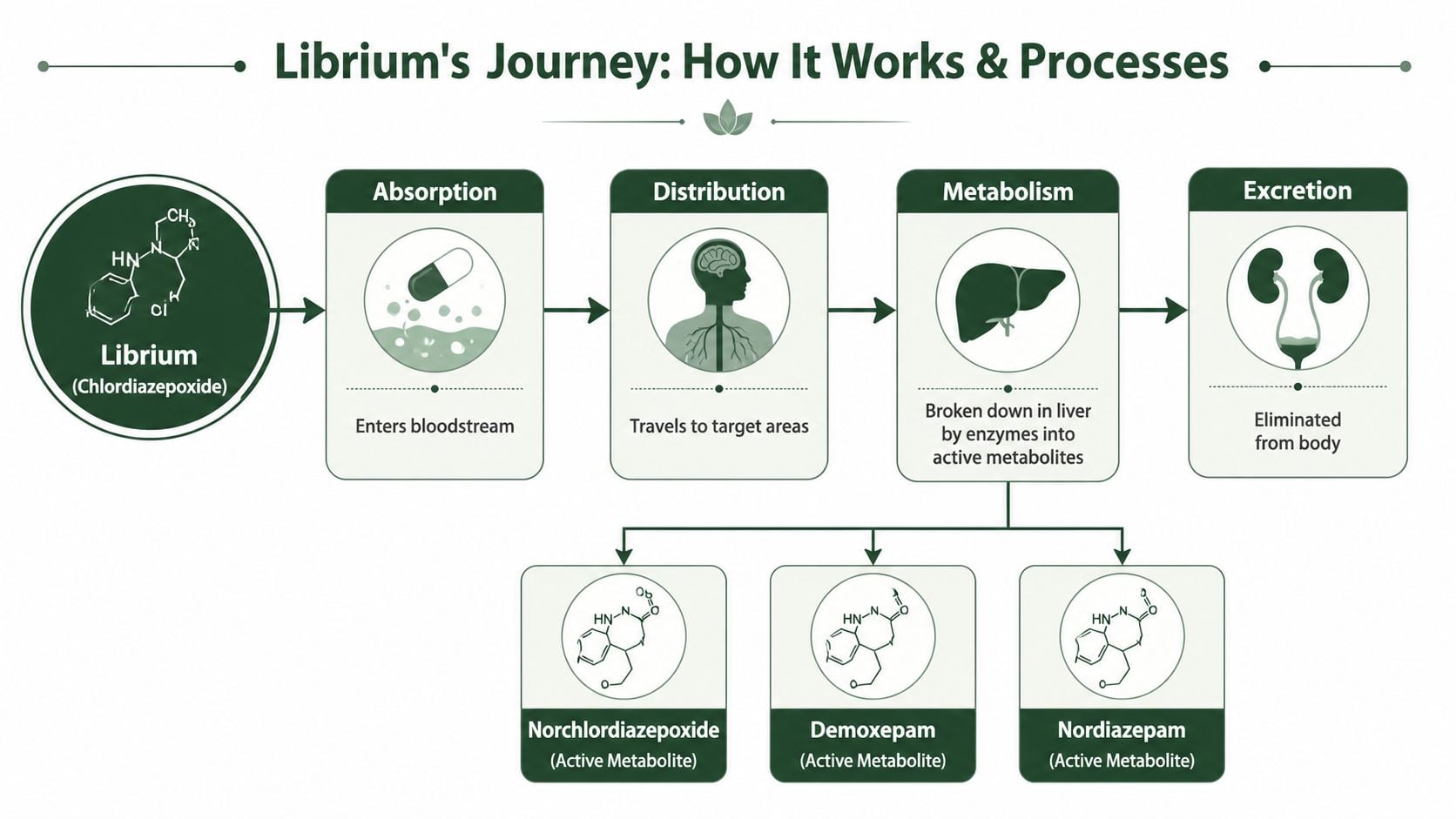
Librium, or chlordiazepoxide, is a long-acting benzodiazepine. Its average elimination half-life is reported as 24 to 48 hours, and using the common rule of about five half-lives for near-complete elimination, a single dose can take roughly 125 to 240 hours, or about 5 to 10 days, to clear to very low levels in the body, according to this Librium half-life reference.
That number helps, but it still doesn't tell the whole story.
Half-life in plain language
A half-life is the time it takes for the amount of a drug in the body to drop by half. The easiest way to think about it is like a fading echo. The sound weakens, but it doesn't vanish all at once. It keeps tapering down over time.
With Librium, the echo is longer than many people expect. The medication's effect may feel less noticeable well before the body has finished processing it.
The part most articles miss
The body doesn't just remove Librium in one clean step. It first metabolizes it into other substances that are still pharmacologically active. That matters because the practical experience of “Librium in the system” often reflects not only the parent drug, but also what it turns into during metabolism.
Confusion often arises. A person may judge the timeline by how sedated they feel after the original dose, while a clinician has to think about the longer tail created by active metabolites. Those metabolites can contribute to lingering sedation, prolonged test detection, and delayed shifts in withdrawal risk.
Clinical reality: For Librium, metabolism isn't just a disposal process. It can extend the medication's presence in ways patients don't always expect.
Why this changes real-life decisions
This longer metabolic tail affects several common situations:
- Driving or work decisions: Feeling “mostly normal” doesn't always mean full physiologic clearance.
- Drug testing: Detectability may continue well after the obvious calming effect fades.
- Taper planning: Stopping too abruptly can become dangerous because the body is adjusting not only to Librium itself, but also to its long-acting metabolites.
- Alcohol withdrawal treatment: The same long-acting profile that makes Librium useful in detox can also complicate what happens after the last dose.
That's why the question isn't just pharmacology. It's a safety question.
Librium Detection Windows by Test Type
When people ask how long does Librium stay in your system, they often mean one thing. How long can a test still find it. The answer depends on the testing method, because each sample type captures a different part of the timeline.
According to this breakdown of Librium detection windows, urine may detect Librium for about 1 to 6 weeks, blood usually for about 6 to 48 hours, saliva for about 1 to 10 days, and hair for up to about 90 days. The same source notes that someone may feel the drug has worn off while testing still detects use for days to weeks.
Quick reference table
| Test Type | Approximate Detection Window (Single Use) | Approximate Detection Window (Chronic Use) |
|---|---|---|
| Urine | Within the broader 1 to 6 weeks range | Often toward the longer end of the 1 to 6 weeks range |
| Blood | About 6 to 48 hours | Usually still considered a short window, though individual variation matters |
| Saliva | About 1 to 10 days | May persist longer within that range depending on use pattern |
| Hair | Up to about 90 days | Up to about 90 days |
This table should be read as an estimate, not a guarantee. Test technology, cutoff levels, pattern of use, and body chemistry all affect the result.
What these windows actually mean
Urine is the most common practical testing method, and it usually creates the most anxiety because the window can stretch much longer than people expect. That's especially true when use has been repeated rather than one-time.
Blood is a different conversation. Its value is usually in identifying recent use, not mapping a long history. Saliva can sometimes bridge that middle ground, while hair has the longest retrospective window.
A helpful comparison appears in this related guide on drug detection timelines across substances. The main lesson is that “still detectable” and “still feeling it” are not the same thing.
Common mistakes people make before a test
- Assuming symptom relief means clearance: Feeling less drowsy doesn't mean the body has finished processing Librium.
- Relying on internet detox tricks: These don't change the underlying metabolism in a dependable way.
- Ignoring repeated dosing: Several days of use can create a very different testing window than one isolated dose.
- Guessing from another benzodiazepine: Librium's long-acting profile makes direct comparisons unreliable.
For families, employers, and patients, this can lead to misunderstandings. A positive test later on doesn't automatically mean new use. It may reflect the long window expected with Librium.
Why Librium Clearance Varies from Person to Person
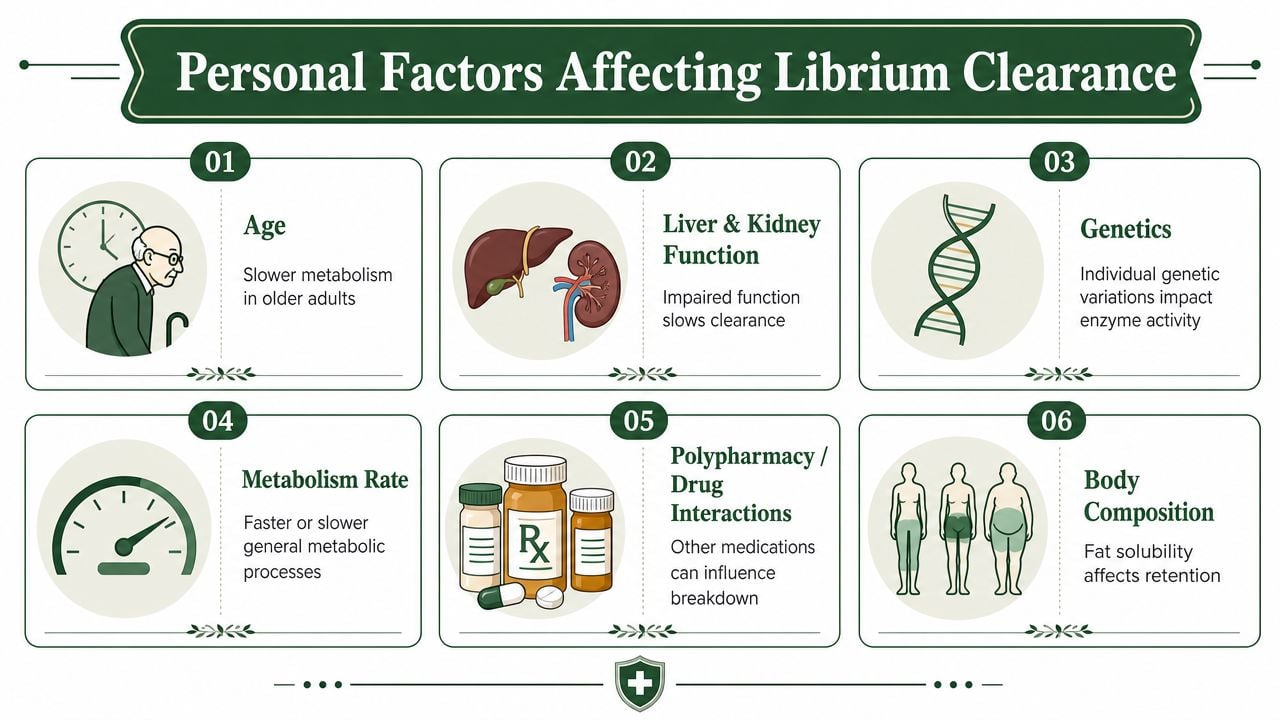
Two people can take the same medication and clear it on very different timelines. That's especially important with Librium, because the body has to process both the drug itself and its long-acting active metabolites. As noted in this explanation of Librium metabolism and metabolites, the practical question isn't only when the last dose is gone, but how long metabolites may still trigger a test or contribute to sedation risk.
The biggest variables
Some factors are straightforward. Others are easy to underestimate.
- Dose and duration of use: Larger amounts and repeated dosing make it harder for the body to “catch up,” especially when metabolites are also accumulating.
- Liver function: Librium is processed through the liver, so reduced liver function can slow clearance significantly.
- Age: Older adults often process long-acting medications more slowly.
- Other medications: Additional drugs can affect sedation, metabolism, or both.
- Body composition and baseline metabolism: These can influence how the medication is distributed and cleared.
Why chronic use changes the picture
A person who took Librium once is dealing with a different clinical issue than someone who took it regularly during a detox, used it for anxiety over time, or mixed it with other sedating substances. Repeated exposure can extend the effective duration of the medication, not just because more was taken, but because the body continues working through active breakdown products.
That's why broad online estimates can feel frustratingly vague. They are broad because the biology is broad.
A timeline can be useful. A personalized assessment is safer.
What doesn't work
People often look for one behavioral trick that will force Librium out faster. In practice, that isn't how this medication works. Hydration, exercise, sweating, supplements, and “flush” products don't reliably override the liver's need to metabolize the drug and its active metabolites over time.
The safer approach is to stop guessing. If there's concern about oversedation, a pending screen, or dependence, the next step should be clinical guidance rather than self-experimentation.
Navigating Librium Withdrawal Timeline and Risks
Detection is one issue. Withdrawal is another, and it's often the more serious one. Librium's long-acting profile can create a dangerous false sense of security because symptoms may not appear right away after the last dose.
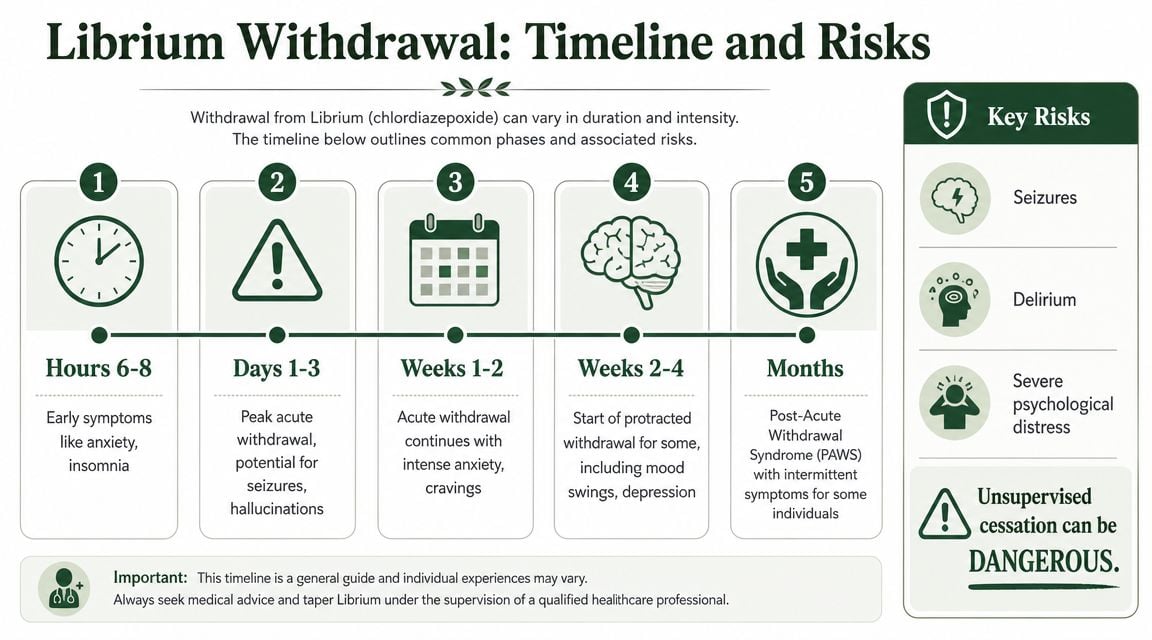
According to this Librium taper and withdrawal timeline reference, withdrawal symptoms may begin one day to a week after the last dose, peak around two weeks, and resolve over three to four weeks. The same source notes that a patient may no longer feel medicated while the drug or its metabolites remain detectable, which can create a confusing and risky period without professional guidance.
Why delayed symptoms matter
People often expect withdrawal to begin as soon as the sedating effect fades. With Librium, that expectation can be wrong. A person may seem stable at first, then become increasingly anxious, restless, or medically vulnerable later.
That delayed onset is one reason abrupt discontinuation is risky. Families may think the hard part has passed when the actual withdrawal process is only beginning.
What withdrawal can look like
Withdrawal doesn't look identical in every case, but several patterns are common:
- Early instability: Anxiety, poor sleep, irritability, tremor, or a sense that something feels wrong.
- Escalation over time: Symptoms can intensify instead of improving quickly.
- Psychological distress: Panic, agitation, depression, and heavy cravings can emerge.
- Medical danger: Benzodiazepine withdrawal can become severe and requires medical judgment.
Real-world trade-offs in tapering
A taper that's too fast can push symptoms higher than necessary. A taper that isn't monitored can also miss warning signs, medication interactions, or co-occurring alcohol use. What works is structured medical oversight. What doesn't work is trying to “tough it out,” using alcohol to soften symptoms, or restarting and stopping unpredictably.
Stopping a long-acting benzodiazepine is not just about getting through a few rough days. It's about managing a timeline that can unfold slowly and unevenly.
People who first received Librium during alcohol withdrawal are at added risk of confusion here. They may assume the medication solved the immediate crisis and forget that the days after treatment still need monitoring. If symptoms begin after discharge, that's not a sign of weakness. It's a sign that the nervous system is still adjusting.
Find Safe and Compassionate Librium Detox in Massachusetts
If Librium use has moved beyond simple short-term treatment, or if stopping it feels physically or emotionally risky, professional support matters. The danger isn't only the medication itself. The danger is trying to interpret sedation, detectability, and withdrawal without enough medical guidance.
For Massachusetts residents, one practical option is detox placement help in Massachusetts. Paramount Recovery Centers provides support for people who need help finding the right level of care, including detox coordination, dual-diagnosis treatment, and step-down options after stabilization.
When professional help makes sense
The need for help is often clearer than people think. A clinical evaluation is warranted when any of these are true:
- Stopping feels unsafe: There's fear of withdrawal, rebound anxiety, or severe insomnia.
- Use has become complicated: Librium is being mixed with alcohol, opioids, or other sedating medications.
- Testing and symptoms don't match: The person feels “fine” but continues having sedation, confusion, or positive screens.
- Mental health is part of the picture: Anxiety, trauma, depression, or panic symptoms are driving ongoing use.
What a safer plan usually includes
Good care isn't just detox. It often includes medical assessment, a taper strategy when appropriate, monitoring for withdrawal complications, and treatment for the reasons the medication became hard to stop in the first place. For some people, that means structured outpatient care after detox. For others, it means a higher level of support until symptoms settle.
No one should have to guess through that process alone, especially with a long-acting benzodiazepine.
If Librium use is causing concern for you or someone you love, Paramount Recovery Centers can help you take the next step with confidential guidance. Call (888) 388-8660 to discuss detox placement, treatment options, and a safer plan for benzodiazepine withdrawal and recovery.


