


Trying to manage bipolar disorder and substance abuse at the same time can feel like being caught in a vicious storm. Each condition feeds the other, creating a chaotic cycle of mood instability and substance use that makes recovery feel impossible. For individuals and families in Massachusetts, understanding this connection is the first step toward finding a clear path forward to lasting wellness.
Key Takeaways for You and Your Loved Ones
This complicated relationship demands a specialized kind of treatment. Here are four essential things to know about bipolar disorder and substance abuse:
- Co-Occurring Disorders Are Incredibly Common: You are far from alone. Research shows that about 50% of people with severe mental health disorders also struggle with substance abuse. The overlap is especially high with bipolar disorder due to shared risk factors in brain chemistry and behavior.
- Self-Medication Always Backfires: Using substances might offer a moment of relief from manic energy or depressive despair, but it almost always makes things worse. Alcohol can deepen depression, while stimulants can ignite a manic episode, creating a dangerous cycle that requires professional help to break. You can explore more about the troubling relationship between mental health and addiction in our detailed article.
- Integrated Treatment is the Gold Standard: Trying to treat one condition while ignoring the other doesn’t work. The most successful recovery plans tackle both bipolar disorder and substance use simultaneously. This integrated approach ensures that mood stabilization and sobriety efforts support each other.
- Specialized Local Care is Within Reach: Getting help is the most important step. Here in Massachusetts, facilities like Paramount Recovery Centers offer dual diagnosis programs built for these interwoven challenges. Finding local, expert care means having a dedicated team by your side through every stage of recovery.
Understanding Dual Diagnosis: Bipolar Disorder and Substance Abuse
When someone is dealing with both a mental health condition like bipolar disorder and a substance use disorder (SUD) at once, we call it a co-occurring disorder, or dual diagnosis. This isn’t a simple case of one problem causing the other. Instead, they are two distinct illnesses that get tangled up, making each other’s symptoms worse.
Imagine trying to walk a tightrope in a hurricane—that’s what it’s like to manage the mood swings of bipolar disorder while also fighting an addiction. The intense highs of mania and the crushing lows of depression often drive people to self-medicate with drugs or alcohol, desperate for any kind of relief.

How Bipolar Disorder and Addiction Interact
Trying to understand the link between bipolar disorder and substance abuse is more than just a clinical exercise—it’s about getting to the powerful “why” behind this dual diagnosis. This isn’t just a coincidence. These two conditions are deeply entangled, with each one making the other more complicated and much harder to manage.
This relationship often kicks off with a desperate attempt to find some kind of balance. The intense emotional swings of bipolar disorder—from the supercharged highs of mania to the crushing lows of depression—are incredibly difficult to live with. It’s no surprise that some people turn to substances, not for a party, but to self-medicate and feel a sliver of control again.
The Self-Medication Cycle
The idea of self-medication is at the heart of this issue. It’s a common, yet dangerous, way to cope where someone uses substances to temporarily silence the symptoms of their mental health condition.
- During a depressive episode: A person might reach for stimulants like cocaine or amphetamines to claw their way out of the fog of lethargy and hopelessness, trying to spark some energy or motivation.
- During a manic or hypomanic episode: They might use depressants like alcohol or benzodiazepines to try and pump the brakes on racing thoughts, calm their agitation, and hopefully get some sleep.
While these substances might offer a moment of relief, they wreak havoc on brain chemistry in the long run, often triggering even more severe or frequent mood episodes. Someone here in Massachusetts trying to manage their symptoms this way might find that alcohol only pulls them deeper into depression, making a return to stability feel impossible.
This concept map helps show the core challenges and the path forward with this complex dual diagnosis.
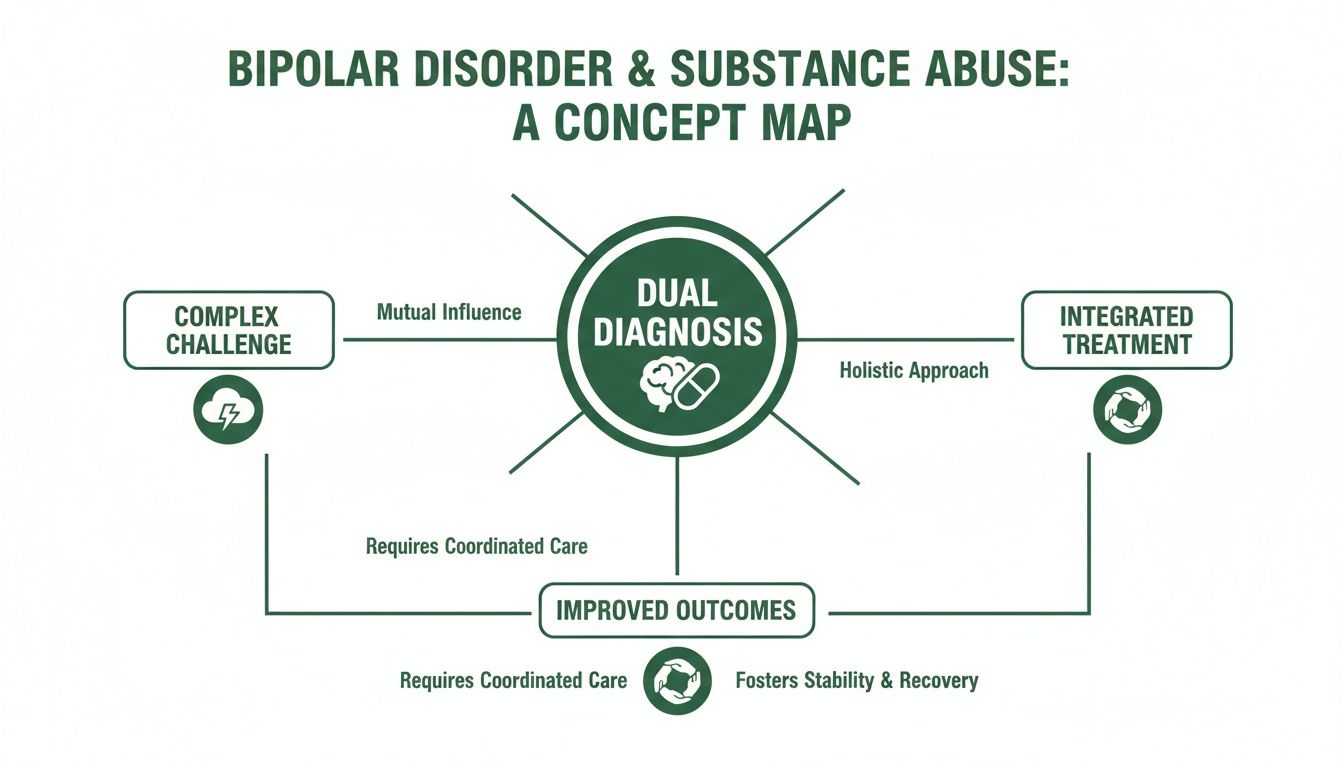
As the visual points out, a dual diagnosis is a complex problem that needs a specialized, integrated treatment plan to have any shot at a lasting recovery.
Shared Brain Pathways
The connection goes deeper than just behavior. Bipolar disorder and substance abuse share common ground right down to the brain’s neurobiology. Both conditions hijack the same neural pathways that are supposed to regulate our mood, control impulses, and process rewards.
Think of the brain’s reward system as a finely tuned instrument. Bipolar disorder throws it out of tune, causing periods of extreme sensitivity (mania) or total numbness (depression). Substance use then comes along and just starts banging on that instrument. It creates a lot of noise for a short time, but it causes long-term damage and makes it nearly impossible to find a natural, healthy rhythm again.
This shared biology explains why having one disorder so dramatically increases the risk for the other. Research shows that the lifetime prevalence of substance use disorders among people with bipolar disorder is between 40-60%. That’s a staggering number when you compare it to just 10-15% in the general population.
How Different Substances Impact Bipolar Symptoms
It’s crucial to understand that different substances have very specific and often destructive effects on bipolar symptoms. People often choose a substance that seems to counteract what they’re feeling, but this almost always backfires. The following table breaks down how common substances interact with manic and depressive episodes.
| Substance | Effect on Manic/Hypomanic Episodes | Effect on Depressive Episodes | Overall Risk |
|---|---|---|---|
| Alcohol | May initially seem calming but can lead to disinhibition, risk-taking, and irritability. | Deepens and prolongs depressive states; increases feelings of hopelessness and suicide risk. | High. Can worsen both poles of the illness and is highly addictive. |
| Marijuana (THC) | Can trigger paranoia, anxiety, and psychosis, especially in high doses. May worsen symptoms of mania. | Can increase apathy, demotivation, and cognitive fog, making depression harder to treat. | High. Strong links to triggering psychosis and worsening overall mood instability. |
| Cocaine/Stimulants | Directly mimics and intensifies manic symptoms, leading to severe agitation, psychosis, and risky behavior. | The “crash” after use causes a profound and often dangerous depressive episode. | Very High. Can trigger severe manic episodes and lead to rapid cycling. |
| Opioids | Can temporarily reduce agitation, but the rebound effect can worsen mood instability. | Offers short-term relief from emotional pain but leads to a deeper, more treatment-resistant depression. | Very High. High risk of addiction, accidental overdose, and severe mood destabilization. |
As you can see, what starts as an attempt to feel better quickly becomes a trap, making the underlying bipolar disorder more severe and chaotic.
Worsening Bipolar Symptoms
Substance use doesn’t just hang around with bipolar disorder; it actively makes it worse. This interaction creates a vicious feedback loop where symptoms become more severe, treatment stops working as well, and the risk for terrible outcomes goes way up.
Substance abuse can mask the symptoms of bipolar disorder, making an accurate diagnosis difficult. At the same time, it can intensify mood episodes, leading to more hospitalizations, poorer functioning, and a higher risk of suicide.
For example, persistent alcohol use can lead to a more stubborn, treatment-resistant depression. Many who face this dual challenge can find useful strategies in our guide on depression and substance abuse treatment. On the flip side, using stimulants can easily push hypomania into full-blown mania or even psychosis.
Another huge risk is rapid cycling, a pattern where someone has four or more distinct mood episodes in a single year. Substance abuse is a well-known trigger for this more severe and destabilizing version of the illness.
To break this cycle, you need a treatment plan that attacks both problems at the same time. For anyone struggling in Massachusetts, specialized dual diagnosis care is the only way to untangle these interwoven issues and start building a real foundation for long-term health.
Recognizing the Signs of Co-Occurring Disorders
Figuring out what’s going on when both bipolar disorder and substance abuse are in the picture is tough. The lines get blurry fast because one condition can easily look like, or even cover up, the other. For families here in Massachusetts, spotting these patterns isn’t about pointing fingers—it’s the crucial first step toward finding compassionate, effective help. This guide will walk you through the behavioral, psychological, and physical red flags that often signal a dual diagnosis.
Behavioral Red Flags to Watch For
Often, the most obvious signs show up in a person’s day-to-day life and routines. The changes might start small, but they tend to get more noticeable as both conditions take a stronger hold.
A huge clue is when the substance use seems to follow the mood episodes. For instance, does a stretch of intense energy, sleepless nights, and risky decisions also come with more drinking or drug use? On the flip side, are deep depressive spells met with attempts to numb the pain with substances?
Other behavioral signs often include:
- Growing Secrecy and Isolation: The person might pull away from family and friends, hiding how much they’re using or the true intensity of their mood swings.
- Sudden Financial Problems: Money troubles that come out of nowhere—like unexplained spending or always needing to borrow cash—can be fueled by the impulsivity of a manic episode and the cost of a substance habit.
- Neglecting Responsibilities: This can look like calling out of work, falling behind in school, or letting personal hygiene and home life slide.
- Relationship Instability: You might notice more arguments, dishonesty, and unpredictable behavior that puts a major strain on partnerships and friendships.
Psychological and Emotional Signs
On the inside, a dual diagnosis can feel like a chaotic storm of emotions. Substance use only scrambles the already unpredictable emotional landscape of bipolar disorder, making everything harder to manage.
When bipolar disorder and substance abuse coexist, mood swings can become more extreme, rapid, and resistant to typical treatments. The person may feel completely out of control, as the substance use disrupts any stability they might have achieved.
Look for these psychological patterns:
- Moods that Don’t Match the Situation: The person might fly into a rage, feel euphoric, or sink into despair for reasons that just don’t seem to fit what’s actually happening.
- Increased Anxiety or Paranoia: Certain substances, especially stimulants or marijuana, can crank up the volume on anxiety and even trigger psychotic symptoms during manic episodes.
- Feelings of Hopelessness: The cycle of self-medicating often creates a deeper sense of failure and despair, making depressive episodes worse and increasing the risk of suicide.
- Difficulty with Concentration and Memory: Both conditions take a toll on cognitive function, making it tough to focus, recall information, or think clearly.
Physical Indicators of a Dual Diagnosis
The body bears a heavy burden from managing both conditions. While some signs are tied to a specific substance, others reflect a general state of physical and mental exhaustion.
Physical warning signs might include dramatic shifts in sleep patterns—like barely sleeping during mania or sleeping excessively during depression—which are almost always made worse by substance use. You may also notice major changes in weight, poor coordination, or slurred speech.
The physical toll of bipolar disorder and substance abuse is a clear signal that the body is struggling. If you see these signs in yourself or someone you love, it’s a critical message that it’s time to seek professional help. For a confidential assessment in Massachusetts, call our dedicated team at (888) 388-8660.
Why Integrated Treatment is Essential for Recovery
When you’re dealing with both bipolar disorder and substance abuse, trying to tackle one problem at a time is like trying to plug one leak on a boat while another one is gushing water. It’s an exhausting, frustrating, and ultimately ineffective cycle. For a real, lasting recovery, treating both conditions together isn’t just a good idea—it’s the modern standard of care and the only proven way to find stability.
This approach is called integrated treatment, and it directly addresses the tangled nature of co-occurring disorders. It gets that the mood instability of bipolar disorder and the compulsive nature of substance use aren’t two separate issues. They’re deeply interconnected parts of a single, complex challenge.

The Problem with Treating Conditions Separately
For years, the standard practice was a sequential model of treatment. A person would be told, “Get sober first, then we’ll work on your bipolar disorder,” or sometimes the other way around. This outdated approach almost always fails because it completely ignores how one condition fuels the other.
Imagine someone in Massachusetts leaving a detox facility. They might be sober, but their bipolar disorder is completely unmanaged. The intense depression or the racing thoughts of mania quickly return, creating overwhelming distress that makes relapse feel almost inevitable. It’s a setup for failure, because untreated mental health symptoms are powerful triggers for substance use.
Core Components of Integrated Treatment
An effective integrated plan treats the whole person, not just a list of symptoms. This requires a single, coordinated team of specialists who truly understand the complexities of both bipolar disorder and substance abuse. This way, every part of the treatment plan supports both sobriety and mental wellness.
Key elements of a strong integrated program include:
- Coordinated Medication Management: A psychiatrist specializing in dual diagnosis will carefully manage medications for mood stabilization (like mood stabilizers or atypical antipsychotics) while being mindful of how they interact with recovery. The goal is simple: level out the emotional highs and lows of bipolar disorder, which in turn reduces the powerful urge to self-medicate.
- Specialized Psychotherapy: Therapy isn’t one-size-fits-all. The right therapies are chosen for their proven effectiveness in treating co-occurring disorders. Cognitive Behavioral Therapy (CBT) helps people identify and change the negative thinking patterns that fuel both conditions, while Dialectical Behavior Therapy (DBT) builds crucial skills for managing intense emotions without turning to substances.
- Medication-Assisted Treatment (MAT): For certain substance use disorders, like opioid or alcohol dependence, MAT can be an absolute game-changer. Medications such as buprenorphine or naltrexone can reduce cravings and withdrawal symptoms, giving a person the stability they need to fully engage in therapy and build a solid foundation for recovery.
- A Person-Centered Approach: No two people have the same story. A high-quality program develops a unique plan based on an individual’s specific needs, history, and goals. The treatment team works together, communicating constantly to ensure the plan is effective and adapting it as the person progresses.
The Power of a Unified Team
The real magic of integrated treatment is having one team that sees the full picture. Instead of a psychiatrist who only sees the bipolar disorder and an addiction counselor who only sees the substance use, you have a unified group of professionals working in concert. This prevents conflicting advice and ensures that progress in one area doesn’t accidentally set you back in another.
An integrated team ensures that sobriety and mental wellness support each other at every step. This synergy is what creates the foundation for a strong, sustainable recovery from both bipolar disorder and substance abuse.
The consequences of not using an integrated model are severe. Co-occurring substance use disorders drastically worsen outcomes for people with bipolar disorder, leading to more frequent hospitalizations, a higher risk of suicide, and a much poorer overall quality of life. As analyses from SAMHSA show, when both disorders are present, the chances of a negative outcome rise sharply. Heavy alcohol use often keeps depression going, and suicide risk surges. You can explore more data on how co-occurring disorders impact bipolar patients on GreenHouseTreatment.com.
By treating both issues at once, we get to the root of the cycle, providing the tools and stability needed to finally break free. For anyone in Massachusetts facing this dual challenge, finding a specialized dual diagnosis program isn’t just an option—it is the essential first step toward reclaiming your life.
If you are ready to learn how an integrated treatment plan can be designed for you or a loved one, call Paramount Recovery Centers at (888) 388-8660 for a confidential discussion.
Finding Dual Diagnosis Treatment in Massachusetts
Taking that first step toward recovery from bipolar disorder and substance abuse can feel like a monumental task, but the right help is closer than you think, right here in Massachusetts. Figuring out where to even begin is often the hardest part. This section is designed to be your roadmap, cutting through the confusion and guiding you toward effective, local care that can lead to real, lasting stability.
Your journey should always start with a comprehensive dual diagnosis assessment. This isn’t just about filling out a form; it’s a deep, collaborative dive into your physical health, your mental health history, and the patterns of your substance use. A skilled clinician will work with you to truly understand how your bipolar symptoms and substance use are tangled together, pinpointing specific triggers and challenges. This is a critical first step because it ensures your treatment plan is built on a solid foundation, tailored to your unique situation.
Your Checklist for Finding Quality Care
- Look for True Dual Diagnosis Programs: Not every treatment center is genuinely equipped to handle co-occurring disorders. It’s essential to find a program, like those at Paramount Recovery Centers, that has a dedicated, experienced team skilled in treating both bipolar disorder and addiction at the same time.
- Verify Licensing and Methods: Make sure any facility you consider is licensed by the Massachusetts Bureau of Substance Addiction Services (BSAS). Top-tier centers use proven therapies like Cognitive Behavioral Therapy (CBT) and Dialectical Behavior Therapy (DBT), which are incredibly effective for dual diagnosis.
- Ask About Medication Management: The right medication is often a cornerstone of managing bipolar disorder effectively. A quality program will have a psychiatrist on staff who specializes in addiction, someone who can prescribe and manage medications to stabilize your mood without getting in the way of your sobriety.
- Confirm Your Insurance Coverage: Dealing with insurance can be a headache. Before you commit to anything, call the admissions team and have them verify your benefits. They can walk you through what your plan covers for both mental health and substance use treatment, so you can avoid any surprises down the road.
What to Look For in a Treatment Center
As you research facilities in Massachusetts, focus on those that offer a full continuum of care. Recovery isn’t a one-and-done event; it’s a journey. A good provider will guide you through different levels of care as your needs evolve, from intensive day treatment to ongoing outpatient support.
Don’t be afraid to ask direct questions about their services. Do they offer:
- Individual and group therapy? You need both for personal breakthroughs and the power of peer support.
- Family involvement programs? Healing often involves the whole family, and therapy can help rebuild those crucial relationships.
- Medication-Assisted Treatment (MAT)? For opioid or alcohol use disorders, MAT can be a vital tool for managing cravings and withdrawal.
- Aftercare planning and alumni support? Lasting recovery is built on a strong support network long after formal treatment ends.
A truly effective treatment program does more than just manage symptoms—it gives you the practical skills and coping strategies you need to navigate both bipolar disorder and substance use for the long haul. The real goal is building a foundation for a life of sustainable wellness.
Your Path to Recovery Starts Here in Massachusetts
At Paramount Recovery Centers, we specialize in the exact kind of integrated care that is non-negotiable for overcoming the combined challenge of bipolar disorder and substance abuse. Our team in Southborough, MA, gets the unique complexities of this dual diagnosis and is committed to creating a safe, compassionate space where healing can happen. Our dual diagnosis treatment programs are built to treat the whole person, not just the diagnoses, using a unified and coordinated approach.
Your path to a healthier, more stable life can begin today. For a confidential assessment and to find out how our team can help, we encourage you to call our admissions coordinators at (888) 388-8660.
Building a Sustainable Life in Recovery
Graduating from a treatment program is a huge accomplishment, but it’s really just the starting line of a lifelong journey. Building a life that truly supports long-term recovery from bipolar disorder and substance abuse means putting in the work to create new skills and support systems that keep you stable. Think of it as creating a personal blueprint for wellness, one that helps you see and plan for challenges before they even pop up.
The absolute cornerstone of this blueprint is relapse prevention. This isn’t about sheer willpower; it’s a practical, real-world strategy. It starts with getting brutally honest about your personal triggers—the people, places, and even feelings that spark the urge to use or throw your mood off balance. Once you know what these high-risk situations are, you can make a concrete plan for how to handle them without derailing your progress.
Four Pillars of Long-Term Stability
- Identify and Manage Triggers: You’ll work with your therapist to map out your specific emotional, environmental, and social triggers. From there, you build a toolbox of healthy coping mechanisms—things like mindfulness, going for a run, or calling your sponsor—that you can pull out the moment a trigger appears.
- Engage in Aftercare: Consistent support is everything. This could look like ongoing individual therapy sessions, regular psychiatric check-ins to manage medication, or structured outpatient programs that offer both accountability and a sense of community.
- Build a Strong Support Network: You have to actively build your circle. This means showing up for support groups like Dual Recovery Anonymous (DRA), which is made specifically for people with co-occurring disorders. It also means choosing to spend your time with sober friends and family who genuinely get it and respect the path you’re on.
- Involve Your Family (Healthily): Your family can be your biggest ally, but everyone needs to learn the new rules of engagement. Family therapy is a game-changer for repairing relationships, teaching better communication, and educating your loved ones on how to support you without accidentally enabling old, destructive behaviors.
The Critical Role of Family and Support Systems
For loved ones here in Massachusetts, learning how to truly support recovery is a skill in itself. It’s about setting healthy boundaries, celebrating the small wins, and encouraging continued involvement in aftercare. It also means they need to take care of themselves, using resources like Al-Anon or their own family counseling.
Understanding common patterns helps, too. For instance, alcohol use disorder (AUD) is far and away the most common substance issue for people with bipolar disorder. The numbers are staggering: some studies show the lifetime prevalence of AUD in bipolar patients can be as high as 58%, which complicates everything from diagnosis to recovery. You can read more about the global impact of bipolar disorder on who.int.
A sustainable recovery isn’t built on individual effort alone; it’s built on a community of support. It’s about creating a life so fulfilling and stable that the old ways just don’t look appealing anymore.
By zeroing in on these strategies, you can shift from just managing symptoms to actually building a life where you can thrive.
Frequently Asked Questions
When you’re dealing with the tangled web of bipolar disorder and substance abuse, it’s natural to have a lot of questions. Here are some straightforward answers to the concerns we hear most often from people in Massachusetts, designed to give you clarity on your path to recovery.
Can I treat my bipolar disorder and addiction separately?
This is a common question, but that one-at-a-time approach is a relic of the past for a simple reason: it doesn’t work. The untreated symptoms of bipolar disorder—whether it’s the impulsivity of a manic episode or the deep despair of a depressive one—are massive triggers for relapse. The most effective strategy is integrated treatment, where one dedicated team addresses both issues together.
What is the best type of therapy for co-occurring disorders?
There’s no single “best” therapy, as every person’s journey is unique. However, a few evidence-based approaches have proven incredibly effective. Cognitive Behavioral Therapy (CBT) helps identify and change the destructive thought patterns that fuel both conditions. Dialectical Behavior Therapy (DBT) is excellent for building skills in emotional regulation and tolerating distress without turning to substances. A quality treatment center will create a plan that fits you perfectly.
Will my insurance cover dual diagnosis treatment in Massachusetts?
Most major insurance plans provide coverage for both mental health and substance use disorder treatment, as they’re considered essential health benefits under the Affordable Care Act. The quickest way to confirm your specific coverage is to call a treatment center’s admissions team. They can verify your benefits and explain what your plan covers in plain English.
How can I help a family member who refuses treatment?
This is an incredibly painful and frustrating situation. The most important thing is to set firm, healthy boundaries to protect your own well-being while still offering support. Express your concerns calmly and without judgment, and consider finding support for yourself through groups like Al-Anon or family therapy. You cannot force someone to get help, but you can create a supportive environment that makes it easier for them to finally say yes.
If you or someone you love in Massachusetts is caught in the cycle of bipolar disorder and substance abuse, please know you are not alone. The dedicated team at Paramount Recovery Centers specializes in the integrated treatment needed to address both conditions simultaneously.
Call us anytime, 24/7, for a completely confidential conversation at (888) 388-8660. It’s time to start your journey toward a stable, fulfilling life.


