
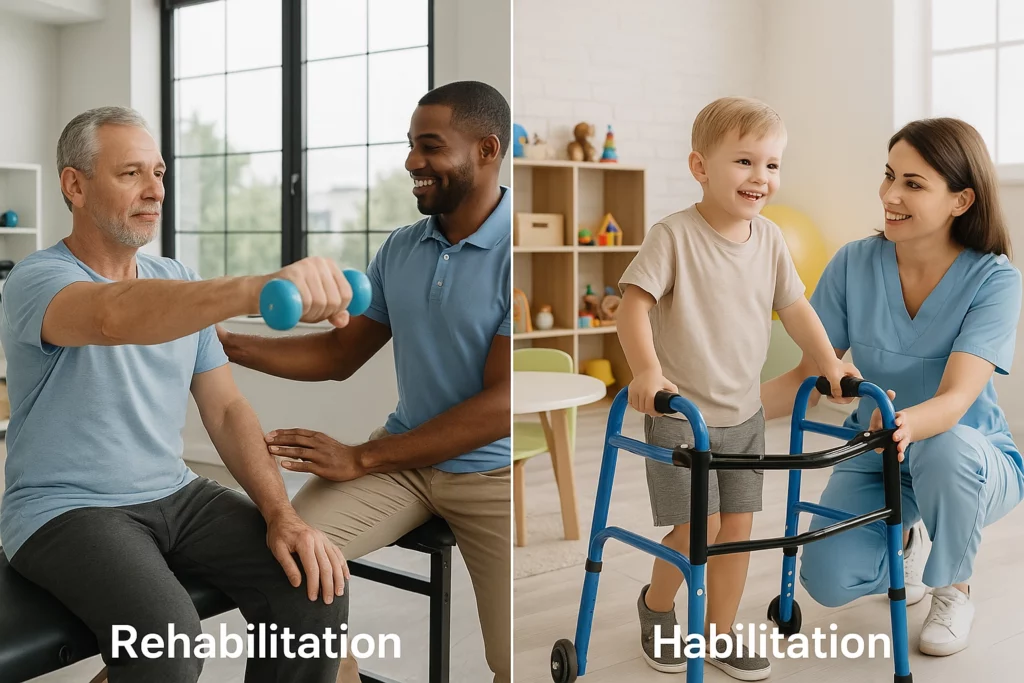


Two words shape the path to independence after injury, illness, or developmental delay, yet they are often confused. Rehabilitation vs habilitation is more than a vocabulary issue. It determines goals, timelines, and the type of expertise you or your loved one will need. If you are new to these services, this guide will give you a clear, confident starting point.
In the sections ahead, you will learn the core difference between rebuilding abilities that were lost and building abilities for the first time. You will see how each approach sets goals, structures therapy plans, and measures progress. We will compare common settings, from hospitals to community programs, and outline the professionals involved, including physical, occupational, and speech therapists. You will find practical examples across ages and conditions, so you can recognize which path fits your situation. We will also touch on insurance language, typical timelines, and how to advocate for the right services. By the end, you will be able to use the terms correctly, ask focused questions, and choose a plan that aligns with your needs.
Understanding Key Comparison Criteria
Clear definitions for beginners
Rehabilitation vs habilitation refers to two distinct, but complementary, care paths. Rehabilitation helps people regain functions lost because of illness, injury, or a behavioral health condition, while habilitation helps people acquire skills they never had, often due to developmental or congenital factors. The federal definitions of habilitation and rehabilitation align with how services are organized in Massachusetts insurance plans, which generally recognize both as essential benefits. Examples are straightforward. After a stroke, rehab may target walking and speech that were previously present; for a young person with OCD who never learned structured exposure skills, habilitation teaches new coping and communication strategies for the first time. Best practice in both includes comprehensive assessment and person centered goals, which research identifies as critical to outcomes.
Restoring skills vs learning new ones
The practical difference is whether you are relearning or learning. A Southborough resident recovering from knee surgery might use rehab to restore gait and balance, while a child with developmental delays may use habilitation to build expressive language. In behavioral health, an adult in recovery from alcohol use disorder could rehabilitate daily routines and relapse prevention skills that lapsed during substance use, while a teen with social anxiety may habilitate first time exposure strategies using ERP. Pros and cons follow naturally. Rehabilitation often shows faster, measurable milestones and discharge once prior functioning returns, but it can plateau without maintenance; habilitation builds foundational abilities across domains, progress is slower and depends heavily on caregiver engagement, which is a known driver of success.
Duration and setting matter for success
Rehabilitation is typically delivered in time limited episodes, from several weeks to a few months, in hospitals, outpatient clinics, or specialized centers. Habilitation usually spans longer horizons, months to years, and often occurs in natural environments such as schools, homes, and community programs, with telehealth options increasingly available across Massachusetts. At Paramount Recovery Centers in Southborough, PHP and IOP offer structured, high frequency sessions appropriate for rehabilitative goals like symptom stabilization and role restoration; habilitative goals are reinforced through step down care, alumni support, and family coaching. Evidence favors individualized plans, early intervention, and trauma informed care, with caregiver participation improving adherence and gains. Action step, ask whether your primary aim is restoration or first time acquisition, then match intensity and setting to safety needs, daily functioning, and available family supports.
Detailed Side-by-Side Analysis
Rehabilitation: restoring lost abilities
Rehabilitation focuses on regaining functions that were present before illness or injury, such as mobility, speech, memory, or emotional regulation. Best practice starts with a comprehensive assessment, then sets person-centered, realistic goals that reflect age, culture, and daily roles. Evidence shows that patient and caregiver engagement, for example a spouse practicing exercises at home, accelerates progress and retention of gains. In Central Massachusetts, a common scenario is a 45-year-old who has a stroke, then works with physical therapy to relearn walking and speech therapy to recover language; this is rehabilitation because the person is relearning prior skills. Psychiatric rehabilitation applies the same logic to mental health and substance use, helping clients restore sleep routines, work stamina, and coping strategies. For context on scope and methods, see this comprehensive definition of rehabilitation; emerging tools like real-time kinematic feedback with head-mounted AR can further boost engagement.
Habilitation: acquiring new skills for daily independence
Habilitation helps people develop abilities they have never had, often due to congenital or developmental conditions. The focus is on first-time skill acquisition, such as basic communication, sensory regulation, or community navigation, built through structured practice and caregiver coaching. Family involvement is pivotal, since carryover in home and school environments multiplies gains. A Worcester County teen with autism learning meal prep, bus routes, and money management is engaging in habilitation, because these are brand-new abilities rather than lost ones. Similarly, a child with cerebral palsy may build stepwise weight shifting, then reciprocal stepping, to achieve first-time walking, supported by occupational and physical therapy.
Side-by-side guidance, use cases, and recommendations
Rehabilitation excels when there is a clear premorbid baseline, offering faster early wins and measurable restoration; constraints include the extent of neurological or tissue damage and the need for high-intensity practice. Habilitation shines for lifelong independence building, especially with early start and consistent caregiver coaching; progress may be gradual and requires long-term coordination. Use cases in Massachusetts include rehabilitation after orthopedic surgery, stroke, or relapse-related functional decline, while habilitation fits developmental language delays, social skills training, or executive function scaffolding. Action steps: confirm whether your primary goals are restorative or first-time skill acquisition, request a comprehensive assessment, involve caregivers from day one, and ask for trauma-informed, individualized plans. At Paramount Recovery Centers in Southborough, our PHP and IOP teams apply these principles, using ERP for OCD and anxiety to restore functioning or build new coping skills, then sustaining gains through alumni support.
Implications for Massachusetts Residents
How Massachusetts laws shape your choice between habilitation and rehabilitation
In Massachusetts, legislation clarifies when habilitation, building new abilities, and rehabilitation, restoring lost function, are appropriate and how they must be delivered. The proposed update to Nicky’s Law would extend the state’s abuse-prevention registry to MassHealth day habilitation providers, strengthening safeguards for people with developmental disabilities who are learning new skills in community settings. See details at Act to update Nicky’s Law for MassHealth day habilitation programs. House Bill H245 seeks to prohibit aversive therapies in any Commonwealth-funded program, pushing habilitative services toward trauma-informed, compassionate practices, which aligns with national trends. Review the bill at MA H245. For rehabilitation, House Bill H1151 would require insurance coverage for cognitive rehabilitation after acquired brain injury, including community reintegration, a frequent need following overdose-related hypoxia or concussion. Learn more at MA H1151. Together, these measures help residents match care type to goals, and they empower families to ask providers about safety protocols, insurance benefits, and caregiver participation.
Where Paramount Recovery Centers fits
Paramount Recovery Centers in Southborough provides rehabilitation-focused care for substance use and co-occurring mental health conditions, while integrating habilitative elements like new coping skills and daily living strategies. Clients access Partial Hospitalization and Intensive Outpatient care, evidence-based therapies such as ERP for OCD and anxiety, CBT, EMDR, and medication management when indicated. Consistent with best practices, we begin with comprehensive assessments and craft person-centered, goal-based plans that reflect culture, age, and socioeconomic context. For example, a Worcester County adult with alcohol use disorder and OCD might enter IOP, use ERP to build brand-new response-prevention skills, and pair that with relapse-prevention rehabilitation to restore functioning at work.
Tailor-made solutions for Massachusetts residents
Our team coordinates closely with local physicians and community resources to support transportation needs, employment schedules, and family obligations common across MetroWest. We help clients verify insurance benefits for cognitive rehabilitation when relevant, reinforce trauma-informed care that Massachusetts is prioritizing, and engage caregivers because participation improves outcomes. If your needs are primarily restorative, rehabilitation tracks like PHP or IOP are recommended. If you require new life skills, we incorporate habilitative skill-building and, when appropriate, coordinate with community day habilitation supports that comply with state protections. This integrated, locally attuned approach sustains progress through structured aftercare and our alumni network, guiding residents from treatment to thriving in everyday Massachusetts life.
Emerging Trends in Disability Support
Trauma-informed care is reshaping rehabilitation and habilitation in Massachusetts
Trauma-informed care, TIC, recognizes how common trauma is and integrates safety, trust, choice, collaboration, and empowerment into every clinical touchpoint. In both rehabilitation, restoring lost abilities, and habilitation, building abilities for the first time, TIC shifts strategies toward gentler pacing, shared goal setting, and caregiver partnership, which is vital for long-term success. Evidence shows TIC improves patient satisfaction and can lower lifetime costs, with analyses suggesting roughly a five-to-one return on investment, see trauma-informed care in rehabilitation nursing. Compared with traditional symptom-only approaches, TIC reduces re-traumatization risks and improves engagement, although it requires consistent staff training and organizational alignment. For Massachusetts residents, practical steps include asking providers if they screen for trauma histories with consent, use calming environments, and invite family or caregivers to co-create goals when appropriate.
AI is personalizing therapy, from intake to daily practice
Artificial intelligence is helping clinicians tailor treatment by analyzing patterns in symptoms, engagement, and outcomes. Tools highlighted in 2026 can automate appointment reminders, support medication adherence, and flag early risk signals, which keeps care timely and focused, see AI’s role in patient care in 2026. In rehabilitation, AI can calibrate cognitive or endurance tasks to the right difficulty each week; in habilitation, it can scaffold skill building for activities of daily living or social communication. For OCD and anxiety care, AI-supported tracking can refine exposure hierarchies based on real-time distress ratings, increasing precision without replacing the therapist. Pros include faster feedback loops and higher engagement; cons include privacy, bias, and device access. Ask about HIPAA-compliant platforms, human oversight of algorithms, and opt-in data sharing.
How Paramount Recovery Centers is adapting right now
At Paramount Recovery Centers in Southborough, TIC principles guide Partial Hospitalization and Intensive Outpatient care, with choice, transparent plans, and collaboration embedded in ERP for OCD and anxiety. Our teams use AI-assisted intake triage, secure symptom monitoring, and personalized practice prompts to support rehabilitation and habilitation goals while clinicians remain the final decision-makers. We pair this with caregiver education and alumni follow-up, which strengthens continuity, a known driver of outcomes. Our approach aligns with findings that organization-wide TIC improves care quality and staff well-being, see trauma-informed organizational change in health systems. When comparing programs in Massachusetts, look for TIC training, measurable outcomes dashboards, and AI tools that enhance, not replace, compassionate clinical care.
Best Practices and Recommendations
How to choose between rehabilitation and habilitation in Massachusetts
Begin with a clear decision rule. Rehabilitation restores prior abilities, often delivering faster functional wins when there was previous baseline. If the goal is to build abilities you never fully developed, such as emotional regulation or daily living skills, pursue habilitation. In Massachusetts behavioral health, that might mean a Southborough adult rebuilding work routines after a depressive relapse, rehabilitation, versus a teen with lifelong OCD learning new response prevention skills, habilitation. Research supports comprehensive, person centered assessment as the first step, it clarifies strengths, barriers, and realistic goals. Confirm your plan lists measurable outcomes and weekly review.
Set goals, timelines, and support systems
Translate personal goals into short, specific targets, for example attend three recovery meetings weekly, complete exposure and response prevention, ERP, homework five days a week, return to part time work by week eight. Expect timelines to differ between rehabilitation vs habilitation. Rehabilitation in intensive behavioral health often shows gains within 8 to 12 weeks, while habilitation for lifelong skill gaps may span several months with staged milestones. Caregiver and family engagement improves adherence and outcomes, schedule regular family sessions and identify one accountability partner. In Massachusetts, plan logistics early, commute to Southborough, insurance approvals, and employer paperwork, so momentum is not lost.
Customized pathways at Paramount Recovery Centers
Paramount Recovery Centers builds individualized care maps after a confidential intake. For a rehabilitation track, many clients start in Partial Hospitalization, 5 days per week, focused on stabilization, relapse prevention, and reestablishing routines, then step down to Intensive Outpatient for community reentry. For a habilitation track, clients with OCD or anxiety may pair ERP with skills groups that teach distress tolerance and social problem solving, building abilities not yet mastered. Both paths prioritize family involvement and alumni support across Massachusetts. Ask for 30, 60, and 90 day objectives and session by session progress reviews.
Conclusion: Choosing the Right Support Path
Rehabilitation and habilitation serve distinct roles on the recovery continuum. Rehabilitation restores abilities you once had but lost to illness, injury, or relapse; habilitation develops brand new capacities you never possessed. Rehabilitation often produces faster functional wins when the goal is to regain routines, while habilitation builds durable life skills but may require more time and repetition. In Massachusetts, an adult whose alcohol relapse derails sleep, punctuality, and social functioning might choose rehabilitation to reestablish those habits. A resident with long standing OCD who never learned graded exposure and response prevention would benefit from habilitation to acquire coping and decision making skills. Outcomes improve when care starts with comprehensive assessment and person centered goals, a best practice reflected in rehabilitation best practices.
At Paramount Recovery Centers in Southborough, our localized approach aligns services with these goals through PHP and IOP tracks, evidence based ERP for OCD and anxiety, trauma informed care, and an alumni network. We help determine fit by clarifying whether your goals involve restoring lost function or acquiring first time skills, then tailoring session frequency, exposure hierarchies, and community supports. Practical next steps include scheduling an intake, bringing a list of top three functional goals, and inviting a family member to the care plan meeting. Our team coordinates with Massachusetts primary care and behavioral health providers, and explains how insurers may categorize habilitative and rehabilitative benefits. If you are unsure which path fits, request a consultation to map a stepwise plan you can start this week.


