
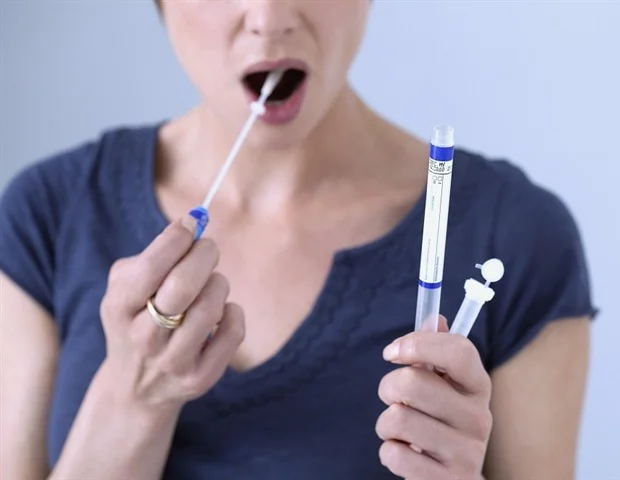


A 60-second honest assessment of your odds
Before any plan, three questions decide most of your outcome. Be precise — hours and amounts matter.
1. When did you last use? Mouth swab tests primarily detect what’s still sitting on the inside of your mouth. The detection window for most substances ranges from about 5 to 48 hours, with chronic cannabis use stretching that further. Twelve hours since last use is on the tighter edge of “winnable.” Six hours is much harder. Two hours is, realistically, very hard.
2. How often do you use? Occasional users clear substances faster than daily users — sometimes 30–50% faster. With cannabis specifically, THC binds to fatty tissue and slowly re-enters oral fluid, which is why heavy daily use can show on a swab past 72 hours regardless of brushing.
3. Is it a rapid on-site test or a lab analysis? Rapid lateral-flow tests have a fixed cutoff and finish in five to ten minutes. Anything not clearly negative gets sent to a lab for confirmation by GC/MS or LC-MS/MS — much more sensitive, much more specific, and much harder to influence.
A rough table of realistic odds with a clean 12-hour preparation effort:
| Your situation | Realistic chance of a clean result |
|---|---|
| Occasional user, 24+ hours since use, rapid screen | 70–85% |
| Occasional user, 12–24 hours since use | 50–70% |
| Daily user, 12 hours since use | 25–45% |
| Heavy/chronic user, same-day use | Low (under 20%) |
| Same-day use, lab-confirmed test | Lower still |
Those are honest ranges based on what oral fluid testing literature reports — not a guarantee.
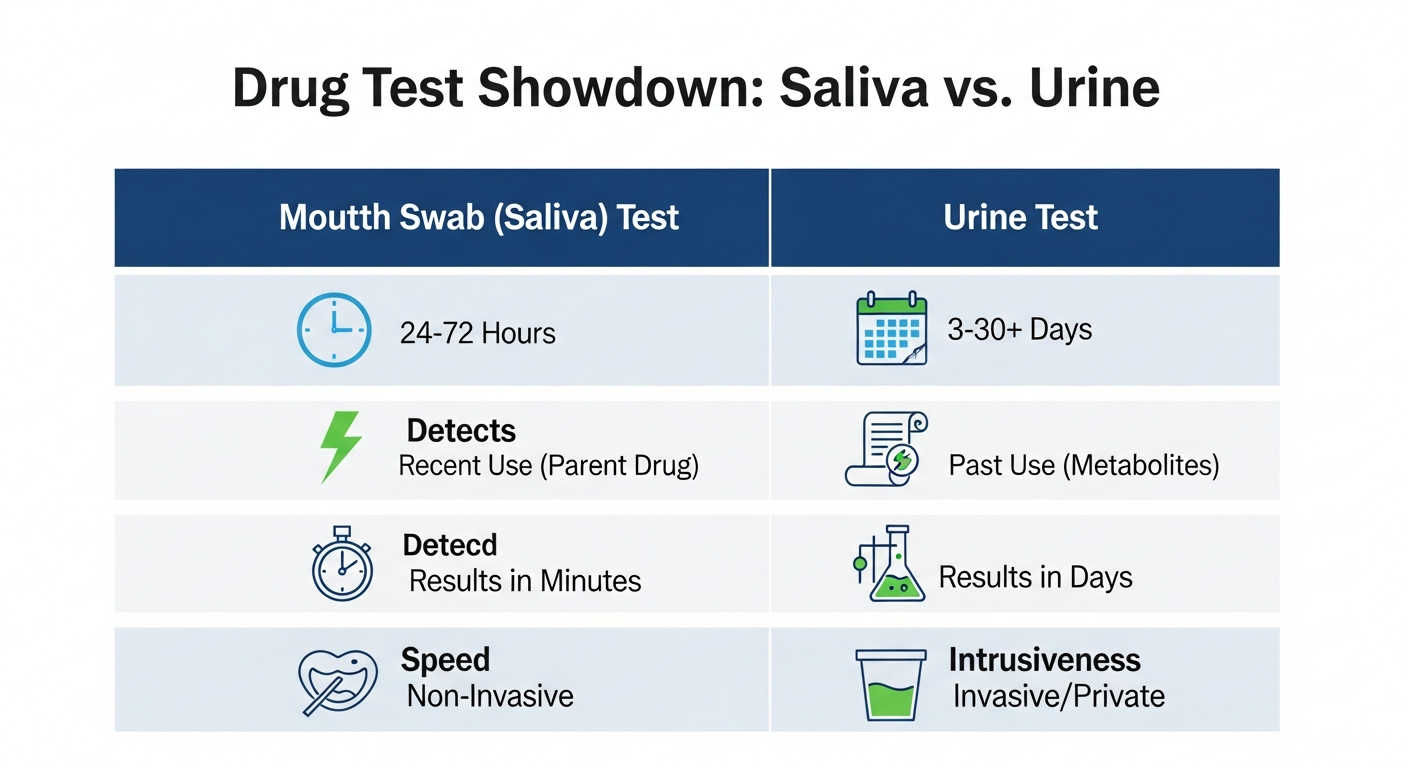
The two things that actually move the needle in 12 hours
Strip away the marketing and there are exactly two levers that have meaningful effect inside a 12-hour window:
Time. Saliva turns over constantly. Every hour you go without using is an hour your body is naturally clearing residue. No product replicates that.
Reducing residue on the surfaces of your mouth. Roughly 70–80% of what an oral fluid test detects is sitting on your tongue, gums, cheek lining, and the spaces between teeth — not in your saliva proper. Cleaning those surfaces and stimulating fresh saliva turnover is the only mechanism behind every legitimate “tip” you’ll read. Everything that works, works through this. Everything that doesn’t work either skips this or pretends to do more than it does.
Internalizing this means you can evaluate any tactic by asking: does this actually clean a surface or stimulate fresh saliva? If yes, it might help a little. If no, it probably doesn’t.
What genuinely helps (and how much)
Consistent gentle oral hygiene. Brush teeth, gums, tongue, cheek lining, and the roof of your mouth with a soft brush three to four times across the day. Be thorough but don’t scrub aggressively — bleeding gums can flag a sample or contaminate it. Real effect, modest size.
Saliva stimulation. Sugar-free gum and sour candies can multiply saliva flow several times above baseline. Fresh saliva carries less residue than stagnant saliva. Real effect, modest size.
Steady hydration. Eight to twelve ounces of water per hour, spread evenly. Helps maintain saliva turnover. Don’t chug — visibly watery samples can be flagged for dilution. Real effect, small size.
Eating real food, especially with some fat content. Chewing scrubs surfaces, and lipids can transiently bind small amounts of THC residue away from the swab area. Stop eating 30 minutes before the test so food particles don’t compromise the sample. Small but real.
Avoiding everything that dries out your mouth. Alcohol, strong coffee, tobacco, and antihistamines reduce saliva flow by 15–30% and concentrate whatever’s still there. Skip them.
That’s the honest list. Notice how unsexy it is — and notice how it doesn’t appear in any product ad.
What probably won’t help (and why)
“Detox” mouthwashes. Toxin Rid Rescue Wash, Stinger, Ultra Wash, Supreme Klean, and the rest. These products work — when they work — through a 20–40 minute window of altered oral chemistry (peroxides, surfactants, pH shifts) that may transiently push a borderline result below cutoff. There are no peer-reviewed clinical trials backing the success rates marketed on the bottles. They’re best-case useful for an occasional user who’s already most of the way to clean and is timing the rinse precisely; they don’t transform a recent heavy-use scenario.
Hydrogen peroxide swishing. Probably the most-recommended internet hack. Two problems: it can irritate or inflame oral tissue (inflammation and bleeding draw scrutiny), and modern lab confirmation panels increasingly include oxidizer/adulterant checks. A flagged adulterated sample is, in many workplace and probation contexts, treated as a presumed positive and a separate violation.
“Substituting” saliva or trying to switch swabs. This is tampering, it carries legal exposure in probation and DOT-regulated workplaces, and modern observed-collection protocols make it impractical. Don’t.
Vinegar, niacin pills, sucking pennies, ice baths, certo, lemon juice on its own. No mechanism, no evidence.
A single frantic deep-clean ten minutes before the test. Counterintuitively worse than steady cleaning across the full window — last-minute scrubbing inflames tissue and the collector may notice unusual mouth condition.
A 12-hour plan if you’re going to try
Assuming a 4 PM test, a clean baseline of physical setup, and the honest understanding that this is influence, not control:
Hours 12 to 8 before (~4 AM to 8 AM): Stop all use immediately, including secondhand smoke exposure. Drink a full glass of water. Brush thoroughly — teeth, tongue (front to back, gentle pressure), inside cheeks, gum line, roof of mouth. Rinse with plain water several times. Begin steady water intake — a glass per hour is a good cadence.
Hours 8 to 4 before (~8 AM to noon): Repeat brushing around the four-hour mark of the day. Between brushings, chew xylitol gum or sour candy to keep saliva turning over. A normal breakfast is fine and probably helpful. Continue water.
Hours 4 to 2 before (~noon to 2 PM): Light lunch, finished at least 90 minutes before the test. Brush again afterward. Optionally rinse with an alcohol-free antiseptic mouthwash like Listerine Zero — alcohol mouthwashes dry the tissue you’re trying to keep cycling.
Hours 2 to 0.5 before (~2 PM to 3:30 PM): Water and gum only. No coffee, no tobacco, no colored drinks. If you’re going to use a detox-style mouthwash, this is the window — follow the label exactly, do every swish-and-spit cycle, and don’t shortcut the timing. Most products advertise a 20–30 minute peak window; using one at noon for a 4 PM test is a wasted product.
Final 30 minutes: Small sips of water only if needed. Arrive early, breathe, and don’t overthink. Stress dries your mouth, which is the opposite of what you’ve spent twelve hours building.
Realistic detection windows by substance
Oral fluid windows are shorter than urine but longer than people think. These are typical ranges from oral fluid testing literature; individual variation is wide.
| Substance | Occasional use | Heavy/daily use |
|---|---|---|
| THC (cannabis) | 24–72 hours | 72+ hours, sometimes longer |
| Cocaine | 24–48 hours | Up to ~3 days |
| Opiates / heroin | 24–72 hours | Similar |
| Amphetamines / meth | 24–48 hours | 48+ hours |
| Benzodiazepines | 24–48 hours | Several days with chronic use |
| Alcohol (when on the panel) | 12–24 hours | Similar |
Note that the chronic-cannabis row is the one most people misjudge. If you’re a daily smoker and last used yesterday, twelve hours of preparation does not guarantee a clean test, period — and any article suggesting otherwise is selling you something.
What’s actually happening at the collection
A trained collector will rub a sterile pad against the inside of both cheeks, the gums, and under the tongue for about two to three minutes. Roughly one to two milliliters of oral fluid is captured. Modern collection devices include a sample-adequacy indicator — you can’t intentionally give too little.
Rapid devices return a result in five to ten minutes. Anything that isn’t clearly negative is a “non-negative” — not a fail, not a pass, a forward-to-the-lab. Lab confirmation by GC/MS or LC-MS/MS uses substance-specific cutoffs (for example, 2 ng/mL for THC, 10 ng/mL for cocaine) and rules out most cross-reactivity.
If your sample comes back confirmed-positive, in most workplace settings it is reviewed by a Medical Review Officer — a licensed physician who’s required to contact you and ask whether a legitimate prescription, medication, or medical explanation accounts for the result, before reporting to the employer. This step is your formal opportunity to disclose anything that legitimately explains a positive (a prescription opioid, a stimulant for ADHD, etc.). Bring documentation to the test or have it ready for the MRO call.
Massachusetts-specific notes
Massachusetts doesn’t have a single comprehensive workplace drug-testing statute, but courts have established that employers generally must have a defined policy, give written notice, and respect reasonable privacy in collection. You can request a confirmation test on a split sample in most circumstances. For probation and court-ordered tests, the rules of your specific order govern, and a refusal or tampered result is typically treated as worse than a positive — read the order, and if you’re unsure, contact your probation officer or attorney before doing anything creative.
If your test is roadside or law-enforcement-related, you have separate rights that vary by situation; this is not the article to make those decisions from. Talk to a lawyer.
What to do if it doesn’t go your way
This is the section the templated articles all skip, and it’s probably the most useful one if your situation is rough.
A non-negative on a rapid screen is not a final result. Wait for lab confirmation. False positives at the rapid stage run roughly 1–5%; lab confirmation drops that to under 0.1%.
Talk to the MRO honestly when they call. Disclose every prescription medication, including ones you stopped recently. Poppy seed consumption can produce opiate positives in a small percentage of rapid screens. CBD products often contain trace THC. The MRO’s job is to determine whether there’s a legitimate medical explanation; this is the moment to give them one if it exists.
Request the split-sample confirmation if your situation warrants it. Most workplace policies allow this. It costs you, but if you genuinely believe the result is wrong, it’s the formal path.
Know that a single positive doesn’t always mean what you fear it means. For some employers it’s a hard termination; for others it’s a referral to an employee assistance program. For probation it varies by judge and state. Don’t make catastrophic decisions before you know the actual consequence in your specific situation.
If you do face consequences, the next test will come. And the test after that. If you find yourself searching for variations of this article every few weeks, the cost of solving it once is almost always lower than the cost of solving it repeatedly.
Frequently Asked Questions
CBD itself isn’t tested for, but most CBD products legally contain up to 0.3% THC. With heavy or daily CBD use, that trace amount can accumulate enough to trigger a positive THC result on a sensitive lab confirmation. Full-spectrum products carry the highest risk; broad-spectrum sits in the middle; isolate is lowest. If you’ve been using CBD daily, treat your test as if you’ve been using cannabis at low levels.
Plain Listerine, no — it’s a regular antiseptic mouthwash and isn’t designed to alter drug residue. Hydrogen peroxide can transiently reduce surface residue, but it has two problems: it irritates oral tissue (which collectors notice and may flag), and modern lab confirmation panels increasingly screen for oxidizers. A flagged adulterated sample is treated as a presumed positive in most workplace and probation contexts, which is worse than failing the original test.
Longer than most articles claim. Occasional users typically clear THC from oral fluid in 24–72 hours, but daily and heavy users can test positive for 72 hours or more, occasionally past a week. THC binds to fatty tissue inside the mouth and slowly re-enters saliva, so brushing alone doesn’t reset the clock. If you smoke daily and your test is in 12 hours, no preparation routine reliably solves that.
Sometimes, but only if the test was specifically ordered with alcohol on the panel. Most standard 5-panel and 10-panel workplace screens don’t include ethanol. When alcohol is tested, the saliva detection window is short — roughly 12–24 hours after the last drink. Hand sanitizer and alcohol-containing mouthwash have caused isolated false positives, so avoid both in the hour before testing.
For most workplace testing, refusal is treated as a positive result under company policy and can be grounds for termination or a rescinded job offer. For DOT-regulated jobs, refusal is itself a federal violation. For probation, refusing or failing to appear is usually treated more seriously than a positive result. There are narrow situations where refusal is legally protected — some pre-employment scenarios, some roadside contexts depending on state — but those decisions should involve a lawyer, not an article.
For practical purposes, almost never from casual exposure. Brief secondhand cannabis smoke can deposit detectable THC in oral fluid, but it typically clears within an hour or two and rarely reaches lab confirmation cutoffs. The exception is extreme exposure — being in an enclosed, unventilated space with active smoking for several hours — which has produced documented positives. If you were just in the same room briefly, you’re fine.
A drug test result is part of your employment record with the testing employer; it doesn’t appear on standard public background checks like criminal records or credit reports. Some industries — DOT-regulated jobs, healthcare, certain federal positions — maintain shared databases where positive results can follow you between employers in the same field. For most jobs outside those sectors, a positive doesn’t follow you to your next application unless the prior employer is contacted as a reference and discloses it.
A note from us
We didn’t write this page to upsell you on rehab. Most people who land here aren’t ready for that conversation, and that’s fine. But the reason a treatment center maintains an article on this topic — and the reason we’d rather tell you the truth than match the templated SEO content recycling across the rest of the industry — is that we see what comes after. Sometimes a mouth swab is just an annoying gate to clear once. Sometimes it’s the first signal that what started as casual use has become something that costs jobs, custody, freedom, or relationships.
If today is the first kind of day, take the steps above, breathe, and good luck. If today is starting to feel like the second kind of day, our admissions team takes confidential calls with no pressure attached, and we cover most major insurance. Either way, we hope the test goes the way you want.


