


Feeling overwhelmed by anxiety can be an isolating experience, but you don't have to navigate it alone. Anxiety group therapy offers a powerful, community-based path to healing, providing a safe and supportive environment where individuals can share their struggles, learn effective coping strategies, and realize they are not the only ones facing these challenges. This guide will walk you through what anxiety group therapy entails, how it works, and how it can help you regain control and find lasting relief.
Key Takeaways
- You Are Not Alone: Group therapy breaks the cycle of isolation by connecting you with others who share similar experiences, fostering a powerful sense of community and understanding.
- Evidence-Based Healing: Sessions are led by trained professionals who teach proven techniques like Cognitive Behavioral Therapy (CBT) and Dialectical Behavior Therapy (DBT) to help you manage anxiety effectively.
- A Safe Space to Grow: All groups are built on a foundation of strict confidentiality and mutual respect, creating a secure environment where you can practice new social skills and build confidence.
- Accessible Support in Massachusetts: Group therapy provides a structured, effective, and often more affordable path to mental wellness for residents across Massachusetts.
Your Path to Relief with Group Therapy
Anxiety has a way of tricking you into believing you're the only one who feels this way. It's an isolating experience. Group therapy directly challenges that feeling by building a small community focused on mutual support and guided by a professional. It’s a place to finally learn that your feelings are not only valid but shared, and that there are proven strategies that can make a real difference in your day-to-day life.
This is what a supportive group setting looks like—a place for connection and shared understanding.

This image really captures the collaborative and non-judgmental atmosphere that is so central to the healing process.
To give you a quick snapshot, here’s a simple breakdown of what group therapy for anxiety involves.
Anxiety Group Therapy At A Glance
| Aspect | Description |
|---|---|
| What It Is | A form of psychotherapy where a small group of individuals meets with a trained therapist to work on anxiety-related challenges together. |
| Primary Goal | To reduce anxiety symptoms, build coping skills, and foster a sense of community and mutual support among members. |
| Key Benefit | It breaks the cycle of isolation by showing you that you are not alone in your experiences. |
| Therapist's Role | To facilitate discussion, teach evidence-based techniques, ensure the group remains a safe and confidential space, and guide the healing process. |
This table shows that group therapy is much more than just a support circle; it's a structured, therapeutic environment designed for real change.
Proven Effectiveness and Accessibility
The need for good, accessible treatment is huge. Globally, it's estimated that only 27.6% of people with anxiety disorders get any kind of help at all. That's a staggering treatment gap, and it makes options like group therapy absolutely essential.
The great news is that it works. Research consistently shows that group therapy can lead to symptom reduction rates of 50-70%. Many people see significant improvement after just 12 weeks of sessions. You can read more about these anxiety statistics to get a fuller picture of treatment impact.
For those of us here in Massachusetts looking for help, these groups offer a structured, effective, and often more affordable path to feeling better.
Group therapy isn’t just about talking; it’s about active learning and healing within a community. It gives you a unique chance to practice new behaviors and get feedback in a setting that feels like the real world, but with a built-in safety net.
If you are tired of facing anxiety by yourself, help is right here. Take that first, brave step and call (888) 388-8660 to learn about anxiety group therapy options near you.
The Science Behind Shared Healing
Opening up about your personal story in a room full of people might sound like the last thing you want to do, but it’s often one of the most powerful steps you can take to heal from anxiety. Anxiety loves to keep you silent and isolated. It tricks you into believing you’re the only one going through such intense worry and fear. Anxiety group therapy is designed to tear down those walls, creating a space where human connection itself becomes a core part of getting better.
This isn’t just about venting or getting emotional support, though that’s part of it. It’s a structured approach, grounded in proven psychological principles. Let’s break down the key reasons why sharing your journey in a group is so effective.
The Power of Universality
One of the first things people feel in group therapy is a profound sense of universality. It’s that "me too" moment—the wave of relief that washes over you when someone else describes a thought or fear you were convinced was yours alone. It completely shatters the illusion that your anxiety is some kind of unique personal failing.
That realization is more than just comforting; it's where real healing begins. When you see your own struggles reflected in others, the shame and stigma that anxiety feeds on start to dissolve. You begin to view your condition not as a character flaw, but as a shared human experience that can be managed and overcome together.
Interpersonal Learning in Action
While individual therapy is fantastic for deep personal insight, anxiety group therapy offers something unique: a real-world lab for social interaction. This is where interpersonal learning comes into play. You don't just talk about social anxiety; you get to practice navigating it in a safe, supportive environment.
You can observe how others handle situations you find difficult. You get to offer feedback, receive it, and try out new ways of communicating, setting boundaries, or just expressing yourself. This dynamic process gives you practical insights that are tough to gain one-on-one, helping you build real confidence for interactions outside the therapy room.
Building a Shared Toolbox of Coping Skills
Imagine a workshop where everyone brings their best tool. One person might have a killer technique for calming panic attacks, while another has a go-to strategy for shutting down negative self-talk. In an anxiety group, the collective wisdom of the members creates a "shared toolbox" of coping mechanisms.
This collaborative vibe speeds up the learning process. You’ll not only be taught evidence-based skills by a professional facilitator but you'll also see exactly how your peers are applying them to their own lives. Even the act of sharing your own successful strategies—a concept known as altruism—can be incredibly empowering. It boosts your self-esteem and reinforces your own progress.
The Evidence Behind the Approach
The effectiveness of this model isn't just a feeling; it's backed by solid research. With an estimated 301 million people worldwide living with an anxiety disorder, the need for effective treatment is huge. Time and again, randomized controlled trials have shown that group therapy using methods like CBT can lead to significant symptom reduction in 50-70% of participants. This proves that it's a powerful and cost-effective way to deliver high-quality mental healthcare. You can read the full research about these therapeutic outcomes.
This scientific backing is so important, especially for those in Massachusetts looking for reliable support. It confirms that joining an anxiety group isn’t just a hopeful shot in the dark—it’s a decision grounded in solid evidence.
"The healing power of a group lies in its unique ability to show you that you are not alone in your journey. Witnessing others' courage inspires your own, and helping someone else reinforces your strength."
Ultimately, the science of shared healing is all about harnessing the power of human connection. It blends professional guidance with peer support to create a dynamic environment where you can learn, practice, and truly grow.
Proven Methods Used in Anxiety Groups
Anxiety groups are much more than just a place to talk; they're structured, active learning environments. A trained therapist doesn't just moderate the discussion—they teach specific, evidence-based techniques that give you practical tools to manage your anxiety for good.
Think of each therapeutic method as a different lens for understanding and tackling anxiety. In a group, you not only learn these strategies but you see them in action as others apply them, which makes the whole process feel less abstract and more achievable.

This kind of collaborative learning is exactly what makes group therapy so powerful—you're working together to build new skills.
Cognitive Behavioral Therapy: Rewiring Anxious Thoughts
One of the most powerful and common approaches is Cognitive Behavioral Therapy (CBT). The central idea is simple but profound: our thoughts, feelings, and behaviors are all connected. All too often, anxious feelings are sparked by negative, distorted thought patterns that run on autopilot in the back of our minds.
In an anxiety group therapy setting, CBT helps you become a detective of your own thoughts. Your therapist will teach the group how to spot these automatic negative thoughts, challenge whether they’re actually true, and reframe them into something more balanced and realistic. It’s like learning to rewire the very circuits in your brain that trigger anxiety. You can dive deeper into specific Cognitive Behavioral Therapy techniques that help anxiety in our detailed guide.
For instance, someone might share a fear of public speaking, driven by the thought, "If I mess up my words, everyone will think I'm an idiot." The group, with the therapist's guidance, would work together to pick that belief apart. Is that really true? What’s a more likely outcome? Tackling these deep-seated fears with others makes it feel far less daunting.
Dialectical Behavior Therapy: Building Emotional Resilience
Dialectical Behavior Therapy (DBT) brings a powerful set of skills to the table, focusing on emotional regulation and acceptance. While it was first developed for other conditions, its tools are incredibly effective for handling the intense, overwhelming emotions that anxiety can bring. DBT skills are usually taught in four key areas:
- Mindfulness: Learning to stay anchored in the present moment without judgment. This helps you observe anxious thoughts without getting swept away by them.
- Distress Tolerance: Gaining practical strategies to get through crisis moments without making the situation worse, like when you feel a panic attack building.
- Emotional Regulation: Understanding where your emotions come from and learning how to turn down their volume so they no longer control your life.
- Interpersonal Effectiveness: Building skills to communicate your needs clearly and set healthy boundaries, which is a game-changer for social anxiety.
In one of our groups here in Massachusetts, members might practice a mindfulness exercise together or role-play a tough conversation, getting instant feedback in a completely safe environment.
Exposure Therapy: Facing Fears Gradually
When anxiety is tied to specific phobias, social situations, or panic, Exposure Therapy is often a key part of the solution. This approach involves systematically and gradually facing the things you fear in a controlled, supportive setting. The goal is to slowly desensitize your fear response over time until it no longer has power over you.
In a group, exposure therapy feels so much safer. You're not alone in facing your fears; you have the encouragement of your peers and the guidance of a professional supporting you every single step of the way.
A group might start small with imagined exposures—like just visualizing giving that presentation—before moving on to real-world practice. The shared courage in the room makes it possible to take brave steps you'd never take on your own. It's a structured process that ensures you're never pushed too far, too fast.
Each of these therapeutic models offers a unique pathway to relief. The table below breaks down their core differences to help you see how they fit together.
Comparing Therapeutic Approaches in Group Therapy
| Therapeutic Model | Primary Focus | Best For Learning |
|---|---|---|
| Cognitive Behavioral Therapy (CBT) | Identifying and changing negative thought patterns and behaviors. | How to challenge and reframe anxious thoughts to reduce their power. |
| Dialectical Behavior Therapy (DBT) | Building skills for emotional regulation, distress tolerance, and mindfulness. | How to manage intense emotions and cope with overwhelming moments. |
| Exposure Therapy | Gradually facing feared situations or objects in a controlled environment. | How to reduce avoidance and desensitize the body's fear response over time. |
Ultimately, many anxiety groups blend elements from each of these approaches to provide a well-rounded set of tools for recovery.
If you’re ready to learn these proven skills in a supportive community, our anxiety therapy groups are here to help. Call (888) 388-8660 to speak with our team today.
Finding the Right Fit for You in Massachusetts
Figuring out if anxiety group therapy is your best next step is a personal decision, but it’s not one you have to make in the dark. This guide is here to help you weigh the options and see if a group setting is the right match for your needs and recovery goals. By getting a clear picture of who benefits most—and when another path might be better—you can make a confident choice for your mental health care right here in Massachusetts.
Group therapy creates a unique space where shared experiences become the bedrock of healing. It builds a sense of community that directly pushes back against the isolation anxiety loves to create, which is why it’s such a powerful option for so many people.
Who Thrives in Anxiety Group Therapy
Certain situations and personalities make someone an ideal candidate for this kind of therapy. If any of these sound like you, a group could be a game-changer for your recovery.
-
Individuals Feeling Isolated by Anxiety: Has anxiety made your world smaller, leaving you feeling cut off from everyone? A group can be a lifeline. Just being in a room with other people who genuinely get what you're going through can break that lonely cycle.
-
Those Wanting to Practice Social Skills: For anyone with social anxiety, the world can feel like you’ve been pushed on stage without a script. Group therapy is a safe, supportive "rehearsal space" where you can practice communicating, setting boundaries, and building confidence before you have to use those skills in the real world.
-
People Who Learn from Shared Experiences: Do you find yourself having "aha" moments when you hear how other people handle their struggles? Group therapy is a living, breathing learning environment. You don't just get guidance from the therapist; you get the collective wisdom and different perspectives of your peers, too.
On top of this, group therapy is incredibly effective for people working through the tangled mess of co-occurring anxiety and substance use disorders. In these dual-diagnosis cases, the peer support found in a group reinforces the crucial message that you are not alone in facing these linked challenges. It creates a solid foundation to build recovery on.
"Finding the right therapeutic fit is about matching the environment to your current needs. A group setting excels at fostering connection and providing real-world practice, which are often crucial missing pieces in the recovery puzzle."
When Individual Therapy Might Be a Better Starting Point
While group therapy is a fantastic tool, it isn’t the perfect fit for every single person at every stage of their journey. Being honest about this is the key to making sure you get the most effective care possible.
There are definitely times when one-on-one support is the right first move.
-
You Are in an Acute Crisis: If you’re dealing with severe, overwhelming symptoms, active suicidal thoughts, or any crisis that requires immediate and intense stabilization, individual therapy is non-negotiable. It gives you the focused, direct attention you need to ensure your safety and tackle the most urgent issues head-on.
-
Severe Social Phobia Prevents Participation: For some, the thought of speaking in front of others is so paralyzing that it would make it impossible to get anything out of a group. In these situations, a therapist can work with you individually to build up foundational skills and confidence. The goal is often to eventually transition into a group once you feel ready.
-
Your Issues Require Deep, Focused Trauma Processing: While groups can and do address trauma, some deep-seated or complex trauma histories are better explored in the complete privacy and safety of individual sessions, at least at the beginning.
Making the right call is all about knowing where you are right now. A lot of people find that a combination of both individual and group therapy gives them the most well-rounded support system. To dig deeper, you can explore our detailed overview of group therapy in MA and see how it all fits together in a larger treatment plan.
If you think a group setting sounds right, or if you're still on the fence and just want to talk it over, our team is here to help. Give us a call at (888) 388-8660 for a completely confidential conversation about your options.
What to Expect in Your First Session
Walking into your first anxiety group therapy session can feel like stepping into the unknown—which, ironically, is a classic trigger for anxiety. But a lot of that nervousness comes from uncertainty. Just knowing what the experience will actually be like, picturing the room and the flow of the conversation, can make a world of difference.
Think of it as the first day of a new class where everyone feels a little hesitant but is also there for the same reason. This is a space designed for safety, and it's structured to help you succeed right from the moment you arrive.
Getting Started: The First Few Minutes
Your first session at one of our Massachusetts-based groups starts with a calm welcome from the therapist. Their main job is to act as a facilitator and guide—they’re there to create a safe atmosphere, not to put you on the spot. You'll join a small group of people, usually between 6 to 10 members, who are probably feeling just as nervous as you are.
The session will kick off with the therapist outlining the ground rules. These aren't just formalities; they are the foundation of the group's safety and trust.
- Confidentiality: This is the big one. What’s said in the group stays in the group. This rule is non-negotiable, as it creates the trust needed for people to share honestly.
- Respectful Communication: Everyone is expected to listen without judgment and speak to others with respect, even when your experiences don't line up.
- Participation is Encouraged, Not Forced: You will never be pushed to speak. Many people get a lot out of just listening, especially at the beginning.
This infographic shows the journey from feeling isolated to learning and practicing new skills in a group setting.
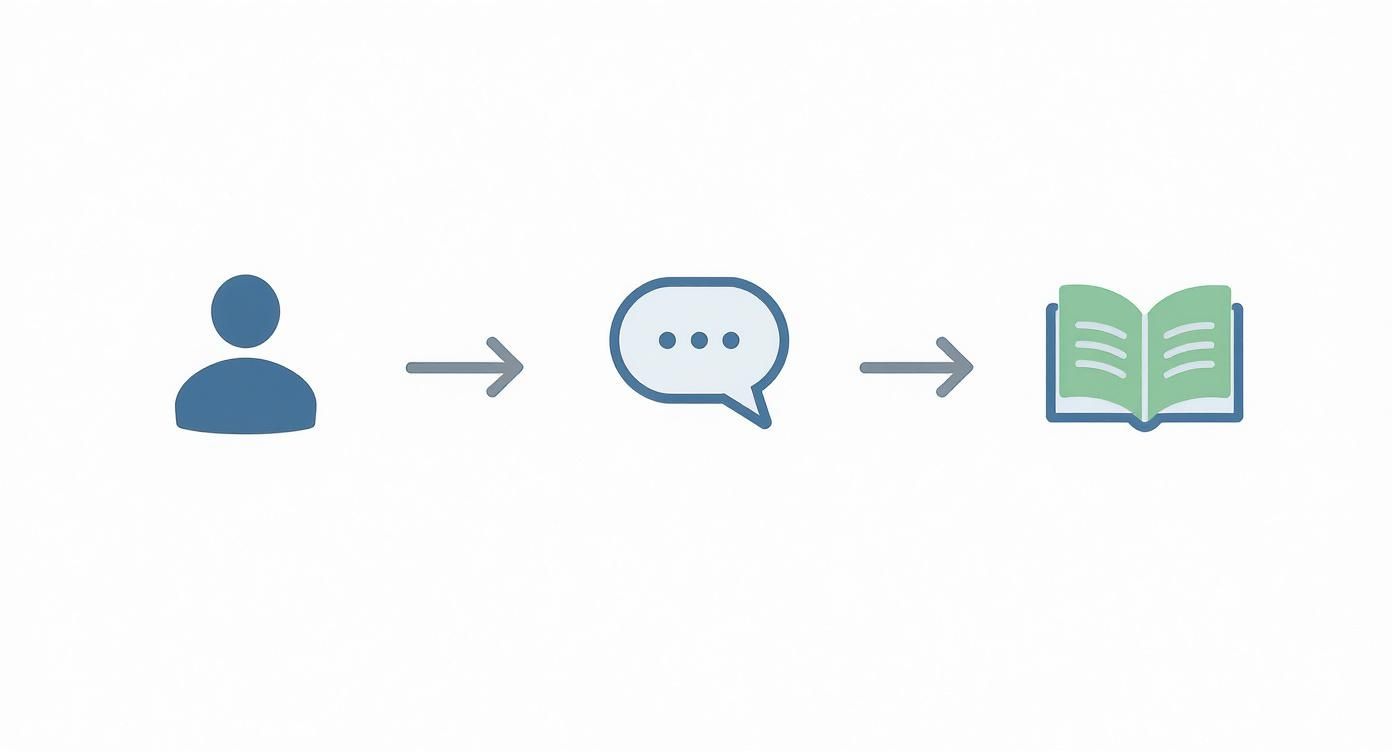
The process it illustrates is exactly how the group environment is designed—to help you move from being on your own to actively engaging and building skills with others.
The Typical Session Structure
Once the guidelines are clear, the session follows a predictable flow. This consistency is intentional. It helps reduce anxiety over time by making the whole experience feel familiar and safe.
Most sessions are broken down into a few main parts:
- Check-In: The meeting usually begins with a "check-in." This is a brief chance for each member to share how their week has been, any challenges they ran into, or any wins they had related to their anxiety.
- Theme and Skill-Building: The therapist will then introduce a specific topic or skill for the day. This could be anything from learning to spot cognitive distortions to practicing a mindfulness technique to manage panic.
- Group Discussion and Practice: This is the heart of the session. The group will talk about the day's theme, share personal experiences tied to it, or even participate in a guided exercise together.
- Wrap-Up: The last few minutes are for summarizing the key takeaways. It’s a time to set intentions for the week ahead and provide a sense of closure before everyone heads out.
Group therapy for anxiety disorders has proven to be a vital and effective intervention. Recent data showed that nearly half (49.9%) of individuals referred for anxiety and depression moved to recovery after therapy, which highlights the significant impact of structured, group-based approaches. Discover more insights about the effectiveness of therapeutic interventions at TherapyRoute.com.
Your Role as a Group Member
Honestly, your only job in that first session is to show up and observe. You're not expected to have all the answers or share your deepest fears right out of the gate. Your role is simply to be present, listen to what others have to say, and engage at whatever level feels right for you.
Feeling prepared can significantly lower the barrier to entry. If you're ready to see what a session is like for yourself, our team is here to answer any questions. Call us at (888) 388-8660 for a confidential chat.
It's Time to Take the First Step
You've seen how anxiety group therapy provides a powerful combination of community, proven strategies, and a safe space to heal. Feeling better is possible, and you absolutely do not have to walk this path by yourself. For anyone in Massachusetts looking for effective, compassionate support, the next step is right here. Our team is ready to help you get started.
If you're searching for the top-rated treatment facility for anxiety effective care support, our center is here for you.
Ready to find your community? Contact Paramount Recovery Centers today. Give us a call at (888) 388-8660 to learn about our anxiety therapy groups in Massachusetts.
Frequently Asked Questions
Thinking about joining an anxiety therapy group is a big step, and it's totally normal to have a few questions buzzing around. Getting some clear, straight-up answers can make all the difference, helping you feel more comfortable and confident about moving forward. Let's tackle some of the most common questions we hear from folks here in Massachusetts who are considering group therapy.
How big are the therapy groups?
One of the first things people worry about is getting lost in a huge crowd or feeling put on the spot. That's why we're very intentional about keeping our anxiety therapy groups small and manageable. A typical group will have somewhere between 6 to 10 members. This is the sweet spot—big enough to bring in a mix of different perspectives but small enough that everyone gets a real chance to talk, be heard, and connect. This kind of intimate setting is what helps build that crucial sense of safety and community.

Is everything I say confidential?
Absolutely. Confidentiality isn't just a rule; it's the bedrock of effective group therapy. Before the very first session kicks off, every single person in the group—therapist included—makes a firm agreement to respect a strict code of privacy. What’s said in the group, stays in the group. Period. This shared pact is what allows people to build enough trust to be vulnerable, share what's really going on, and do the hard work of healing.
Think of it like a sanctuary. The confidential nature of group therapy creates a unique space where you can finally let your guard down and talk about your anxiety without worrying about judgment or having your story repeated outside that room.
What if I'm too anxious to speak at first?
This is probably the single most common fear people have, and it makes perfect sense. The very thing you're there to work on—anxiety—is what makes the idea of speaking up so terrifying. Please know this: it's completely okay. There is zero pressure to share before you feel ready. Many people get a ton of value out of just listening for the first few sessions. Our therapists are pros at creating a gentle, low-pressure vibe and will support you in participating at whatever pace feels right for you.
How long does group therapy last?
That really depends on the type of group you join. Different groups have different structures and goals. Generally, they fall into two main formats:
- Time-Limited Groups: These are structured like a course, often running for a set number of weeks (e.g., 10-12 weeks). Everyone starts and ends together, moving through a specific curriculum like learning CBT skills.
- Ongoing Groups: These groups don't have a fixed end date. People can join when there's an opening and stay for as long as they find it helpful. This format is great for long-term support.
When you have your first consultation with us, we’ll talk through your specific needs to figure out which format makes the most sense for your journey right here in Massachusetts. Ready to take the next step? Call us for a confidential conversation at (888) 388-8660 to learn more about our anxiety group therapy options.


